Wie die Scangeschwindigkeit die Hitzeeinwirkung verändert, Gehärtete Tiefe und Oberflächenhärte
Wie die Scangeschwindigkeit die Hitzeeinwirkung verändert, Gehärtete Tiefe und Oberflächenhärte
In induction scan hardening, Scan-Geschwindigkeit influences how long each section of the workpiece is exposed to the induction heating zone. Changing this speed can alter the temperature distribution, hardened case depth and final hardness.
A slower scan generally provides more heating exposure, which may produce a deeper hardened layer under comparable conditions. Jedoch, it does not necessarily increase surface hardness. The result also depends on power, Frequenz, Induktorgeometrie, material condition and quenching.
Understanding these relationships is essential when adjusting scan speed to meet a specified hardening requirement.
2. Why Scan Speed Affects Case Depth
3. Why Surface Hardness Does Not Always Follow Case Depth
4. How Scan Speed Interacts with Power, Frequency and Quenching
5. How to Evaluate a Scan Speed Adjustment
1. How Scan Speed Changes Heating Exposure
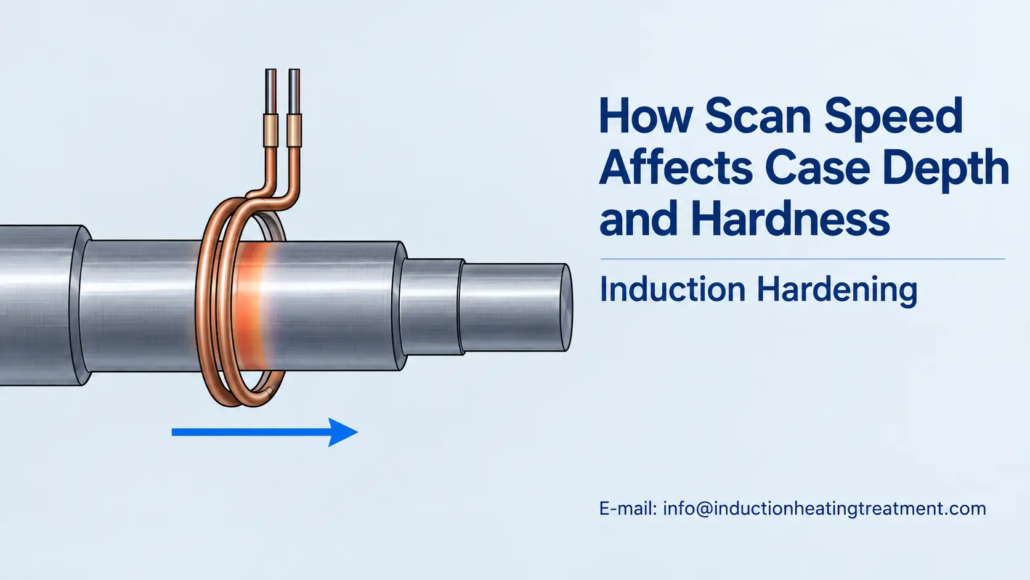
beim Scan-Härten, the workpiece moves relative to the induction coil, allowing a selected surface to be heated progressively.
The workpiece may travel through a stationary inductor, or the inductor may move along the workpiece. In either arrangement, scan speed refers to the relative travel speed along the hardening path.
For shafts that rotate during scanning, axial scan speed and rotational speed are separate variables. Axial movement determines how the heating zone advances along the shaft, while rotation affects circumferential exposure.
Scan speed and local heating time
For a given effective heating-zone length, increasing scan speed reduces the time a surface location spends passing through that zone.
The relationship can be approximated as:
Heating exposure time ≈ Effective heating-zone length ÷ Scan speed
This is a geometric approximation, not a calculation of the complete thermal cycle or final case depth.
The actual heating response depends on how electromagnetic energy is distributed, how efficiently the inductor couples with the workpiece and how heat moves through the material.
When scan speed decreases, a surface location generally receives a longer period of heating under otherwise comparable conditions. This may allow the required temperature to develop farther below the surface.
At higher speeds, the shorter exposure may limit heating at depth unless other process conditions are adjusted.
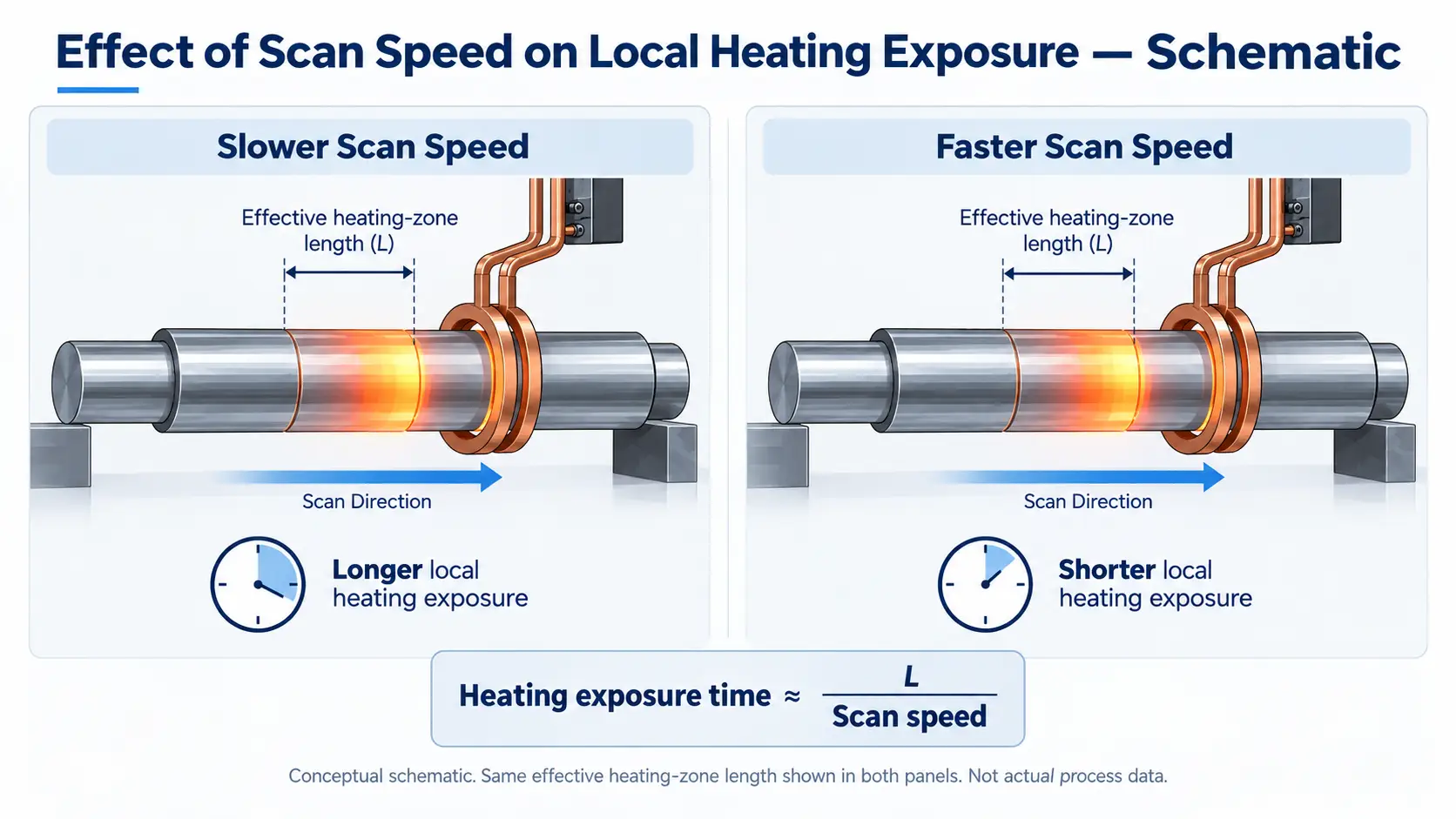
A slower scan speed gives each surface location more time within the heating zone, allowing the required temperature to develop farther below the surface.
Why constant power does not mean constant heating
Two workpieces processed at different scan speeds may receive different thermal cycles even when the machine maintains the same actual electrical power.
The amount of energy delivered over a given length of the scanning path can change with speed. Jedoch, that relationship does not directly establish the temperature distribution or final hardened depth.
Spulengeometrie, Kopplung, heat conduction and temperature-dependent material properties also influence the result.
Aus diesem Grund, scan speed should be evaluated as part of the heating process rather than treated as an independent machine setting.
2. Why Scan Speed Affects Case Depth
The final hardened case depends on the region that undergoes sufficient austenitization and subsequent cooling to develop the required hardened microstructure.
Scan speed influences this process by changing the time available for heating and thermal redistribution.
Heating depth is not the same as case depth
Induction heating generates heat within the workpiece through induced electrical currents. Betriebsfrequenz, material properties and inductor geometry influence the initial distribution of that heating.
Wärme wird auch in angrenzendes Material geleitet.
With a longer heating exposure, the temperature may rise farther below the surface. Under suitable conditions, this can increase the depth of material capable of developing the required hardened microstructure after quenching.
Jedoch, electromagnetic penetration depth and final hardened case depth are not interchangeable.
The final case depth depends on the combined electromagnetic, thermal and metallurgical response, including the cooling conditions.
Why austenitization time matters
Reaching a high surface temperature does not necessarily mean that the material has been adequately austenitized throughout the required depth.
Austenite formation and, wo relevant, carbide dissolution and carbon redistribution depend on temperature and time. Their behavior also depends on steel composition and prior microstructure.
A faster scan may provide insufficient time for the required transformation at depth, even when the surface reaches a suitable temperature.
Reducing speed may increase the depth of sufficiently austenitized material. Jedoch, excessive heating exposure can also produce an unwanted temperature distribution or overheating.
The objective is not to maximize heating time but to establish an appropriate thermal cycle for the specified hardened region.
What research shows
A published study, Evaluation of Case Depth in Induction-Hardened Steels, investigated SCM435 chromium-molybdenum steel and S45C carbon steel rods.
Under the study’s specific induction-hardening conditions, case depth was varied by changing the speed at which the rods passed through the induction coil. The researchers examined the resulting hardness-depth profiles and magnetic properties.
The study provides evidence that travel speed can influence hardened case depth. It does not establish a universal relationship between scan speed and case depth for other materials, workpiece geometries or heating systems.
Effektive Gehäusetiefe
When comparing results, the case-depth definition must remain consistent.
Effective case depth is determined using a specified hardness criterion and measurement method. It is not necessarily the same as the total depth affected by heating.
A speed adjustment may change the hardness distribution below the surface and therefore the measured effective case depth.
A deeper heated region alone does not establish that the required case depth has been achieved.
3. Why Surface Hardness Does Not Always Follow Case Depth
Surface hardness and case depth describe different characteristics of an induction-hardened component.
Surface hardness indicates the hardness at the specified measurement location. Case depth describes how far the required hardened condition extends below the surface.
Although both depend on the heating and quenching process, they do not necessarily respond to scan-speed changes in the same way.
A deeper case does not always mean higher surface hardness
Consider two comparable steel shafts processed at different scan speeds.
If both receive sufficient surface austenitization and appropriate quenching, their measured surface hardness may be similar even though the depth of hardening differs.
The slower scan may allow sufficient heating to develop farther below the surface without producing a corresponding increase in surface hardness.
Surface hardness is influenced by steel composition, the microstructure produced during quenching and any subsequent tempering.
Once the required surface microstructure has been achieved, additional heating exposure does not necessarily increase hardness.
What happens when scanning is too fast?
If scan speed is excessive for the selected heating conditions, the available exposure may be insufficient for adequate austenitization.
Depending on the material and process, this may reduce effective case depth and can also affect surface hardness.
Jedoch, low surface hardness alone does not prove that scan speed is too high. Materialzustand, heating distribution and quenching may produce similar results.
The distinction becomes clearer when surface hardness is considered alongside the hardness-depth profile.
| Beobachtetes Ergebnis | What It May Indicate |
|---|---|
| Surface hardness meets the requirement, aber die Gehäusetiefe ist unzureichend | Adequate surface hardening but insufficient hardening at depth |
| Case depth increases while surface hardness remains similar | A deeper hardened region without a comparable change in surface hardness |
| Both hardness and case depth are insufficient | Erhitzen, austenitization and cooling conditions require evaluation |
These observations help interpret the result but do not establish the cause independently.
A complete investigation of soft spots and uneven hardness is covered in Ungleichmäßige Härte nach Induktionshärten.
For scan-speed adjustment, the important distinction is that acceptable surface hardness does not necessarily confirm acceptable effective case depth.
4. How Scan Speed Interacts with Power, Frequency and Quenching
A scan speed that produces the required case depth with one inductor and power setting may not produce the same result after changes to the coil, frequency or workpiece geometry.
The relevant variables must be considered together.
Power and scan speed
Power influences the rate of electrical energy delivery, while scan speed changes the heating exposure of each location along the scanning path.
Increasing power may allow faster scanning while maintaining the required heating condition. Jedoch, this depends on coupling efficiency, inductor geometry and the resulting temperature distribution.
More power does not automatically compensate for shorter heating exposure at every depth.
A higher power level may increase surface heating intensity without producing the required subsurface temperature history. It can also increase the risk of excessive local heating.
Frequency and inductor design
Frequency influences the distribution of induced currents, while inductor geometry determines how the electromagnetic field is applied to the workpiece.
The effective heating-zone length, coil-to-part gap and power distribution can all change the heating response at a given scan speed.
Zum Beispiel, a longer effective heating zone may provide greater exposure time at the same speed, but the actual result still depends on how heating power is distributed within that zone.
Fluxtrols Optimierung von Axle-Scan-Hardening-Induktoren examines the interaction between inductor design, frequency and scan speed using computer simulation of a particular axle application.
The study illustrates why scan speed cannot be optimized independently of the heating arrangement. Its findings are specific to the modeled conditions rather than universal speed-setting rules.
Scan speed and quench timing
In scanning systems where a quenching zone follows the inductor, scan speed can also affect the interval between heating and effective cooling.
When the heating and quenching zones maintain a fixed spatial relationship, increasing the relative travel speed generally reduces the time required for a location to move between them.
The actual quench delay depends on the machine arrangement and the effective heating and cooling zones.
Changing scan speed can therefore alter both the heating exposure and the subsequent cooling sequence.
Detailed quenching variables are discussed separately in Abschreckkontrolle beim Induktionshärten.
5. How to Evaluate a Scan Speed Adjustment
There is no universally correct scan speed for induction hardening.
The appropriate setting depends on the workpiece material, Geometrie, required hardened region and the complete heating and quenching arrangement.
A speed adjustment should be evaluated against the finished hardening result, not simply the machine’s programmed value.
Compare trials under defined conditions
To evaluate the effect of scan speed, engineers need to identify which other process conditions remained unchanged.
Relevant information includes the steel and its incoming condition, Werkstückabmessungen, inductor configuration, actual heating power, frequency and quenching arrangement.
If speed and power are changed together, the resulting difference cannot be attributed to scan speed alone.
Controlled comparisons can help establish the influence of speed, while coordinated parameter adjustments may be necessary to develop a workable production process.
Verify hardness and case depth separately
After changing scan speed, the actual hardened result should be checked against the workpiece specification.
The most relevant characteristics are:
— Surface hardness at the specified locations
— Effective case depth using the applicable definition
— Hardened-pattern position and coverage
— Scan-start and scan-end regions, wo relevant
Hardness-depth profiles can help distinguish a change in surface hardness from a change in hardened depth.
The evaluation should also check whether the hardened region extends beyond its intended boundaries, particularly near shoulders, fillets or section transitions.
An industrial example appears in Induction Heat Treating: How to Shorten the Time to Production, where induction tooling and process settings were developed and verified against specified hardening requirements.
This illustrates the importance of evaluating the finished hardening pattern rather than relying only on machine parameters.
Detailed inspection methods are covered in So prüfen Sie induktionsgehärtete Teile. Process qualification and subsequent parameter changes are addressed in Validierung des Induktionshärtungsprozesses.
Selecting a suitable scan speed
A suitable scan speed is one that produces the required hardness, effective case depth and hardened pattern within an established process window.
Reducing speed may increase heating exposure and case depth, but it may also create excessive heating or an unwanted hardened region. Increasing speed may shorten the production cycle, provided the required heating and quenching conditions are maintained.
The final setting must be supported by verified results on representative workpieces.
Schlüssel zum Mitnehmen
Scan speed influences the thermal cycle, but it does not independently determine surface hardness or case depth. Both results must be evaluated against the actual material, process conditions and specified hardening requirements.
Häufig gestellte Fragen
Klicken Sie auf eine Frage, um die Antwort zu erweitern.
Does a slower scan speed always produce a deeper case?
A slower scan generally provides longer heating exposure, which may allow a deeper hardened layer to develop under otherwise comparable conditions. The result still depends on power, Frequenz, Induktorgeometrie, material condition and quenching.
Does higher surface hardness mean deeper case depth?
Nein. Oberflächenhärte und Härtetiefe beschreiben unterschiedliche Eigenschaften. Two parts can have similar surface hardness but different hardening depths. Acceptable surface hardness does not by itself confirm acceptable effective case depth.
Can I raise scan speed and compensate with more power?
Increasing power may allow faster scanning, but it does not automatically compensate for shorter heating exposure at every depth. A higher power level can raise surface heating intensity without producing the required subsurface temperature history.
How should I verify a scan speed change?
Check surface hardness, effective case depth and hardened-pattern position against the specification, and confirm whether other process conditions remained unchanged. Compare results under defined conditions rather than attributing differences to scan speed alone.
Establish a Scan Hardening Process That Meets Your Case Depth
Send your workpiece drawing and hardening requirements to develop a verified scan speed, Leistung, frequency and quenching combination for your parts.