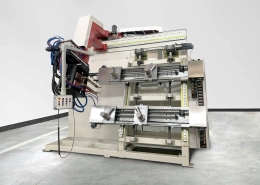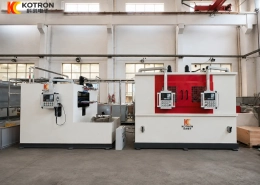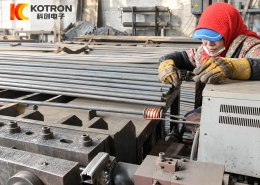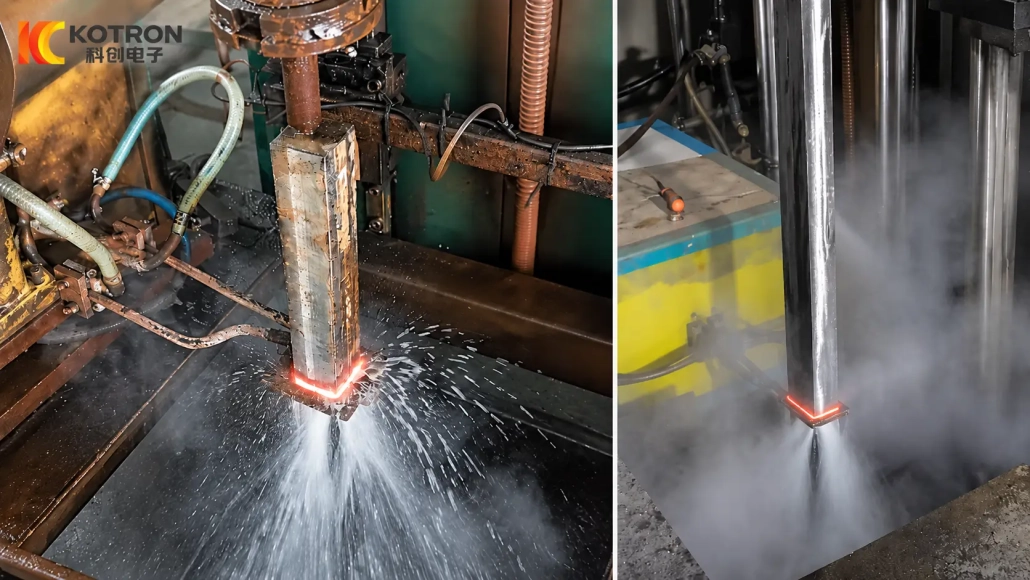
Máquina de endurecimiento por inducción de cuatro lados para rieles guía, Piezas cuadradas y rectangulares
Ⅰ. Simultaneous Induction Hardening of Four Faces
Simultaneous Induction Hardening of Four Faces — For Square and Rectangular Parts
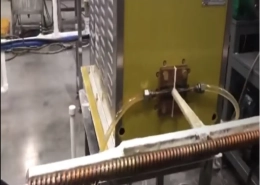
The video shows a square-section component undergoing simultaneous four-face induction hardening.
For parts with four functional surfaces, this approach avoids repeating separate heating cycles for each face. Where a longer section has to be hardened, the heating and quenching zone can be combined with controlled scanning along the workpiece.
The final process depends on the part geometry, required hardening pattern and dimensional requirements.
Ⅱ. Why Square and Rectangular Parts Need a Different Hardening Approach
A square or rectangular cross-section does not interact with the induction field in the same way as a round shaft.
The center of a flat face and the adjacent corner region have different geometric relationships with the inductor. Como resultado, heat distribution around the cross-section cannot be controlled simply by applying the same settings used for a cylindrical component.
A four-side hardening process therefore has to address two areas at the same time:
•the working area across each flat face
•the corner and edge regions between adjacent faces
The aim is to develop the required hardening pattern across all four functional surfaces while controlling excessive variation between the faces and corners.
Dimensiones de la pieza de trabajo, corner shape, material, relación bobina-parte, frecuencia, power and movement all influence the result.
Ⅲ. Four Faces in One Hardening Cycle
The main process difference is straightforward: all four longitudinal faces are treated within one coordinated hardening cycle.
This can be useful for components where several external surfaces are involved in guiding, sliding, contact or wear.
A conventional face-by-face process may require repeated repositioning:
one face → reposition → next face → reposition again
A dedicated four-side arrangement removes that repeated sequence by processing the four faces together.
This does not mean that every square or rectangular component can use the same coil or setup. A guide rail, square shaft and rectangular bar may have similar overall shapes but still differ in corner geometry, hardened width, material condition and dimensional requirements.
The machine configuration therefore follows the part rather than a fixed component category.
Ⅳ. Scanning Long Guide Rails, Square Shafts and Rectangular Bars
Long parts often require hardening over an extended working section instead of at one fixed position.
Para estas aplicaciones, the system can be configured so that the active heating and quenching zone travels along the required length. The scan start and stop positions are set according to the specified hardened area.
Relevant process factors include:
•cross-section dimensions
•required hardened length
•material
•requisito de dureza
•profundidad de la capa, cuando se especifica
•corner geometry
•straightness or other dimensional requirements
For long precision parts, thermal symmetry and quenching conditions also need to be considered because dimensional change can become as important as the hardness result.
Where DSP digital control is used, the heating cycle can be coordinated with programmed machine movement and timing. The exact control functions depend on the selected machine configuration.
Ⅴ. Custom Inductor Design and Corner Heating
The inductor is developed around the actual cross-section of the workpiece.
A bobina that works well around a round shaft should not be assumed to produce the required heating pattern on a square or rectangular part. The flat surfaces, corners and available coupling space need to be considered together.
For four-side induction hardening, the process normally focuses on several relationships:
Flat-face coverage
The required working width on each face needs to receive sufficient heating.
Corner regions
Corners may respond differently from the center of the flat surfaces because the local geometry changes the electromagnetic coupling and heat flow.
Coil-to-part distance
Variation in the local coupling relationship can change the heat input around the cross-section.
Movement and power
When scanning is used, the selected power and travel conditions need to work together over the treatment length.
The induction power supply is selected as part of this process rather than independently from the coil. IGBT-based power conversion can be used with the required operating range, while the final frequency and power depend on the workpiece and hardening requirement.
Ⅵ. Typical Workpieces and Application Areas
This type of equipment is not limited to guías.
It can be configured for different square, rectangular and prismatic components where four external faces require surface hardening.
Typical workpieces can include:
Guide Rails and Guide Bars
Long components with several guiding, sliding or contact surfaces.
Square Shafts
Square-section transmission, support or mechanical components with multiple working faces.
Rectangular Bars
Long rectangular parts with hardened surfaces along part or all of their length.
Prismatic Mechanical Components
Parts with several flat external surfaces that are not suited to a conventional round-shaft hardening arrangement.
Custom Parts
Non-standard components where the drawing specifies hardening on four external faces.
Possible application areas include machine tools, industrial automation, linear-motion systems, material-handling equipment, general machinery and other custom mechanical systems.
The application should still be judged from the actual part geometry and hardening requirement rather than the industry name alone.
Ⅶ. IGBT Power and DSP Digital Control
La fuente de alimentación por inducción., machine movement and quenching sequence need to work as one process.
For suitable configurations, the machine can use IGBT induction power with control digital DSP. The IGBT power stage provides electronically controlled power conversion, while the DSP system manages the required operating and control functions.
Dependiendo de la configuración seleccionada, DSP control can support functions such as:
•ciclos de calentamiento programados
•el control de energía
•heating timing
•machine-operation coordination
•operating-status monitoring
•recipe storage for recurring parts
These functions should be specified according to the production requirement. They should not be treated as identical standard features on every machine.
For customers producing multiple part variants, the control system can also be configured around different stored programs, provided the mechanical and electrical range of the machine is suitable for those parts.
Ⅷ. Machine Configuration Is Based on the Part
A four-side induction hardening machine should not be selected from power rating or overall length alone.
The starting point is the workpiece drawing.
| Información | Por qué es importante |
|---|---|
| Cross-section shape | Defines the basic inductor and tooling arrangement |
| Width and height | Affects coupling and available processing space |
| Corner geometry | Esquinas pronunciadas, chamfers and radii can change heating behavior |
| Longitud total | Influences machine travel and support |
| Área endurecida requerida | Defines the treatment and scanning range |
| Material | Affects the hardening response |
| Dureza requerida | Defines the final surface target |
| Profundidad del caso, si se especifica | Influences process development |
| Requisitos dimensionales | Relevant for long or precision components |
| Requisito de producción | Influences automation and machine layout |
The mechanical structure, inductor, fuente de alimentación por inducción, workpiece support, scanning travel, quenching arrangement and control functions can then be configured around the application.
Two parts with similar outer dimensions may still require different process solutions if their corner shape, hardening pattern or dimensional requirements are different.
IX.. Preguntas frecuentes
Haga clic en una pregunta para ampliar la respuesta.
+ Can all four faces be hardened simultaneously?
Sí. The machine concept is based on simultaneous hardening of four external faces. The inductor and process still need to be developed around the actual part.
+ Can the same machine process both square and rectangular parts?
It may be possible if the parts fall within the mechanical and process range of the system. Different dimensions and corner geometries can require changes to the inductor, fixture and process program.
+ Is this machine only for guide rails?
No. Guide rails and guide bars are typical applications, but the same process concept can also be applied to square shafts, rectangular bars and other prismatic components with four functional surfaces.
+ Why do the corner regions require special attention?
Their geometry differs from the center of the flat faces, so the local coupling and heat distribution can also differ. Corner behavior therefore needs to be considered during coil and process development.
X.. Send Us Your Part Drawing
Para una evaluación inicial, send us the part drawing or basic cross-section together with the required hardening area. The most useful starting information is part dimensions, material, required hardened area and production requirement. If hardness, case-depth or dimensional requirements are already defined, también se pueden incluir. We can then evaluate the four-side induction hardening process and configure the inductor, fuente de alimentación por inducción, scanning arrangement and machine layout around the application.