
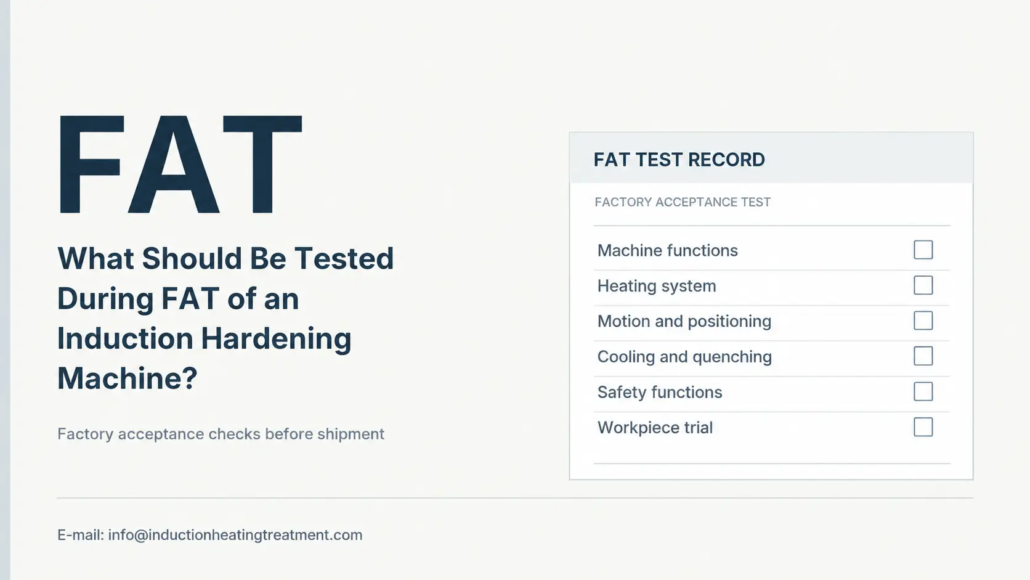
Qué se debe probar durante la FAT de una máquina de endurecimiento por inducción?
Factory Acceptance Checks for Machine Functions, Safety and Hardening Performance
A Factory Acceptance Test (FAT) checks whether an induction hardening machine meets its agreed requirements before shipment from the manufacturer’s facility.
Para los ingenieros, quality personnel and technical buyers reviewing a new machine, the challenge is knowing what should be tested and what evidence is needed for acceptance. A successful automatic cycle alone does not demonstrate that the machine meets every functional, safety or hardening-performance requirement.
This guide focuses on practical pre-shipment checks for induction hardening equipment. It does not replace machine-specific safety validation or formal production process qualification.
2. Which Machine Functions and Safety Systems Must Be Checked?
3. How Should Hardening Performance Be Demonstrated During FAT?
4. What Can FAT Approve, and What Must Wait Until SAT?
1. What Should Be Agreed Before the Factory Acceptance Test?
FAT should begin with an agreed test plan, not simply a demonstration of the machine running.
A standalone induction power supply requires different acceptance tests from a CNC scanning hardening machine equipped with workpiece rotation, automated quenching and material handling. The scope must reflect the equipment being supplied and the requirements it is expected to meet.
Define the acceptance criteria
Before testing, the manufacturer and customer should agree on the machine configuration, required functions, test methods and acceptance criteria.
The FAT plan should establish:
— Which machine functions and operating conditions will be tested.
— What measurements and inspection results are required.
— Whether representative workpieces and fixtures will be available.
— Which electrical, cooling and quenching conditions can be provided at the factory.
— How test results, deviations and incomplete items will be recorded.
— Which requirements must be verified later at the customer’s site.
Acceptance criteria should come from the approved technical agreement, equipment specifications or other applicable requirements.
A generic checklist can help organize the tests, but it cannot establish universal limits for heating power, velocidad de escaneo, cooling flow or workpiece hardness.
Verify the tested machine configuration
The FAT should also confirm that the installed power supply, inductor, herramientas, mechanical assemblies and controls correspond to the approved equipment documentation.
Software versions and process recipes need to be identified. If temporary programs, substitute inductors or alternative test loads are used, those differences must be recorded.
Factory utilities can also affect the scope of testing. Electrical supply and cooling-water conditions at the manufacturer’s facility may differ from those available after installation.
IEC 62381:2024 provides a framework for FAT, SAT and related acceptance activities in process-industry automation. Its approach to test planning and responsibilities can inform equipment-specific procedures, although it is not a dedicated acceptance standard for induction hardening machines.
Referencia: IEC 62381:2024 — Factory Acceptance Test, Site Acceptance Test and Site Integration Test
2. Which Machine Functions and Safety Systems Must Be Checked?
Functional testing should demonstrate that the equipment performs its specified operations under agreed conditions.
The test scope depends on the machine design. A scanning hardening machine, Por ejemplo, needs verification of axis motion and workpiece rotation, while those functions may not apply to a stationary hardening installation.
Main FAT test areas
| Test Area | What Should Be Verified | Typical Acceptance Evidence |
|---|---|---|
| Electrical and heating system | Power supply operation, specified output capability under the agreed load, operating frequency and heating sequence | Actual operating measurements and cycle records |
| Mechanical motion | Axis travel, velocidad de escaneo, posicionamiento, workpiece rotation and applicable travel limits | Motion measurements and functional test records |
| Inductor and tooling | Installed configuration, mounting, workpiece clearance and relevant connections | Configuration and inspection records |
| Equipment cooling | Cooling circuit operation, specified supply conditions, monitoring and fault responses | Applicable flow, presión, temperature and alarm records |
| Workpiece quenching | Quench delivery, valve operation, timing and specified monitoring functions | Functional test results and recorded quenching conditions |
| PLC / HMI | Operating modes, recipe selection, automatic sequence, alarms and recovery functions | Test records and program identification |
| Safety functions | Parada de emergencia, protective guards, interlocks and specified protective responses | Documented safety-function test results |
| Automatic operation | Completion of the agreed machine sequence, including handling functions where supplied | Cycle records and documented deviations |
These are typical FAT test categories. Not every item applies to every machine, and some projects will require additional tests.
Editable FAT Checklist (Excel)
For recording individual tests, use the Induction Hardening Machine FAT Checklist:
The template includes test items, acceptance criteria, actual results, Pass / Fail / N/A selections, evidence references, an open-items register and an acceptance summary.
It is intended as a project-adaptable recording tool. Test methods and acceptance limits must be confirmed against the applicable technical agreement before use.
Check actual operation, not only programmed values
For a scanning machine, entering a speed into the HMI does not establish that the axis moves at that speed. Where scan speed or positioning accuracy is an acceptance requirement, it should be verified through appropriate measurements or recorded feedback.
The same distinction applies to heating power.
The programmed power setting does not necessarily represent the electrical operating condition achieved under load. The installed inductor, matching arrangement and workpiece can influence the power supply’s operating behavior.
Where output performance is part of FAT, the test should use defined load conditions and record the relevant actual electrical values.
Separate equipment cooling from workpiece quenching
Many induction hardening installations have cooling circuits for the power supply and inductor, together with a separate system for quenching the workpiece.
Equipment cooling protects the electrical components and inductor from excessive temperature. Its functional checks may involve circulation, supply conditions, monitoring and responses to cooling faults.
The workpiece quenching system delivers the medium used to cool the heated material. Its tests may include pump and valve operation, entrega de spray, quench timing and relevant monitoring signals.
These systems must be evaluated separately. Adequate cooling-water flow through the inductor does not establish that the workpiece receives the required quench.
Del mismo modo, confirming that quench valves operate at the programmed time does not prove that the hardened workpiece will meet its specification.
Verify safety functions against the approved safety design
Safety-related FAT tests may include emergency-stop functions, protective guards, access interlocks and the machine’s specified response to monitored faults.
Each test should establish whether the required protective response occurs under the approved test conditions, rather than simply checking whether an alarm appears on the HMI.
The safety checks discussed here are illustrative, not a complete machinery safety validation procedure. Required safety functions, performance requirements and test methods must be determined from the machine-specific risk assessment, applicable regulations and standards, and approved safety design.
Testing must be performed by qualified personnel using controlled, approved procedures. FAT does not replace any separate safety verification or conformity assessment required for the equipment or its destination market.
3. How Should Hardening Performance Be Demonstrated During FAT?
A machine may complete its programmed heating and quenching sequence without producing an acceptable hardened workpiece.
When the FAT agreement includes hardening-performance acceptance, representative workpiece trials provide evidence that functional testing alone cannot supply.
Use representative workpieces and defined test conditions
Before the trial, the test plan should identify the workpiece material, geometría requerida, initial condition, fixture and required hardening result.
Where practical and required by the agreement, testing should use the intended production inductor and quenching arrangement.
Por ejemplo, una shaft-hardening trial may need to demonstrate a specified hardened length, surface hardness and effective case depth.
The test record should identify the actual process conditions, especially where they differ from those intended for production.
Inspect the hardened result against the workpiece specification
Depending on the agreed requirements, a hardening trial may include:
— Surface-hardness measurements at specified locations.
— Effective case-depth measurements using the agreed definition and method.
— Examination of the hardened case pattern.
— Crack inspection or metallographic examination where required.
— Dimensional checks on specified critical features.
These measurements address different aspects of the result.
A shaft can meet its surface-hardness requirement while having insufficient effective case depth. It may also reach the required hardness but fail a specified dimensional tolerance after quenching.
The inspection plan therefore needs to identify the characteristics to be measured, the measurement locations and the acceptance criteria. Where destructive testing is required, suitable test pieces must be provided.
An industry example is documented in GH Induction’s Machinery Manufacturing Regulations (DOC-12, 2016 edition). The document describes equipment and part-treatment tests that include applicable surface-hardness measurements, hardening-depth measurements, microscopic examination and crack testing.
These are examples of one manufacturer’s documented acceptance arrangements, not mandatory FAT tests for every induction hardening installation.
For detailed inspection methods, ver Cómo inspeccionar piezas endurecidas por inducción.
Evaluate repeated operation where required
One successful hardening cycle establishes the result of that particular trial. It provides limited evidence about operation over repeated cycles.
If continuous operation, cycle time or repeat performance is part of the FAT agreement, the test plan should define the operating conditions, duration or cycle count, and acceptance requirements.
Records may include completed cycles, interruptions, alarms and relevant changes in operating conditions.
Repeated successful operation can demonstrate machine behavior under the tested conditions, but it should not automatically be treated as proof of statistical process capability or full production qualification.
What if production workpieces are unavailable?
FAT can still verify much of the machine’s functionality without production-representative parts.
Mechanical movement, los controles, la refrigeración, safety functions and portions of the automatic sequence may be tested using approved alternative arrangements. Heating-system performance may also be evaluated with an appropriate defined test load.
Sin embargo, a dry run or substitute workpiece cannot establish the hardness or effective case depth of the intended production component.
If the agreed workpiece trials cannot be completed at the factory, the unverified requirements should be clearly identified, with the remaining tests assigned to an appropriate later acceptance or qualification stage.
4. What Can FAT Approve, and What Must Wait Until SAT?
FAT establishes what the machine has demonstrated under agreed factory conditions. It does not automatically prove that the equipment will meet every requirement after installation at the customer’s facility.
The distinction is particularly relevant when the final electrical supply, cooling-water conditions, plant interfaces or production tooling differ from those used during FAT.
FAT, SAT and process validation
| Activity | Propósito principal |
|---|---|
| FAT — Factory Acceptance Test | Verify agreed equipment functions, safety requirements and applicable performance tests under factory conditions |
| SAT — Site Acceptance Test | Verify the installed equipment and specified functions under the customer’s site conditions |
| Process Validation / Calificación | Demonstrate that a defined hardening process produces conforming workpieces under its specified conditions |
Por ejemplo, a hardening machine may pass FAT using the manufacturer’s cooling-water system but still require verification of the customer’s water supply and connections after installation.
De manera similar, a successful factory hardening trial does not automatically qualify the production process. Whether FAT results can contribute to formal process qualification depends on the applicable requirements and the representativeness of the test conditions.
Further details are covered in Validación del proceso de endurecimiento por inducción.
What should the FAT report contain?
The FAT report should record the tested machine configuration, test procedures, acceptance criteria, actual conditions and results.
Each required test should have a documented outcome. Failed or incomplete items should be identified together with corrective actions, responsibilities and any necessary retesting.
Outstanding items are often managed through a punch list or open-items register.
Whether an unresolved item prevents acceptance or shipment, or can be closed during SAT, depends on the agreed acceptance procedure and any applicable mandatory requirements.
What does FAT approval actually mean?
Consider a CNC induction hardening machine that completes its automatic cycle and produces a shaft meeting the specified surface hardness.
That is useful evidence, but it does not close other acceptance requirements that remain untested. If effective case depth, scan accuracy or safety-function performance is part of the FAT scope, those results must also be verified.
A properly completed FAT establishes which agreed requirements have been met, under what conditions, and which obligations remain before the equipment enters production.
For induction hardening machines, the value lies not simply in demonstrating that the equipment runs, but in connecting each acceptance requirement to a defined test and a documented result.
Conclusión clave
A Factory Acceptance Test is not a demonstration that the machine runs — it is evidence that each agreed requirement has a defined test and a documented result. Agree the acceptance criteria before testing, verify machine functions and safety systems separately from hardening performance, and carry unverified items forward to SAT or process qualification.
Preguntas frecuentes
Haga clic en una pregunta para ampliar la respuesta.
Does a FAT replace the Site Acceptance Test (SAT)?
No. FAT verifies agreed functions under factory conditions, while SAT verifies the installed machine under the customer’s site conditions — including the actual electrical supply, cooling water and plant interfaces. Both are usually required before the equipment enters production.
Can a FAT proceed without production workpieces?
Sí, for much of the machine. Movimiento, los controles, la refrigeración, safety functions and parts of the automatic sequence can be tested with approved alternative loads. Sin embargo, the hardness and effective case depth of the intended component cannot be established this way, so those items are deferred to a later acceptance or qualification stage.
Does a successful FAT qualify the production process?
No. A single hardening trial establishes the result of that trial. Process validation or qualification is a separate activity that demonstrates repeatable conformance under the defined production conditions.
Who should attend the FAT?
Typically representatives of both the manufacturer and the customer — engineering and quality personnel who can witness the tests, confirm the acceptance criteria and sign the report.
Planning a Factory Acceptance Test for Your Induction Hardening Machine?
Send us your machine specification and acceptance requirements, and we will help you define the FAT checks that matter for your equipment.


