Máquina de endurecimiento por inducción de zapatas de freno para frenos de tambor de vehículos automotrices y comerciales
Ⅰ. See the Brake Shoe Induction Hardening Process
Brake Shoe Induction Hardening
Localized Heating and Quenching
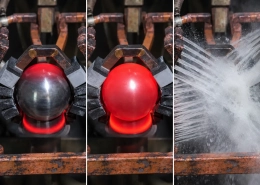
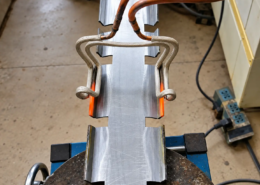
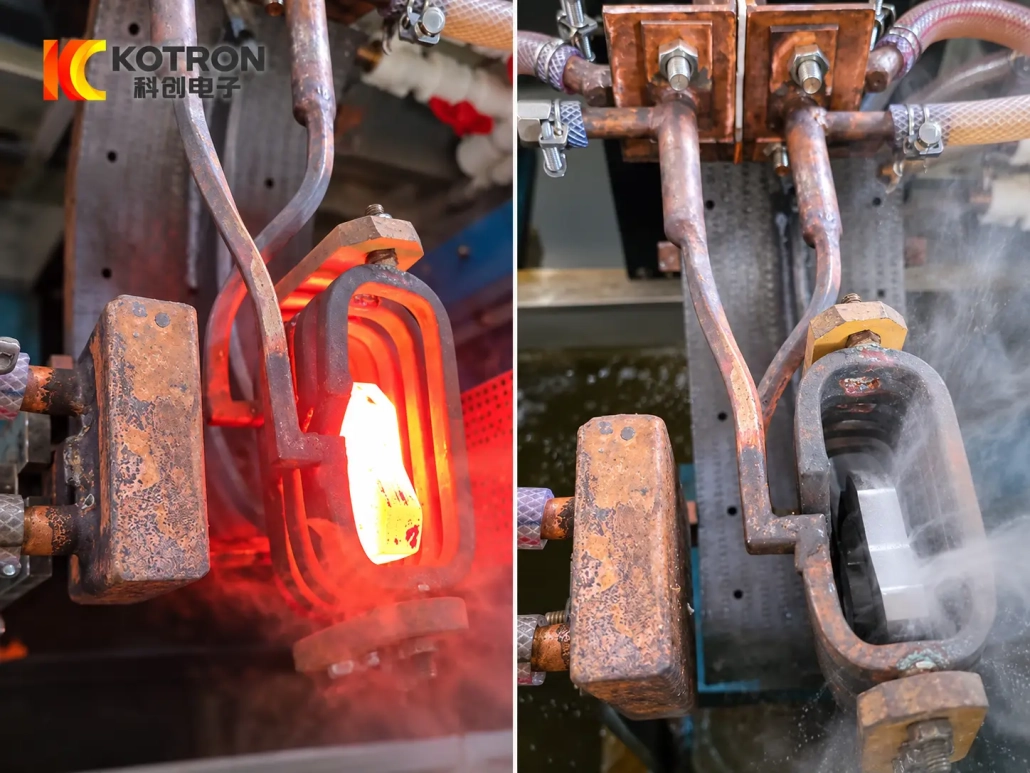
This application shows calentamiento por inducción localizado on a curved brake shoe profile. A contoured inductor follows the required treatment area, and the heated zone is quenched as part of the hardening cycle.
The exact heating position and movement arrangement are selected according to the brake shoe geometry and the area specified for hardening.
Ⅱ. Localized Hardening for Different Brake Shoe Designs
Brake shoe geometry can vary considerably between different models. Changes in radius, arc length, ancho, espesor de la sección, hole pattern or end geometry can affect both the tooling and the heating process.
The equipment can be developed for brake shoes with different:
•Curved profiles and radii
•Widths and section dimensions
•Hole and slot arrangements
•End geometries
•Áreas endurecidas requeridas
•Loading and handling requirements
The hardening zone should be defined from the customer drawing or heat-treatment specification.
In some brake shoe designs, localized hardening may be required around an end, contact area, cam-related area, anchor-related area or another specified position. These locations vary by component and should not be assumed from the brake shoe name alone.
Por eso brake shoe induction hardening equipment is normally designed from the actual part and treatment requirement rather than selected only by workpiece size.
Ⅲ. Customized Inductor and Fixture Design
The inductor and fixture have a direct relationship with the brake shoe geometry.
Diseño de inductores
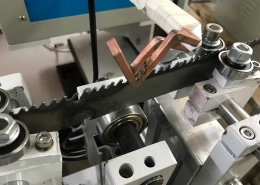
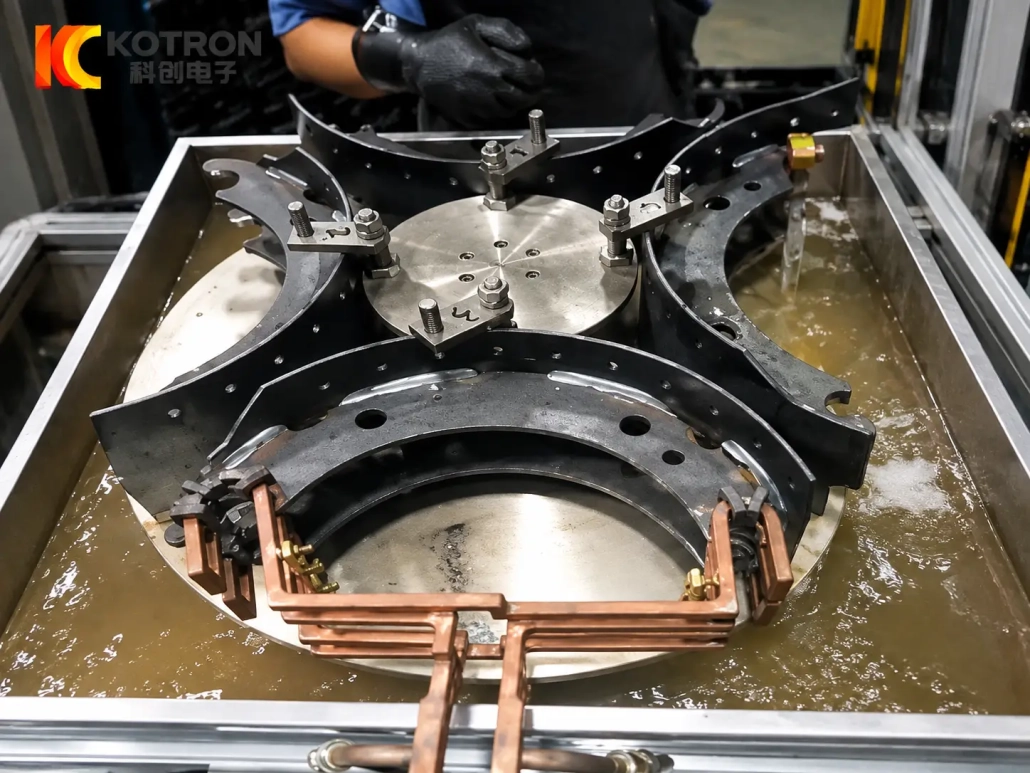
For curved or irregular brake shoe profiles, una contoured inductor can be designed around the required heating area. The coil shape, working clearance and position are selected to match the local treatment zone.
A different radius or hardened position may require a different inductor, even when the parts are both classified as brake shoes.
Where several related brake shoe models need to be processed, tooling compatibility can be evaluated from the drawings. En algunos casos, different inductors can be used on the same machine; in others, the mechanical arrangement may also need to change.
Fixture Design
The fixture holds the brake shoe in a defined position relative to the inductor and quenching system.
Its design considers:
•Workpiece profile
•Available locating points
•Hardening position
•Dirección de carga
•movimiento requerido
•Changeover between part models
Para producción repetida, the fixture arrangement can also be designed around the required loading and cycle method.
Ⅳ. Controlled Heating and Quenching
A brake shoe hardening cycle is not determined by induction power alone. Heating position, potencia y frecuencia, Tiempo de calentamiento, relative movement and quenching need to be considered together.
The process generally follows:
Posicionamiento → Localized Induction Heating → Temple → Cycle Completion
The machine movement is selected to obtain the required heating pattern. En algunas aplicaciones, the inductor moves relative to the brake shoe; other projects may use a different positioning arrangement.
The movement method is therefore part of the process configuration, not a fixed requirement for every machine.
El temple system is also designed around the treated area and workpiece geometry. Spray position, timing and sequence are coordinated with the heating cycle according to the application.
Target hardness, effective case depth and hardened pattern should be defined from the customer’s technical requirement and confirmed during process development.
Ⅴ. Automatic Brake Shoe Induction Hardening for Production
Automatic Brake Shoe Induction Hardening
Automated Heat Treatment Process
Para producción repetida, el brake shoe induction hardening machine can be configured with automated positioning, cycle control and quenching.
The production arrangement can be developed according to:
•Volumen de producción requerido
•Number of brake shoe models
•Método de carga y descarga.
•Fixture arrangement
•Changeover requirements
•Espacio de fábrica disponible
•Condiciones existentes de la línea de producción.
Manual, semi-automatic and automatic configurations can be considered.
Cuando sea necesario, automatic indexing, carga, unloading or transfer functions can also be integrated into the machine layout. These functions are selected from the actual production requirement rather than treated as standard equipment on every project.
Ⅵ. Machine Configuration and Digital Process Control
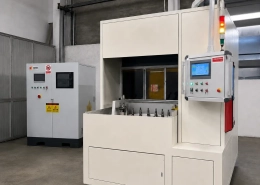
un completo brake shoe induction hardening system combines the fuente de alimentación por inducción with the mechanical, quenching and control systems required for the workpiece.
A project can be configured with:
•Fuente de alimentación de calentamiento por inducción
•Transformador de inducción
•Customized inductor
•Brake shoe fixture
•Positioning or movement mechanism
•Sistema de enfriamiento
•Cooling-water system
•PLC or CNC control
•Interfaz operativa HMI
•Sistema de protección eléctrica
•Optional automated handling equipment
The induction power and operating frequency are selected together with the workpiece material, section dimensions, área calentada, required hardening result and production cycle.
IGBT induction power technology and control digital DSP can be used according to the selected system configuration.
Process parameters may include:
•tiempo de calentamiento
•Salida de energía
•Positioning sequence
•Movement parameters
•Tiempo de enfriamiento
•Cycle sequence
Where the control configuration supports it, almacenamiento de recetas, registros de alarma, process monitoring and production-data functions can also be included.
These functions are useful when established hardening conditions need to be recalled for different brake shoe models or repeated production batches.
Ⅶ. What Determines the Right Brake Shoe Hardening Machine?
The most useful starting point is the actual brake shoe rather than a machine model number.
| Información del proyecto | Utilizado para determinar |
|---|---|
| Brake shoe drawing | Overall equipment and tooling concept |
| Radius and profile | Inductor and fixture design |
| Material y grado | Heating-process development |
| Section dimensions | Potencia, frequency and coil configuration |
| Área endurecida requerida | Heating position and tooling |
| Target hardness | Process-development requirement |
| Profundidad efectiva del caso, si se especifica | Heating and quenching process |
| Number of part variants | Tooling and changeover arrangement |
| Requisito de producción | Cycle and automation level |
| Método de carga | Fixture and handling design |
| Línea de producción existente | Integración de equipos |
| Inspection requirement | Process validation plan |
A drawing marking the required hardened area is particularly useful because two brake shoes with similar overall dimensions can still require different induction tooling or process settings.
If several brake shoe models are involved, their drawings can be reviewed together to determine whether they can share the same machine platform with different tooling and programs.
Ⅷ. Preguntas frecuentes
Haga clic en una pregunta para ampliar la respuesta.
Can one machine process different brake shoe models?
It may be possible when the parts fall within the designed mechanical and process range. Different models can require different inductors, programas de fijación o de proceso, so the drawings should be reviewed before the final machine configuration is selected.
Does every brake shoe require a different induction coil?
No necesariamente. Similar parts may be able to share tooling, but changes in radius, profile or hardened area can require another inductor. Coil compatibility should be confirmed from the actual part geometry.
Can the machine be configured for automatic production?
Sí. Posicionamiento, cycle control, temple, indexing and material handling can be automated according to the production requirement. The final automation level depends on the workpiece range and production arrangement.
What information is needed before designing the machine?
The most useful information is the brake shoe drawing, material, main dimensions, required hardened area and production requirement. If hardness, case depth or inspection requirements have already been defined, they should also be provided.
Send Us Your Brake Shoe Drawing
To evaluate the correct brake shoe induction hardening machine, send us the actual workpiece information:
Brake Shoe Drawing or Photos + Material + Main Dimensions + Required Hardened Area + Requisito de producción
Si está disponible, también incluye:
Dureza objetivo + Profundidad efectiva del caso + Inspection Requirements
De estos detalles, el poder de inducción, frecuencia, inductor, fixture, movimiento, quenching method and automation configuration can be evaluated together.