Welche Prozessdaten sollte eine Induktionshärtemaschine aufzeichnen??
Key Heating, Motion and Quenching Records for Process Monitoring and Traceability
Running the same induction hardening program does not guarantee that every workpiece experiences identical processing conditions. Effektiv induction hardening process data logging should capture the actual variables needed to identify process deviations, investigate abnormal cycles and maintain production traceability.
The objective is not to record every available machine signal, but to retain meaningful evidence of what happened during each hardening cycle.
2. Setpoints, Actual Values and Process Curves
3. How Should Process Records Be Linked to Individual Workpieces?
4. What Can Process Records Actually Prove?
1. What Process Parameters Should Be Recorded?
The required records depend on the hardening method, workpiece and approved process conditions. A stationary hardening operation, Zum Beispiel, has different motion-monitoring requirements from a CNC scanning process.
For most production applications, process records can be organized into five categories.
| Data Category | Typical Records | Engineering Purpose |
|---|---|---|
| Workpiece and recipe | Part or batch ID, recipe ID and revision, station ID | Identifies the workpiece and intended process |
| Induktionserwärmung | Actual power, Betriebsfrequenz, Erwärmungszeit, relevant voltage and current signals | Reviews electrical heating conditions |
| Workpiece motion | Actual scan position, Scan-Geschwindigkeit, Drehzahl, movement status | Checks the recorded treatment movement |
| Abschrecken | Quench activation, Timing, relevant flow, pressure or temperature measurements | Reviews monitored cooling-system conditions |
| Cycle events | Start/end timestamps, completion status, alarms and limit violations | Identifies interrupted or abnormal cycles |
These are typical recording categories, not a mandatory list for every induction hardening machine.
Several distinctions matter when selecting the actual signals:
Erhitzen: Actual power and relevant electrical measurements help identify changes during heating. Jedoch, converter output power is not necessarily equal to power transferred into the workpiece. Electrical signals also cannot directly establish the final temperature distribution or hardness.
Bewegung: Actual scan position and speed are generally more informative than programmed values alone when movement affects the hardening pattern. A correct power curve cannot confirm that the workpiece followed the intended treatment path.
Abschrecken: Fluss, Druck, temperature and timing records may be relevant, depending on the cooling arrangement. A measured flow rate does not necessarily describe local spray coverage or cooling conditions across the workpiece.
Temperatur: Where reliable workpiece Temperaturmessung is available, the signal can help evaluate thermal response at the measurement location. It should not automatically be treated as representative of the entire heated region.
Some supporting variables, such as polymer quenchant concentration, may be managed through periodic measurements rather than recorded for every cycle, provided the approved control plan permits that approach.
The appropriate recording scope should be based on the parameters that matter to the validated process, not simply on which values the controller can display.
Zum Beispiel, Neturen’s VIZWATCHER heating process monitor uses electrical measurements and impedance changes to help identify variations in heating conditions and possible equipment abnormalities.
This illustrates why relevant electrical signals may provide useful diagnostic information beyond the basic power setting, although their interpretation depends on the equipment and process.
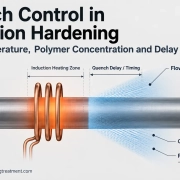
For detailed cooling-system control, siehe Abschreckkontrolle beim Induktionshärten.
2. Setpoints, Actual Values and Process Curves
One of the most important decisions in induction hardening data recording is whether to save programmed values, actual measurements or complete process curves.
A setpoint defines the intended operating condition. Eine actual value represents the corresponding measurement or feedback signal during operation.
Both are useful, but they answer different questions.
Zum Beispiel, saving the programmed heating power confirms the selected setting. Recording actual power provides information about the electrical output during the cycle.

Setpoint vs. actual data in a hardening cycle.
Why record process curves?
A cycle summary may contain heating duration, maximum power or total recorded energy. These values are useful, but they may conceal changes that occurred during processing.
Two cycles can have similar summary values while showing different variations in their power curves.
Time-resolved data can reveal temporary interruptions or unexpected changes that would not be apparent from a final value alone.
Für Scanhärtung, linking measurements to scan position may be particularly useful because it helps associate a deviation with a location along the treatment path.
Such recorded patterns are often called process signatures.
SMS Elotherm’s ELO-PROCESS monitoring technology provides an industrial example, recording process-related electrical and cooling-system measurements and displaying them as curves for evaluation.
How much data should be recorded?
Not every parameter requires continuous sampling.
| Recording Method | Suitable Information |
|---|---|
| Once per cycle | Part ID, recipe revision, cycle status |
| Zeit- or position-resolved | Relevant power, movement and other changing process signals |
| Event-based | Alarms, Unterbrechungen, limit violations |
| Periodic checks | Supporting conditions such as quenchant concentration, ggf |
The sampling interval should be appropriate for the changes that need to be detected. If measurements are recorded too slowly, brief disturbances may be missed.
Recording every available signal at unnecessarily high frequency, Jedoch, can create large datasets without improving process understanding.
Once a process has been qualified, selected actual values or process signatures may be compared against approved limits or reference conditions.
An out-of-limit event can flag a cycle for investigation, but a deviation from a reference curve does not automatically prove that a workpiece is defective. Ebenso, a matching curve does not independently establish that the required hardness or case depth was achieved.
Monitoring limits need to be supported by the established process and its verification evidence.
3. How Should Process Records Be Linked to Individual Workpieces?
Accurate process measurements are of limited value for traceability unless they can be associated with the workpieces that were processed.
A historical power curve may reveal an abnormal event, but without reliable identification, it may be difficult to determine which parts require review.
What should a cycle record contain?
A practical cycle record may include:
— Part serial number or batch reference.
— Machine and station identification.
— Recipe ID and revision.
— Cycle start and completion timestamps.
— Relevant process measurements or stored curves.
— Alarm and out-of-limit events.
— Cycle completion and disposition status.

Conceptual schematic — data availability and traceability depend on the monitoring configuration.
The required level of traceability depends on the application.
Part-level traceability links records to individual components. Batch-level traceability links records to an identified group of components. Batch records should not be treated as equivalent to individual-part records when investigating a specific abnormal cycle.
Why recipe revisions and alarm records matter
A recipe name alone may not identify the exact process conditions used for a historical workpiece.
If a heating sequence or controlled parameter is revised, the production record should preserve an unambiguous reference to the applicable approved configuration.
Tooling or inductor identification may also be relevant where multiple configurations are used.
Ebenso, alarms should be linked to the affected production cycle rather than stored only in a general machine event history.
Zum Beispiel, if a quench-flow measurement falls outside its approved limit, the records should help identify the relevant production cycle and whether the associated component requires further evaluation.
An alarm clearing after the event does not establish that the previously affected workpiece is acceptable.
Reliable traceability depends on maintaining the relationship between workpiece identification, recorded conditions and production decisions.
4. What Can Process Records Actually Prove?
Induktionshärten process monitoring and finished-part inspection answer different questions.
Process records can provide evidence of the measured machine conditions during production. They can help establish whether monitored variables remained within approved limits and whether an abnormal event occurred.
They cannot independently prove the final hardness, wirksame Einsatzhärtetiefe, microstructure or hardened-pattern geometry.
| Recorded Information | What It Can Help Establish | What It Cannot Directly Prove |
|---|---|---|
| Actual power curve | Electrical output behavior during heating | Workpiece temperature distribution |
| Scan position and speed | Recorded movement along the treatment path | Correct coil-to-part gap throughout processing |
| Quench-flow measurement | Flow at the measurement location | Uniform cooling across the workpiece |
| No recorded alarms | No monitored alarm condition was reported | Compliance with all product requirements |
| Part ID and recipe revision | Association with a controlled process configuration | Final metallurgical acceptance |
How should engineers use these records?
If a scanned induction-hardened shaft fails a case-depth inspection, the production record may help identify an unexpected change in scan speed, heating output or quenching conditions.
Such findings provide directions for investigation. They do not independently establish which variation caused the failed result.
Materialzustand, inductor positioning and other relevant factors may still need to be examined.
Ebenso, if all recorded parameters remain within their limits, an unmonitored variation may still have influenced the hardening result.
Process records are most valuable when compared with an established process baseline and linked to actual inspection evidence.
For process qualification and acceptance of operating conditions, siehe Validierung des Induktionshärtungsprozesses. Finished-part verification methods are covered in So prüfen Sie induktionsgehärtete Teile.
Schlüssel zum Mitnehmen
Effektiv induction hardening process data logging should preserve the information needed to identify the workpiece, reconstruct relevant operating conditions, detect meaningful process deviations and investigate abnormal cycles.
Some information belongs in a cycle summary, some requires time- or position-resolved curves, and some is appropriately maintained through periodic checks.
The goal is not to create the largest possible database. It is to retain reliable, interpretable records that help engineers understand what happened during production—and recognize when further investigation or product verification is necessary.
Häufig gestellte Fragen
Klicken Sie auf eine Frage, um die Antwort zu erweitern.
Does recording more data make a hardening process more reliable?
Nicht unbedingt. Recording every available signal at unnecessarily high frequency can create large datasets without improving process understanding. The recording scope should be based on the parameters that matter to the validated process, with time-resolved curves used only where brief changes need to be detected.
Can process records replace hardness or case-depth inspection?
Nein. Process records show what the machine measured during production and whether monitored variables stayed within approved limits. They cannot independently prove final hardness, wirksame Einsatzhärtetiefe, microstructure or hardened-pattern geometry. Finished-part inspection is still required where product requirements must be verified.
What is the difference between a setpoint and an actual value?
A setpoint is the intended operating condition programmed into the machine. An actual value is the corresponding measurement or feedback signal recorded during the cycle. Both are useful, but the actual value describes what the equipment did, not just what it was set to do.
Why should alarms be linked to specific workpieces?
An alarm stored only in a general machine event history may not identify which parts were affected. Linking alarms to the production cycle preserves the relationship between the abnormal event and the workpieces processed, so the relevant components can be evaluated.
Need reliable process data logging for your induction hardening operations?
KOTRON supplies induction hardening equipment with CNC control and process monitoring. Share your workpiece, hardening specification and traceability requirements to discuss a suitable solution.