Templado después del endurecimiento por inducción: ¿Cuándo es necesario y qué cambia??
Tempering after induction hardening is commonly used to modify the condition produced by quenching. It can reduce the brittleness of the as-quenched hardened layer, relieve part of the residual stress and adjust the final balance between hardness and toughness. ASM describes tempering of induction-hardened steels as a subcritical heat treatment used for purposes including toughness, ductility, la estabilidad dimensional, stress relief and control of mechanical properties. (ASM Digital Library)
That does not mean every induction-hardened component should receive the same tempering treatment. The requirement should come from the part drawing, material specification or validated heat-treatment process. Material, hardened condition and required final properties all affect the decision.
2. What Changes During Tempering?
3. When Is Tempering Needed After Induction Hardening?
4. Why Tempering Temperature Alone Is Not Enough
5. Induction Tempering and Furnace Tempering Are Not the Same Thermal Cycle
6. How Should the Final Result Be Evaluated?
7. What Information Defines the Tempering Requirement?
1. Why Is Tempering Used After Induction Hardening?
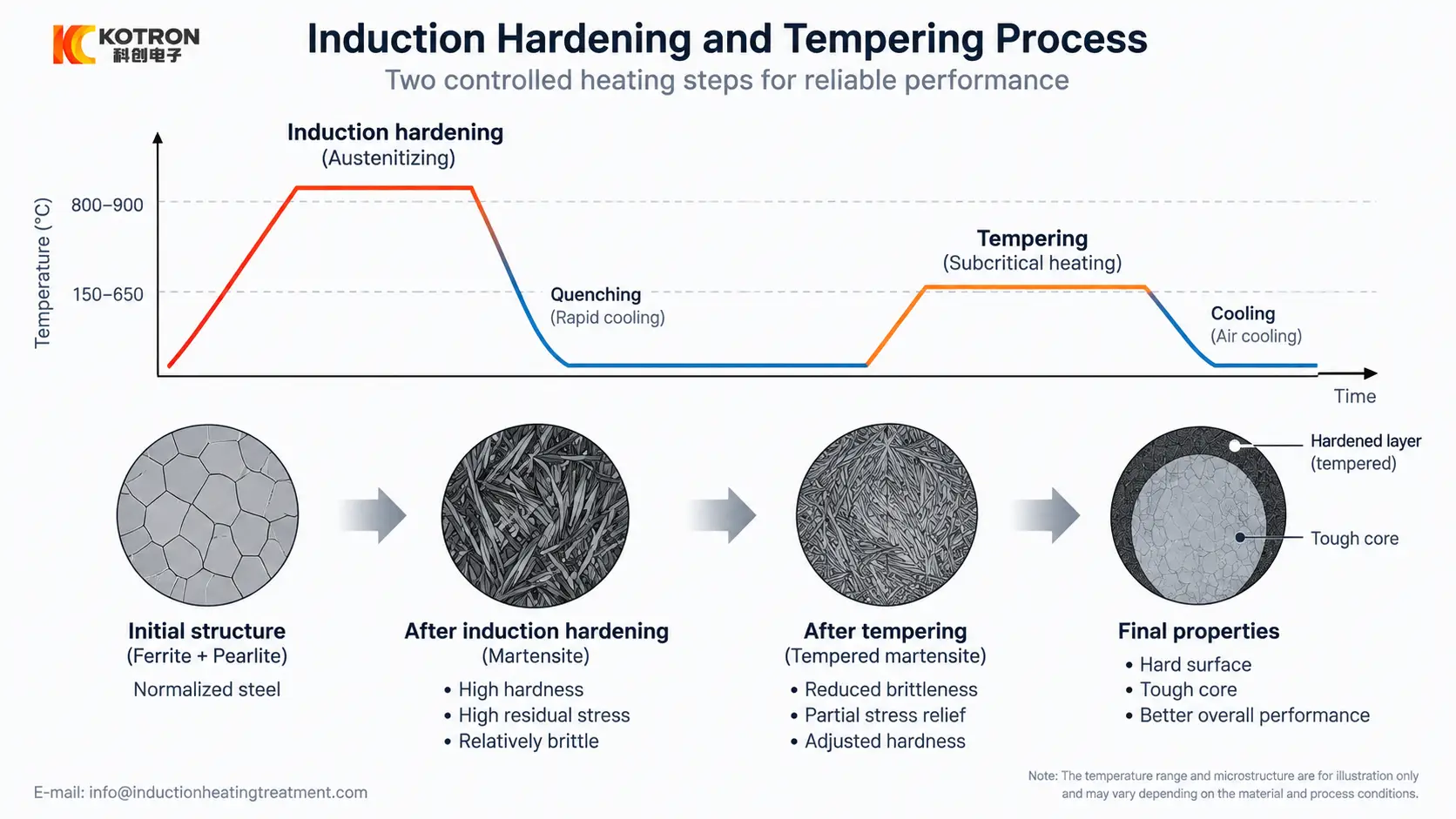
Durante temple por inducción, the selected surface region is heated and quenched to produce the required hardened structure. For suitable steels and process conditions, this normally involves formation of martensite in the hardened region.
The as-quenched condition provides high hardness, but it can also be relatively brittle and contain significant residual stresses. Tempering reheats the hardened steel below its critical transformation temperature so that this condition can be adjusted without repeating the austenitizing and quenching process. (ASM Digital Library)
For production parts, the purpose is therefore not simply to make the hardness lower. Tempering is used when the final component requires a different balance of properties from the as-quenched condition.
The relevant question is:
Does the as-quenched hardened region already meet the required final material condition, or is a tempering step required to reach it?
The answer depends on the component specification and the material response.
2. What Changes During Tempering?
Several properties can change during tempering, and they should not be considered independently.
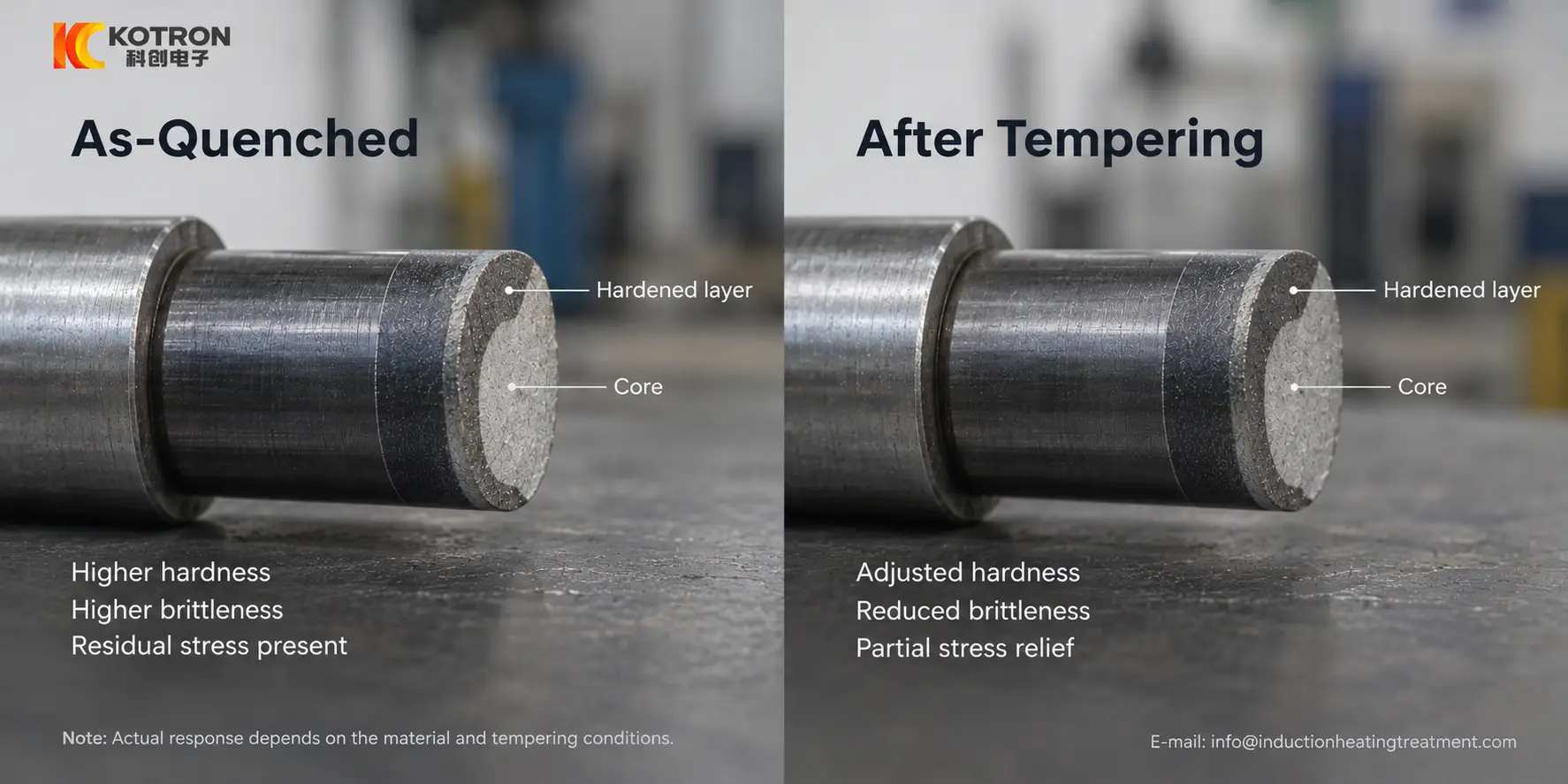
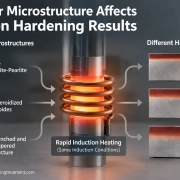
As-quenched vs. tempered condition — hardness, brittleness and residual stress all change.
Dureza
Tempering generally reduces the hardness of as-quenched martensitic steel. The extent of that reduction depends on the steel and the complete time-temperature history of the tempering cycle. (ASM Digital Library)
This is why an as-quenched hardness value should not automatically be treated as the final hardness when tempering is part of the specified heat-treatment sequence.
Toughness
The as-quenched martensitic structure can be relatively brittle. Tempering can reduce that brittleness and adjust the balance between hardness and toughness.
The objective is not necessarily to obtain the highest possible hardness. It is to obtain the condition required for the component after the complete heat-treatment process.
Residual Stress
Induction hardening creates a residual-stress distribution as a result of localized heating, transformation and quenching. The actual distribution depends on the material, part geometry and process.
Tempering can relieve part of the stresses created during hardening. Stress relief is one of the recognized purposes of tempering hardened steels. (ASM Digital Library)
This should not be interpreted as meaning that tempering removes all residual stress or automatically corrects distortion.
Dimensional Stability
Stress relaxation and microstructural changes during tempering can affect la estabilidad dimensional. Al mismo tiempo, dimensional changes can also occur during the tempering cycle itself.
For precision components, the relevant dimensions therefore need to be considered after the complete hardening and tempering sequence rather than only after quenching.
3. When Is Tempering Needed After Induction Hardening?
There is no universal rule that can be applied to every induction-hardened component.
For an established production part, the drawing, heat-treatment specification or approved process should normally define whether tempering is required.
Where the process is still being developed, the decision depends mainly on the final condition required from the hardened component.
| Factor | What needs to be considered |
|---|---|
| Material | Different steels respond differently to hardening and tempering |
| As-quenched condition | Dureza, hardened pattern and stress state depend on the preceding hardening process |
| Required final hardness | The requirement normally applies to the finished heat-treated condition |
| Toughness requirement | The as-quenched condition may not provide the required balance of hardness and toughness |
| Hardened area and geometry | Localized hardening creates different thermal and stress conditions across the component |
| Drawing or process specification | Production acceptance should follow the specified heat-treatment requirement |
This distinction matters because tempering should not be used as a general correction for an unsuitable induction hardening process.
If a component has an incorrect hardening pattern, profundidad de caso insuficiente, local soft areas o agrietamiento, the cause should first be investigated in the hardening and quenching process. Tempering does not compensate for every problem created earlier in the cycle.
4. Why Tempering Temperature Alone Is Not Enough
A tempering process cannot be defined by temperature alone.
The metallurgical response depends on both temperature and time, together with factors such as steel composition and the condition produced during hardening. ASM specifically treats time-temperature exposure as a central issue when comparing induction tempering with conventional furnace tempering. (ASM Digital Library)
This becomes especially important when an existing furnace tempering process is being considered for conversion to induction heating.
A statement such as:
“The furnace process uses this temperature, so the induction process should use the same temperature.”
is not enough to establish an equivalent process.
Induction heating can bring a selected region to temperature much more rapidly and can produce a different thermal history from furnace heating. The process therefore has to be developed around the required final properties rather than copied from a nominal temperature value alone.
The required tempering condition may depend on:
•material
•as-hardened condition
•required final hardness
•treated area
•método de calentamiento
•tiempo a temperatura
•geometría de la pieza
No single time-temperature combination should be assumed to apply to all induction-hardened components.
Process flow: hardened workpiece → induction tempering → tempered workpiece.
5. Induction Tempering and Furnace Tempering Are Not the Same Thermal Cycle
Both induction heating and furnace heating can be used for tempering, but they deliver heat differently.
Furnace tempering generally exposes a larger portion of the component to a relatively extended heating cycle. Induction tempering can apply heat more locally and over a shorter cycle, depending on the part and equipment arrangement.
ASM’s treatment of induction-hardened steels specifically distinguishes the time-temperature exposure requirements of furnace and induction tempering. (ASM Digital Library)
Por esa razón, one method should not be considered automatically equivalent to the other simply because the same peak temperature is used.
The choice between them depends on the required tempered zone, production process and validated material result.
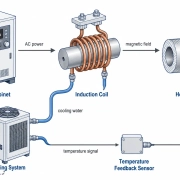
Equipment selection comes after this metallurgical requirement has been established. A separate question is then whether the application is better suited to an induction tempering system or another tempering method.
6. How Should the Final Result Be Evaluated?
If tempering is part of the specified process, the important acceptance condition is normally the condition after tempering, not only the condition immediately after induction hardening.
Por ejemplo, if the drawing specifies final surface hardness, that value should be evaluated at the appropriate stage of the completed heat-treatment sequence.
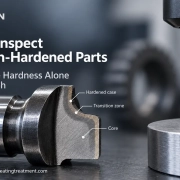
Other requirements may include case depth, patrón de endurecimiento, microestructura, dimensional tolerance or crack inspection, depending on the component specification.
The inspection plan should therefore follow the drawing and applicable process requirements. A machine completing the programmed heating cycle confirms that the process ran; it does not by itself confirm that every specified property of the finished part has been achieved.
For a more detailed discussion of this distinction, consulte nuestra guía de inspección de endurecimiento por inducción, including surface hardness, effective case depth and hardening-pattern verification.
7. What Information Defines the Tempering Requirement?
When evaluating tempering after induction hardening, the most useful starting information is relatively simple:
•material
•dibujo de la pieza
•área endurecida
•required final hardness
•requisito de profundidad de caso, si se especifica
•any drawing-defined tempering or final heat-treatment requirement
If an existing tempering process is already approved, its process information can also provide a useful reference.
The objective is to define the required final material condition first. The heating method and equipment configuration can then be developed around that requirement.
Conclusión clave
Tempering after induction hardening is not simply an additional heating step used to reduce hardness. It modifies the as-quenched hardened condition and can adjust hardness, toughness, residual stress and dimensional stability toward the final condition the component specification requires.
induction hardening → quenching → tempering when required → final verification
The correct tempering condition is the one that produces the specified final part condition—not a temperature or cycle copied from another component.
Not Sure Whether Your Part Needs Tempering?
Send us the material, part drawing and required final hardness. We can help define the tempering requirement and the right heating method for the application.