Làm cứng cảm ứng cho răng Spline bên trong
Ⅰ. Watch Internal Spline Induction Hardening in Operation
Video: Localized induction heating of internal spline teeth using a customized bore inductor.
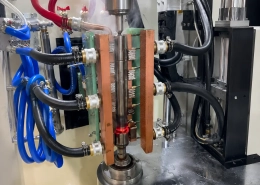
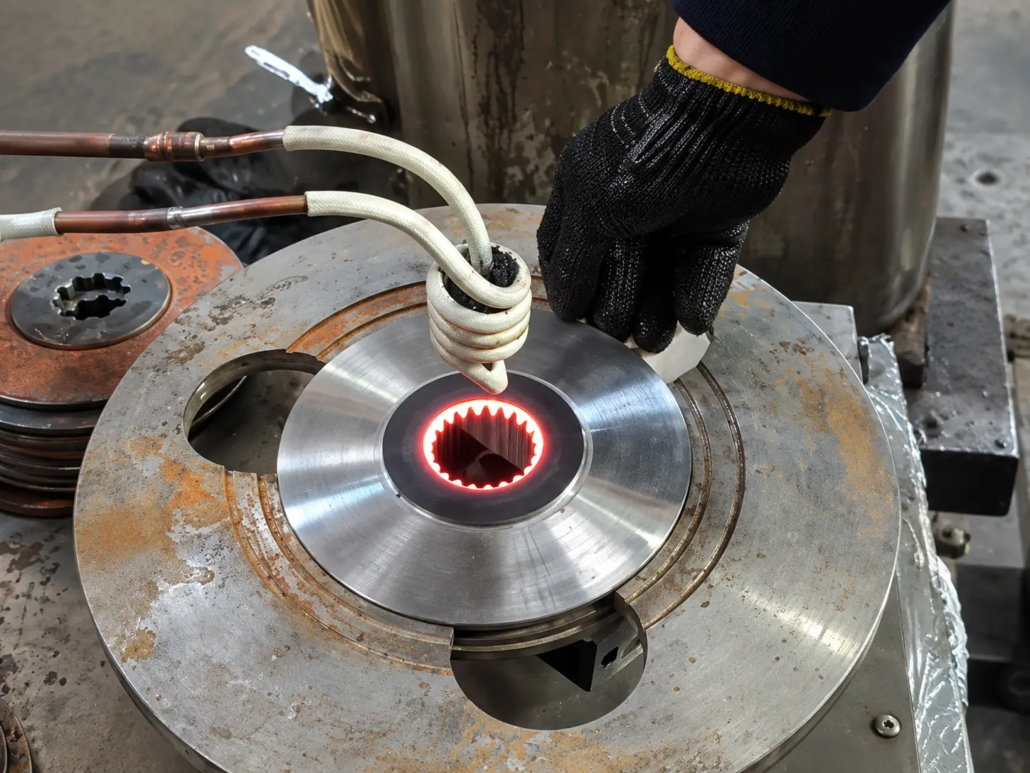
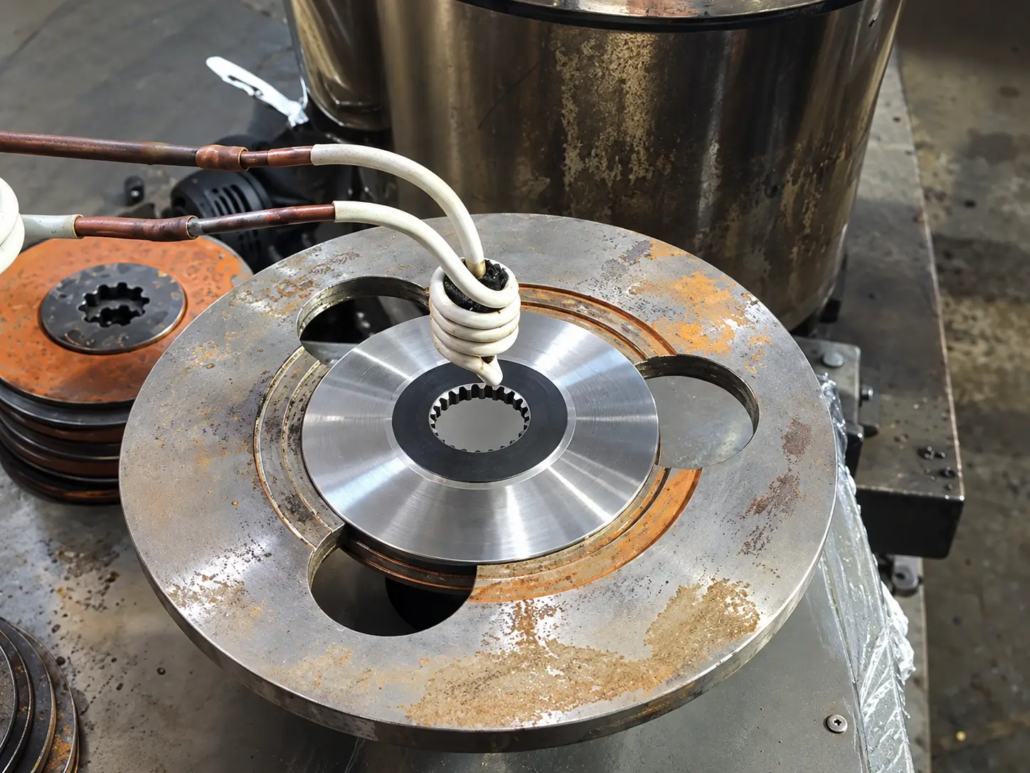
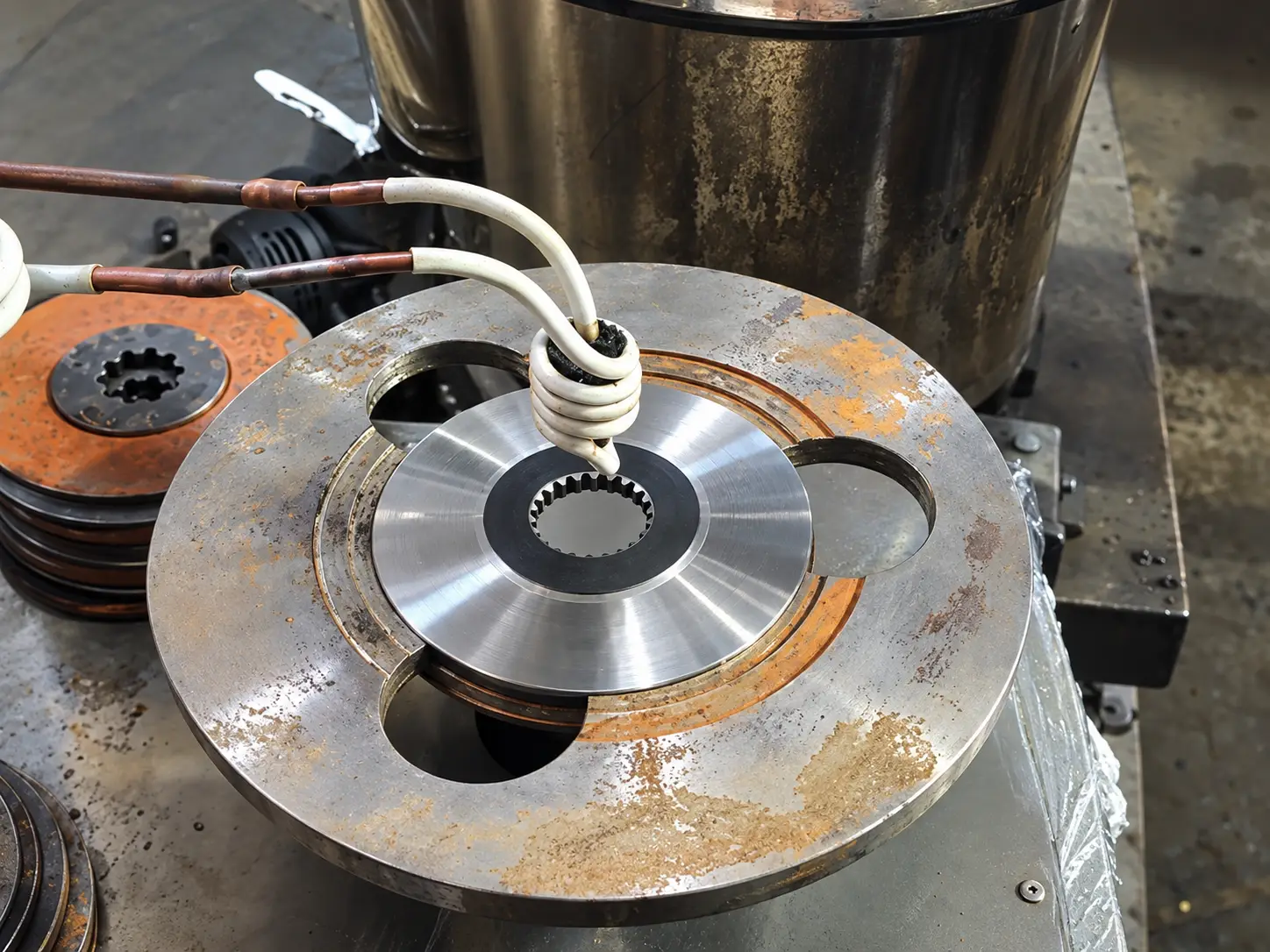
The video shows a circular metal component with internal spline teeth machined into its central bore. A compact induction coil is positioned near the splined opening, directing heat toward the internal tooth region.
Trong quá trình nung nóng, the spline area becomes visibly red-hot while much of the surrounding component remains comparatively dark.
The demonstration highlights the use of a compact inductor for localized heating inside a toothed bore.
Chi tiết ứng dụng
| Mục | Sự miêu tả |
|---|---|
| Gia công | Circular metal component with internal spline teeth |
| Khu điều trị | Internal spline bore |
| Quy trình | Tôi cứng bằng cảm ứng |
| Phương pháp sưởi ấm | Localized induction heating |
| Cuộn cảm | Compact bore-type induction coil |
| Hardening Objective | Specified hardness distribution across the required internal spline surfaces |
The video identifies the process as induction hardening and describes consistent hardness across the spline teeth as a process objective. The visible footage shows the heating stage; the subsequent quenching method and final hardness results have not been verified.
Ⅱ. Suitable Workpieces and Industrial Applications
Internal splines provide a mechanical connection between mating components for torque transmission. Their tooth surfaces may experience contact pressure, repeated loading and relative movement during operation.
For suitable hardenable steels, induction hardening can be used to treat selected spline surfaces without requiring the entire component to undergo the same hardening cycle.
Phôi điển hình
— Internally splined hubs.
— Splined sleeves and couplings.
— Transmission components with internal splines.
— Drivetrain components with splined connections.
— Custom mechanical parts requiring localized spline hardening.
Relevant Industries
Automotive and Drivetrain Manufacturing
Selected transmission and constant-velocity joint components contain internal splines. Induction hardening may be used where their design specifies localized hardened tooth surfaces.
Power Transmission Equipment
Splined hubs, couplings and related components transfer torque between connected shafts and assemblies. Surface hardening may be required according to their loading and wear conditions.
Construction and Heavy Machinery
Heavy-duty transmission components may incorporate internal splines. The required treatment depends on the steel grade, tooth geometry and operating conditions.
General Machinery Manufacturing
Custom splined sleeves, hubs and mechanical connections can also be evaluated for localized induction hardening.
The specific end use of the workpiece shown in the video has not been confirmed. These industries represent potential applications rather than verified uses of the demonstrated component.
Ⅲ. Customized Inductor Design for Internal Spline Hardening
Thiết kế cuộn cảm is a central consideration when heating internal spline teeth.
The tooth profile creates different electromagnetic coupling conditions at the tips, flanks and roots. A suitable inductor must work within the available bore space while producing a heating pattern appropriate to the specified hardened region.
Bore Geometry and Coil Clearance
The induction coil must be matched to the internal spline diameter, axial length, tooth profile and surrounding workpiece geometry.
Limited space inside the bore also affects coil construction, electrical connections and cooling arrangements.
Heating Distribution Across the Teeth
The required hardening pattern may cover the tooth flanks, rễ cây, tips or a specified combination of these surfaces.
Heating conditions are influenced by coil geometry, tần số vận hành, power and heating duration. These parameters must be evaluated together rather than selected independently.
A visibly heated spline does not establish that every part of the tooth profile has reached the required hardening condition.
Workpiece Fixtures and Positioning
The fixture supports and locates the workpiece relative to the inductor.
The mechanical arrangement must provide suitable access to the bore and maintain the required position during processing. Different spline sizes or profiles may require separate inductors and tooling.
Ⅳ. Heating Methods and Quenching Arrangement
The appropriate hardening method depends on spline length, required treatment area, material and production conditions.
Stationary Induction Heating
In a stationary arrangement, the workpiece and inductor remain at a defined relative position during heating.
This method may be suitable for a relatively short treatment region when the coil can produce the required heating pattern.
Scanning Induction Hardening
For longer spline bores or a defined axial treatment length, relative movement between the workpiece and inductor may be required.
The heating power, scanning speed and quenching sequence must be coordinated to obtain the specified hardened region.
The demonstrated video does not establish whether a complete stationary or scanning hardening sequence was used.
Quenching the Internal Spline Surfaces
For suitable hardenable steels, the required surface region must reach the appropriate austenitizing condition before controlled quenching produces the intended hardened structure.
Internal tooth geometry affects how the quenchant reaches the heated surfaces. The cooling arrangement must therefore account for the tooth profile, bore access, required hardened depth and dimensional requirements.
Depending on the selected process, the system may use an integrated heating and quenching inductor assembly or a separate quenching arrangement.
The final hardness profile depends on the combined heating and quenching conditions, not on the induction power supply alone.
Ⅴ. Induction Hardening Equipment and Control Configuration
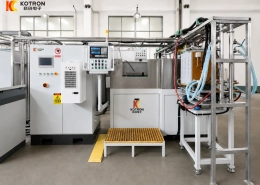
KOTRON supplies induction hardening equipment solutions that combine the heating system, customized tooling, quenching equipment and necessary control functions.
The equipment scope is selected according to the workpiece, hardening specification and production requirements.
| System Component | Cân nhắc về cấu hình |
|---|---|
| Nguồn Điện Cảm Ứng | Power and frequency selected for the workpiece and heating requirements |
| Internal Bore Inductor | Customized to the spline profile, bore dimensions and treatment area |
| Vật cố định phôi | Ủng hộ, locating and clamping arrangement |
| Hệ thống làm nguội | Quenchant delivery and cooling conditions matched to the process |
| Motion System | Stationary positioning or scanning movement where required |
| CNC / PLC Control | Coordination of heating, movement and quenching operations |
| Equipment Cooling | Cooling arrangement matched to the electrical equipment and inductor |
| Production Automation | Đang tải, unloading and handling according to production needs |
Induction Power Supply and Digital Control
The power supply must be electrically matched to the selected inductor and provide the required heating output.
KOTRON’s available equipment includes DSP-controlled induction power supplies. According to the selected configuration, digital control supports regulation of heating parameters such as power, current and operating time.
For applications requiring production records, optional monitoring functions may include operating-parameter display, đường cong quá trình, parameter-limit alarms and historical records.
These functions assist process supervision but do not directly establish the finished workpiece’s hardness or effective case depth.
Reference Induction Power Supply Models
Several induction power supply models are available for evaluating internal spline hardening applications. The appropriate selection depends on the spline geometry, vật liệu, diện tích gia cố cần thiết, case depth and production cycle.
The following models provide reference configurations for initial equipment selection.
| Người mẫu | Công suất | Dải Tần Số | Potential Application |
|---|---|---|---|
| XG-80 | 80 kW | 20–40 kHz | Smaller internal spline components |
| XZG-160SCZ | 160 kW | 1–50 kHz | Medium-sized internal spline applications |
| ZG-200SCN | 200 kW | 5–20 kHz | Larger internal spline and internal-tooth components |
| XZG-250SCN | 250 kW | 5–20 kHz | Larger workpieces with higher heating power requirements |
These configurations are provided as selection references rather than fixed recommendations for particular spline sizes.
The required power and frequency must be evaluated together with the inductor design, heating conditions and quenching process. A higher power rating does not automatically provide greater case depth or a more uniform hardened profile.
The power supply used in the video demonstration has not been identified as one of these models.
Specialized Power Supply Options
For certain tooth profiles, simultaneous dual-frequency heating may be evaluated to influence heating distribution across the tooth geometry.
Its suitability for internal splines depends on the workpiece, inductor and required hardening pattern. The demonstrated video does not establish the use of dual-frequency technology.
Where hardening and tempering are required in a coordinated production process, suitable multi-station and multi-frequency arrangements may also be evaluated.
Machine Movement and Automation
The mechanical arrangement may range from a manually loaded heating station to an integrated hardening system with controlled movement and automated handling.
Possible project-specific functions include programmable positioning, quét, tự động tải và dỡ hàng, and coordinated heating and quenching control.
The required configuration depends on component size, tốc độ sản xuất, changeover requirements and existing production facilities.
Ⅵ. Selecting the Right Equipment for Internal Spline Teeth
Equipment selection begins with the internal spline geometry and the required hardening result.
The bore diameter alone is not sufficient to determine the induction power, frequency or coil design.
| Yếu tố lựa chọn | Xem xét kỹ thuật |
|---|---|
| Material and Steel Grade | Hardenability and required heat-treatment cycle |
| Bore Diameter | Available space and inductor clearance |
| Spline Tooth Profile | Heating distribution across tooth tips, flanks and roots |
| Spline Length | Heating coverage and possible scanning requirements |
| Required Hardened Area | Position and extent of the treatment |
| Target Surface Hardness | Required properties of the treated surface |
| Độ sâu trường hợp hiệu quả | Heating and quenching process requirements |
| Yêu cầu sản xuất | Equipment layout, processing sequence and automation |
Hardness and Case-Depth Verification
For components requiring a defined hardness profile, the process should be established through suitable trials and inspection.
Depending on the specification, verification may include surface hardness measurements, hardness traverses and examination of the hardened layer.
Inspection positions should reflect the required functional surfaces of the spline, including the tooth flanks and roots where specified.
Results established for another gear, spline or internal bore cannot automatically be applied to a new workpiece.
For internal splines and other internal bores, KOTRON also offers a dedicated máy làm cứng cảm ứng lỗ khoan bên trong for automotive and motorcycle precision components. Externally splined shafts can be treated with the spline shaft induction hardening machine.
Ⅶ. Câu hỏi thường gặp
Bấm vào một câu hỏi để mở rộng câu trả lời.
Can induction hardening treat both the tooth flanks and roots of an internal spline?
A customized process can be developed for a specified hardening pattern that includes these regions. The achievable result depends on tooth geometry, vật liệu, heating conditions and quenching. Hardness distribution should be verified against the workpiece specification.
Does every internal spline require a specially designed induction coil?
The inductor must match the bore dimensions, required hardened area and available clearance. Different workpieces may share an inductor where their geometries and process requirements are compatible, but tooling suitability must be evaluated.
Is dual-frequency induction heating necessary?
KHÔNG. Single-frequency heating may be suitable for an internal spline application. Dual-frequency technology is an additional option for selected tooth profiles and hardening requirements.
Can the system process different spline components?
Different parts may be processed within the designed mechanical and electrical range of the equipment. Changes in spline size or tooth profile may require different inductors, đồ đạc hoặc cài đặt quy trình.
Can the equipment be supplied with automatic handling and quenching?
Có. The equipment scope can include suitable quenching systems, programmable movement, process control and automated workpiece handling. These are configured according to the production application.
Ⅷ. Request a Customized Internal Spline Hardening Solution
For internal spline induction hardening, the most useful starting point is the workpiece drawing and the required treatment area.
Xin vui lòng gửi cho chúng tôi:
— Bản vẽ phôi hoặc hình ảnh.
— Vật liệu hoặc lớp thép.
— Spline bore diameter and length.
— Spline tooth profile or dimensions.
— Khu vực đông cứng cần thiết.
— Số lượng sản xuất hoặc yêu cầu chu kỳ.
If already defined, vui lòng bao gồm độ cứng bề mặt mục tiêu và độ sâu trường hợp hiệu quả.
Dựa trên những chi tiết này, KOTRON có thể đánh giá nguồn điện cảm ứng, customized bore inductor, đồ gá chi tiết gia công, quenching arrangement and required machine control or automation.
Need induction hardening for internal spline teeth?
Send your workpiece drawing and KOTRON will evaluate a customized internal spline induction hardening solution.