Máquina automática de montagem retrátil por indução da carcaça do motor para montagem do estator
Ⅰ. Automatic Motor Housing Shrink Fitting Machines in Operation
Vídeo 1 — Linear Automatic Motor Housing and Stator Assembly Line
Vídeo 2 — Four-Station Rotary Motor Housing Shrink Fitting Machine
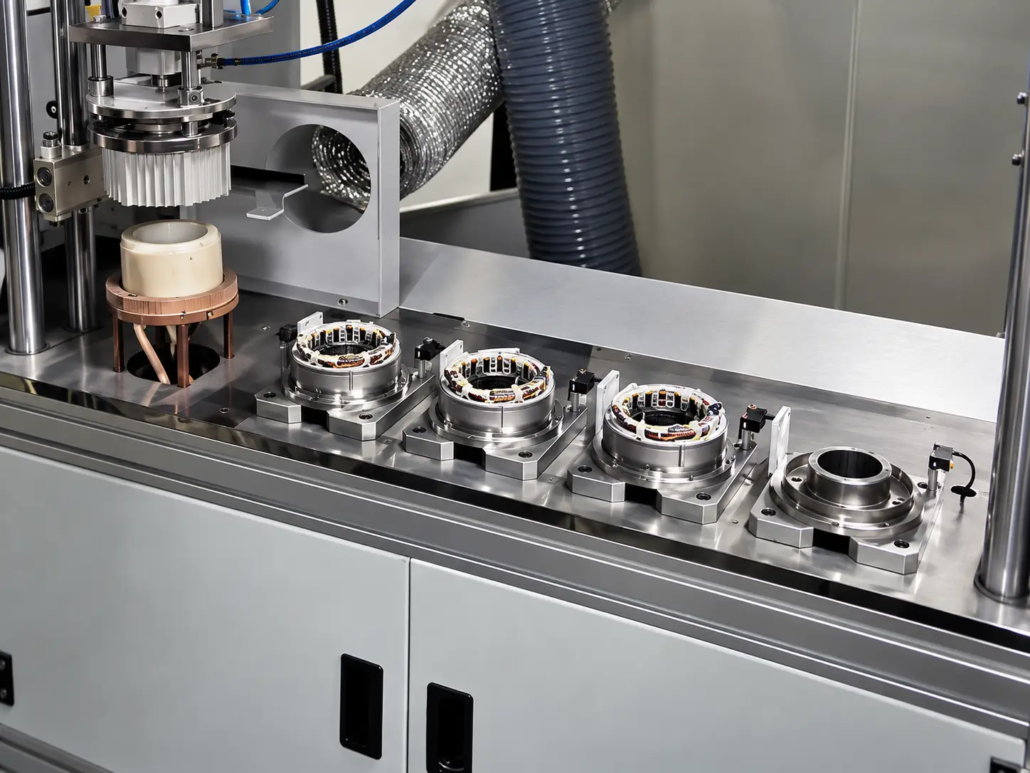
These two configurations demonstrate how induction heating and automated stator insertion can be integrated into motor assembly production.
The linear system arranges processing stations along a production path, while the rotary system uses a four-station indexing table to transfer workpieces between defined positions.
Both configurations can be adapted to the actual motor components, assembly sequence, e os requisitos de produção.
Ⅱ. Assembly Challenges in Motor Stator-to-Housing Shrink Fitting
Motor stators are commonly secured inside their housings through an interference fit. During assembly, sufficient clearance must be available to insert the stator without excessive mechanical resistance or damage.
Several conditions need to be considered:
•Assembly clearance: The housing must expand sufficiently to accommodate the stator during insertion.
•Heating conditions: The housing must reach the required thermal condition without exceeding applicable material or component temperature limits.
•Stator alignment: The stator and housing must remain correctly positioned during insertion.
•Insertion force: Mechanical loading should be monitored to help identify abnormal resistance.
•Dimensional variation: Housing bore tolerances, stator outside diameter, e specified interference affect the required heating and assembly conditions.
Insufficient clearance or incorrect alignment can increase insertion resistance and may damage the housing or stator.
An automatic shrink fitting system coordinates housing heating, posicionamento da peça, and stator insertion to support a controlled assembly process.
Ⅲ. Induction Heating of Aluminum and Cast Iron Motor Housings
Vídeo 3 — Standalone Motor Housing Induction Heating Process
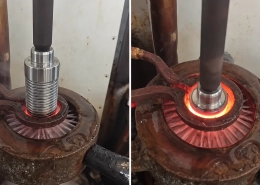
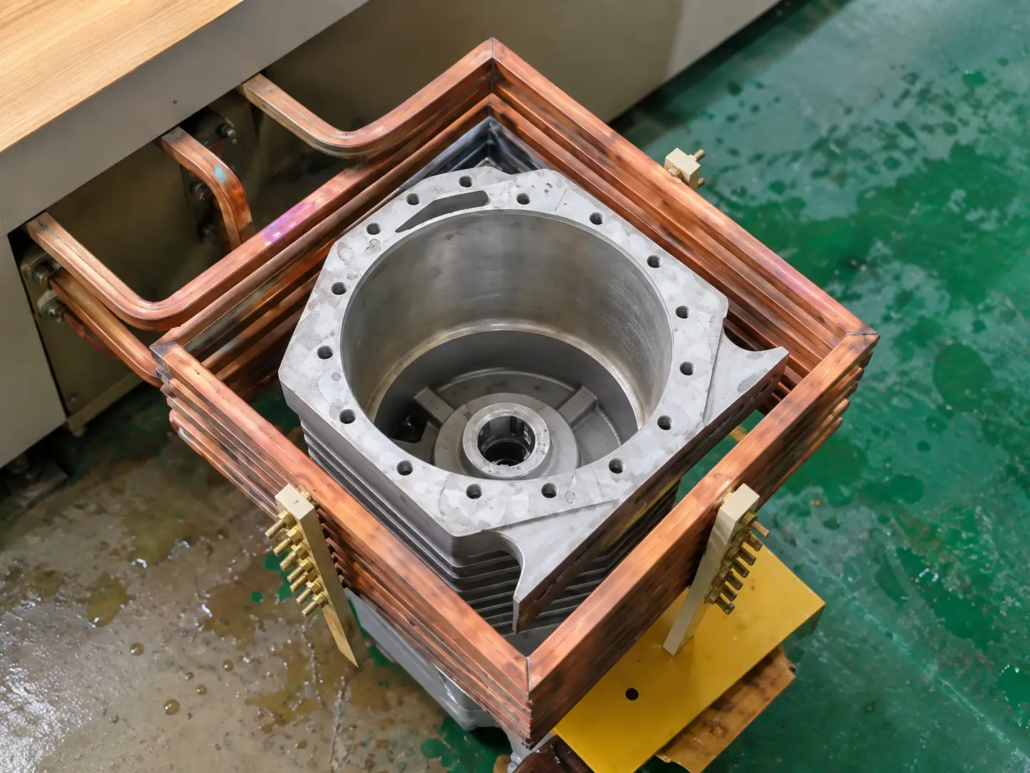
Induction heating expands the motor housing bore to provide the clearance needed for stator insertion. The required heating condition depends on the housing material, diâmetro do furo, interferência, initial component temperature, and assembly timing.
Aluminum Motor Housings
Aluminum has a relatively high coefficient of thermal expansion, which can be advantageous for thermal interference-fit assembly.
No entanto, its propriedades elétricas e térmicas must be considered when selecting the induction heating arrangement. Projeto de indutor, frequência de operação, potência, tempo de aquecimento, and temperature feedback are configured according to the housing geometry and material.
Cast Iron Motor Housings
Cast iron motor housings can also be heated for shrink fitting, but their electromagnetic, thermal, and mechanical characteristics differ from those of aluminum.
Heating parameters and tooling must therefore be evaluated for the actual housing rather than assuming that one configuration is suitable for both materials without adjustment.
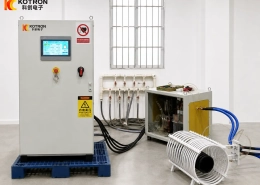
The induction heating unit can also be supplied as a standalone solution when automatic stator insertion is not required.
Ⅳ. Automatic Stator Insertion, Temperature Feedback and Force Monitoring
The automatic assembly process coordinates induction heating and stator insertion so that the required assembly clearance is available when the stator enters the housing.
①Motor Housing Positioning
The housing is located in a fixture designed for its geometry, dimensões, and assembly orientation.
②Induction Heating and Temperature Feedback
The housing is heated according to the established process settings. feedback de temperatura is used to monitor the heating condition and support the configured temperature-control process.
The measurement arrangement and control method depend on the equipment configuration and workpiece requirements.
③Automatic Stator Insertion
The stator is aligned with the heated housing and inserted using the automatic assembly mechanism.
Insertion tooling, movimento, and positioning are configured according to the stator geometry, housing bore, and required assembly depth.
④Insertion Force Monitoring
The system monitors insertion force during assembly, providing information about mechanical loading and helping identify abnormal resistance.
Force monitoring supports process observation but does not replace dimensional inspection or other required assembly quality checks.
⑤Cooling and Interference Fit Formation
After insertion, the housing cools and contracts around the stator, forming the specified interference fit.
The final assembly condition depends on component dimensions, propriedades do material, temperature conditions, and the specified interference.
Ⅴ. Linear and Four-Station Rotary Assembly Configurations
KOTRON offers two automatic equipment arrangements for motor housing shrink fitting applications.
Linear Automatic Motor Housing Assembly Line
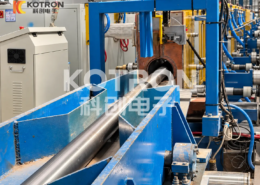
The linear configuration arranges processing and assembly stations along a production path.
Dependendo da aplicação, the line can coordinate housing handling, aquecimento por indução, stator positioning, and insertion. Its layout can be developed around the required process sequence and integration with other production operations.
Four-Station Rotary Motor Housing Shrink Fitting Machine
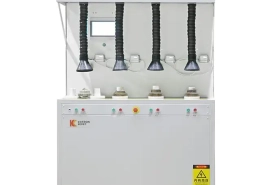
The rotary configuration uses a four-station indexing table to move workpieces between defined processing positions.
Heating and assembly operations are arranged around the rotary platform. The functions assigned to individual stations depend on the equipment design and workpiece requirements.
Selecting the Appropriate Configuration
| Consideração | Linear Assembly Line | Four-Station Rotary Machine |
|---|---|---|
| Layout | Stations along a production path | Stations around an indexing table |
| Movimento da peça | Linear transfer between stations | Indexed rotary movement |
| Production integration | Can be arranged around upstream and downstream operations | Multiple operations arranged around a rotary platform |
| Tooling arrangement | Based on the required station sequence | Based on station positions and indexing requirements |
| Selection factors | Workpiece handling, process sequence, space, and production needs | Workpiece handling, process sequence, space, and production needs |
The appropriate layout depends on the required operations, housing and stator dimensions, manuseio de materiais, espaço disponível, and target production capacity.
Actual cycle time must be evaluated for the specific assembly process rather than assumed from the machine layout alone.
Ⅵ. Applicable Motor Housings and Equipment Configuration
The motor housing shrink fitting machine is designed for applications where controlled housing expansion provides the clearance required for stator insertion.
As aplicações típicas incluem:
•Aluminum motor housing and stator assembly
•Cast iron motor housing and stator assembly
•Water pump motor housing assembly
•Motor housings with different bore diameters and structural designs
•Suitable bare stator cores and wound stator assemblies
Equipment configuration depends on the actual motor components and their assembly requirements.
Relevant factors include housing geometry, stator dimensions, interferência, insertion direction, propriedades do material, and permissible temperature exposure.
For wound stator assemblies, the process must account for the thermal limits of winding insulation and other temperature-sensitive components.
Different workpieces may require dedicated inductors, suportes, insertion tooling, or heating programs. Compatibility should be confirmed through engineering evaluation.
Ⅶ. Information Required for Motor Housing Shrink Fitting Machine Selection
To determine a suitable motor housing shrink fitting machine configuration, please provide the following information where available.
Motor Housing Details
•Housing drawing or photographs
•Material: alumínio, ferro fundido, or other specified material
•Diâmetro do furo, dimensões gerais, and wall thickness
•Relevant dimensional tolerances
Stator Details
•Stator drawing and outside diameter
•Stator length and dimensional tolerances
•Bare stator core or wound stator assembly
•Temperature-sensitive components or insulation requirements
Assembly Requirements
•Specified interference between housing and stator
•Required insertion depth and assembly orientation
•Alignment and positioning requirements
•Applicable temperature limits
•Assembly force requirements, se especificado
•Required inspection and process monitoring
Requisitos de produção
•Target production capacity or cycle time
•Requisitos de carga e descarga
•Preferred linear or rotary arrangement, se houver
•Integration with existing production equipment
•Available installation space
•Required automation functions
These details help determine the induction heating arrangement, insertion mechanism, ferramentas, process-control functions, and suitable machine layout.
For broader industrial interference-fit applications, consulte o nosso Linha Automática de Encaixe por Indução.
Ⅷ. Perguntas frequentes
Clique em uma pergunta para expandir a resposta.
Can one machine handle both aluminum and cast iron motor housings?
A machine can be configured for both materials when the induction heating arrangement, ferramentas, and process settings are suitable for the intended components. Because aluminum and cast iron have different material properties, their heating and assembly conditions must be evaluated separately.
Why is the motor housing heated before stator insertion?
Heating expands the housing bore, creating additional clearance for insertion. This helps reduce assembly resistance and supports insertion without excessive mechanical loading. The required temperature depends on the housing material, dimensões, specified interference, and assembly conditions.
What is the difference between linear and rotary shrink fitting machines?
A linear machine arranges processing stations along a production path. A four-station rotary machine transfers workpieces between defined positions using an indexing table. The suitable configuration depends on the assembly sequence, handling requirements, installation space, and production objectives.
IX.. Request a Motor Housing Shrink Fitting Solution
KOTRON provides induction heating and automatic assembly equipment for motor housing shrink fitting applications.
Share your motor housing and stator drawings, material information, interference requirements, e os objetivos de produção. Our team can help evaluate a suitable induction heating arrangement, insertion tooling, retroalimentação de temperatura, force monitoring, and automatic assembly configuration.