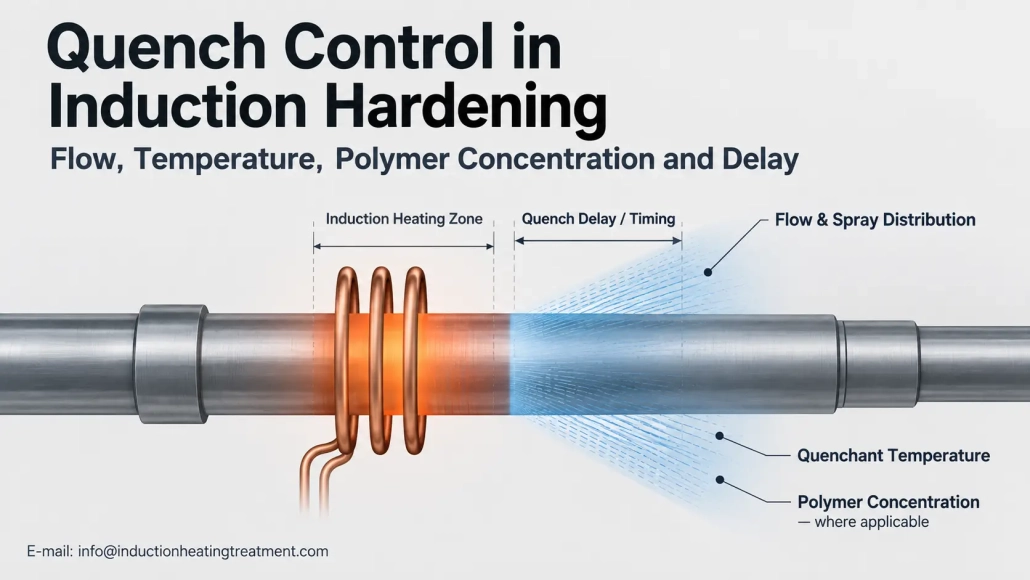
유도 경화의 담금질 제어: 유량, 온도, 폴리머 농도 및 지연
How Spray Conditions and Quenchant Control Affect Quench Severity and Process Repeatability
A repeatable induction heating cycle does not guarantee a repeatable hardened result if the quench condition changes.
유도 경화에서, spray delivery, quenchant temperature, polymer concentration where applicable, and the timing between heating and quenching all form part of the process recipe.
2. Quench Flow, Pressure and Spray Distribution
3. Why Quenchant Temperature Matters
4. How Polymer Concentration Changes Quench Behavior
5. Why Quench Delay and Timing Must Be Controlled
6. How to Establish and Monitor a Quench Process Window
1. Why Quench Control Matters After Induction Heating
유도 가열 creates the austenitized region that is intended to harden. The following quench determines how that heated region cools through the transformation range.
이 이유로, induction quenching should be treated as a controlled process rather than simply a spray that turns on after heating.
Liquid-quench arrangements used with induction hardening include open spray, flood, immersion and submerged spray systems. Spray quenching is particularly relevant to localized induction hardening because the quenchant can be directed toward the heated zone.
A useful concept here is quench severity. 실질적으로, it describes how strongly a particular quench condition removes heat from the workpiece. It is influenced by more than the name of the quenchant alone; fluid movement, temperature and application method also matter.
The objective is not simply to maximize cooling. The required quench condition must be appropriate for the steel, heated pattern, part geometry and final heat-treatment requirement.
2. Quench Flow, Pressure and Spray Distribution
A flow-meter reading is useful, but it does not fully describe the cooling condition at the workpiece surface.
In spray quenching, cooling is also influenced by how the liquid reaches the hot surface. Relevant factors can include:
•유량
•Spray pressure
•Nozzle or orifice arrangement
•Quench-ring design
•Spray coverage
•Impingement direction
•Distance between the spray device and the workpiece
•Blocked or worn openings
•Workpiece shape and movement
ASM describes spray-quenching performance in terms of spray characteristics such as droplet velocity and volumetric flux, illustrating why pump flow alone is not a complete description of heat removal at the surface.
The same principle appears in induction-specific testing. A 2024 study compared two quench-ring designs while using the same PAG solution flow rate and found different cooling behavior between the two ring designs.
So a stable total flow does not necessarily prove that every part is receiving the same local quench condition.
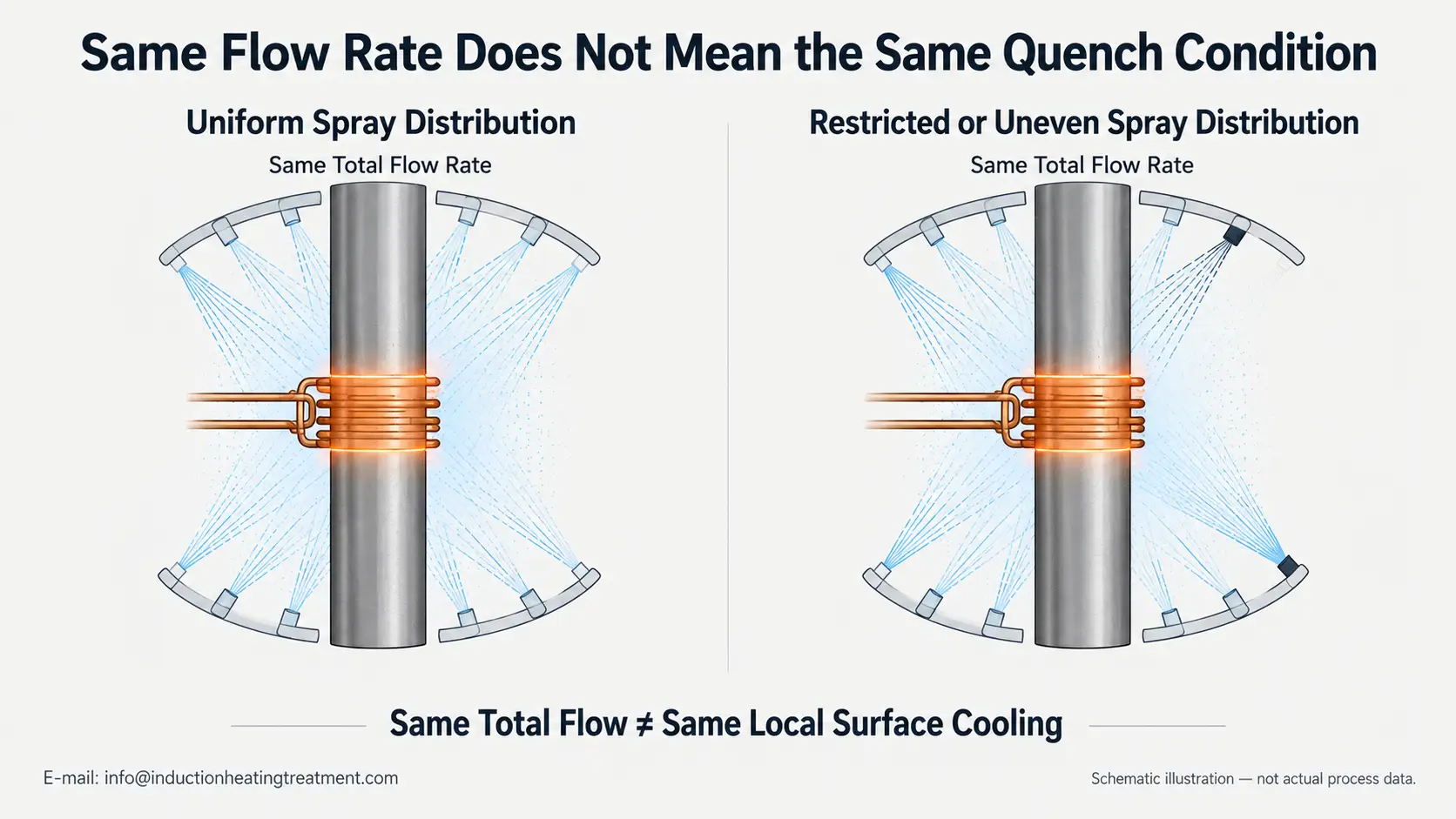
The same total flow can produce different local cooling conditions when the spray distribution changes.
For production control, flow or pressure readings should therefore be considered together with the condition and position of the spray head or quench ring.
3. Why Quenchant Temperature Matters
The bulk temperature of the quenchant affects its heat-transfer behavior.
This can become important during continuous production. Each heated workpiece transfers energy into the quench system, and the bath or circulation loop can gradually become warmer if the cooling system does not remove that heat at the required rate.
Polymer quenchants are particularly sensitive to changes in bulk temperature. Industry guidance notes that their heat-extraction rate generally decreases as bulk quenchant temperature increases.
That does not mean that the coldest possible quenchant is automatically the correct condition.
The appropriate temperature range should be established for the actual quenchant and hardening process. What matters in production is keeping the bulk temperature within the range that was validated during process development.
Useful checks may include:
•Quench-tank temperature
•Return-fluid temperature where relevant
•Heat-exchanger or chiller condition
•Tank level and circulation
•Temperature drift during extended production
If results change only after the system has been operating for some time, comparing quenchant temperature with earlier stable production can be useful.
4. How Polymer Concentration Changes Quench Behavior
Polymer concentration is relevant only where an aqueous polymer quenchant is used. It is not a universal control variable for plain-water quenching.
PAG and other polymer quenchants are used in induction hardening because their cooling characteristics can be adjusted through solution condition. Polymer formulation, 집중, temperature and fluid motion all affect quenching performance.
For a particular quenchant, a change in concentration can change quench severity. The required concentration therefore belongs to the validated process rather than being treated as a universal value for induction hardening.
Actual concentration can drift
Bath condition can change through factors such as:
•Water evaporation
•Replenishment practices
•Quenchant losses through drag-out
•Incorrect additions
•Contamination by other process fluids
Evaporation is especially important because loss of water can increase the polymer concentration if it is not corrected.
Refractometer readings also need interpretation
Handheld refractometers are commonly used to monitor polymer solutions. The instrument reports a refractive reading, often in °Brix, which is then converted using the factor specified for the particular quenchant.
A Brix reading should therefore not automatically be treated as the actual polymer percentage.
Hard water, dissolved process fluids and other contaminants can also affect the relationship between the refractometer reading and the true bath condition. Where accuracy is important, the measurement method and conversion factor should follow the quenchant supplier’s recommendations.
이것은 중요한 구분입니다:
Polymer concentration control and refractometer control are related, but they are not exactly the same thing.
5. Why Quench Delay and Timing Must Be Controlled
The interval between effective induction heating and effective quenching is another process variable.
It is commonly described as quench delay 또는 퀜칭 타이밍.
The way that delay is created depends on the hardening method.
Fixed-position or 단발 경화
The delay may be mainly controlled by the time between the end of induction heating and the start of quenchant delivery.
스캔 경화
The effective timing can depend on the spacing between the heating zone and quench zone together with the relative travel speed.
During this interval, heat continues to redistribute inside the workpiece. A change in quench timing can therefore change the temperature distribution present when rapid cooling starts.
Industry troubleshooting literature also treats the time or distance between heating and quenching as a meaningful induction-hardening variable.
The shortest possible delay is not automatically the correct one. Some processes intentionally use a defined delay.
The important requirement is that the selected timing is appropriate for the application and remains repeatable.
Effective quench timing can change through:
•Valve response
•Control timing
•Scan speed
•Spray-head position
•Heating-to-quench spacing
•Mechanical positioning or motion
This is why timing should be treated as part of the process recipe where it materially affects the hardening result.
6. How to Establish and Monitor a Quench Process Window
유량, 온도, polymer concentration and timing should not be assigned independently.
예를 들어, a polymer solution at a different bulk temperature may not have the same cooling behavior even when its measured concentration is unchanged. 마찬가지로, the same total flow delivered through a different quench-ring geometry can produce a different surface-cooling condition.
A practical quench process window should therefore be established from the complete system rather than from one isolated setting.
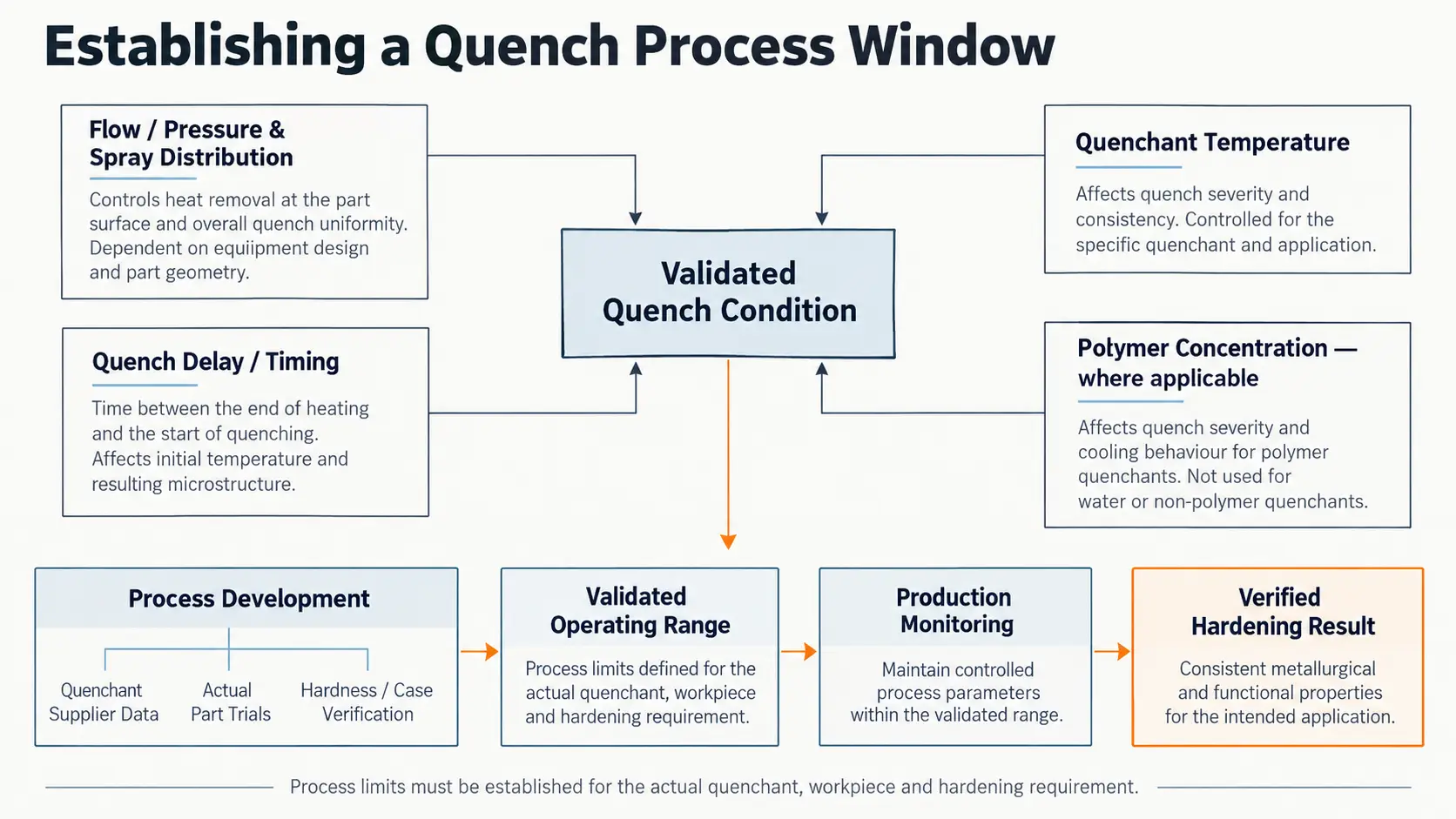
A quench process window links quenchant, 유량, 온도, concentration and timing to a verified hardening result.
The starting point normally includes:
Quenchant supplier information
Use the specified method for concentration measurement, operating temperature and bath maintenance where a commercial polymer quenchant is involved.
Actual part trials
The spray configuration, 유량, 압력, 온도, concentration and timing need to be evaluated on the real workpiece because geometry and heated pattern influence the required cooling condition.
Verified hardened results
The acceptable process window should be linked to results such as 경도, 경도 프로필, 유효 케이스 깊이 and any relevant dimensional or metallurgical requirements.
Once the process has been validated, production monitoring should focus on the variables that were shown to matter:
| Process variable | Production check |
|---|---|
| Quenchant | Correct medium and formulation |
| 유량 | Within the validated operating range |
| 압력 | Spray delivery where pressure is a controlled parameter |
| 분무 패턴 | Coverage and condition of nozzles or quench-ring openings |
| Bulk temperature | Within the established process range |
| Polymer concentration | Supplier-specified measurement method, 해당되는 경우 |
| Quench timing | Heating-to-quench relationship remains repeatable |
| Filtration | Condition sufficient to protect spray openings |
| Tank / circulation system | Stable level and fluid delivery |
| Heat exchanger / 냉각 시스템 | Able to maintain the validated bath condition |
The important point is not to record the largest possible number of parameters. It is to maintain the same validated quench condition that was used when the hardening process was qualified.
If a production part later develops soft spots or uneven hardness, quench records can then be compared with the established baseline. A broader investigation should also consider material, 가열 패턴, 코일 위치, workpiece movement and other possible causes rather than assuming that the quench system is responsible.
For that wider troubleshooting problem, the existing 유도 경화 후 경도 불균일: 연점 발생 원인과 예방 방법 article should remain the main reference rather than repeating the full diagnostic sequence here.
핵심 내용
Repeatable induction hardening requires more than repeatable heating. Flow and spray distribution, quenchant temperature, polymer concentration where applicable, and quench timing need to remain within a validated process window so that the workpiece receives a repeatable cooling condition.
자주 묻는 질문
답변을 펼치려면 질문을 클릭하세요..
Does a stable total flow guarantee a repeatable quench?
아니요. Spray distribution, nozzle or quench-ring condition, spray-head position and workpiece movement all affect local cooling even when the total flow is unchanged.
Is colder quenchant always better?
아니요. The operating temperature range should be established during process development and kept within that validated range in production. Polymer quenchants in particular extract heat less strongly as bulk temperature rises, but the coldest possible quenchant is not automatically the correct condition.
Is a refractometer reading the same as polymer concentration?
Not exactly. A refractometer reports a refractive reading, often in °Brix, which must be converted using the factor for the specific quenchant. Hard water and contaminants can also shift the relationship, so the measurement method should follow the supplier’s recommendations.
Should quench delay always be as short as possible?
아니요. Some processes intentionally use a defined delay. The requirement is that the selected timing is appropriate for the application and remains repeatable, not that it is minimal.
Validate Your Quench Process Window
Send your quenchant, spray configuration and hardening requirement — we can help establish and hold a repeatable quench process window.