흑연주형용 유도가열 시스템
Ⅰ. Graphite Mold Induction Heating in Operation
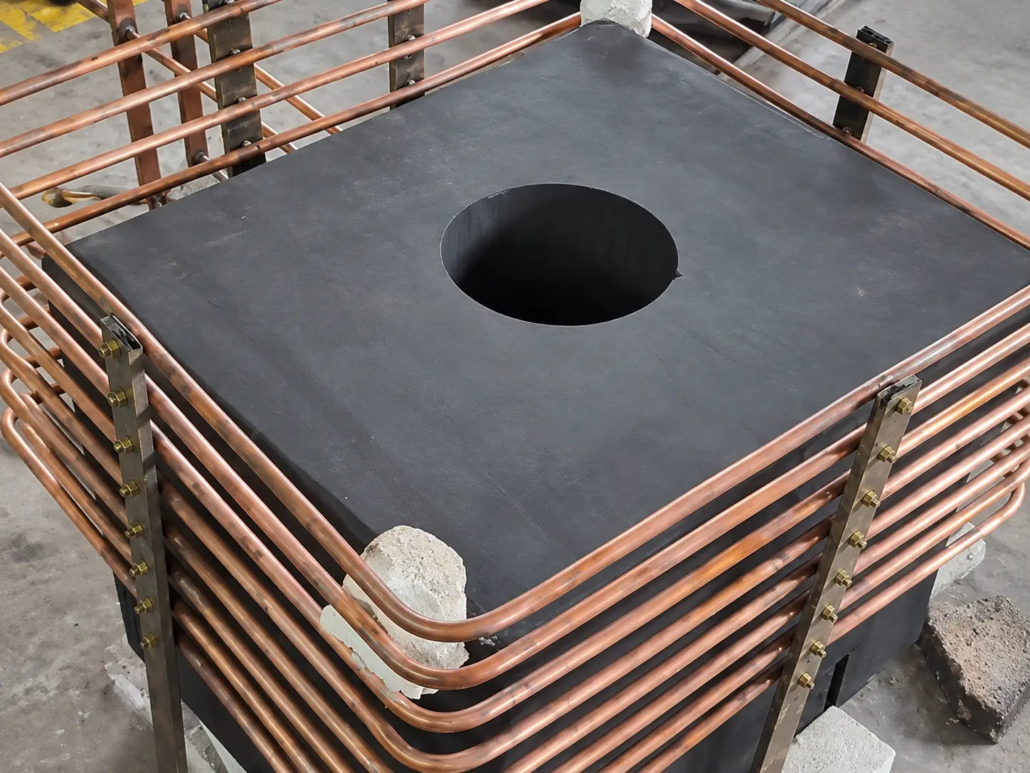
Medium-frequency induction heating of a square graphite mold using a multi-turn rectangular copper coil
The video shows a square graphite mold with a circular opening at its center. A multi-turn copper induction coil surrounds the outer perimeter, following the mold’s rectangular outline.
The coil is positioned outside the mold, leaving the central opening unobstructed. This arrangement allows the graphite body to be heated inductively without placing a heating element inside the opening.
Demonstrated Heating Arrangement
| 목 | 설명 |
|---|---|
| 워크피스 | Square graphite mold with a central circular opening |
| 가열방식 | Medium-frequency induction heating |
| 인덕터 | Multi-turn rectangular copper coil |
| Coil Position | Surrounding the mold’s outer perimeter |
| Heating Arrangement | Direct induction heating of conductive graphite |
Application Note: The video demonstrates the mold and induction coil arrangement. The mold’s specific manufacturing application, 치수, graphite grade, operating parameters and measured heating results have not been provided.
Ⅱ. Why Use Induction Heating for Graphite Molds?
Graphite is electrically conductive, allowing an alternating magnetic field to induce currents within the material. The graphite’s electrical resistance converts this energy into heat.
This makes 유도 가열 an option when the graphite mold itself needs to be heated, particularly where a surrounding coil arrangement is practical.
인덕션 가열 대. External Resistance Heating
| 고려 사항 | 유도 가열 | External Resistance Heating |
|---|---|---|
| Heat Generation | Induced electrical currents generate heat within the graphite | Heating elements generate heat that transfers to the mold |
| Heating Arrangement | A coil can surround the mold without direct contact | Heating elements transfer heat through radiation and other heat-transfer mechanisms |
| Temperature Distribution | Influenced by electromagnetic coupling, graphite properties and thermal conduction | Influenced by heater placement, thermal insulation and heat transfer |
| Main Equipment Requirements | 유도 전원, matched coil and cooling | Heating elements, insulation and suitable temperature controls |
Direct induction heating can be useful where the mold geometry allows suitable coil access and the process benefits from heating the graphite itself.
그러나, induction does not automatically provide faster heating or a more uniform temperature than 저항 가열. Actual performance depends on the mold, equipment design and operating conditions.
Flame, infrared and other external heating methods have different requirements and must be evaluated separately.
Graphite Mold Applications
Graphite molds and tooling are used in industrial processes including hot pressing, sintering, glass forming and certain casting operations.
Induction heating is used in some of these applications to heat graphite molds or tooling directly.
예를 들어, a mold used for hot pressing may require heating while installed in other processing equipment, whereas a mold requiring preheating before a separate operation presents different equipment requirements.
The suitable heating arrangement depends on the mold geometry, operating temperature, surrounding equipment and process environment.
Ⅲ. Custom Coil Design and Heating Equipment
The induction 코일 and power supply must be selected together to obtain suitable heating conditions for the graphite mold.
The rectangular coil shown in the video is one arrangement. Other mold dimensions, internal openings and heating requirements may call for different coil geometries.
Coil Geometry and Graphite Properties
The electrical resistivity of graphite varies with its grade and material characteristics, influencing electromagnetic coupling and the distribution of induced currents.
Mold shape also matters. Corners, 벽 두께, cavities and internal openings affect current distribution and subsequent heat flow.
For the demonstrated square mold, the central opening is particularly relevant if the inner surfaces must reach a specified temperature.
Positioning a rectangular coil around the outer perimeter does not automatically produce the same temperature at the mold’s corners, outer surfaces and central opening.
The coil and heating process are evaluated using:
— Mold dimensions, wall thickness and internal openings
— Graphite grade and electrical properties
— Required heating area and target temperature
— 코일 모양, number of turns and clearance
— Heating time and operating conditions
Power Supply and Frequency Selection
The demonstrated application uses medium-frequency induction heating equipment, as identified in the video.
Power and operating frequency are considered together with mold dimensions, graphite resistivity, coil geometry and the required heating cycle.
Frequency influences induced-current distribution, while coil position and clearance affect coupling between the inductor and graphite.
The electrical characteristics of the coil and workpiece must also be compatible with the selected power supply.
Our available induction heating equipment includes digitally controlled power supply options, with heating settings selected for the application.
Coil Cooling and Thermal Protection
The coil is exposed to electrical losses and heat from the mold during operation.
Conductor dimensions, cooling requirements and thermal clearance are therefore part of the inductor design. Water-cooled copper coils may be used where the electrical and thermal loads require them.
For higher-temperature applications, insulation or shielding may also be necessary to protect surrounding components.
Temperature Measurement and Operating Atmosphere
Where the process requires a defined temperature, the measurement method and sensor position need to be considered during equipment design.
For molds with internal openings or thick sections, measuring only the outer surface may not adequately represent the temperature at the required working area.
Graphite can oxidize in oxygen-containing environments at elevated temperatures. Protective-atmosphere equipment may be required for certain high-temperature or prolonged heating operations.
온도 피드백, insulation and atmosphere protection are selected according to the application rather than assumed to be part of every heating system.
장비 구성
| 구성 요소 | Selection Considerations |
|---|---|
| 유도 전원 공급 장치 | Electrical matching, 출력 전력 및 작동 주파수 |
| Custom Copper Inductor | Mold geometry, winding arrangement, clearance and cooling |
| Mold Positioning | Mechanical support, alignment and thermal exposure |
| 가열 제어 | Heating duration, power settings and temperature requirements |
| Auxiliary Equipment | 절연, temperature measurement and atmosphere protection where required |
When heating equipment is installed alongside an existing machine, the available space, mechanical interfaces and operating environment must also be considered.
For projects with specified temperature-distribution or heating-time requirements, process trials and measurements may be needed to verify the selected configuration.
Ⅴ. Request a Customized Graphite Mold Induction Heating Solution
Need to heat a graphite mold with a custom induction coil?
Send us your mold drawing or photographs. We can review the mold geometry, heating requirements and suitable coil arrangement to support an initial power supply and equipment evaluation.
For an initial enquiry, 제공해주세요:
— Graphite mold drawing or photographs
— Main dimensions and graphite grade, 알려진 경우
— Required heating area or heating purpose
— Target temperature and heating time, 지정된 경우
— Production requirements
If the heating system will be integrated into an existing machine, please also share the available installation space and operating conditions.
Based on your information, we can evaluate the induction power supply, custom coil design, mold positioning and necessary supporting equipment.
Get a Customized Graphite Mold Heating Solution
Send us your mold drawing or photographs, and we will review the geometry, heating requirements and suitable coil arrangement to evaluate the induction power supply, custom coil design and mold positioning for your application.