Rèn khuyết tật Lap: Nguyên nhân, Ngoại hình và cách nhận biết chúng
Rèn khuyết tật Lap: Nguyên nhân, Ngoại hình và cách nhận biết chúng
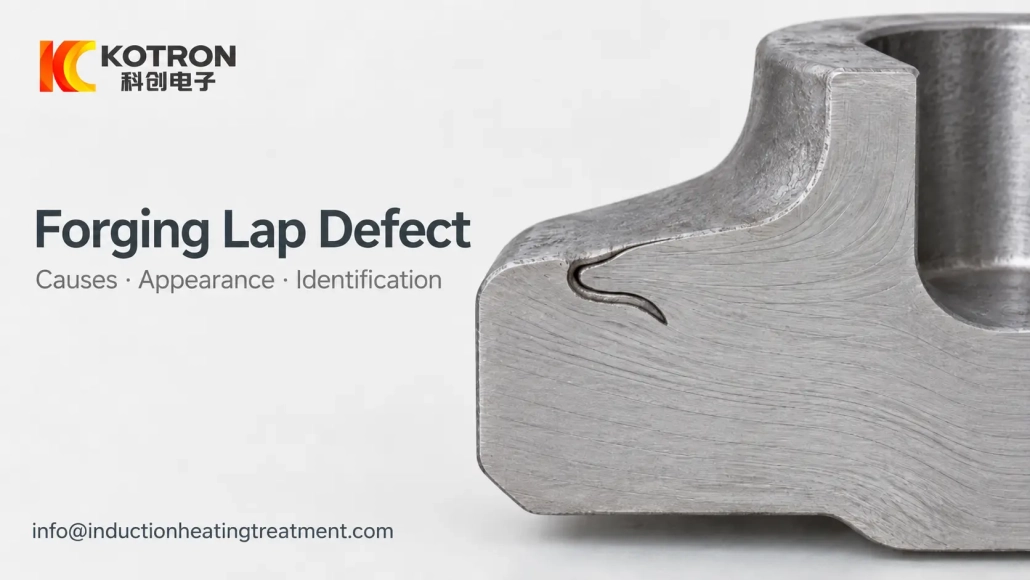
A line or seam on a forging surface is not always a crack. It may be a forging lap, while some apparently similar indications can come from internal laminations or other discontinuities.
A forging lap forms when surface metal folds over and is pressed back into the workpiece without fully bonding to the surrounding material. Correct identification matters because the remedy depends on the source. Billet condition, die geometry, heating and metal flow can all contribute, and changing only one process variable may not remove the defect.
2. What Causes Lap Defects in Forging?
3. How to Identify a Forging Lap
4. Forging Lap vs. Crack vs. Lamination
5. What Grain Flow Can Tell You About Lap Formation
6. How to Trace and Prevent Forging Laps
1. What Is a Forging Lap?
A forging lap is a surface-connected discontinuity created when part of the metal folds onto or into the workpiece during deformation.
The folded surface may remain as an interface instead of welding completely to the base metal.
One common formation path begins with a sharp projection, fin, depression, scratch or other surface irregularity produced before or during forging. During subsequent deformation, this irregular section can be folded into the main body of the workpiece.
Thin projections cool more quickly than the surrounding section and may oxidize more readily. If an oxide layer forms between the folded metal and the base material, complete bonding becomes more difficult during later deformation.
Laps can also develop near sudden changes in section or in areas where metal is forced to flow in several directions.
2. What Causes Lap Defects in Forging?
A lap can have more than one contributing cause.
Billet surface condition
Scabs, rough areas, deep scratches, depressions or other surface damage can later be folded into the forging.
Tooling condition
Worn or damaged die surfaces may create local irregularities that are pressed into the workpiece during later deformation.
Die and groove design
If the die does not guide the metal flow properly, one part of the material may fold against another instead of filling the cavity smoothly.
Điều kiện sưởi ấm
Improper or non-uniform heating can affect plasticity and metal flow. Heating is one factor in the process, but it should not automatically be treated as the root cause of every lap.
Forging sequence and operation
Incorrect preform geometry, excessive local material, poor deformation sequence or unsuitable operating practice can create fins, sharp corners or unstable flow patterns that later develop into laps.
Trong thực tế, the defect should be traced through the complete process rather than assigned to one cause from appearance alone.
3. How to Identify a Forging Lap
A forging lap normally begins from the surface and extends inward along the folded interface.
On a prepared section, several features may support the diagnosis:
— The opening may be wider than that of a fine crack.
— The two sides may appear comparatively smooth.
— The tip is often rounded or blunt rather than sharply pointed.
— Oxidation may be present along the folded interface.
— In steel forgings, decarburization may appear on one or both sides.
— Oxide inclusions may remain inside the defect.
— The lap may form an acute angle with the surface.
— Its direction may follow the local metal flow.
No single feature is conclusive.
Ví dụ, oxidation inside a discontinuity does not by itself prove that the defect is a lap. The defect shape, surface connection, surrounding microstructure and metal flow should be considered together.
Material also matters. In non-ferrous forgings, the oxide and decarburization features commonly used when examining steel may not be present. Trong những trường hợp đó, the flow-line pattern across the section can provide more useful evidence.
4. Forging Lap vs. Crack vs. Lamination
These defects can look similar during initial inspection, but their formation mechanisms are different.
| Đặc điểm | Forging Lap | Lamination | Vết nứt rèn |
|---|---|---|---|
| Basic mechanism | Surface metal folds into the workpiece without fully bonding | Internal discontinuity remains separated into layers | Material fractures under local stress |
| Typical origin | Surface defect, dụng cụ, metal flow, forging sequence | Internal crack, inclusion, shrinkage cavity, porosity or similar material discontinuity | Tình trạng vật chất, nhiệt độ, stress and deformation |
| Typical position | Usually surface-connected | Commonly internal | Surface or internal |
| Section appearance | Folded interface, often with a relatively blunt end | Layered separation | Shape depends on the fracture mechanism |
| Oxy hóa / mất cacbon | May be present in steel | Depends on origin | Depends on when and how the crack formed |
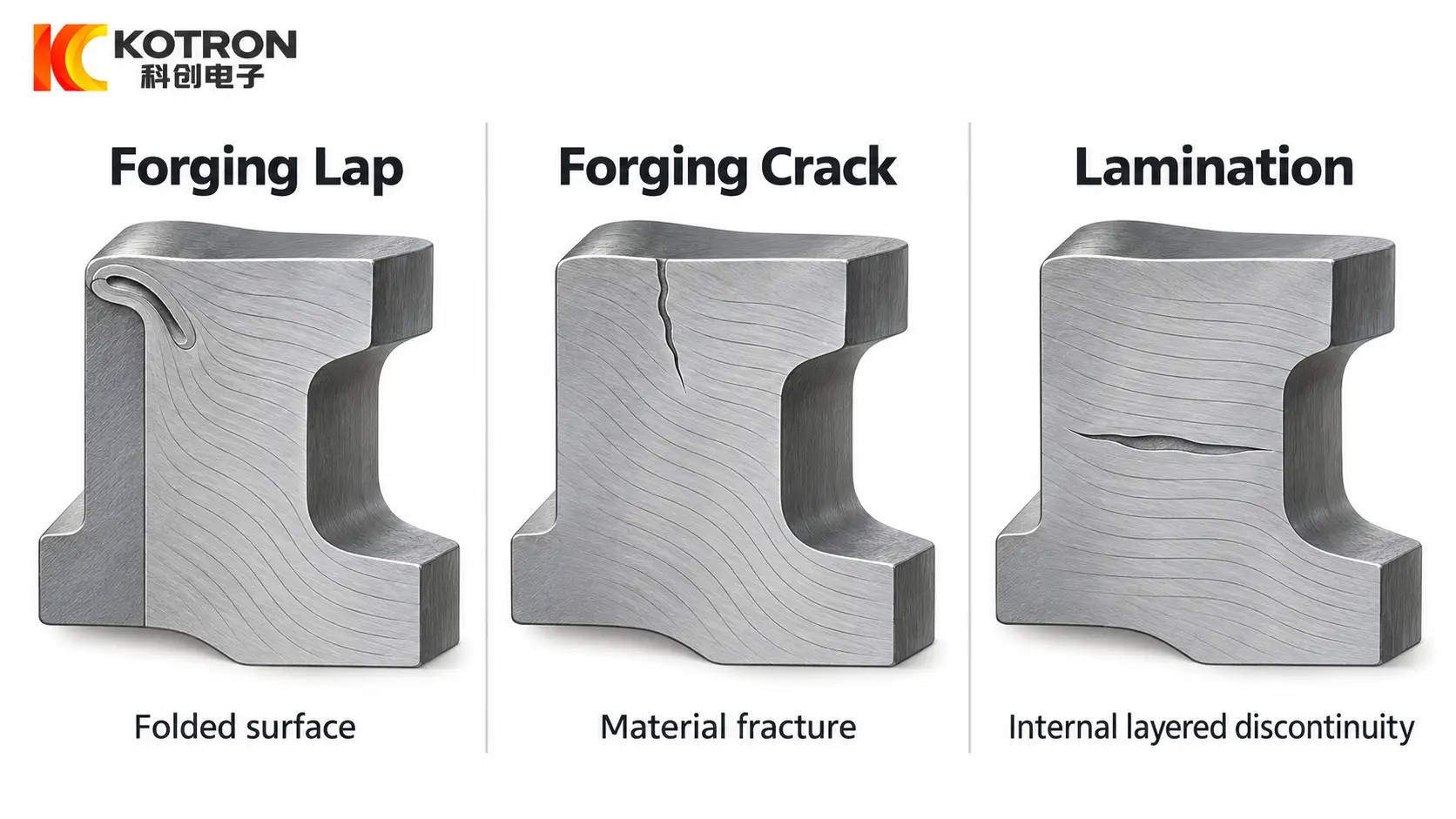
A lap is produced by folding. A crack is produced by fracture.
Lamination is different again. It usually involves an internal discontinuity that existed in the material and remained unbonded or became elongated during further deformation.
This distinction is important during root-cause analysis. A surface-connected folded defect points toward a different process history from an internal layered discontinuity.
For a more detailed discussion of crack morphology and the difference between forging and quenching cracks, that subject is better treated separately rather than repeated here.
5. What Grain Flow Can Tell You About Lap Formation
Metal flow inside a forging provides useful evidence about how the part was formed.
Under suitable forging conditions, flow lines generally follow the main contour of the component. Where material movement becomes unstable, the flow pattern may become distorted, interrupted or locally vortex-like.
This matters when examining a lap because the defect may follow the direction in which the surface metal was folded.
A local change in flow direction near a rib, branch, corner or sudden section change may also indicate why the metal folded instead of filling the die as intended.
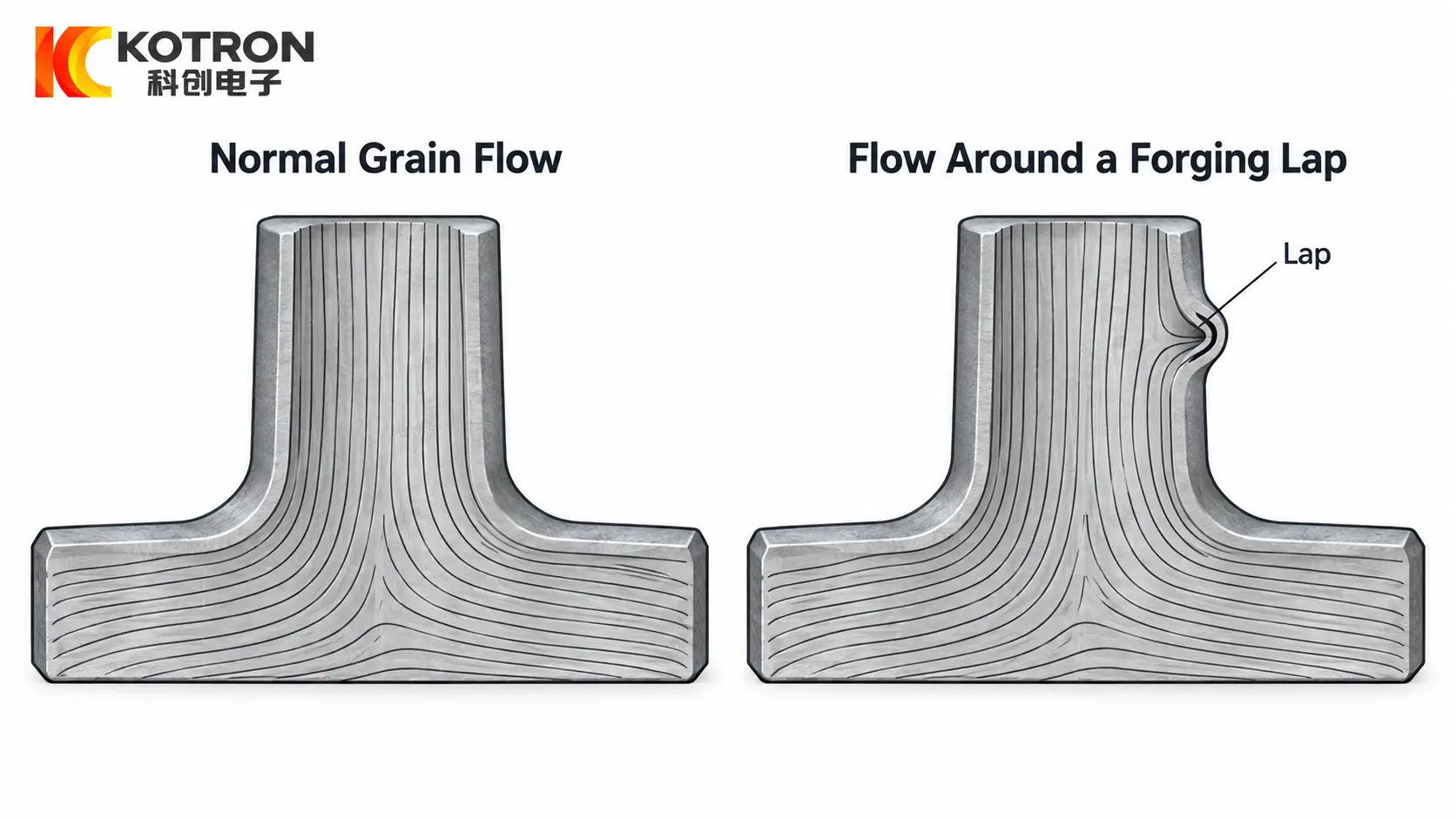
Grain-flow examination therefore helps answer a different question from surface inspection:
not only where the defect is, but how the metal moved before the defect formed.
Abnormal flow does not automatically mean that a lap is present, and a lap should not be diagnosed only from flow lines. The two observations are most useful when evaluated together.
6. How to Trace and Prevent Forging Laps
Once a lap is confirmed, the next step is to work backward through the process.
① Check the billet surface
Look for scabs, scratches, depressions, seams or other irregularities that could have been folded into the forging.
If the defect follows an original surface imperfection, changing the die or heating process alone will not solve the problem.
② Inspect the dies and preform
Check for worn surfaces, local damage and geometry that may create fins, sharp projections or excessive material accumulation.
The preform should also be reviewed. Poor material distribution before the final forging step can force metal to fold during cavity filling.
③ Review metal flow
Examine the defect location in relation to ribs, bosses, section changes and other areas where the direction of flow changes.
If laps repeatedly appear in the same region, the local flow pattern and die design deserve particular attention.
④ Review heating conditions
Heating should be checked together with the mechanical process.
Low or uneven billet temperature may reduce forgeability and make deformation less stable. Excessive temperature can create other metallurgical problems and should not be used simply as a way to make the material flow more easily.
Ở đâu induction billet heating is used, repeatable and reasonably uniform temperature control can reduce one source of process variation. It cannot correct poor billet quality, damaged tooling or unsuitable preform design.
⑤ Review the forging sequence
A defect may originate during an earlier forming step and only become obvious after the final operation.
For recurring defects, it is therefore useful to inspect intermediate shapes rather than examining only the finished forging.
The most effective prevention usually comes from identifying which part of the process first creates the fold: tình trạng bề mặt, material distribution, dụng cụ, heating or deformation sequence.
Chìa khóa mang đi
A forging lap is not simply another name for a crack. It is a folded-metal discontinuity, and its shape, surface connection, oxidation condition and relationship with metal flow can help distinguish it from cracks and internal laminations.
When a lap is found, the investigation should extend beyond the final forging step. Billet quality, dụng cụ, preform design, heating conditions and metal flow all need to be considered before deciding what should be changed.
Câu hỏi thường gặp
Bấm vào một câu hỏi để mở rộng câu trả lời.
How is a forging lap different from a crack?
A lap forms when surface metal folds over and is pressed back without fully bonding, while a crack forms when material fractures under stress. Laps usually start from the surface and follow the metal flow, whereas a crack is produced by fracture.
Can a forging lap be identified by oxidation alone?
KHÔNG. Oxidation inside a discontinuity does not by itself prove a lap. The defect shape, surface connection, surrounding microstructure and metal flow should all be considered together.
What causes forging laps?
There is no single cause. Billet surface condition, tooling condition, die design, heating and the forging sequence can all contribute. The defect should be traced through the complete process rather than assigned to one cause from appearance alone.
How can forging laps be prevented?
The most effective prevention is to identify which part of the process first creates the fold — tình trạng bề mặt, material distribution, dụng cụ, heating or deformation sequence — and correct it. This usually means checking the billet, chết, preform, metal flow and heating together.
Need Reliable Billet Heating for Forging?
Consistent heating is one factor in controlling forging quality. Send us your part, material and production rate, and we will recommend the right induction heating setup.