Rèn vs đúc: Độ bền, Chi phí, Khuyết tật & Ứng dụng
How to Choose Between Forged and Cast Metal Parts
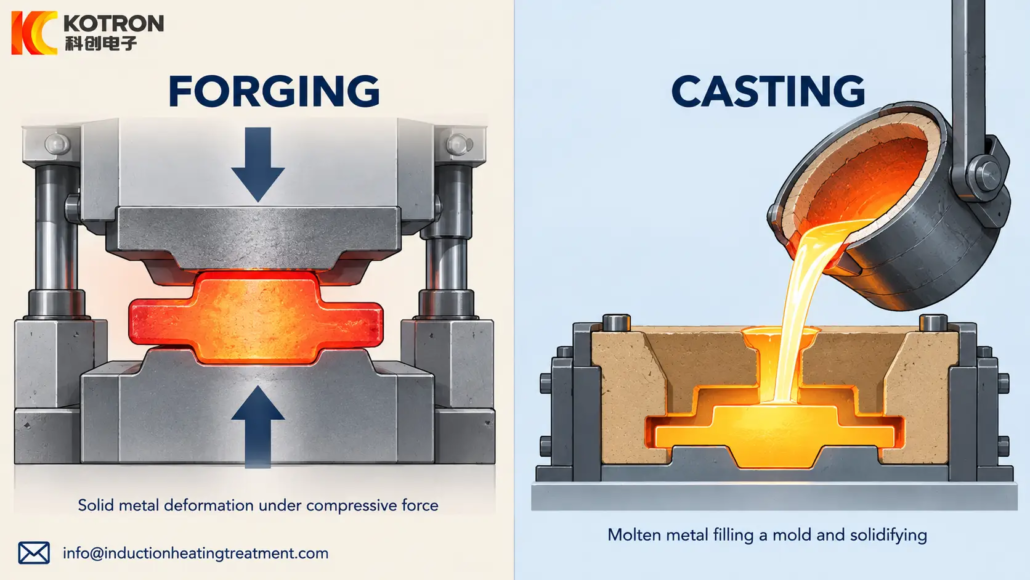
Rèn shapes solid metal through plastic deformation, trong khi đúc forms parts by introducing molten metal into a mold and allowing it to solidify. This fundamental difference affects the internal structure, achievable geometry, mechanical properties and manufacturing cost of a component.
Forging is often selected for solid, highly loaded parts where fatigue resistance and controlled material properties are important. Casting is particularly useful for complex shapes, internal passages and components that would require extensive machining if produced from solid stock. Tuy nhiên, neither method is inherently superior for every application.
The most useful comparison considers the actual material grade, service loads, hình học chi tiết, quality requirements and total cost of producing an acceptable finished component.
2. Độ bền, Grain Flow and Fatigue Performance
3. Typical Defects and Quality Inspection
4. Hình học, Tooling and Total Manufacturing Cost
5. How to Choose Between Forging and Casting
6. Induction Heating in Forging and Casting Production
1. Rèn vs đúc: Key Differences
How Forging Works
Forging uses compressive forces from a press, hammer or other forming equipment to deform metal in the solid state.
In hot forging, billets or bars are heated to an appropriate forming temperature before deformation. The workpiece remains solid. Warm forging and cold forging are also used when suitable for the material and component requirements.
Common methods include open-die forging and closed-die forging. The choice affects dimensional capability, tooling requirements, material flow and production economics.
How Casting Works
Casting involves melting metal, filling a mold cavity and allowing the metal to solidify into the required shape.
Different casting methods offer different capabilities. Sand casting is widely used for a broad range of part sizes and production quantities. Investment casting can produce intricate shapes with relatively fine detail, while die casting is commonly used for high-volume production of suitable nonferrous alloys.
The selected method influences surface finish, dimensional accuracy, internal soundness and tooling investment.
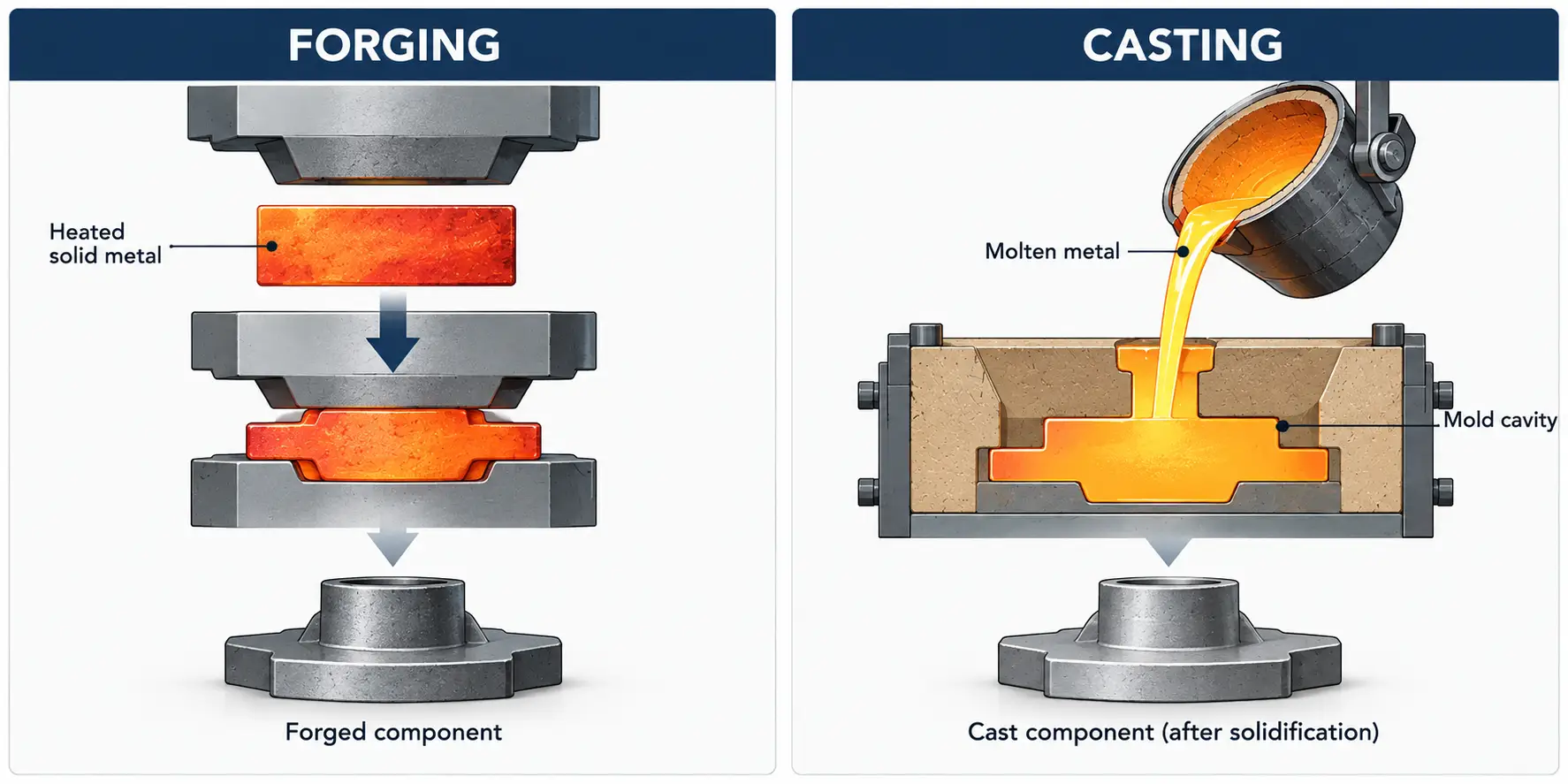
Forging deforms solid metal, while casting solidifies molten metal in a mold.
Key Differences at a Glance
| Yếu tố | Rèn | Đúc |
|---|---|---|
| Forming process | Plastic deformation of solid metal | Solidification of molten metal in a mold |
| Hình học chi tiết | Well suited to many solid, load-bearing shapes | Particularly suitable for complex shapes and internal cavities |
| Material structure | Deformation can modify microstructure and develop directional grain flow | Microstructure develops through solidification and subsequent processing |
| Mechanical performance | Can offer advantages for demanding loading conditions | Can meet demanding specifications with suitable alloy, processing and quality control |
| Typical defects | Laps, folds, forging cracks and underfilling | Porosity, shrinkage defects, inclusions and hot tears |
| Manufacturing economics | Influenced by forming equipment, dụng cụ, deformation and machining | Influenced by mold type, chảy, năng suất, machining and production quantity |
| Typical parts | Trục, connecting rods and gear blanks | Pump housings, complex valve bodies and machine housings |
These differences establish the general capabilities of each process. The final choice requires evaluating the component rather than assuming that one manufacturing method always produces a better result.
2. Độ bền, Grain Flow and Fatigue Performance
Why Forged Components Often Perform Well Under Load
Forging changes the shape and internal structure of metal through plastic deformation. Depending on the alloy, starting stock, deformation temperature and reduction, the process can refine microstructure and alter the distribution and orientation of structural features.
This can be beneficial for components subjected to bending, torsion, impact or repeated loading.
Tuy nhiên, mechanical performance is not determined by forging alone. Material composition, nhiệt luyện, internal discontinuities, surface condition and component geometry remain important.
Grain Flow and Directional Properties
In forging, grain flow commonly refers to the directional pattern produced as the material deforms, including the alignment of microstructural features and inclusions.
A well-designed forging may develop a flow pattern favorable to the principal loading direction. This can contribute to improved performance in certain applications.
Grain flow is not the same as grain refinement. Grain refinement concerns grain size, while grain flow describes directional features associated with deformation. The two can influence properties in different ways.
Poorly controlled deformation, unfavorable flow patterns or forging defects may reduce the expected benefits. A forged component should therefore be evaluated against its actual mechanical requirements.
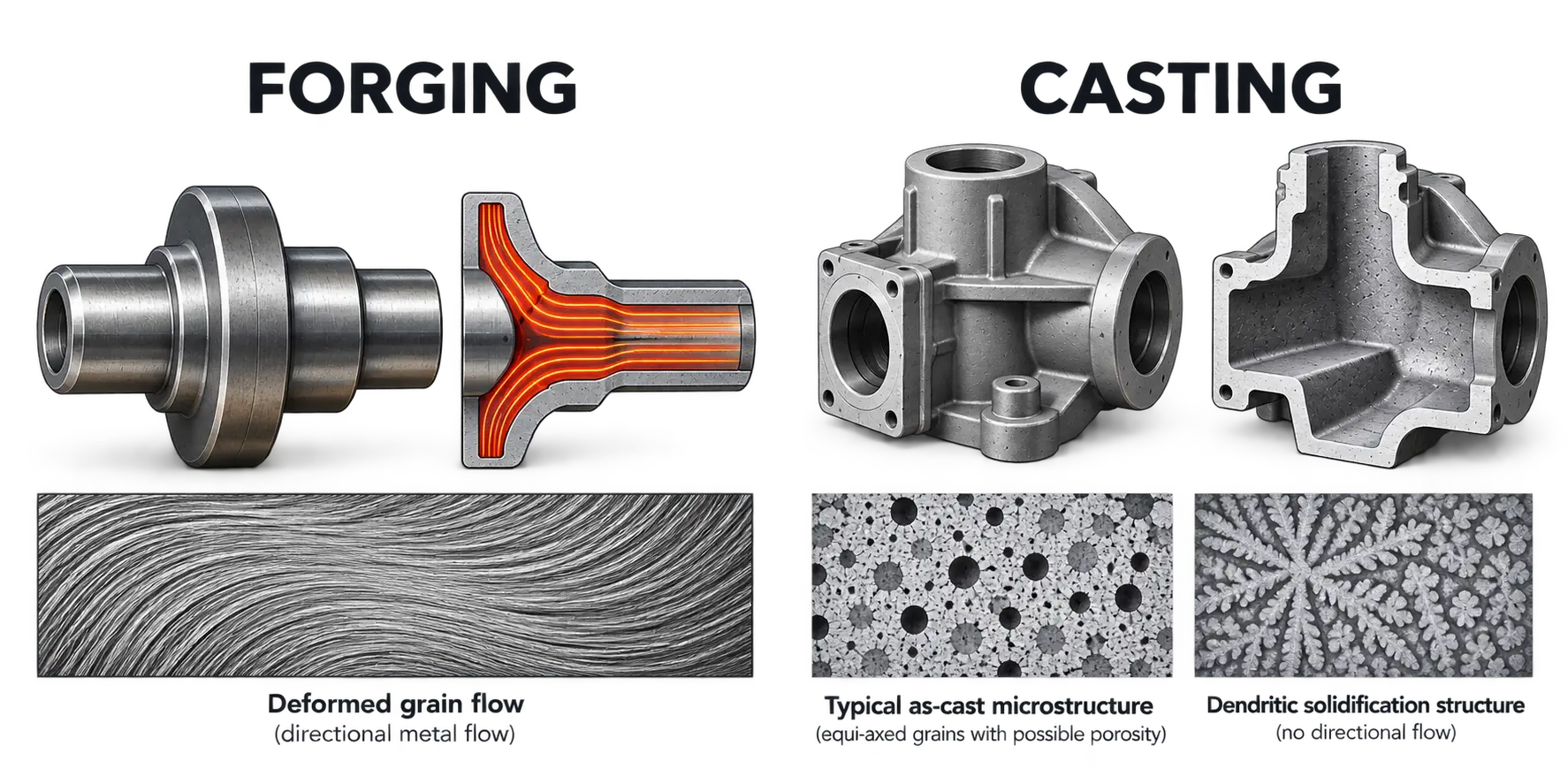
Directional grain flow produced by forging deformation.
Forged vs Cast Fatigue Strength
Fatigue failure develops under repeated or fluctuating stress and is strongly influenced by crack initiation and propagation.
Internal discontinuities, khuyết tật bề mặt, residual stresses and geometric stress concentrations can affect fatigue life in both forged and cast components.
Forging may offer an advantage when controlled deformation and material quality reduce critical discontinuities and provide favorable directional properties.
Casting can also produce components with adequate fatigue performance. Alloy selection, solidification control, nhiệt luyện, machining and inspection all influence the result.
For critical applications, fatigue requirements should be established through relevant specifications, testing and component-level evaluation rather than a general assumption that all forgings outperform all castings.
3. Typical Defects and Quality Inspection
The manufacturing route influences the types of defects that may occur, but neither forging nor casting guarantees defect-free material.
Understanding how discontinuities form is more useful than assuming that a particular defect belongs exclusively to one process.
Typical Casting Defects
Casting quality is influenced by melt preparation, mold filling, feeding and solidification.
Common defects include:
Gas porosity: Voids associated with gas trapped or released during solidification.
Shrinkage cavities and shrinkage porosity: Voids resulting from inadequate feeding as the metal contracts during solidification.
Hot tears: Cracks that form when contraction is restrained during the final stages of solidification.
Nonmetallic inclusions: Unwanted material incorporated into the casting.
Misruns and cold shuts: Defects associated with incomplete mold filling or insufficient fusion between advancing metal streams.
Their occurrence depends on the alloy, casting method, mold design and process control.
Typical Forging Defects
Forging defects may originate from the starting material or develop during heating and deformation.
Ví dụ bao gồm:
Laps and folds: Material folded onto itself during deformation, potentially creating surface discontinuities.
Vết nứt rèn: Cracks associated with excessive local strain, unsuitable forming temperature, material limitations or other processing conditions.
Underfilling: Incomplete filling of the intended die cavity.
Surface discontinuities: Defects inherited from the starting stock or introduced during processing.
Internal discontinuities: Defects that may remain from the starting material or develop under unfavorable processing conditions.
Forging deformation can close certain internal voids under suitable conditions, but closure does not necessarily mean metallurgical bonding or complete defect elimination.
Nonmetallic inclusions, cracks and other discontinuities may remain even after substantial deformation.
Inspection and Acceptance Requirements
Quality inspection should be selected according to the material, hình học, expected defect types and applicable acceptance criteria.
Visual and dimensional inspection are commonly used to evaluate external features. Ultrasonic testing and radiographic testing may be used to investigate internal discontinuities where the material and geometry permit.
Magnetic particle testing can reveal surface and near-surface discontinuities in suitable ferromagnetic materials, while liquid penetrant testing is used for surface-breaking discontinuities in compatible materials.
Inspection capability is not identical for every forged or cast component. Coarse microstructures, độ dày phần, tình trạng bề mặt, complex geometry and defect orientation can affect detection.
Đối với các bộ phận quan trọng, inspection procedures and acceptance limits should be established from the relevant material and component specifications.
Can You Identify a Forged or Cast Part by Appearance?
Surface texture, parting lines and other manufacturing marks may provide clues, but they are not definitive evidence.
Machining, blasting, coating and other finishing operations can remove or obscure these features. Some forging and casting methods can also produce similar external appearances.
Manufacturing records, material documentation and appropriate metallurgical examination provide a more reliable basis for identifying the production route.
4. Hình học, Tooling and Total Manufacturing Cost
Manufacturing cost should be evaluated for the finished, accepted component rather than only the initial forging or casting.
Geometry and Manufacturing Feasibility
Casting is often advantageous when a part requires internal passages, complex cavities or external features that are difficult to form through conventional forging.
Pump housings and certain valve bodies are typical examples. Casting can create flow passages within the component, reducing the amount of machining or assembly that might otherwise be required.
Forging is often suitable for solid components where material deformation and directional properties provide practical benefits.
Tuy nhiên, geometry alone does not determine the choice. Kích cỡ, hợp kim, required tolerances and available manufacturing processes must also be considered.
Tooling and Production Quantity
Closed-die forging may require significant die investment. For suitable high-volume production, that cost can be distributed across many components.
Casting tooling costs depend strongly on the selected process.
Sand casting can be economical for certain low-volume or large-component applications, while high-pressure die casting typically requires more substantial tooling investment but can be advantageous at high production volumes.
Neither forging nor casting is consistently cheaper across all production conditions.
Machining, Yield and Quality Costs
The total manufacturing cost may include:
— Starting material and material losses.
— Melting or billet heating.
— Forming or casting operations.
— Dies, molds and associated tooling.
— Trimming, cleaning and machining.
— Heat treatment and surface finishing.
— Kiểm tra, rework and rejected parts.
Near-net-shape forging and precision casting can reduce machining requirements when the component geometry and tolerances are suitable.
Material utilization also varies. Forging may produce flash and trimming scrap, while casting may require gates, runners and risers that must be removed or recycled.
The meaningful economic comparison is the cost per accepted finished part at the required production volume.
5. How to Choose Between Forging and Casting
A practical selection begins with the component’s service requirements and works backward to the manufacturing process.
Bước 1: Establish Material and Loading Requirements
Identify the required alloy, mechanical properties and operating conditions.
A component exposed to repeated bending or torsional loading may benefit from a forging route that provides suitable material quality and directional properties.
A casting may also be acceptable if its specified properties, quality level and design satisfy the service requirements.
The decision should be supported by engineering specifications rather than the manufacturing method alone.
Bước 2: Evaluate Part Geometry
Determine whether the component contains internal cavities, flow passages, thin walls or other features that strongly influence manufacturability.
A solid shaft may be well suited to forging.
A complex pump housing with internal flow passages may be more practical to cast.
When both routes are feasible, compare the amount of subsequent machining and assembly required.
Bước 3: Define Quality and Inspection Requirements
Consider the types, sizes and locations of discontinuities that could affect component performance.
For fatigue-critical parts, defects near highly stressed regions may be particularly important.
For pressure-containing components, integrity requirements may influence material selection, manufacturing route and inspection.
Quality acceptance should be defined through the applicable specifications and service conditions, not simply by labeling one process as stronger or more reliable.
Bước 4: Compare Production Volume and Total Cost
Estimate tooling investment, tốc độ sản xuất, material utilization, gia công, nhiệt luyện, inspection and rejection costs.
A process with a lower initial tooling cost may not produce the lowest cost per accepted part at high volume.
Ngược lại, a technically feasible forging route may be uneconomical for a complex, low-volume component.
Examples from Industrial Manufacturing
| Thành phần | Important Selection Factors | Manufacturing Considerations |
|---|---|---|
| Crankshaft | Fatigue loading, material properties and production volume | Forging is common in demanding applications; suitable casting routes are also used for certain designs |
| Gear blank | Material quality, đang tải, machining and subsequent heat treatment | Forging is often used for highly loaded gear components, subject to design and material requirements |
| Pump housing | Internal flow passages, geometry and pressure requirements | Casting can form complex internal passages efficiently |
| Valve body | Pressure integrity, service environment, alloy and internal geometry | Both forged and cast designs are used, depending on the applicable requirements |
The Final Decision
Choose the manufacturing route that can consistently meet the required performance, geometry and quality specifications at an acceptable total cost.
For demanding applications, this decision should be supported by material data, process capability, inspection requirements and discussions with qualified manufacturers.
6. Induction Heating in Forging and Casting Production
Induction heating can support both forging and casting production, but it serves different purposes.
Billet Heating Before Forging
In hot forging, metal billets or bars must reach an appropriate forming temperature before deformation.
Một induction billet heating system can heat suitable conductive workpieces while they remain solid. The heated material is then transferred to a press, hammer or other forging equipment.
Heating requirements depend on material grade, kích thước chi tiết, forming temperature and production rate.
KOTRON provides induction heating equipment for forging applications. More information is available on the rèn cảm ứng page.
Induction Melting for Casting
Casting requires molten metal to be prepared before mold filling.
Một lò nấu chảy cảm ứng can melt suitable metals and alloys using cảm ứng điện từ. The molten metal is then handled and poured according to the selected casting process.
Melting equipment supports metal preparation; it does not replace mold design, pouring, solidification control or casting inspection.
The distinction is straightforward: induction billet heating prepares solid metal for forging, while induction melting produces liquid metal for casting.
Chìa khóa mang đi
Forging and casting offer different manufacturing capabilities. Forging can provide advantages for certain highly loaded components, while casting is particularly useful for complex shapes and internal passages.
The appropriate process should be selected by comparing service requirements, tính chất vật liệu, hình học, quality acceptance and total manufacturing cost.
Trong sản xuất, induction heating may be used for solid billet heating before forging or for melting metal before casting. These are distinct thermal applications that require different equipment configurations.
Câu hỏi thường gặp
Bấm vào một câu hỏi để mở rộng câu trả lời.
Can a metal part be both cast and forged?
Có. Some manufacturing routes use cast stock or specially produced preforms that undergo subsequent forging. Conventional wrought products also commonly originate from cast ingots or continuously cast material. The final component’s properties depend on the complete processing history, not only its initial solidification method.
Does forging eliminate internal porosity?
Không nhất thiết. Suitable deformation may close certain internal voids, but complete metallurgical bonding is not guaranteed. The outcome depends on temperature, biến dạng, stress state, defect characteristics and subsequent processing. Internal quality must be verified where required.
How can you tell if a part is forged or cast?
Surface appearance and manufacturing marks may provide indications, but machining and finishing can obscure them. Manufacturing records, material certification and appropriate metallurgical examination are more reliable than visual appearance alone.
Choosing between forging and casting for your production?
KOTRON supplies induction heating equipment for solid billet heating before forging and metal melting for casting. Tell us about your component and production requirements.