Máy gia nhiệt đầu thanh cảm ứng để rèn
Ⅰ. See Bar End Heating in Production
Bar end heating is usually a preparation step rather than the final operation. Only the section that needs to deform is heated before forging, upsetting or another hot-forming process.
Localized Bar End Heating
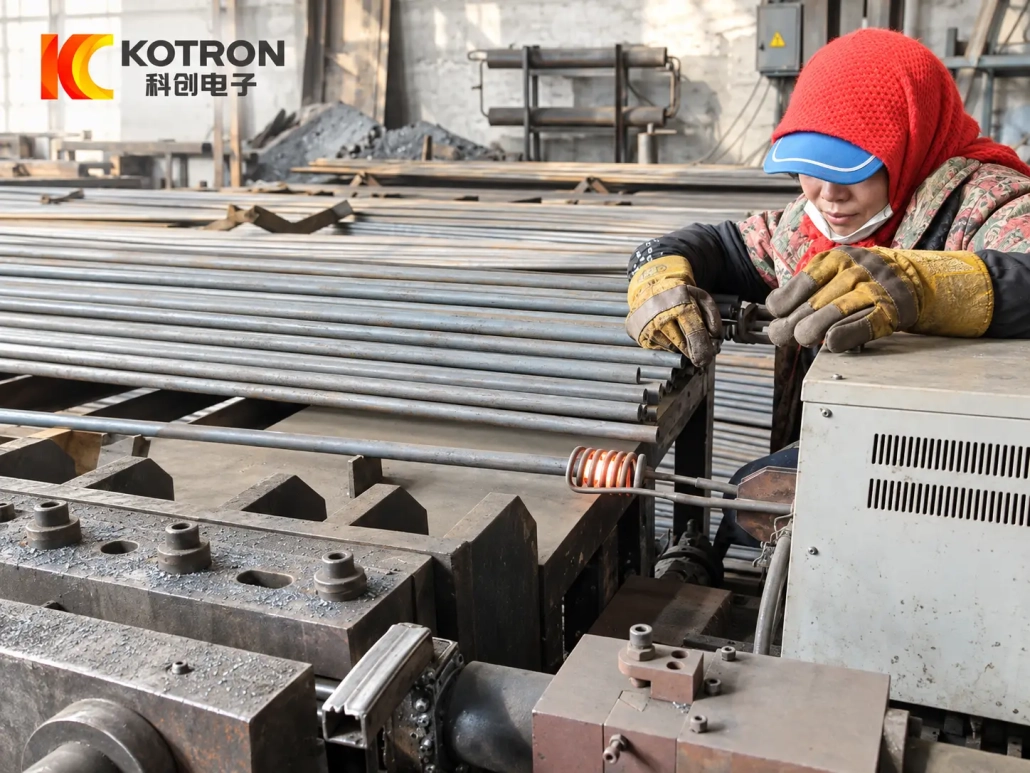
The first video shows an operator-assisted heating setup. A long bar is positioned at the induction coil while the heating area is concentrated near the end of the workpiece.
Most of the bar remains outside the heating zone.
Heating Before the Next Forming Step
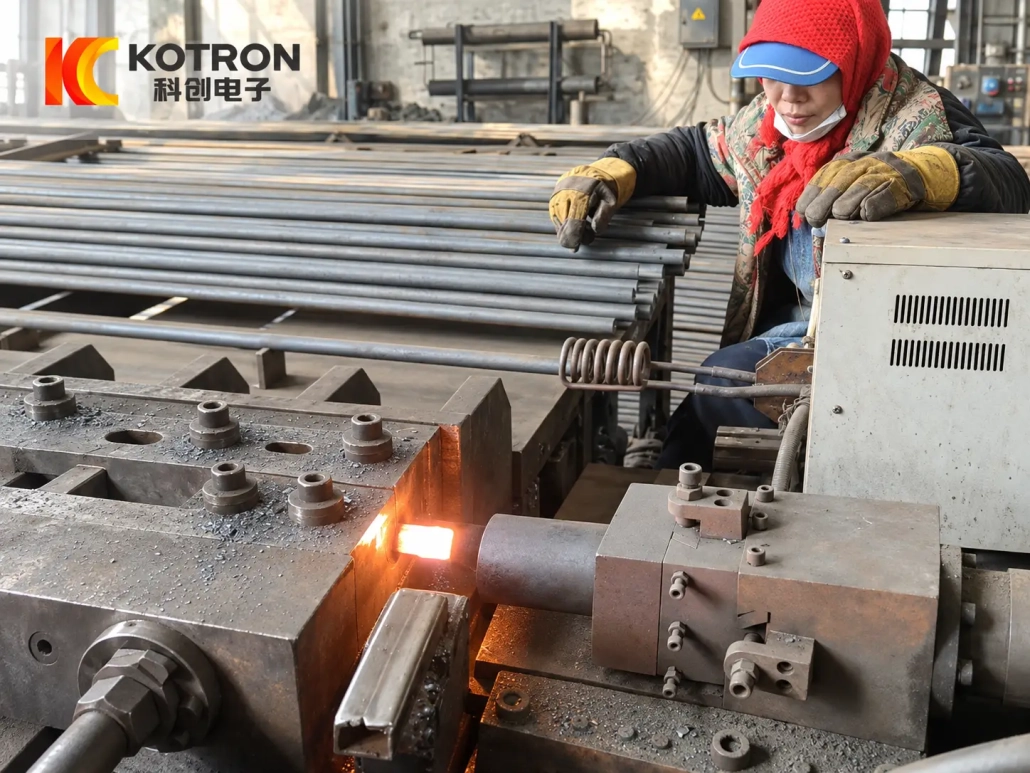
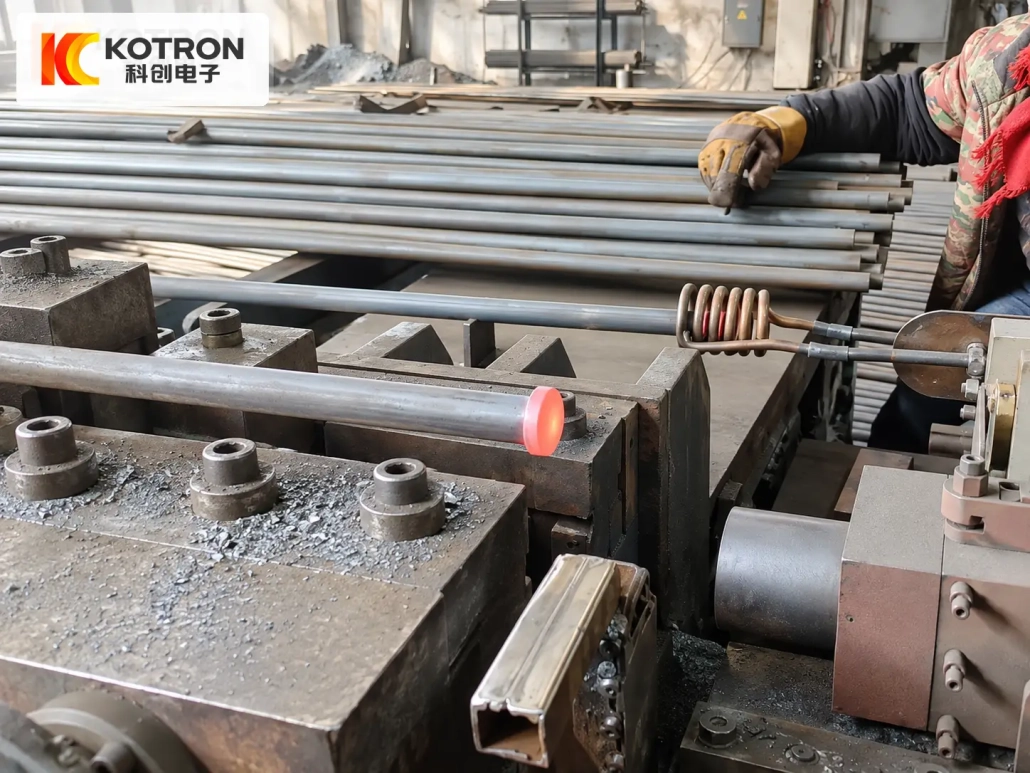
The second video follows the heated end after the heating stage and into the next production step. The visible hot zone remains concentrated around a short section near the bar end.
Cùng nhau, the two videos show the basic process clearly:
Ⅱ. What Is Bar End Induction Heating?
Bar end heating is a type of localized, or partial, gia nhiệt cảm ứng.
Không giống như whole-billet heating, the complete workpiece does not need to pass through a long induction furnace. The inductor is arranged around the section that must reach the required forming temperature.
This is useful when only one end of a long workpiece needs to deform.
Các ví dụ điển hình bao gồm:
— Bar end forging
— Upsetting
— Rivet and fastener forming
— Shaft-end forming
— Local hot forming
— Other processes requiring a heated end section
The equipment is therefore selected according to the working end of the bar, not simply according to its total length.
Ⅲ. Why Heat Only the Bar End?
If the next operation only changes the end geometry, heating the entire bar may be unnecessary.
Localized induction heating concentrates the heating process around the required section while the rest of the workpiece stays substantially cooler.
This can be useful for long bars or shafts where only a relatively short section will be forged.
The practical benefit is not simply “faster heating.” The heating zone itself can be matched more closely to the forming requirement.
Đối với việc lựa chọn thiết bị, several factors have to be considered together:
— Bar material
— Diameter
— Required heated length
— Target temperature
— Heating cycle
— Production rate
— Following forming process
A change in any of these can affect the final equipment configuration.
Ⅳ. Typical Bar End Heating Applications
Bar End Forging
A selected section of the bar is heated before forging. The rest of the workpiece does not need to pass through the heating zone.
Upsetting
Localized heating can prepare the end of a bar for an upsetting process where the heated section is plastically deformed.
Rivet and Fastener Forming
Rod or bar ends can be heated before forming when the production process requires a hot working section.
Shaft-End and Local Hot Forming
Longer shafts or similar components may also require only one end to be heated before local forming.
Similar localized-heating principles may be adapted to some tube or sleeve end-forming applications, but these should be evaluated separately because their geometry and inductor requirements can differ from solid bars.
Ⅴ. Heated Length and Inductor Design
The required heated length is one of the most important pieces of information when designing a bar end heating system.
Two bars with the same diameter may still need different heating setups if one process requires only a short hot section and the other needs a longer transition zone.
The inductor is therefore matched to factors such as:
— Bar diameter
— End geometry
— Heated length
- Vật liệu
— Required temperature distribution
— Feeding direction
A universal cuộn dây should not be assumed for every workpiece.
When the bar size or heated length changes significantly, a different inductor may be required even if the same induction power supply is retained.
A simple drawing showing the required hot section is often more useful for equipment selection than the nominal bar diameter alone.
Ⅵ. Heating Temperature and Process Control
There is no single standard temperature for every bar end heating application.
The correct temperature depends on the material and the forming process that follows.
XG-100 Forging Configuration
In one supplied XG-100 bar-heating configuration, the workpiece was heated to approximately 1150°C for forging.
This should be treated as a project example rather than a universal setting for all bar end heating machines.
Different materials or forming operations may require different target temperatures.
Giám sát nhiệt độ
Trường hợp cần thiết, temperature measurement can be added to the heating process.
Depending on the selected control package, the equipment can be combined with temperature monitoring and corresponding control functions.
The heating result should be considered together with:
— Output power
— Operating frequency
— Heating time
— Workpiece position
— Inductor design
— Feeding sequence
For production equipment, the target temperature should be confirmed from the actual material and process requirement.
Ⅶ. Manual or Automatic Bar Feeding
The mechanical arrangement does not have to be the same for every customer.
Operator-Assisted Heating
For flexible or lower-volume production, an operator can position the bar at the heating station and remove or transfer it after heating.
This arrangement may be useful where several workpiece specifications are processed or where full automation is not required.
The first video on this page shows this type of operator-assisted production environment.
Automatic Feeding
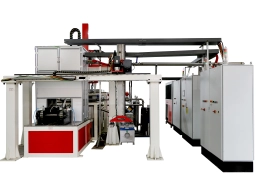
For repeated batch production, a feeding mechanism can be added to move the workpiece into a defined heating position.
A typical sequence may include:
The final design depends on the workpiece length, trọng lượng, diameter and production cycle.
Where the heating station has to work with downstream forging equipment, the feeding and transfer arrangement can also be developed around the production sequence.
Ⅷ. Heating Power and DSP Control
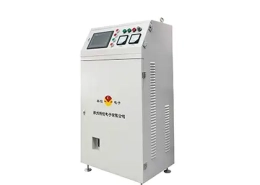
The induction heating system can use an IGBT power supply with Điều khiển kỹ thuật số DSP.
Đối với ứng dụng này, the important point is not the name of the control technology itself. The power supply needs to provide controllable output that matches the heating process.
Tùy theo cấu hình đã chọn, the control and monitoring system can include parameters such as:
— Voltage
— Current
— Output power
— Operating frequency
— Heating time
— Equipment status
— Alarm information
Additional monitoring or temperature-control functions can be configured when required.
For recurring production, these functions can help operators check whether the heating process is running under the expected conditions.
Ⅸ. Available Power Configurations
The following models are among the available configurations in the supplied product information.
| Người mẫu | Công Suất | Tần số |
|---|---|---|
| XG-30 | 30 kW | 20–40 kHz |
| XG-60 | 60 kW | 20–40 kHz |
| XG-100 | 100 kVA | 20–40 kHz |
| XZG-160SCZ | 160 kW | 1–50 kHz |
The ratings above are reproduced from the corresponding equipment information, so the unit used for XG-100 differs from the other listed models.
These models should not be matched to bar diameter by a fixed rule.
Actual quyền lực and operating frequency are selected from the load and process, bao gồm:
Vật liệu + Đường kính + chiều dài nóng + Nhiệt độ mục tiêu + Thời gian gia nhiệt + Tỷ lệ sản xuất
A large workpiece does not automatically mean that the highest-rated machine is the correct choice. The required heating cycle and the heated section also matter.
Ⅹ. How to Select the Right Bar End Heating Machine
The quickest way to evaluate a project is to start with the workpiece.
Thông tin phôi
Vui lòng cung cấp:
— Material and grade
— Bar diameter
— Total length
— Workpiece weight, khi có liên quan
— Drawing or clear photo
Heating Requirement
We also need to know:
— Required heated length
— Target temperature
— Following forging or forming process
— Any special requirement for the heated zone
Yêu cầu sản xuất
Đối với kế hoạch sản xuất, useful information includes:
— Required pieces per hour
— Manual or automatic handling
— Available upstream and downstream equipment
— Whether the heater will be integrated with forging equipment
Nếu có thể, mark the section that needs to be heated directly on the drawing.
Từ những chi tiết này, sức mạnh cảm ứng, tần số, inductor and feeding arrangement can be evaluated together.
Ⅺ. Câu hỏi thường gặp
Bấm vào một câu hỏi để mở rộng câu trả lời.
Can the machine heat only one end of a long bar?
Có. The inductor and workpiece position can be arranged so that the required end section is placed in the heating zone while most of the bar remains outside it.
Can the heated length be customized?
Có. Heated length is one of the inputs used for inductor design. If the required length changes significantly, a different coil or positioning arrangement may be needed.
Công suất cảm ứng cần thiết được chọn như thế nào?
Không nên chọn công suất chỉ từ đường kính. Vật liệu, kích thước thanh, chiều dài nóng, nhiệt độ mục tiêu, heating time and required production rate all affect the selection.
Can one machine process different bar diameters?
Có thể. Different workpieces may use the same power supply but require different inductors, đồ đạc hoặc cài đặt quy trình. The practical range should be checked from the actual workpiece list.
Can automatic feeding be added?
Có. Automatic feeding can be configured for suitable batch-production applications. The mechanism is selected according to bar dimensions, weight and production sequence.
Is 1150°C the standard temperature for bar end forging?
KHÔNG. Approximately 1150°C is an example from one supplied XG-100 forging configuration. The correct temperature depends on the workpiece material and the required forming process.
Ⅻ. Send Us Your Workpiece Details
A bar end heating machine should be selected from the part and the process, not only from the nominal power rating.
Send us the bar drawing and mark the section that needs to be heated.
Please include:
We can then evaluate the power supply, tần số vận hành, inductor and feeding arrangement for the application.
Plan Your Bar End Heating Machine
Send your bar drawing and mark the section that needs to be heated. We will evaluate the power supply, tần số vận hành, inductor and feeding arrangement for the application.