Linha de perfilagem assistida por indução para perfis de suporte metálico
Ⅰ. Induction-Assisted Edge Rolling in Operation
Vídeo: Continuous edge heating and rolling of a notched metal support profile using dual-side induction heating.
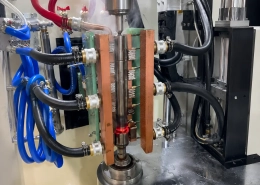
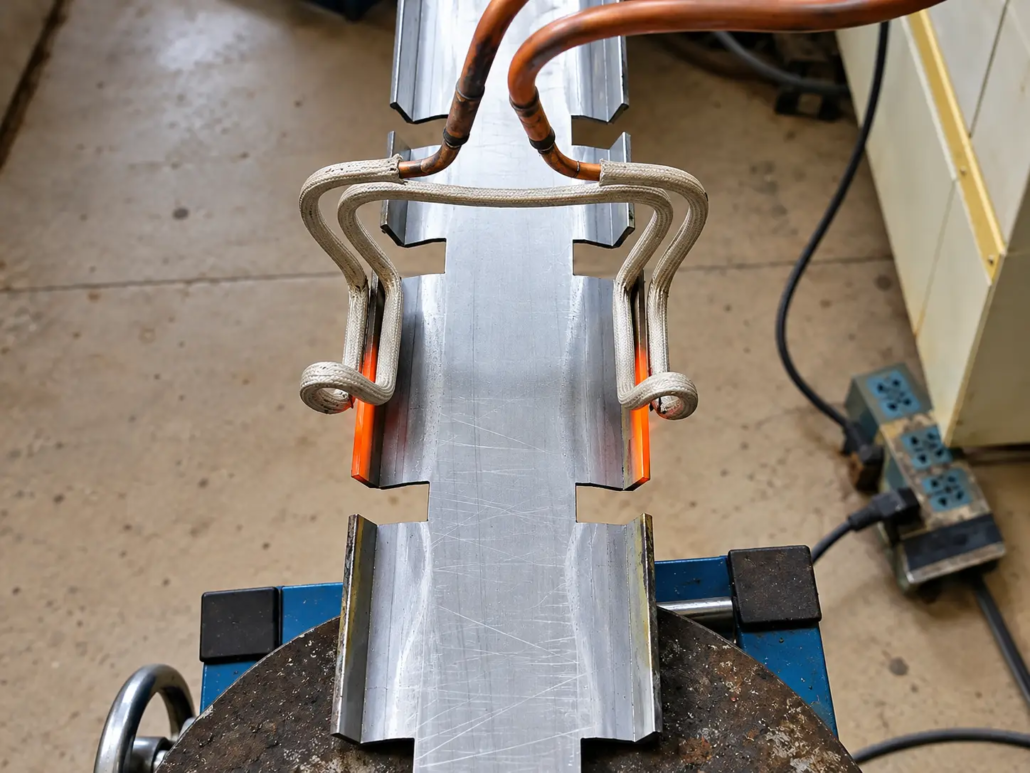
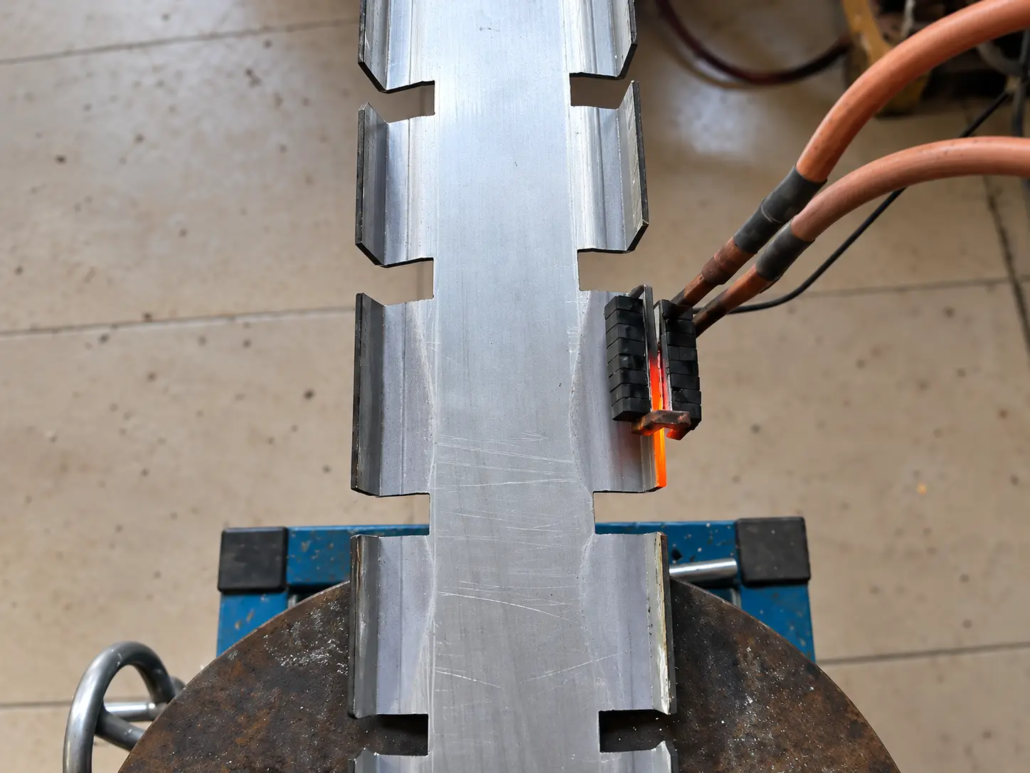
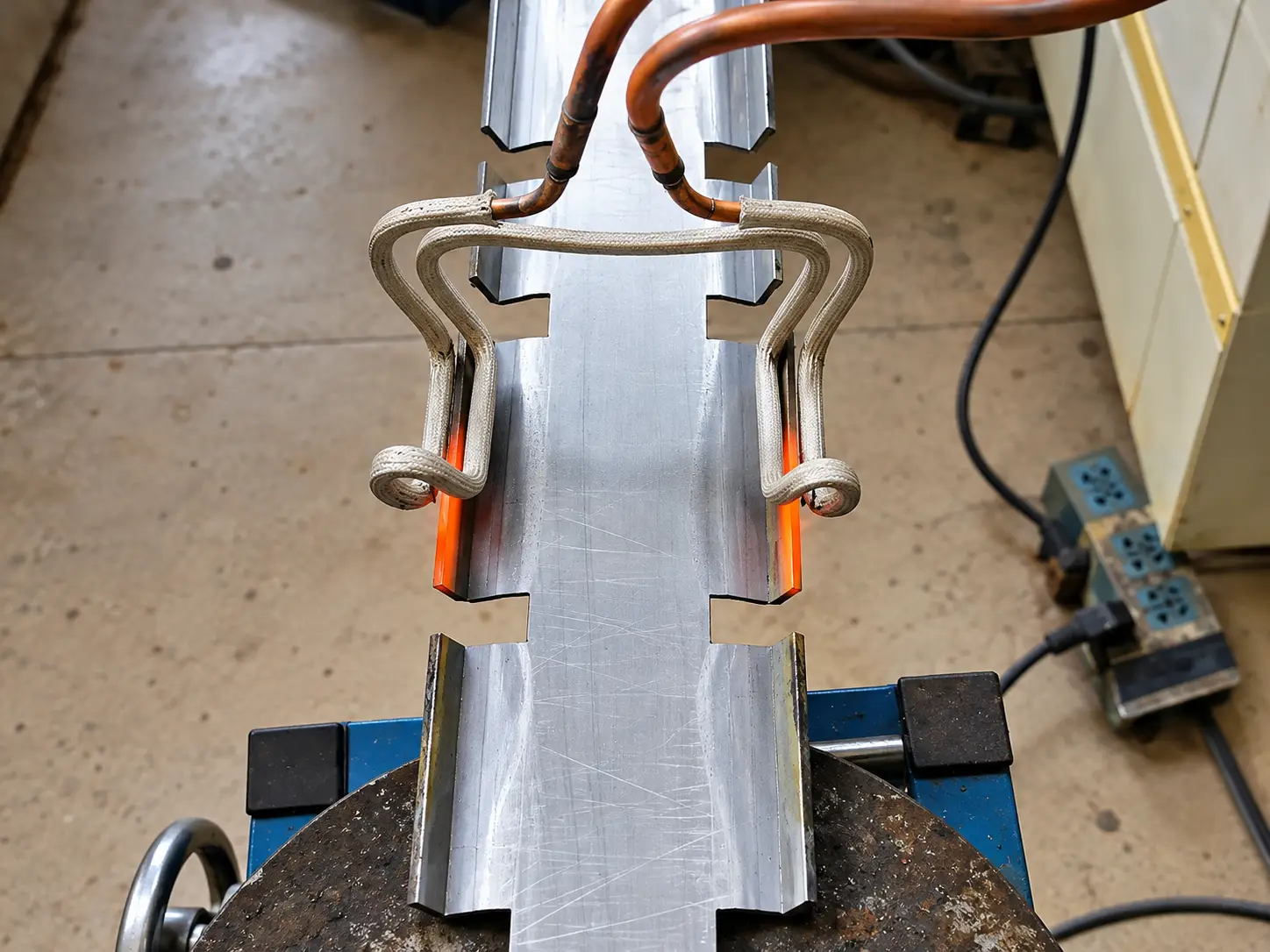
The video shows a channel-shaped metal support profile with rectangular notches along both edges. Two inductors heat the longitudinal edge regions as the profile moves through the equipment.
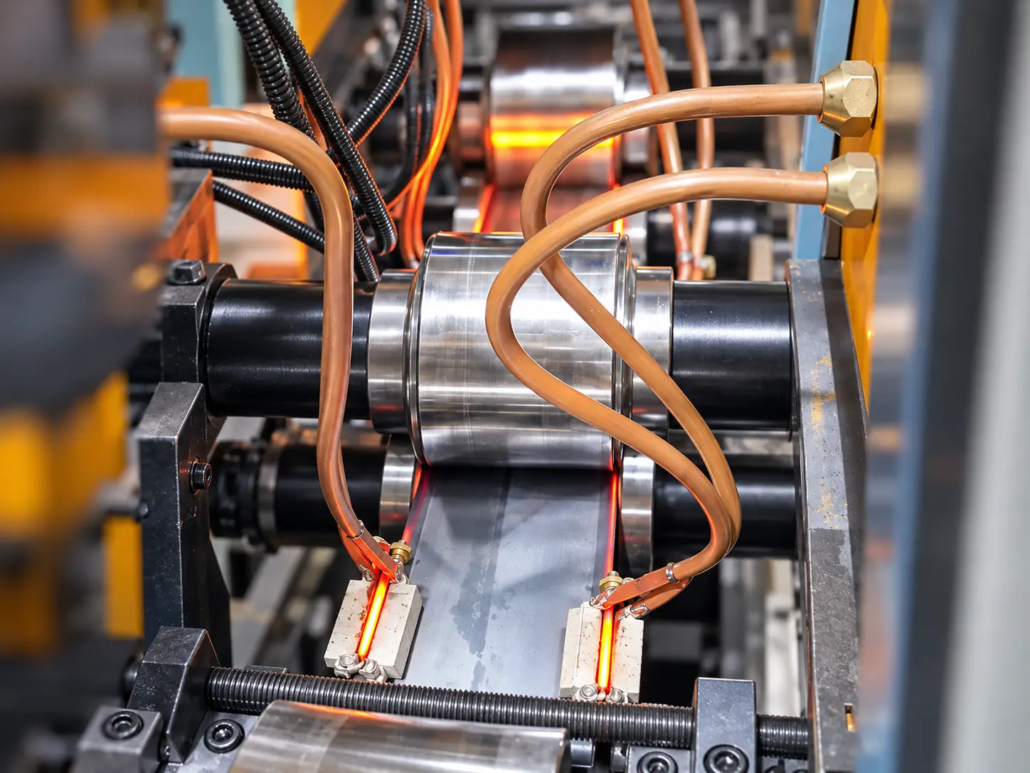
The rolling mechanism supports and guides the workpiece while applying the mechanical force needed for edge forming. The central section remains outside the primary heating areas.
Demonstrated Equipment and Process
| Item | Descrição |
|---|---|
| Peça de Trabalho | Notched metal support profile |
| Heating Area | Both longitudinal edges |
| Método de aquecimento | Aquecimento por indução localizado |
| Inductor Arrangement | Dual-side inductors |
| Forming Method | Continuous edge rolling |
| Movimento da peça | Roller-assisted feeding |
| Equipment Scope | Integrated heating and rolling line |
The footage shows the heating arrangement and rolling equipment. It does not establish the operating temperature, velocidade da linha, production capacity or finished edge dimensions.
Ⅱ. Metal Support Profiles and Edge Rolling Applications
The line is intended for metal profiles whose edges require localized heating before rolling deformation.
The demonstrated workpiece has a channel-shaped cross-section with regularly spaced edge notches. Unlike a continuous strip, its interrupted edges present changing metal geometry to the inductors as the profile advances.
This affects the design of both the heating and rolling equipment. The notches can change local electromagnetic coupling, while the rolling tools must accommodate the interruptions without losing the required profile alignment.
The same process can be adapted to other suitable support channels and profiled metal sections, including continuous and notched edge designs.
The main selection factors are the material, corte transversal, edge geometry, required deformation and production speed. A drawing of the finished edge is particularly useful because it determines the rolling tool design and helps establish the heating requirements.
Ⅲ. Dual-Side Induction Heating and Continuous Rolling
The induction heating stage brings the specified edge regions to suitable forming conditions before they undergo deformation.
For materials and forming operations that benefit from elevated temperatures, aquecimento localizado can reduce forming resistance without requiring the entire profile to reach the same temperature.
Inductor Design for Profile Edges
The two inductors are positioned alongside the moving profile, with their heating conductors arranged near the edges to be processed.
A geometria da bobina and clearance are important, particularly when the workpiece has notches. As a notch passes the heating position, the local metal geometry changes, which can affect electromagnetic coupling and heat distribution.
The inductor design must account for these interruptions while maintaining sufficient clearance for continuous feeding.
Heating both edges simultaneously does not guarantee identical temperature distributions. Potência, frequência, conductor geometry and workpiece movement must be considered together to establish the required heating conditions.
Matching Heating to Rolling Speed
In continuous operation, line speed affects the time each section of the profile spends within the effective heating region.
If feeding speed changes without a corresponding process adjustment, the heat input per unit length will also change.
The distance between the inductors and forming rolls is another practical consideration. The edges begin losing heat after leaving the heating zone, so the rolling stations must be positioned with the forming temperature requirements in mind.
Rolling and Workpiece Guidance
The forming rolls apply pressure to produce the specified edge shape. Roll profiles, clearances and station alignment determine how the material is deformed.
Guiding rollers maintain the position of the moving profile through the heating and rolling sections. This is particularly important where changes in lateral position could alter the clearance between the edges and inductors.
For notched profiles, the rolling arrangement must also accommodate the interrupted edge geometry.
The heating conditions and mechanical forming sequence are established for the same material and finished profile specification.
Ⅳ. Production Line Configuration and Custom Tooling
We provide integrated induction heating and rolling equipment rather than a standalone edge heater.
The demonstrated arrangement combines dual-side heating with a roller-based processing system. Other machine layouts are developed from the profile dimensions, required edge deformation and production conditions.
Main Equipment Components
| Componente | Função |
|---|---|
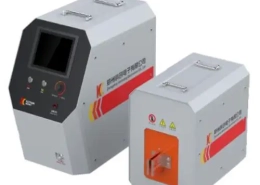
| Fonte de Alimentação por Indução | Supplies heating power matched to the material and process |
| Dual-Side Inductors | Apply localized heat to the specified profile edges |
| Feeding and Guiding System | Supports, positions and advances the workpiece |
| Rolling Stations | Produce the required edge geometry through mechanical deformation |
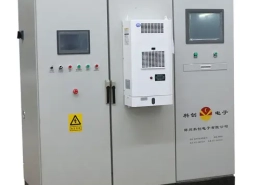
| Controlo do Processo | Coordinates heating output and line operation |
| Automação | Carregando, handling and operating sequences where required |
Custom Inductors and Rolling Tools
The inductors are designed for the actual profile width, edge dimensions and notch arrangement. Their shape and mounting position must provide access to the heating areas without interfering with workpiece movement.
The rolling tools are designed from the required finished section. Roll geometry, clearances and station arrangement are established according to the material and forming operation.
For profiles with repeated notches, both sets of tooling must accommodate the changing edge geometry throughout the processing cycle.
Power Supply and Line Control
Our induction heating equipment includes digitally controlled fonte de alimentação opções.
The required power and operating frequency are selected with the inductor design, taking account of the workpiece material, heated area and processing speed.
Heating output and feeding speed can be coordinated through the line control system. Temperature feedback and additional automation functions can be incorporated where the process requires them.
The machine layout also accounts for access to the inductors and rolling tools, workpiece handling and maintenance.
For a new profile or forming operation, process trials may be needed to establish suitable heating and rolling conditions. Finished dimensions and forming quality should then be checked against the specified requirements.
Ⅴ. Request a Customized Induction-Assisted Roll Forming Line
We supply complete induction heating and rolling solutions for metal support profiles requiring localized edge heating and continuous forming.
To evaluate your application, Por favor, envie:
•Workpiece drawings or photographs
•Material ou classe de aço
•Main dimensions and edge geometry
•Required finished edge shape
•Quantidade de produção ou velocidade de linha alvo
Se disponível, include drawings or photographs showing the profile before and after rolling.
Com esta informação, we can review the induction heating arrangement, rolling tooling, workpiece guidance and production line configuration, then prepare a technical proposal for your project.
Solicite uma proposta de linha de produção personalizada
Send your profile drawings and we will review the induction heating arrangement, rolling tooling, workpiece guidance and line configuration, then prepare a technical proposal for your project.