Induction Normalizing vs Annealing: When to Use Each (and When Induction Tips the Scale)
Most heat treatment shops have a default: they either normalize everything or anneal everything. The choice is usually habit, not engineering. Induction normalizing changes that equation — not because induction is always the better process, but because its speed and control make normalizing practical in applications where a furnace would be too slow and annealing would be overkill.
Normalizing and annealing both heat steel above the transformation temperature. What separates them is the cooling step — and everything about the final part follows from that one variable: hardness, strength, machinability, grain structure, whether the part distorts in the next operation.
| 1. What Actually Happens in Each Process | 4. Where Induction Changes the Trade-Off |
| 2. When Normalizing Wins | 5. What Determines Your Equipment Spec |
| 3. When Annealing Wins | 6. Mistakes That Cost the Most |
1. What Actually Happens in Each Process
Both processes heat steel above its upper transformation temperature — typically 800–950°C depending on carbon content and alloy. The difference is what happens next.
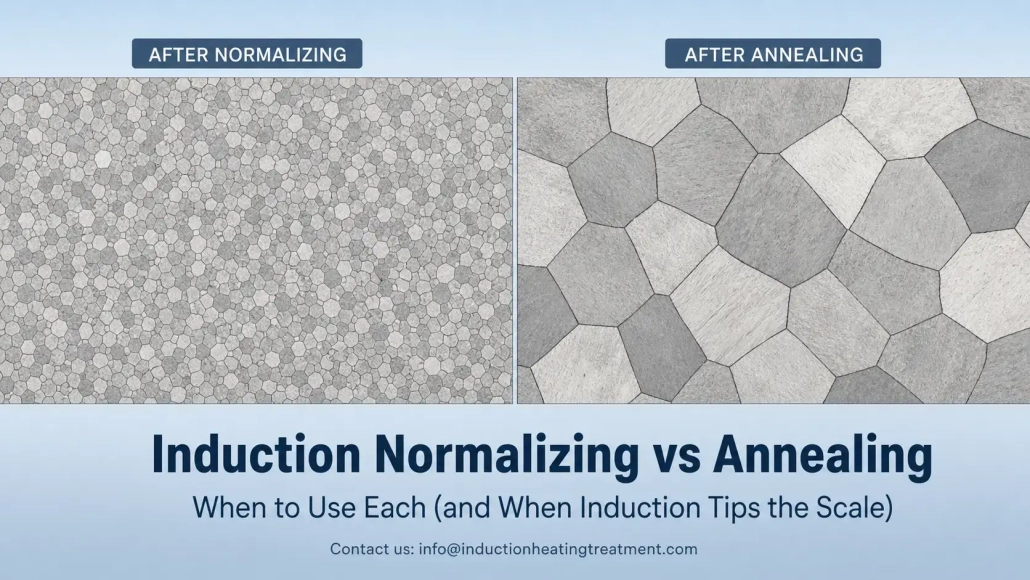
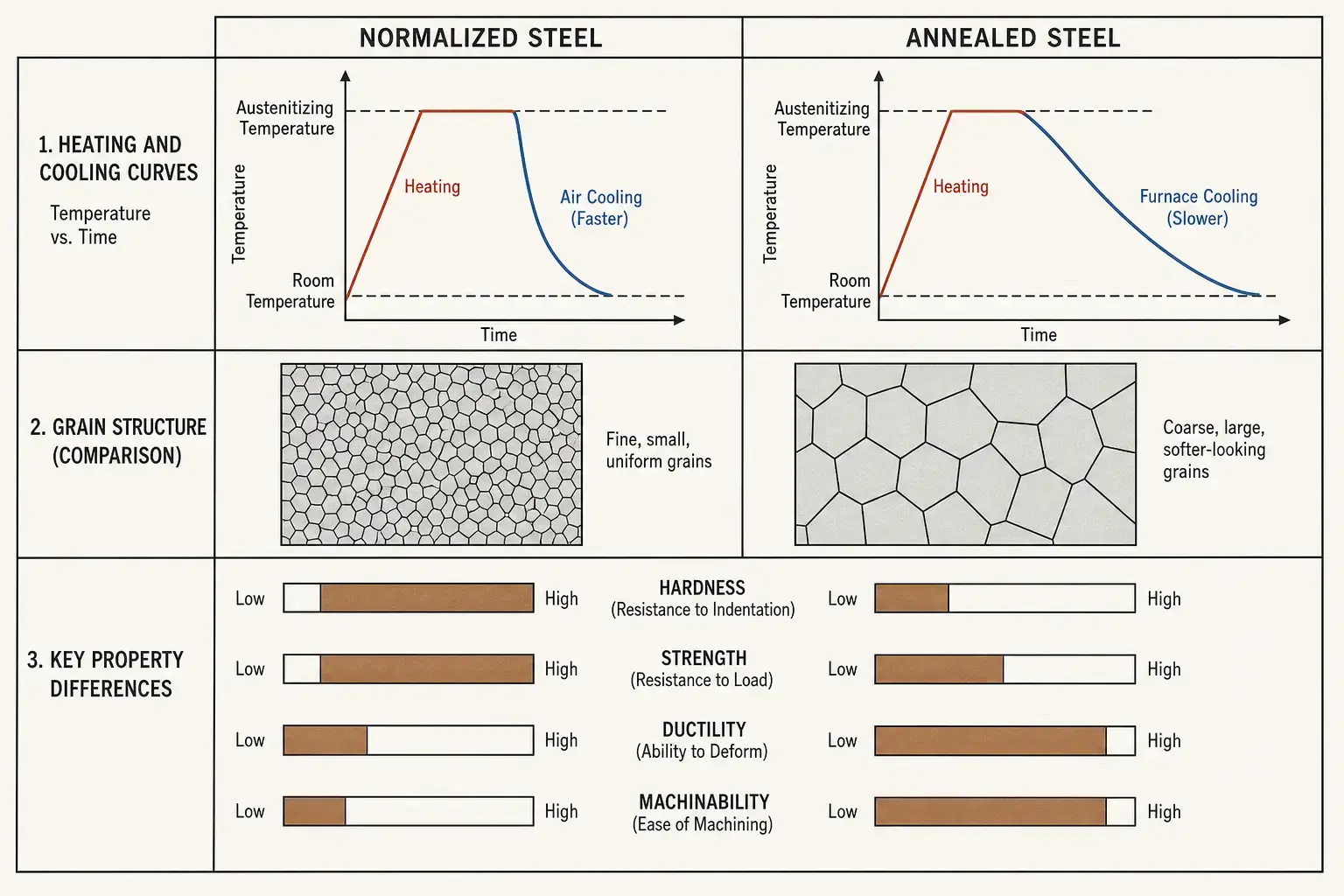
Normalizing pulls the part out and lets it cool in air. The faster cooling produces a finer grain structure, moderate hardness, and more uniform mechanical properties. Annealing keeps the part inside the furnace and lets it cool slowly — sometimes over hours. The slow cooling produces maximum softness, high ductility, and a coarse grain structure.
In induction heating, the heat-up is fast and localized — seconds instead of minutes. That alone does not change the metallurgy of normalizing or annealing. What changes is where you can run the process and how easily you can integrate it into a production line. More on that in Section 4.
| Aspect | Normalizing | Annealing |
|---|---|---|
| Cooling | Air — faster | Furnace-controlled — slow, often over hours |
| Hardness | Moderate | Lowest possible for the grade |
| Grain structure | Fine, uniform | Coarse, softened |
| Strength | Moderate to high | Low |
| Ductility | Moderate | High |
| Machinability | Good for medium-carbon steel | Best for high-carbon & alloy steel |
| Typical use | After forging, casting, welding, hot rolling — reset structure before next step | Before cold forming, deep drawing, heavy machining — soften for the next step |
2. When Normalizing Wins
Normalizing is the right call when the problem is inconsistent structure. Forging, casting, rolling, and welding leave behind non-uniform grain patterns, variable hardness, and residual stress. Normalizing resets all of that with an air cool — fast enough to refine the grain, slow enough to avoid the brittleness of a full quench.
| Application | Why Normalizing Fits |
|---|---|
| Forged steel parts | Resets grain structure after hot working; removes inconsistency from variable cooling after forging |
| Cast steel components | Improves uniformity before machining or hardening — cast structures are inherently coarse and uneven |
| Welded pipe & tube sections | Refines the heat-affected zone where weld microstructure differs from parent material |
| Medium-carbon steel before induction hardening | Creates a consistent starting microstructure — more predictable case depth and hardness distribution |
| Parts needing balanced strength & machinability | Air cool produces moderate hardness — hard enough for function, soft enough to cut without excessive tool wear |
A forged automotive shaft is a typical case. It comes out of hot forging with a grain structure shaped by whatever cooling happened on the shop floor that day. If it goes straight to machining or hardening, tool wear varies, distortion varies, case depth varies. Normalizing wipes that history clean. The shaft enters the next operation with a known starting point.
3. When Annealing Wins
Annealing is the right call when the part needs to be as soft and workable as possible. The slow furnace cool — sometimes controlled over hours — produces the lowest achievable hardness and the highest ductility for a given steel grade.
This makes annealing the default when the next operation is cold forming, deep drawing, severe bending, or heavy machining on high-carbon or alloy steel. Normalizing would leave these materials too hard, chewing through tooling and raising scrap rates.
| Application | Why Annealing Fits |
|---|---|
| High-carbon & alloy steel before machining | Spheroidized annealed structure = longest tool life, best chip control |
| Parts entering cold forming or drawing | Maximum ductility prevents cracking during severe deformation |
| Heavily welded fabrications | Slow cool relieves residual stress without introducing new distortion |
| Precision components requiring dimensional stability | Stable, stress-free microstructure before final machining — less movement after material removal |
| Wire, strip, thin-gauge tube | Soft condition required before bending, flattening, or redrawing operations |
Induction has a role in annealing too, but it is limited. Induction annealing works well for localized softening or stress relief on specific features. For full-part annealing that requires slow, controlled cooling over hours, a furnace is still the practical choice. The right question is not “can induction do annealing” but “does this specific part need the full furnace cycle, or can a localized anneal solve the problem faster?”
4. Where Induction Changes the Trade-Off
Here is what induction does not change: the metallurgy. Normalizing still requires heating above transformation and cooling in air. Annealing still requires slow cooling. The physics is the same.
Here is what induction does change: speed, footprint, integration, and localization.
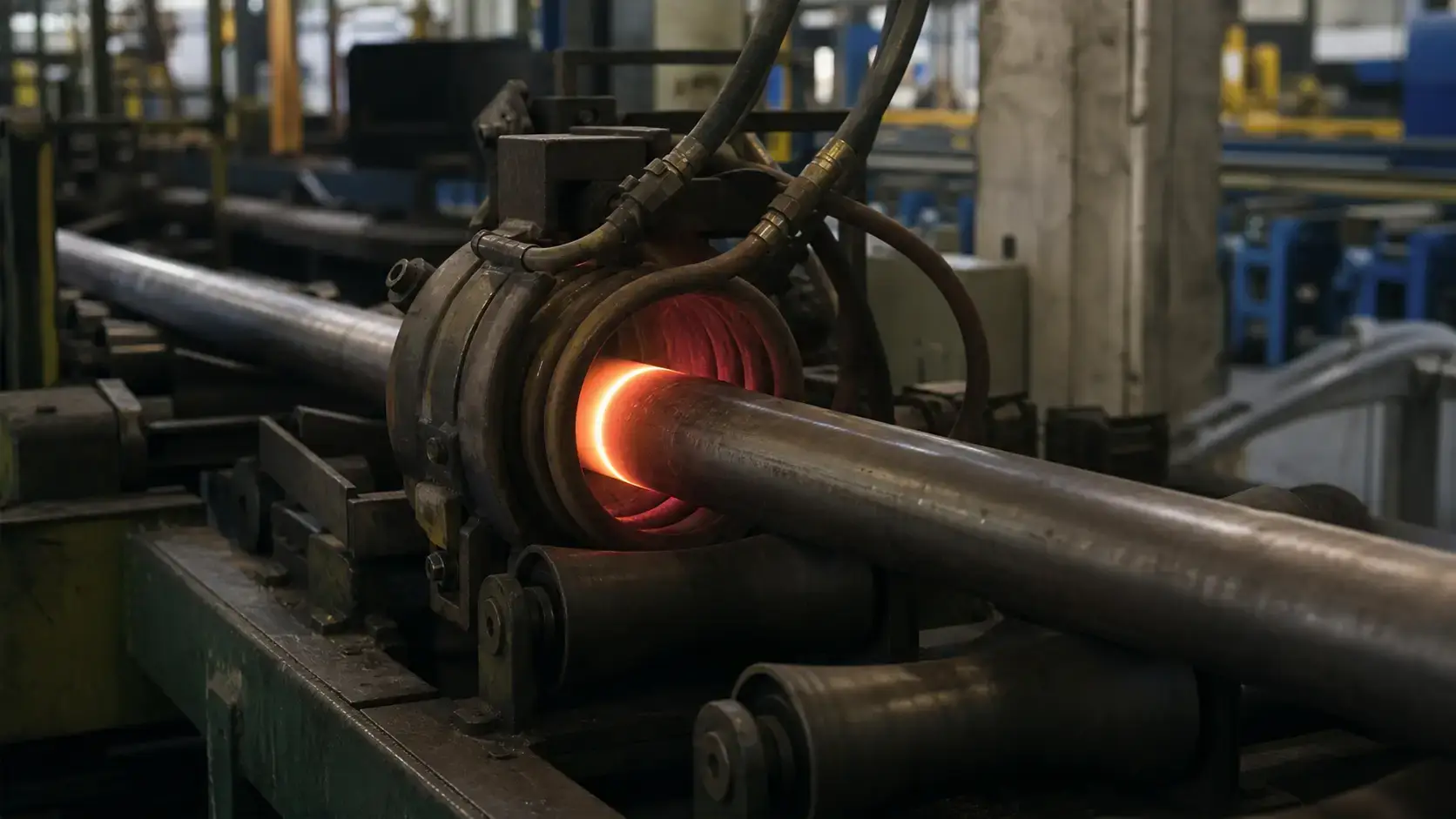
A furnace heats the whole part — and the air around it, and the chamber, and the fixtures — to reach temperature. Induction generates heat directly in the workpiece surface. For normalizing, where air cooling is the final step, that speed unlocks inline processing. A pipe or tube moving continuously through a coil at line speed can be normalized in seconds, not batch cycles.
Localization matters too. On a welded tube, only the weld seam and heat-affected zone may need normalizing. Induction can target that zone without heating the full circumference. On a forged automotive component, a specific bearing journal or gear blank area can be normalized while the rest of the part stays as-forged. A furnace cannot do that.
Two examples make this concrete:
— Pipe and tube normalizing. ERW tube mills run continuously. Taking pipe offline for batch furnace normalizing breaks the flow. Inline induction normalizing — coil positioned after the weld station, heating the seam zone to transformation temperature, air cooling on the run-out table — keeps the line moving. The key variables: tube diameter, wall thickness, line speed, and coil geometry. Get the frequency wrong and you heat only the surface. Get the power wrong and the line slows down.
— Automotive component normalizing. Forged gear blanks, shafts, and yokes enter the machining cell with whatever grain structure the forging process left behind. Induction normalizing before machining — sometimes in the same cell, with the same robot that loads the lathe — gives every part the same starting condition. The alternative is a batch furnace, which means inventory between operations, longer lead time, and parts that cool at different rates depending on where they sat in the basket.
Induction normalizing does not make annealing obsolete. For high-carbon steel that needs spheroidized structure before precision machining, the furnace anneal still wins. But for the broad middle — medium-carbon forgings, castings, weldments, and parts headed for induction hardening — induction normalizing often fits the production flow better. It removes the furnace as the bottleneck.
5. What Determines Your Equipment Spec
Material grade and carbon content. Low-carbon, medium-carbon, alloy, and tool steels do not respond the same way to the same temperature and cooling. A medium-carbon forging may normalize acceptably with a straightforward heat-and-air-cool cycle. A high-carbon steel may need tighter temperature control and verified cooling uniformity. Always review the material specification before setting target temperatures.
Part geometry and section thickness. Thin sections heat through quickly and cool uniformly. Thick sections develop a temperature gradient from surface to core during heating, and they cool at different rates across the section during air cooling. For induction normalizing, this affects frequency selection — lower frequency for deeper penetration, higher for surface-dominant heating on thin walls. It also affects heat time, scan speed or line speed, and whether the part needs rotation for uniformity.
Production rate and line integration. A normalizing process that works in a test lab falls apart at production speed if the power supply cannot sustain the duty cycle. Required throughput determines power supply size, coil arrangement, cooling capacity, and controls. For inline operations — tube normalizing at 30 meters per minute, for example — line speed is the first number the equipment designer needs. For discrete parts, cycle time and loading method matter more. A five-second heat cycle paired with a twenty-second manual load sequence is a three-second net cycle waiting to happen.
Temperature measurement and control. Induction heats fast. That means the control system has less time to react to a temperature excursion than it would with a furnace. Pyrometers, thermal cameras, or contact sensors must be positioned to read the critical area of the part — not a convenient but irrelevant surface. On moving or rotating parts, emissivity, scale, surface condition, and viewing angle all affect the reading. Closed-loop power control with real-time temperature feedback is worth the cost when the temperature window is tight.
Cooling method. For normalizing, air cooling is the default — but the actual cooling rate depends on part size, air movement, spacing between parts, and ambient shop temperature. Forced air can accelerate cooling but must be uniform. For annealing, cooling control is the whole game: the cooling curve defines the final properties. If your process calls for annealing, verify that the cooling method — furnace cool, insulated chamber, controlled ramp — can hold the required rate before you specify the heating side. As for the induction equipment itself, the power supply, capacitors, bus, and coil all need reliable water cooling. Undersized cooling shortens coil life and creates nuisance faults that eat into uptime long before anything actually fails.
6. Mistakes That Cost the Most
— Annealing when normalizing is enough. You pay for the full furnace cycle — energy, time, floor space — to produce a softer part than you needed. For medium-carbon forgings headed to machining and hardening, normalizing usually delivers the right balance of machinability and strength without the annealing overhead.
— Normalizing when the part needs maximum softness. High-carbon and alloy steels normalized instead of annealed will eat tooling, crack during forming, or both. If the next operation is severe cold work or heavy cutting on a hard grade, annealing earns its cost.
— Ignoring prior material history. The same steel grade responds differently depending on whether it was cast, forged, rolled, welded, or previously heat treated. Review incoming microstructure, not just the chemistry on the cert.
— Treating the induction coil as an accessory. A well-designed power supply paired with the wrong coil is a well-designed paperweight. Coil geometry determines heating pattern, uniformity, and whether the part reaches temperature before the line moves on. If the supplier cannot show you coil designs for your specific part geometry, keep looking.
— Confusing normalizing with hardening. Normalizing uses air cooling to refine grain structure. Hardening uses rapid quenching to form martensite. If a hardened part has cracking, soft spots, or distortion, the root cause is in the quench, the hardening process, or the starting microstructure — not the normalizing step.
Key Takeaway
Normalizing is not a cheaper annealing. Annealing is not a softer normalizing. They are different processes for different manufacturing problems. If the goal is grain refinement and consistent structure before the next operation: normalize. If the goal is maximum softness for forming or heavy machining: anneal. Induction normalizing does not change that decision tree — but it does make normalizing faster, more localized, and easier to integrate into a production line. Define the metallurgical requirement first. Pick the equipment second.
Q: Is normalized steel harder than annealed steel?
A: Yes. Normalized steel is harder and stronger than annealed steel of the same grade. The faster air cool produces a finer grain structure and higher strength. The exact difference depends on carbon content, alloy content, and section size.
Q: Can induction heating do annealing, or only normalizing?
A: Induction can do both, but the limitation is cooling. Normalizing only needs air cooling after heating — induction handles that well, especially inline. Annealing needs slow, controlled cooling — often over hours in a furnace or insulated chamber. Induction works for localized annealing on specific features, but full-part annealing with a controlled cooling curve is still furnace territory for most applications.
Q: When is furnace normalizing still the better choice?
A: When you are processing large batches of mixed parts that need long, uniform soak times, or when part geometry makes coil design impractical — very irregular shapes, extreme size variation within a batch, or parts that cannot be fixtured for inline heating. A furnace normalizes everything in the basket the same way. Induction normalizes one part, or one zone, at a time. Pick the tool that matches the production pattern.
Get an Engineering Review for Your Normalizing Application
Send us your part drawing, material grade, and production rate. We will tell you whether induction normalizing, annealing, or a different approach fits your process — before you commit to equipment.