Surface Decarburization in Induction Hardening: Causes, Detection, and Control
Separating Carbon Loss from Heating and Quenching Problems
A low-hardness surface after induction hardening does not automatically mean the induction process caused surface decarburization.
The carbon-depleted layer may have formed earlier during rolling, forging, annealing or another high-temperature operation. In other cases, the problem may not be decarburization at all, but insufficient heating, poor quenching or a localized soft spot.
The useful approach is therefore to identify the surface condition first, determine how deep it extends, and only then decide which part of the manufacturing process needs to be changed.
2. Where Decarburization Comes From in Induction-Hardened Parts
3. Decarburization or a Soft Hardening Result?
4. How to Confirm and Measure Decarburization Depth
5. Prevention and Corrective Actions
6. When Protective Atmosphere Is Worth Considering
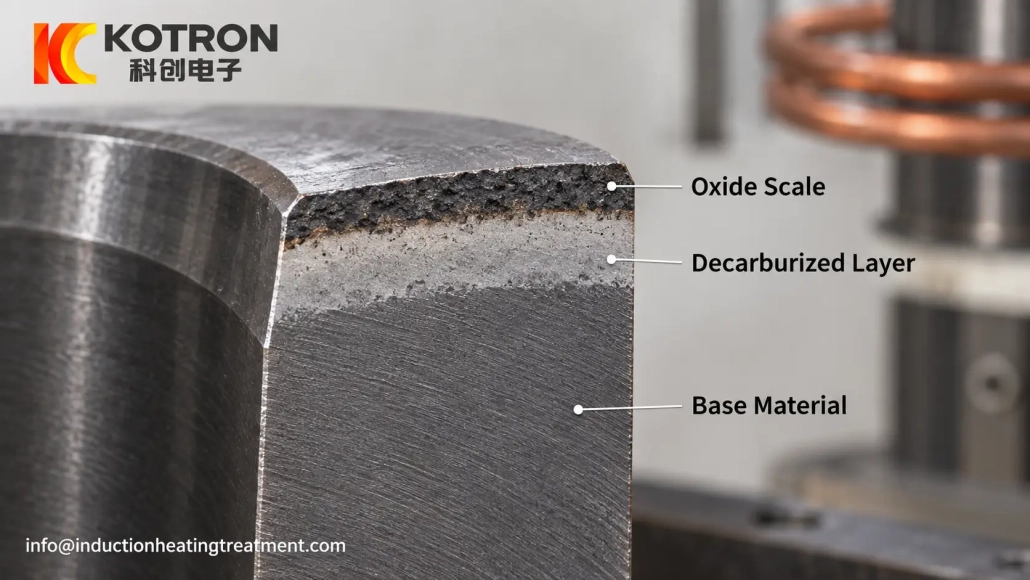
1. What Surface Decarburization Is — and How It Differs from Oxide Scale
Decarburization is the loss of carbon from the surface region of steel during high-temperature exposure. The affected area is commonly described as a decarburized layer, or simply a decarb layer in heat-treatment practice.
Depending on severity, the surface may show partial or complete decarburization. The distance from the surface into the material over which the effect can be detected is referred to as the decarburization depth.
Oxidation is a different process.
When hot steel reacts with an oxidizing atmosphere, oxides form on the surface. The visible result is usually oxide scale or scaling.
| Condition | Main change | Typical consequence |
|---|---|---|
| Surface oxidation | Oxides form on the steel surface | Scale, roughness, cleaning or material loss |
| Decarburization | Carbon content decreases below the surface | Reduced hardenability and lower surface hardness |
| Both | Oxidation and carbon loss occur during high-temperature exposure | Surface-quality and hardness problems |
The distinction matters because removing oxide scale does not restore the carbon that has already been lost beneath the surface.
A heavily scaled part is also not automatically heavily decarburized. Conversely, a surface that does not look badly oxidized may still contain a decarb layer.
Visual inspection alone is therefore not enough.
2. Where Decarburization Comes From in Induction-Hardened Parts
One of the first questions should be:
Was the decarburization actually produced during induction hardening?
Often, it was not.
Steel can develop a decarburized surface during earlier operations such as:
•Hot rolling
•Forging
•Annealing
•Normalizing
•Prolonged high-temperature furnace heating
If that layer remains after machining, it enters the induction hardening process as part of the incoming material.
This is especially important because induction hardening generally uses a much shorter high-temperature cycle than conventional furnace heat treatment. The short cycle limits the time available for additional carbon loss.
It does not, however, restore carbon to a layer that was already decarburized.
For example, a shaft may be heated and quenched correctly during induction hardening but still show low hardness immediately below the surface because the starting material already contained a carbon-depleted layer.
Increasing induction power in that situation may change the heat pattern without addressing the real cause.
Where decarburization does form during thermal processing, the main variables include:
Temperature. Higher temperatures generally increase diffusion and accelerate surface reactions.
Time. The longer the steel remains at elevated temperature, the more opportunity there is for the affected layer to grow.
Atmosphere. Oxygen, water vapor, carbon dioxide and the overall chemical condition of the heating atmosphere influence surface reactions and carbon loss.
Material condition. Steel composition and the condition of the incoming surface also affect how the material responds.
These variables should be reviewed across the whole manufacturing route, not only at the induction machine.
3. Decarburization or a Soft Hardening Result?
A low surface-hardness reading is a symptom. It is not a diagnosis.
Several induction hardening problems can produce apparently similar results.
| Possible cause | Typical clue |
|---|---|
| Decarburization | Carbon-depleted layer extending inward from the surface; often confirmed by metallography or hardness profile |
| Insufficient induction heating | Hardened zone or case does not reach the required condition in the affected area |
| Poor quenching | Localized soft area associated with inadequate or uneven cooling |
| Coil / coupling issue | Hardness pattern follows the geometry of the inductor or coil-to-part relationship |
| Incoming material variation | Similar processing produces inconsistent response between parts or locations |
A pre-existing decarb layer often follows the original steel surface relatively continuously.
A quenching problem is more likely to produce a localized pattern corresponding to spray coverage, geometry or cooling conditions.
Insufficient induction heating may show up as an incorrect hardness pattern or inadequate hardened depth rather than a thin carbon-depleted surface layer.
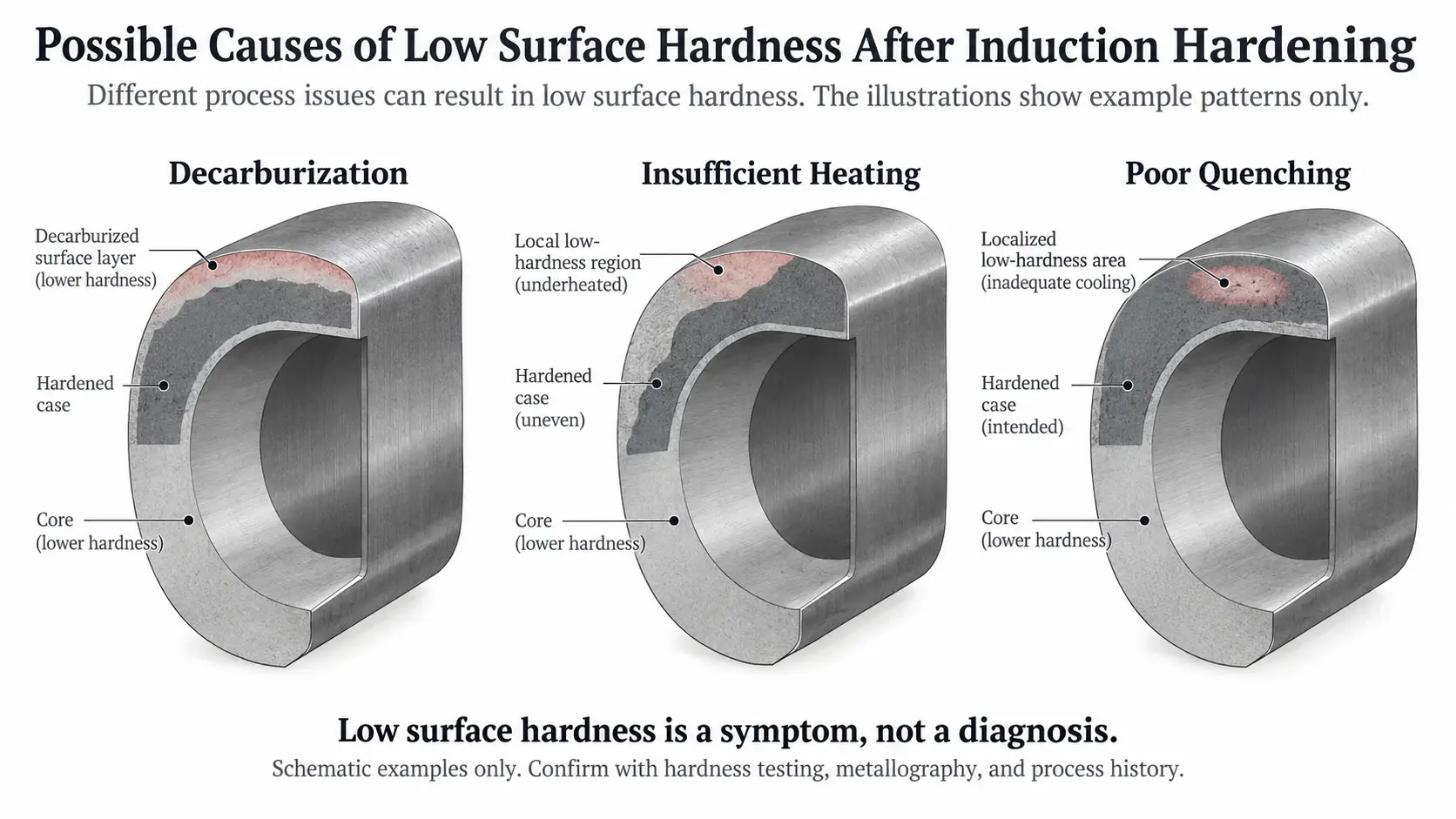
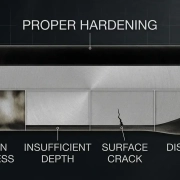
Decarburization, insufficient heating and poor quenching compared against a low surface-hardness reading.
This distinction matters because the corrective actions are completely different.
If the issue is poor quenching, changing the incoming material specification will not solve it.
If the issue is inherited decarburization, repeatedly adjusting scan speed or power may not solve it either.
The next step should therefore be measurement, not guesswork.
4. How to Confirm and Measure Decarburization Depth
Decarburization is normally evaluated from a cross-section rather than judged from surface appearance alone.
Two methods are especially useful in production troubleshooting.
Metallographic Examination
A section is cut, prepared and examined from the surface toward the unaffected material.
Depending on the steel and its heat-treatment condition, complete decarburization may appear as a strongly altered near-surface structure, while partial decarburization may show a gradual transition toward the unaffected base material.
The exact appearance depends on steel grade and prior processing, so a single microstructural feature should not be treated as universal proof.
Microhardness Traverse
A series of small hardness measurements is taken from near the surface toward the interior.
If decarburization has affected the hardening response, the hardness may increase progressively as the measurements move away from the surface and into unaffected material.
This is particularly useful when the engineering question is:
How deep does the affected layer extend?
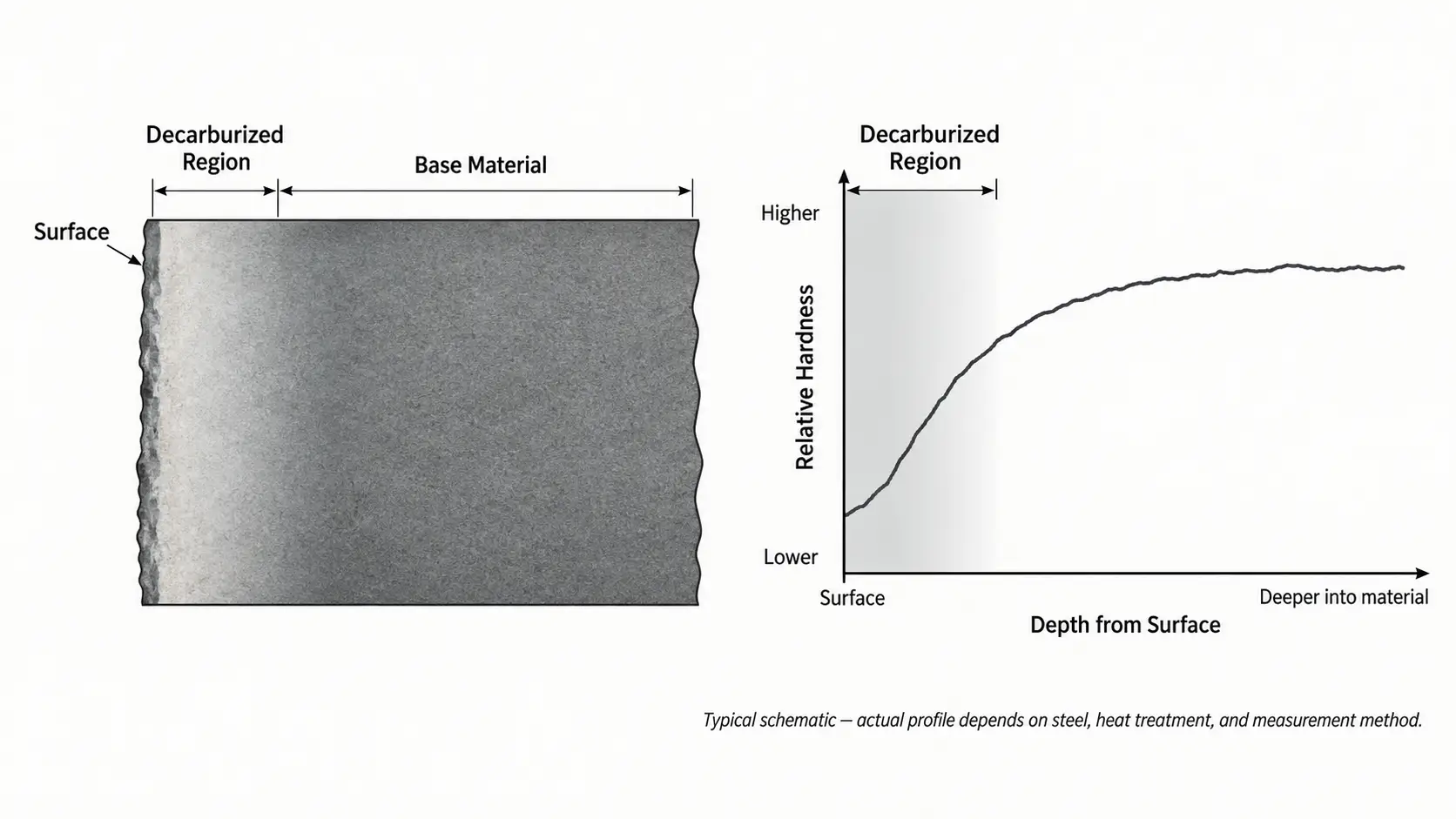
Microhardness traverse showing hardness increasing from a decarburized surface toward unaffected material.
ASTM E1077 covers methods for determining decarburization depth in steel, including microscopic and microindentation hardness approaches.
One point is important for quality control:
ASTM E1077 provides methods for measuring decarburization. It does not establish one universal allowable decarburization depth for every component.
Acceptance limits must come from the relevant drawing, product specification, material requirement or agreement between supplier and customer.
This prevents a common mistake: confusing “measured according to ASTM E1077” with “acceptable according to ASTM E1077.”
5. Prevention and Corrective Actions
Once decarburization has been confirmed, the next question is where it entered the process.
Start upstream.
If incoming bar, forging or tube already contains a significant decarb layer, review earlier hot-working or furnace operations and the amount of material removed before final hardening.
Possible actions include:
•Specifying an allowable incoming decarburization depth
•Increasing machining allowance where appropriate
•Removing the affected surface before final hardening
•Reviewing forging, rolling, annealing or normalizing conditions
•Reducing unnecessary high-temperature exposure
•Improving atmosphere control during the operation where carbon loss occurs
The induction hardening process should then be checked separately.
Heating temperature and time should be sufficient for hardening but should not be increased without a process reason. Coil design, frequency, power and scan speed should produce the required heat pattern without unnecessary dwell.
If the final surface is soft but metallography shows no meaningful decarb layer, attention should shift toward the induction heating and quenching process rather than continuing to treat the problem as decarburization.
This is also where existing troubleshooting information on uneven induction heating, soft spots and quench coverage becomes more relevant than further decarb analysis.
6. When Protective Atmosphere Is Worth Considering
Protective-atmosphere induction heating can be useful when the hot steel surface needs better protection from the surrounding air.
Its most direct value is reducing oxidation and oxide scale. Under appropriately controlled atmosphere conditions, it can also help limit decarburization.
That does not mean every induction hardening process needs a protective atmosphere.
For many ordinary components, the induction heating cycle is short, minor surface oxidation is acceptable, and scale can be removed later without creating a meaningful production problem.
Protective-atmosphere heating becomes more attractive when:
•Surface scale must be minimized
•Subsequent blasting, pickling or grinding is undesirable
•The component has a high-value finished surface
•Decarburization limits are tight
•Surface condition affects downstream processing
•Additional machining allowance is limited
The terms protective atmosphere, inert atmosphere and controlled atmosphere should also not be treated as automatically interchangeable.
An atmosphere that reduces oxygen exposure may be effective for oxidation control without necessarily providing the carbon-control conditions required to prevent every form of decarburization.
For that reason, atmosphere selection has to follow the material and process requirement rather than simply choosing a gas name.
When low surface hardness appears after induction hardening, the most efficient troubleshooting sequence is usually:
Confirm the surface condition → measure the affected depth → check incoming material → review previous thermal processing → check induction heating and quenching → then change the process.
That sequence helps separate a true decarburization problem from a heating or quenching problem — and avoids adjusting the induction machine for a defect that may have formed much earlier in production.
Key Takeaway
A soft surface after induction hardening is a symptom, not a diagnosis. Surface decarburization is one possible cause, but the carbon-depleted layer often forms earlier during rolling, forging or furnace heating. Confirm the surface condition and measure the affected depth before changing any part of the process.
Frequently Asked Questions
Click a question to expand the answer.
Does a low surface hardness after induction hardening always mean decarburization?
No. The carbon-depleted layer may have formed earlier during rolling, forging, annealing or another high-temperature operation, or the soft surface may come from insufficient heating, poor quenching or a localized soft spot rather than decarburization.
How is decarburization depth measured?
From a cross-section, using metallographic examination or a microhardness traverse from the surface toward the interior. ASTM E1077 covers methods for determining decarburization depth, but acceptance limits come from the drawing or product specification, not from the standard itself.
Can induction hardening restore carbon to a decarburized layer?
No. Induction hardening uses a short high-temperature cycle that limits additional carbon loss, but it does not restore carbon to a layer that was already decarburized. Increasing power or adjusting scan speed will not fix inherited decarburization.
Does every induction hardening process need a protective atmosphere?
No. Many ordinary components have short heating cycles where minor oxidation is acceptable. Protective-atmosphere heating becomes more attractive when scale must be minimized, decarburization limits are tight, or the surface condition affects downstream processing.
What is the first step when a soft surface appears?
Confirm the surface condition, measure the affected depth, check the incoming material and review previous thermal processing before adjusting the induction heating and quenching. This separates a true decarburization problem from a heating or quenching problem.
Control Surface Decarburization in Your Hardening Process
Send your material specification, heat-treatment requirement and processing route. We will help confirm whether the soft surface is decarburization, measure the affected depth, and identify the right stage to correct.