Automatic Induction Hardening and Tempering Line for Automotive Transmission Components
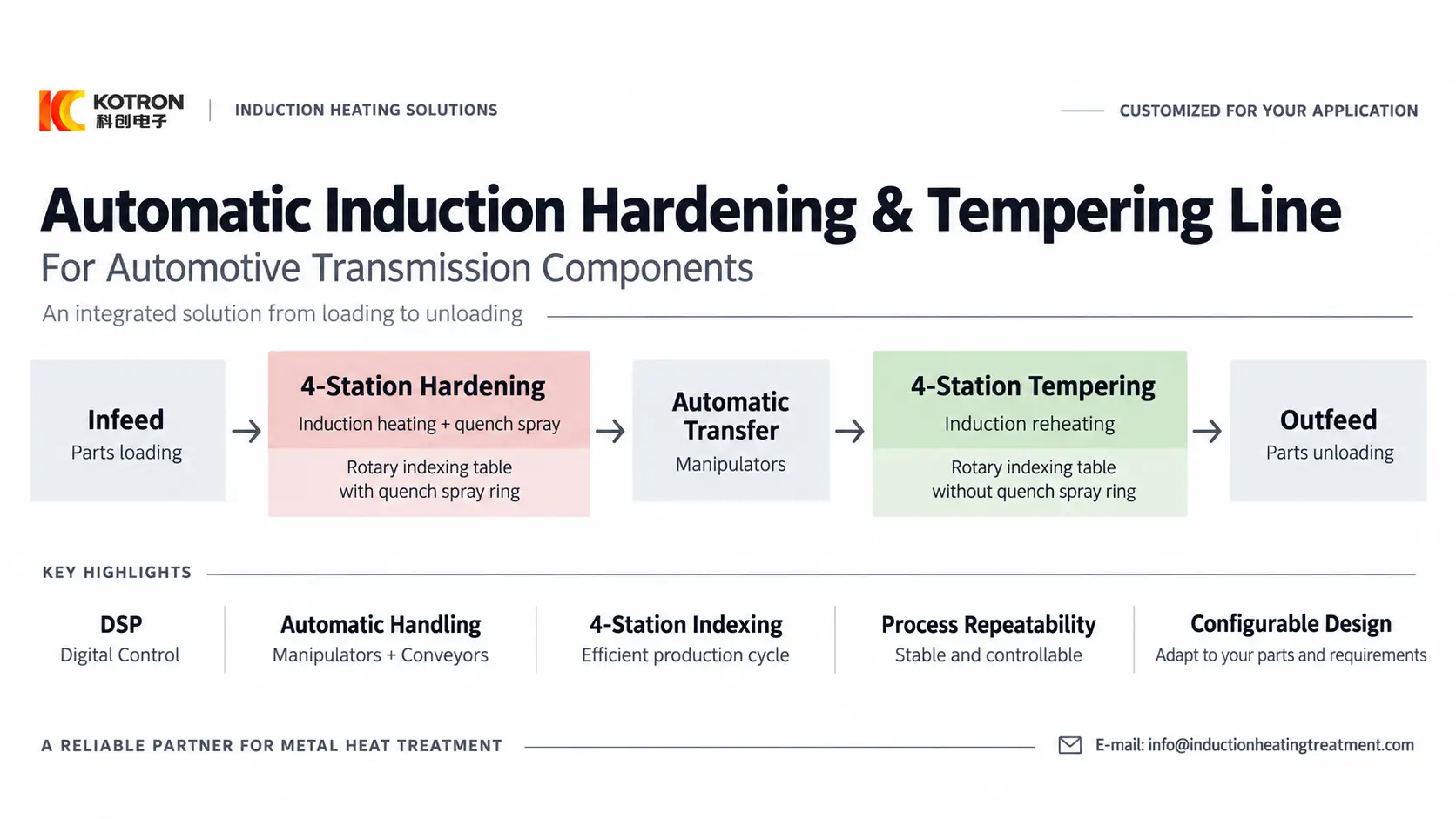
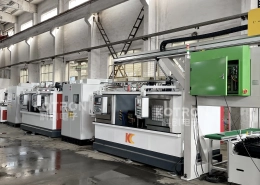
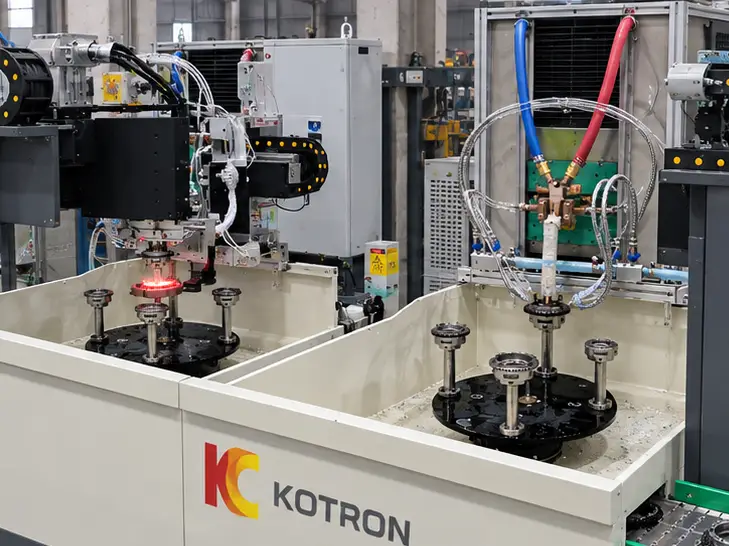
Automatic induction hardening and tempering line — two 4-station rotary indexing machines linked by automatic manipulators, with infeed and outfeed conveyors.
Ⅰ. See the Complete Automated Process
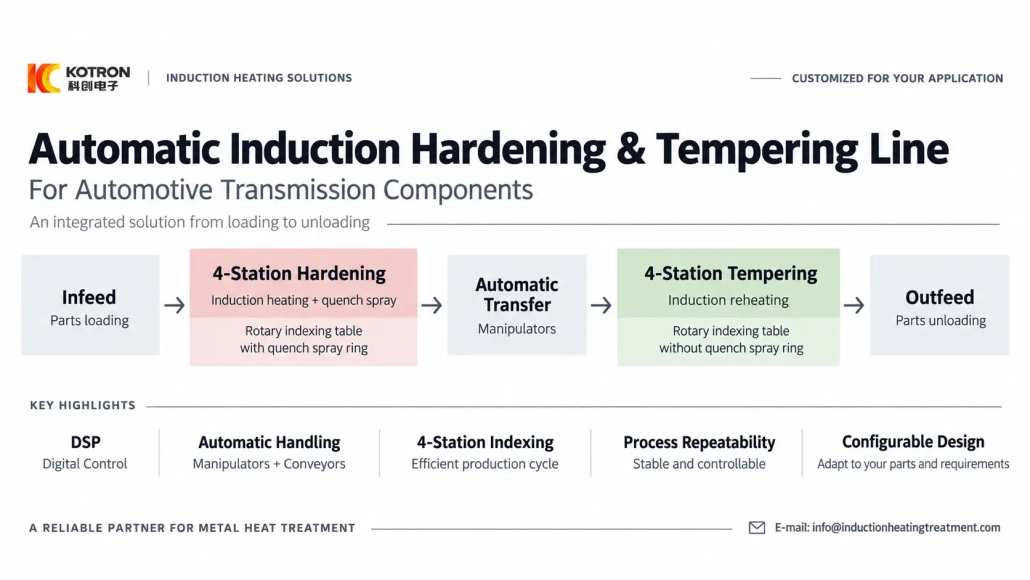
The production flow is straightforward:
1.Infeed Conveyor
2.Induction Hardening
3.Automatic Transfer
4.Induction Tempering
5.Outfeed Conveyor
A manipulator loads the incoming component onto the first 4-station machine. After hardening, a second manipulator transfers it to the tempering machine. A third manipulator unloads the finished component onto the outfeed conveyor.
Hardening, transfer and tempering are connected as one automatic heat-treatment line instead of separate manual operations.
Ⅱ. Two 4-Station Machines for Hardening and Tempering
The two rotary indexing machines perform different parts of the heat-treatment process.
Hardening Stage
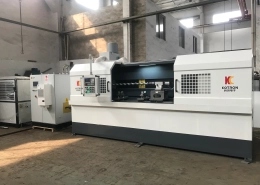
The first machine performs induction hardening.
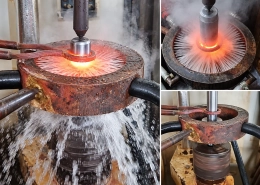
The required area is heated by the induction system and then rapidly cooled by the quenching system. A quench spray ring is therefore installed at the hardening stage.
Tempering Stage
The second machine performs induction tempering.
The hardened component is reheated according to the required tempering process. No hardening-stage quench spray ring is used on this machine.
Together, the two stages form the complete quenching and tempering process used for this automotive transmission component.
The customer’s material specification determines the required hardness, tempering condition and other metallurgical results. Our equipment provides the heating, quenching, movement and control platform used to carry out that process.
Ⅲ. Why Use a 4-Station Rotary Indexing Layout?
Four stations do not mean four different heat-treatment processes.
Each machine has a rotary indexing table with four workpiece positions. The table indexes the components through defined positions during the automatic production cycle, making it easier to coordinate processing, loading, unloading and part transfer at a stable rhythm.
This configuration is particularly suitable when the heat-treatment equipment has to work together with manipulators and conveyors rather than as an isolated machine.
The completed line uses two 4-station machines, but four stations are not a fixed requirement.
Another project may use a different number of stations, a different table arrangement or another loading method. The station quantity should follow the component, required production cycle and automation layout.
Ⅳ. DSP Digital Control Works Together with Automation
The main value of digital control is not simply that the machine can heat a metal part.
In repeated manufacturing, an established process has to be executed consistently from one workpiece to the next and from one production batch to another.
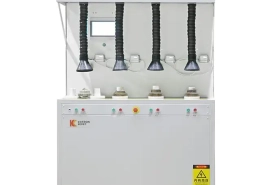
Our induction systems can use IGBT power conversion with DSP digital control, allowing the heating power supply to become part of the automated production system instead of operating as a manually adjusted standalone heater.
Depending on the project requirements, the control and monitoring system can be configured with:
1.Digital power setting
2.Heating-time control
3.Voltage and current monitoring
4.Power monitoring
5.Temperature feedback
6.Temperature closed-loop control
7.Workpiece recipe management
8.Process parameter limits
9.Alarm and event records
10.Heating or process curves
11.Historical production records
12.Batch information
13.PLC / HMI communication
14.Production-line integration
A process recipe can store the operating conditions developed for a particular component. When the same product returns to production, the corresponding settings can be recalled instead of rebuilding the process from manual adjustments.
Temperature feedback adds direct thermal information from the workpiece, while digital power control provides repeatable electrical input under established operating conditions.
Production records and alarms also make it easier to review what happened during a batch rather than relying only on an operator’s memory.
This is where digitalization and automation work together: the digital system controls and records the process, while the automatic machine executes the movement and production sequence.
Ⅴ. Why Automate Hardening and Tempering?
For automotive transmission component production, the benefit is not simply replacing an operator with a manipulator.
Automation controls how the workpiece moves through the complete process.
In this line:
1.The first manipulator loads the hardening machine
2.The second transfers the component from hardening to tempering
3.The third unloads the finished part
4.The conveyors connect the line with upstream and downstream handling
This removes repeated manual transfer of heated components and fixes the handling sequence within the machine cycle.
Hardening and tempering can also use their own heating parameters while remaining part of the same production line.
For manufacturers producing the same or related components repeatedly, this provides a practical route from an operator-dependent process toward a more standardized production method.
Digital control also makes the induction section easier to integrate with PLC-controlled indexing tables, manipulators, conveyors and other automatic equipment.
Ⅵ. A Completed Solution for Automotive Transmission Components
This project was built for a toothed automotive transmission component and combines:
| Item | Completed Project |
|---|---|
| Application | Automotive transmission component |
| Heat-treatment process | Induction hardening + induction tempering |
| Hardening machine | 4-station rotary indexing machine |
| Hardening cooling | Quench spray ring |
| Tempering machine | 4-station rotary indexing machine |
| Tempering-stage hardening spray ring | Not used |
| Part transfer | 3 automatic manipulators |
| Material flow | Infeed and outfeed conveyors |
| Induction control | DSP digital control |
| Production mode | Automatic |
This table describes the configuration used for this project. It is not a fixed specification for every customer.
Our heat-treatment systems can also be configured with recipe management, temperature measurement and closed-loop control, process curves, alarm records, historical production data and other digital monitoring functions according to the required level of process control.
Ⅶ. Configure the Line Around Your Production Process
A new project does not have to copy this two-machine, 4-station layout.
The station quantity, induction power, operating frequency, inductor, quenching system, fixtures, manipulators, conveyors and control functions can all be configured around the customer’s component and production requirement.
If you are planning a similar automatic heat-treatment line, the most useful starting information is:
1.Workpiece drawing
2.Material
3.Heat-treatment area
4.Required hardness
5.Case depth
6.Existing process
7.Production rate
8.Automation requirement
From these details, we can evaluate whether a similar hardening-and-tempering line is suitable or whether another station layout would better match the production process.
The heat-treatment process belongs to the manufacturer. Our job is to provide the digital induction heating and automation equipment that can carry it out in a controlled, repeatable and scalable way.
Plan Your Automatic Hardening and Tempering Line
Send your workpiece drawing and process requirements. We will evaluate the station layout and recommend a configuration matched to your production rate.