Multi-Station Induction Hardening Machine for Small Precision Automotive Parts
Ⅰ. See the Multi-Station Hardening Process
The video shows the actual production process for a small fuel-injection component.
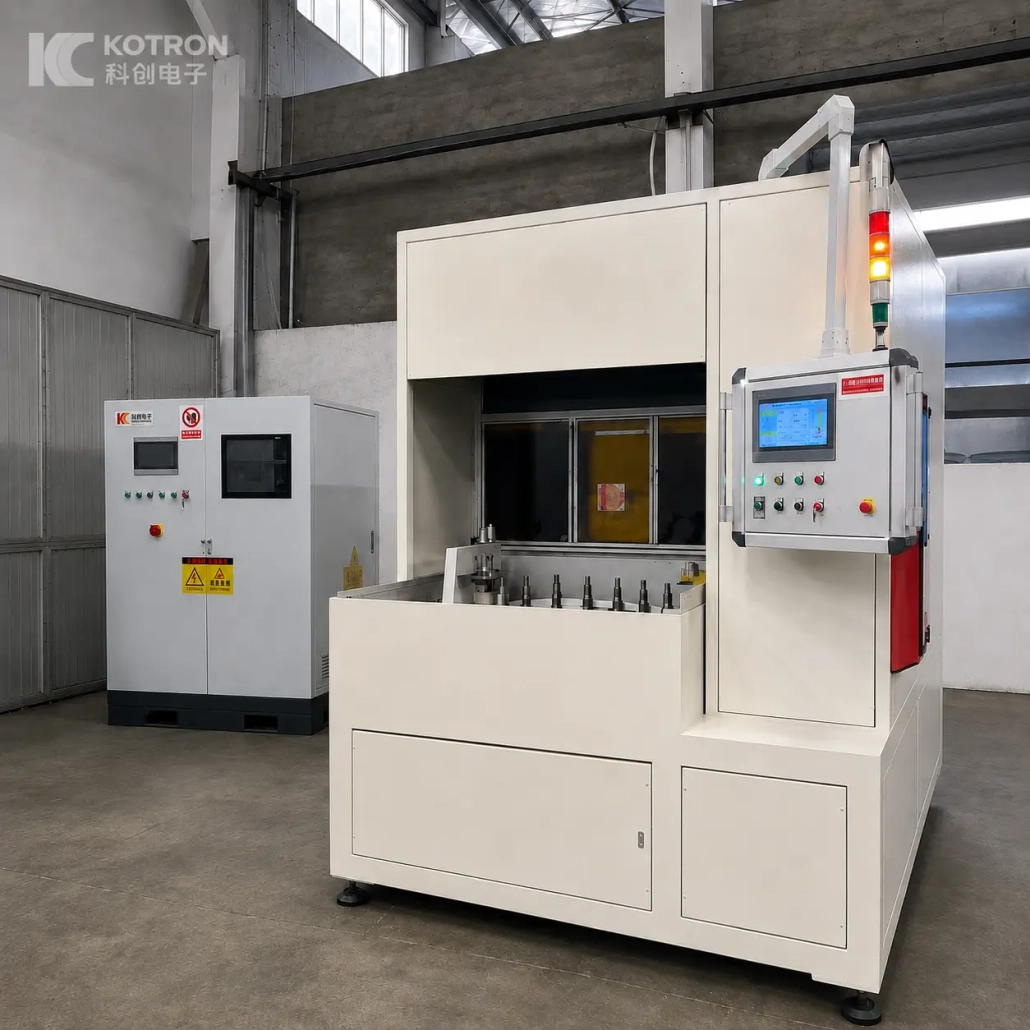
Several workpieces are held vertically around the indexing mechanism. As the machine cycles, they move from one position to the next. The recorded process clearly shows a selected area of the workpiece being heated by induction, followed by spray quenching.
The rotary arrangement allows different workpieces to be at different stages of the production cycle at the same time. This makes the machine particularly suitable for repeated batch production of small components.
Ⅱ. What Parts Are Suitable for Multi-Station Hardening?
A rotary indexing layout is particularly useful when compact workpieces can be positioned consistently at the heating and quenching stations.
Typical applications can include fuel injector nozzles, small gears and other compact precision parts with similar positioning and hardening requirements. The final suitability depends on the material, geometry, hardened area and production volume.
The inductor and fixture are matched to the actual component rather than treated as universal tooling.
KOTRON also develops induction hardening equipment for larger automotive parts such as gears, half shafts, CV-joint components, steering parts and bearing-related components. These applications may require different machine structures from the compact rotary indexing system shown here.
Ⅲ. How the Rotary Indexing Process Works
The basic production sequence is:
Loading → Indexing → Induction Heating → Spray Quenching → Cooling → Unloading
Workpieces are arranged around the indexing mechanism. After one process step is completed, the table moves them to the next position.
At the heating position, the inductor concentrates heat on the required section rather than heating the complete workpiece. Quenching follows according to the established process.
The number of indexing positions does not necessarily equal the number of heating stations. A rotary table may carry several workpieces while using fewer actual heating and quenching positions.
The final station arrangement is selected according to the workpiece and required production sequence.
Ⅳ. High-Frequency Induction Hardening: Actual Operating Data
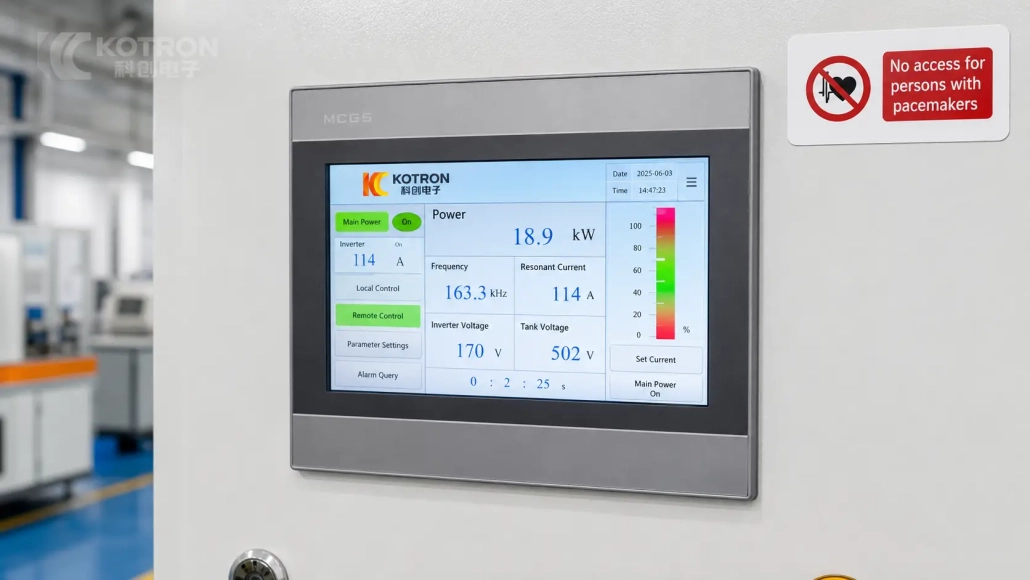
The HMI shown in the recorded process provides a useful view of the machine under real operating conditions.
| Operating Value | HMI Reading |
|---|---|
| Power | 18.9 kW |
| Frequency | 163.3 kHz |
| Resonant Current | 114 A |
| Inverter Voltage | 170 V |
| Tank Circuit Voltage | 502 V |
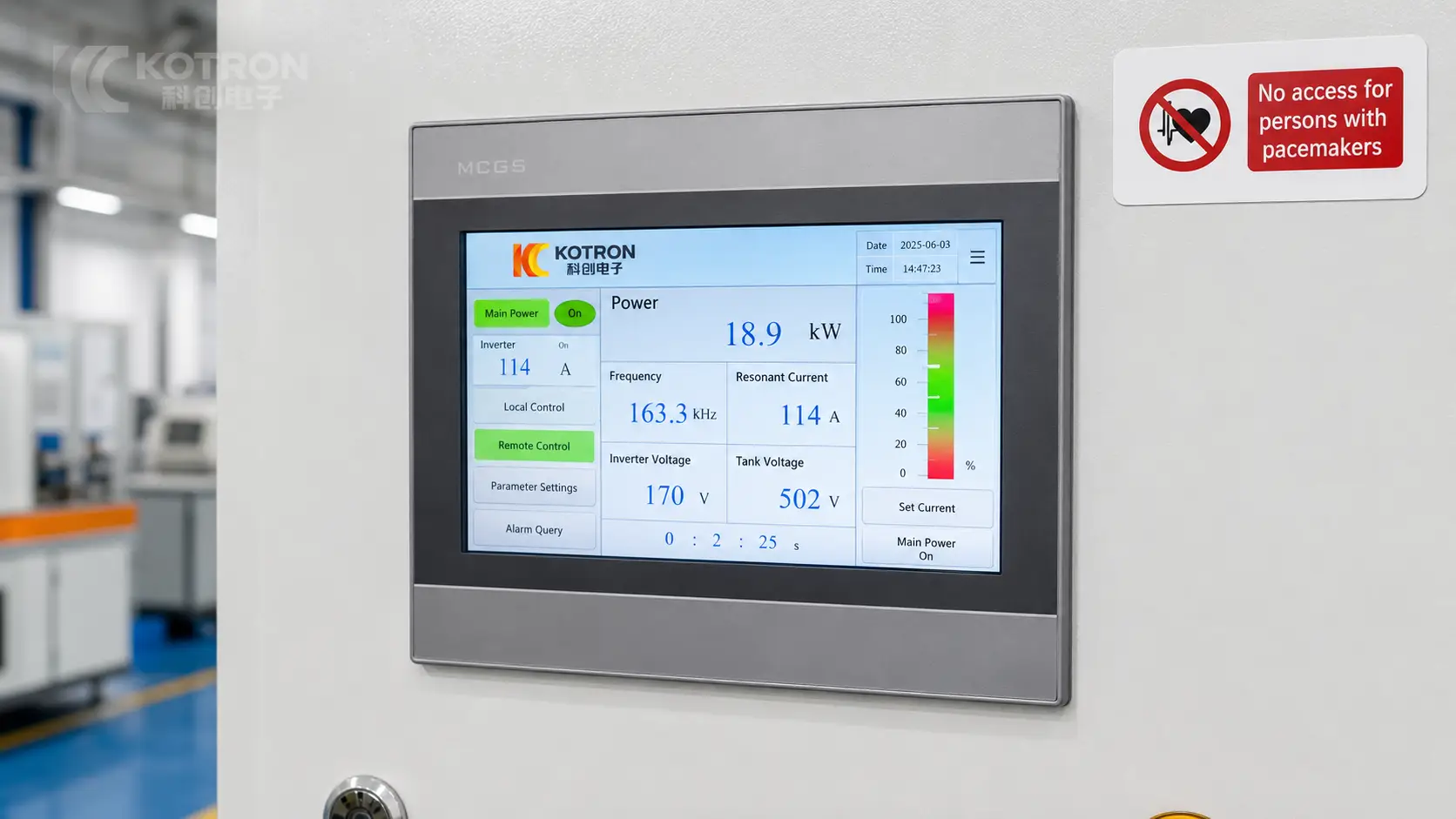
These are real-time readings from this particular heating cycle, not the rated specifications of the machine.
Final power and frequency are selected according to the workpiece material, geometry, hardened area and required hardening depth. The 163.3 kHz value shown here is process data from this application rather than a universal setting for small automotive parts.
Ⅴ. Machine Structure and Process Control
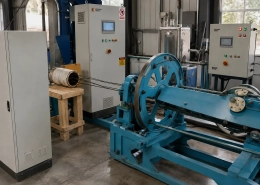
The machine uses an enclosed structure that separates the processing area from the operator position.
Its working arrangement combines the rotary indexing mechanism, vertical workpiece fixtures, induction heating position, spray quenching system and operator controls within one production cell.
The HMI on the recorded machine displays operating information including power, frequency, current and voltage. Parameter setting, local and remote control, and alarm-query functions can also be seen on the interface.
For projects that require more complex heating processes, time-shared multi-frequency power, workpiece rotation and adjustable inductor positioning can be configured as required.
Ⅵ. Custom Machine Layouts for Different Automotive Parts
A compact rotary indexing machine works well for certain small precision components, but it is not the only form of induction hardening equipment used for automotive production.
A long half shaft, for example, may require additional support and a scanning hardening process. Gears and CV-joint components require different fixtures, inductors and movement arrangements.
KOTRON develops the machine around the actual part rather than treating one mechanical layout as a universal solution.
The main factors include workpiece geometry, material, hardening position, required hardness and case depth, production rate, induction frequency, inductor design, workpiece movement and quenching method.
For related components with similar dimensions, one machine platform may sometimes be used with different fixtures, inductors and process programs. Parts with substantially different geometry normally require another machine configuration.
Ⅶ. Automation and Process Monitoring
The level of automation can be selected according to the production line.
Automatic loading, unloading, workpiece transfer and downstream conveying can be integrated where required. The actual arrangement depends on workpiece shape, production volume and factory layout.
Process monitoring is also available as a project option where production records or traceability are required. Depending on the configuration, operating parameters, alarms, process curves and historical production data can be recorded and reviewed.
These functions are selected according to the project rather than treated as standard equipment on every multi-station machine.
Ⅷ. What We Need Before Machine Selection
A useful technical proposal starts with the workpiece, not with a machine power rating.
| Workpiece Information | Process / Production Requirement |
|---|---|
| Part drawing | Area to be hardened |
| Material and grade | Required surface hardness |
| Overall dimensions | Required effective case depth |
| Part weight, if relevant | Target production rate |
| Current loading / handling method | Automation requirement |
| Complete part range, if applicable | Traceability requirement |
If several parts need to be produced on the same system, send the complete part range. We can then evaluate whether they can share one machine platform with different fixtures and inductors, or whether separate machine arrangements would be more practical.
The inductor is also selected around the actual workpiece geometry rather than supplied as one universal coil.
Ⅸ. Frequently Asked Questions
Click a question to expand the answer.
+ What parts are suitable for a multi-station induction hardening machine?
The rotary indexing format is particularly suitable for repeated production of small precision components that can be positioned consistently through a defined heating and quenching cycle.
+ Is the machine only for fuel injector nozzles?
No. The machine shown here is a fuel injector nozzle application. Other compact precision components can be evaluated for a similar multi-station arrangement. Larger or substantially different automotive parts may require another machine layout.
+ Can different parts use the same machine?
Possibly. Parts with similar dimensions and movement requirements may share the same machine by changing the fixture, inductor and process program. The practical range has to be checked from the actual drawings.
+ Can automatic loading be added?
Yes. Automatic loading and unloading can be integrated according to the workpiece and required production cycle.
+ How are induction power and frequency selected?
They are determined from the workpiece material, dimensions, required heating area, hardening depth, cycle time and inductor design. The real-time values shown in the video are specific to that recorded process.
Send Your Part Drawing to Discuss the Hardening Process
Send your workpiece drawing and hardening requirements. We will evaluate the part and propose a suitable multi-station induction hardening layout.