Disc Outer Diameter Induction Hardening for Mechanical Components
Ⅰ. Watch the 300 mm Disc Induction Hardening Process
Video: Super-audio-frequency induction hardening application for the outer circumference of a 300 mm disc.
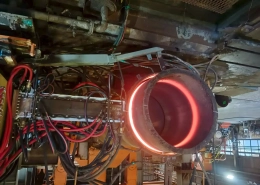
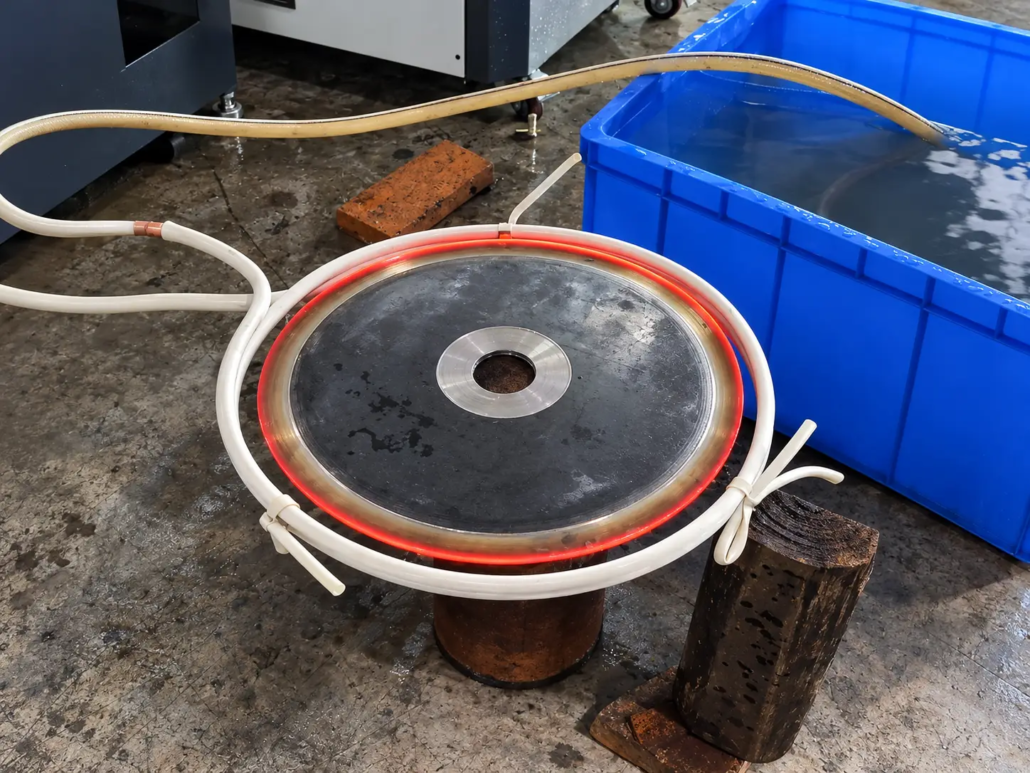
The demonstration shows a circular metal disc with a central hole positioned inside a circular induction coil. During heating, a continuous red-hot band develops around the outer circumference, while the central portion remains comparatively dark.
The video presents the process as suitable for uniform peripheral hardening. Confirming hardness uniformity requires testing of the hardened surface.
Application Details
| Item | Description |
|---|---|
| Workpiece | Circular metal disc with a central hole |
| Outer Diameter | 300 mm |
| Treatment Area | Smooth outer circumference |
| Process | Induction hardening |
| Heating Method | Super-audio-frequency induction heating |
| Inductor | Customized circular induction coil |
| Equipment Solution | Induction power supply, tooling, quenching and control equipment as required |
The video identifies the application as induction hardening, although the visible footage primarily shows the heating stage rather than the subsequent quenching operation.
Ⅱ. Workpieces and Industrial Applications
This induction hardening arrangement is intended for circular components that require localized treatment around their outer diameter.
For suitable hardenable steel parts, peripheral hardening may be used where the outer surface is subject to wear or mechanical contact, while the main body does not require the same hardened condition.
Potential applications include:
— Steel discs requiring outer diameter hardening.
— Circular mechanical components with wear-resistant outer surfaces.
— Disc-shaped power transmission components.
— Suitable flanged components requiring peripheral hardening.
— Custom circular steel parts with localized surface-hardening requirements.
Relevant manufacturing sectors may include general machinery, industrial equipment, power transmission equipment and heavy machinery.
Ⅲ. How the Induction Hardening System Works
The heating arrangement uses a circular inductor positioned around the workpiece’s outer circumference.
When the induction power supply energizes the coil, the alternating magnetic field induces electrical currents within the metal component. The resulting heat is concentrated in the region coupled to the inductor.
The complete hardening process involves coordinated workpiece positioning, induction heating and quenching.
Workpiece Positioning
The disc is supported and located relative to the induction coil. The fixture must maintain the required position and clearance while accommodating the workpiece geometry and heating conditions.
Peripheral Induction Heating
The circular inductor directs electromagnetic energy toward the outer circumference.
Coil geometry, power, frequency, heating time and coupling conditions influence the resulting temperature distribution.
For this application, the heating arrangement is intended to produce a circumferential heating band suitable for the required hardening process.
Quenching
For a suitable hardenable steel, the required surface structure is produced by heating the selected region to the appropriate austenitizing condition and applying a suitable quenching process.
The quenching method must be matched to the material, required hardened depth, workpiece geometry and allowable distortion.
Heating uniformity alone does not establish hardness uniformity. The final hardening result depends on both the heating and quenching stages.
Ⅳ. Customized Induction Coil and Workpiece Tooling
The circular induction coil is a key part of the equipment configuration.
Its geometry is selected to match the disc’s outer diameter and the required width of the heating band. Coil-to-workpiece clearance, electrical matching and the distribution of electromagnetic energy must also be considered.
For different disc geometries, the design may need to account for:
— Outer diameter and workpiece thickness.
— Width and location of the hardened area.
— Peripheral profile and surrounding features.
— Coil clearance and workpiece positioning.
— Required heating depth and temperature distribution.
The 300 mm disc shown in the video is one application example, not a fixed equipment size limit.
Workpiece fixtures are also selected for the production process. A simple positioning arrangement may be sufficient for some applications, while others require dedicated clamping, handling or movement mechanisms.
The coil, fixture and heating process should be developed together to achieve the required treatment area.
Ⅴ. Complete Induction Hardening Equipment Configuration
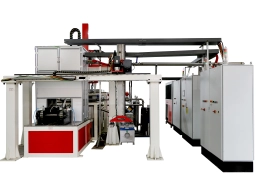
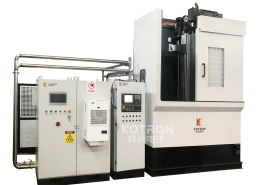
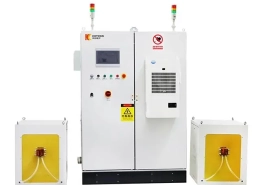
KOTRON supplies induction heating and hardening equipment solutions covering the power supply, customized inductor, workpiece tooling, quenching equipment and associated control and automation systems.
For disc outer diameter hardening, the equipment scope is established according to the required process and the customer’s existing production facilities.
| Equipment Component | Configuration Considerations |
|---|---|
| Induction Power Supply | Power and operating frequency selected for the workpiece and heating requirement |
| Induction Coil | Customized circular inductor matched to the outer diameter |
| Workpiece Fixture | Positioning, support and clamping according to the part geometry |
| Quenching Equipment | Cooling arrangement matched to the material and hardening requirement |
| Process Control | Heating parameters and process sequence control |
| Automation | Loading, unloading, positioning and handling where required |
| Cooling System | Equipment cooling matched to the selected induction system |
Power Supply and Process Control
The demonstrated application uses super-audio-frequency induction heating.
For a new project, the operating frequency and power must be selected according to material properties, workpiece dimensions, required hardened depth and heating conditions.
The control arrangement can be specified to coordinate heating parameters and the relevant machine operations.
Quenching Integration
For a complete hardening process, the quenching equipment must be coordinated with the heating stage.
Quenchant selection, cooling conditions and quenching timing affect the resulting hardness and dimensional stability. The actual arrangement is established during process development.
Automation and Production Integration
For batch production, the equipment may incorporate programmable workpiece positioning, automatic loading and unloading, and coordinated process control.
The required automation level is determined by the production cycle, workpiece variety, handling requirements and available factory layout.
Ⅵ. Selecting the Right System for Disc Outer Diameter Hardening
Disc diameter is only one factor in selecting an induction hardening system.
The material, section thickness, required hardened area and production conditions must be evaluated together.
| Selection Factor | Engineering Consideration |
|---|---|
| Material | Hardenability and heating/quenching requirements |
| Workpiece Dimensions | Coil size, fixture design and heating demand |
| Hardening Area | Position and width of the required hardened band |
| Target Hardness | Required surface properties |
| Effective Case Depth | Heating frequency, thermal cycle and quenching requirements |
| Production Requirements | Processing sequence, handling and automation |
| Existing Equipment | Scope of integration with available production systems |
Where a specified surface hardness or hardened depth is required, the process should be developed and verified through appropriate testing.
For components that require hardening on an internal surface instead of the outer diameter, KOTRON also offers an internal bore induction hardening machine for automotive and motorcycle precision parts.
Ⅶ. Frequently Asked Questions
Click a question to expand the answer.
Can the system process discs larger or smaller than 300 mm?
Different workpiece sizes can be evaluated by selecting appropriate induction coils, power supplies and fixtures. The actual working range must be established for the selected equipment configuration.
Does the system heat the entire disc?
The demonstrated induction coil is arranged to concentrate heating around the outer circumference. Heat also conducts into adjacent material, so the actual heating distribution depends on the workpiece and process conditions.
Can uniform hardening be achieved around the disc circumference?
The circular inductor is intended to support circumferential heating. Achieving the specified hardness distribution also requires suitable material, controlled heating and quenching conditions. The result should be verified by hardness testing where required.
Can the system be supplied with quenching and automation equipment?
Yes. Complete solutions can include the induction power supply, customized coil, workpiece tooling, quenching equipment, control system and required automation. The final supply scope is defined for each project.
Ⅷ. Request a Disc Induction Hardening Solution
If your application involves hardening the outer circumference of a disc-shaped component, KOTRON can evaluate a suitable induction hardening system based on the workpiece and production requirements.
For an initial technical proposal, please provide:
— Workpiece drawing or photographs.
— Material or steel grade.
— Outer diameter, inner diameter and thickness.
— Required hardening area.
— Production quantity or cycle requirement.
If available, please also include the target surface hardness and effective case depth.
With this information, KOTRON can evaluate the induction power supply, circular inductor, workpiece fixture, quenching arrangement and any required automation.
Need induction hardening for the outer diameter of a disc-shaped component?
Send your workpiece details and KOTRON will evaluate a suitable induction hardening solution.