
Induction Hardening vs. Carburizing: How to Choose the Right Process
A hard surface with a tougher core can be produced by more than one heat-treatment route. A drawing marked “surface hardened” does not, by itself, tell you whether the part should be carburized or induction hardened.
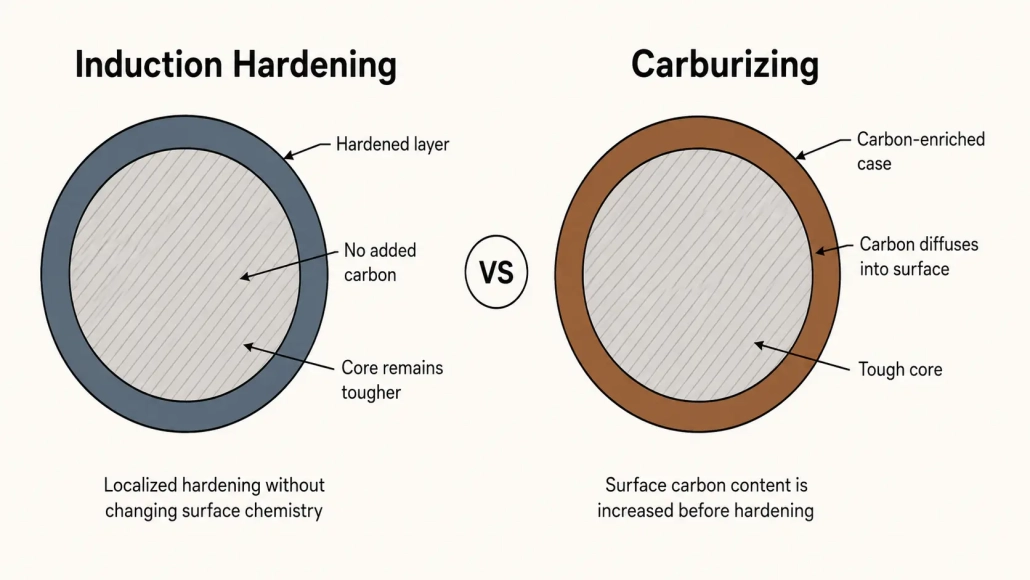
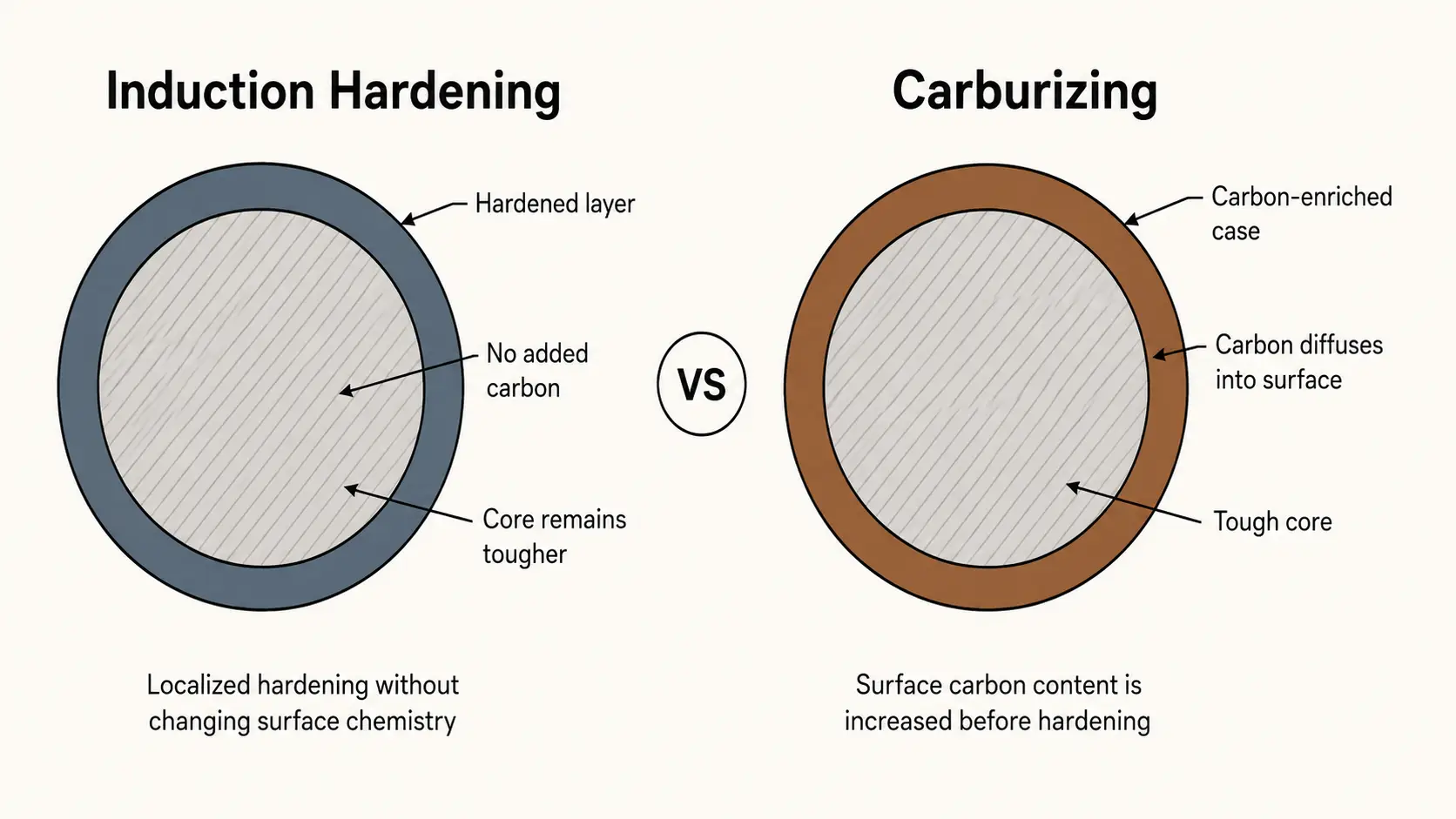
The two processes can serve similar design goals, but they get there differently. Carburizing changes the carbon content near the surface before hardening. Induction hardening relies on the carbon and hardenability already present in the steel, heating selected areas and then quenching them.
That difference affects material choice, hardened-zone geometry, distortion, production flow and equipment. For a shaft, gear, pin or transmission component, the useful question is not “which process is better?” but “which process fits this part?”
| How Carburizing Works | How Induction Hardening Differs |
| Material Choice | Hardened Area & Part Size |
| Distortion | Production Volume |
| What About Gears? | Selection Checklist |
1. “Case Hardening” Does Not Mean Only Carburizing
The terminology can be confusing. Carburizing is a case-hardening process, but it is not the only way to produce a hard surface and tougher core. Induction hardening is usually discussed as a surface-hardening or localized heat-treatment process because it hardens the existing steel without deliberately adding carbon to the surface.
For selection work, the metallurgical distinction matters more than the label. ASM International’s overview of surface hardening discusses induction hardening and carburizing as different routes with different material and process requirements.
2. How Carburizing Produces the Hardened Case
Carburizing is a thermochemical process. A steel component is held at elevated temperature in a carbon-rich environment so carbon can diffuse into its surface. The carbon-enriched layer is subsequently hardened, normally by quenching, while the lower-carbon core retains a different combination of properties.
This is why carburizing is closely associated with low-carbon and low-alloy carburizing steels. The NIST reference on heat treatment of iron and steel notes that lower-carbon grades are widely used for carburizing, while medium-carbon steels are commonly used in heat-treated conditions. ASM’s Gas Carburizing chapter identifies temperature, carbon potential and time as principal process variables.
Case depth is tied to diffusion. A deeper carburized layer generally requires more carburizing time, although temperature, furnace technology and boost/diffuse strategies can change the cycle.
Carburizing makes particular sense when the component was designed around a carburizing-grade steel and a carbon-enriched case is part of the required metallurgical structure. Gears and pinions are familiar examples, but the drawing and service requirement should decide the route, not the part name alone.
3. How the Induction Hardening Process Differs
Induction hardening does not normally increase surface carbon. An induction coil heats a selected region of the workpiece; the required zone is brought into the austenitizing range and then quenched to produce the hardened structure. ASM specifically describes induction hardening as a way to harden a surface without altering the chemical composition of the surface layer.
Because there is no carburizing step, the steel itself must contain enough carbon and have sufficient hardenability to reach the specified result. ASM notes that steels chosen for induction hardening need suitable carbon content and alloying for the required hardness distribution; medium-carbon steels are common choices.
The process can also be highly localized. A bearing journal on a long shaft can be treated without taking the whole shaft through a furnace cycle. A longer cylindrical surface can be scan hardened, with the heating and quenching zone moving along the part.
That localization is one reason induction hardening is considered for shafts, pins, rollers, splines and large components with defined working surfaces.
4. Induction Hardening vs. Carburizing at a Glance
| Selection Factor | Induction Hardening | Carburizing |
|---|---|---|
| Surface chemistry | Normally unchanged | Carbon is diffused into the surface |
| Typical material approach | Steel already has sufficient carbon and hardenability | Commonly low-carbon carburizing grades |
| Heated area | Can be localized to selected zones | Part is processed in a carburizing environment |
| Hardened pattern | Strongly influenced by coil, movement and quench | Strongly influenced by carbon diffusion and subsequent hardening |
| Production flow | Well suited to in-line and one-piece processing | Commonly batch or continuous furnace processing; single-piece systems also exist |
| Main variables | Power, frequency, heating time, coil geometry, motion, quench | Temperature, carbon potential, time, diffusion strategy, quench |
| Tooling | Part-specific coil and fixture often required | Furnace fixtures, atmosphere control and quench system are central |
The table is an initial screening tool. There are induction-hardened gears and carburized shafts. Component names are poor selection rules.
5. Material Choice May Decide the Issue Before the Machine Does
If a component is still at the design stage, material and heat treatment should be considered together.
A low-carbon carburizing steel selected to develop a hard carbon-rich case and a tough core is not automatically a good candidate for conventional induction hardening. Conversely, if a medium-carbon steel already has the hardenability needed for the specified surface hardness, carburizing may add a metallurgical step the design does not require.
Replacing carburizing with induction hardening is therefore not simply an equipment substitution. Material grade, required case, core properties and the drawing may all need review.
ASM’s guide to selecting steels for case hardening treats carburizing steels and steels for induction or flame hardening as separate material-selection categories.
6. Hardened Area and Part Size Often Favor Induction
Consider a long shaft that needs hardness only on two bearing journals. Treating those zones individually may be more practical than sending the whole component through a furnace process.
Induction becomes particularly attractive when the hardened area is clearly defined: a journal, pin surface, spline, raceway or selected section of a large component. ASM also notes that induction or flame hardening can be used when gear teeth need high hardness but part size or configuration does not lend itself to carburizing and quenching the entire part.
This does not mean “large part = induction.” Diameter transitions, shoulders and restricted quench access can complicate coil design and the heating pattern. The advantage is the ability to engineer the process around the zone that actually needs treatment.
For long cylindrical surfaces, the next question may be fixed-position versus scanning hardening. Our guide on how to select an induction hardening system goes further into power, frequency, case depth and workpiece requirements.
7. Distortion: Induction May Help, but It Is Not Distortion-Free
Carburizing and the subsequent hardening cycle can produce dimensional change, so distortion has to be considered in process planning and finishing allowances. ASM’s material on carburized gears specifically treats heat-treatment distortion as part of process planning.
Induction hardening heats a more limited volume of material in many applications and can offer tighter control of surface distortion in suitable parts. ASM cites tighter surface-distortion control than conventional carburizing, along with one-piece flow and repeatability, for certain aerospace transmission applications.
That is not the same as saying induction causes no distortion. Rapid localized heating, quenching stresses, an unsuitable coil or difficult geometry can still lead to dimensional change or cracking. Both processes require validation on the actual part.
8. Production Volume Does Not Produce a Simple Winner
Induction hardening fits naturally into automated manufacturing. A part can be positioned, heated, quenched and moved to the next operation, while CNC equipment can coordinate scanning position, travel speed, rotation and quenching. For repeated shafts and similar parts, a CNC induction hardening system can reproduce an established motion and heating sequence.
Carburizing should not be dismissed as an old batch-only process. Batch and continuous furnaces remain established production methods, while low-pressure carburizing has also been developed for highly controlled and even single-piece production. ASM has published work specifically on true single-piece-flow carburizing systems.
The economics depend on throughput, part mix, required case, finishing operations and existing plant equipment. A large batch designed around a carburizing route may fit a furnace operation very well. A line that needs selective treatment of specific zones may integrate more directly with induction.
9. What About Gears?
Gears are where simple rules become risky.
Carburizing is an established route for many steel gears because a carbon-enriched case can be developed around the tooth surface while maintaining required core properties. Induction hardening is also used for gears when size, configuration, production method or the desired hardened pattern favors selective treatment. ASM’s gear heat-treatment material covers both carburizing and induction hardening rather than treating either as a universal answer.
Large gears can introduce further choices such as encircling hardening, tooth-by-tooth treatment and different scanning strategies. Those decisions deserve their own process analysis rather than a rule that every gear belongs to one heat-treatment method.
10. A Practical Selection Check
Check each statement that fits your part and count the checks.
☐ Only defined working areas (journals, splines, raceways) need hardening, not the whole surface.
☐ The steel already has the carbon content and hardenability to reach the specified surface hardness.
☐ The required case is shallow to moderate and localized, not a deep carbon-enriched case over complex surfaces.
☐ The part is a shaft, pin, roller, spline or large component with defined working surfaces.
☐ Production is in-line or one-piece flow, not large furnace batches.
☐ Tight control of surface distortion matters for the finishing allowance.
☐ The equipment will run one repeatable part family rather than several geometries.
☐ The drawing was not designed around a carburizing-grade steel.
Score 6–8: Induction hardening is likely the better fit.
Score 3–5: Gray zone — test both processes on the actual part.
Score 0–2: Carburizing is likely the better fit.
If the part is a low-carbon carburizing steel and needs a carbon-enriched case over complex working surfaces, carburizing may be the logical route. If the steel already has adequate hardenability and only selected zones need treatment, induction hardening deserves serious evaluation.
Between those cases is a wide range where testing, metallurgical review and production economics decide the answer. Changing an existing component from carburizing to induction hardening may also mean reviewing the steel grade, hardness specification, case-depth requirement and finishing sequence rather than simply replacing one machine with another.
The safest starting point is the workpiece drawing, not the heat-treatment machine. Define the material, hardened area, case depth, hardness requirement and production rate first. Then select the process and equipment around the part rather than forcing the part into a preferred process.
Frequently Asked Questions
Can induction hardening replace carburizing on an existing part?
Not by swapping equipment alone. The steel grade, case depth, hardness specification and finishing sequence may all need review before a carburized part moves to induction hardening.
Is carburizing always a batch furnace process?
No. Batch and continuous furnaces are common, but low-pressure carburizing has also been developed for highly controlled and even single-piece production.
Does induction hardening always cause less distortion than carburizing?
It can offer tighter surface-distortion control on suitable parts, but it is not distortion-free. Rapid localized heating and quenching stresses can still produce dimensional change or cracking.
Which process is better for gears?
Both are used. Carburizing develops a carbon-enriched case over the tooth surface; induction hardening is used when size, configuration or the desired hardened pattern favors selective treatment.
Put the Drawing Before the Machine
Send us the steel grade, hardened area, case depth and production rate from your drawing. We’ll review induction hardening against carburizing for your specific component.


