
Single-Shot vs. Scan Induction Hardening: When Should You Use Each?
A shaft may need only one bearing seat hardened. Another may require a continuous hardened surface along most of its length. A third may have several separate areas that need different treatment. All three can be induction hardened, but they do not necessarily need the same process.
One of the first decisions is therefore how the required area will be heated: all at once, progressively by scanning, or in a sequence of separately positioned zones. There is no general rule that single-shot is better than scanning, or vice versa.
Which method fits the geometry and hardened area of this particular part?
1. Single-Shot and Scan Hardening: The Basic Difference
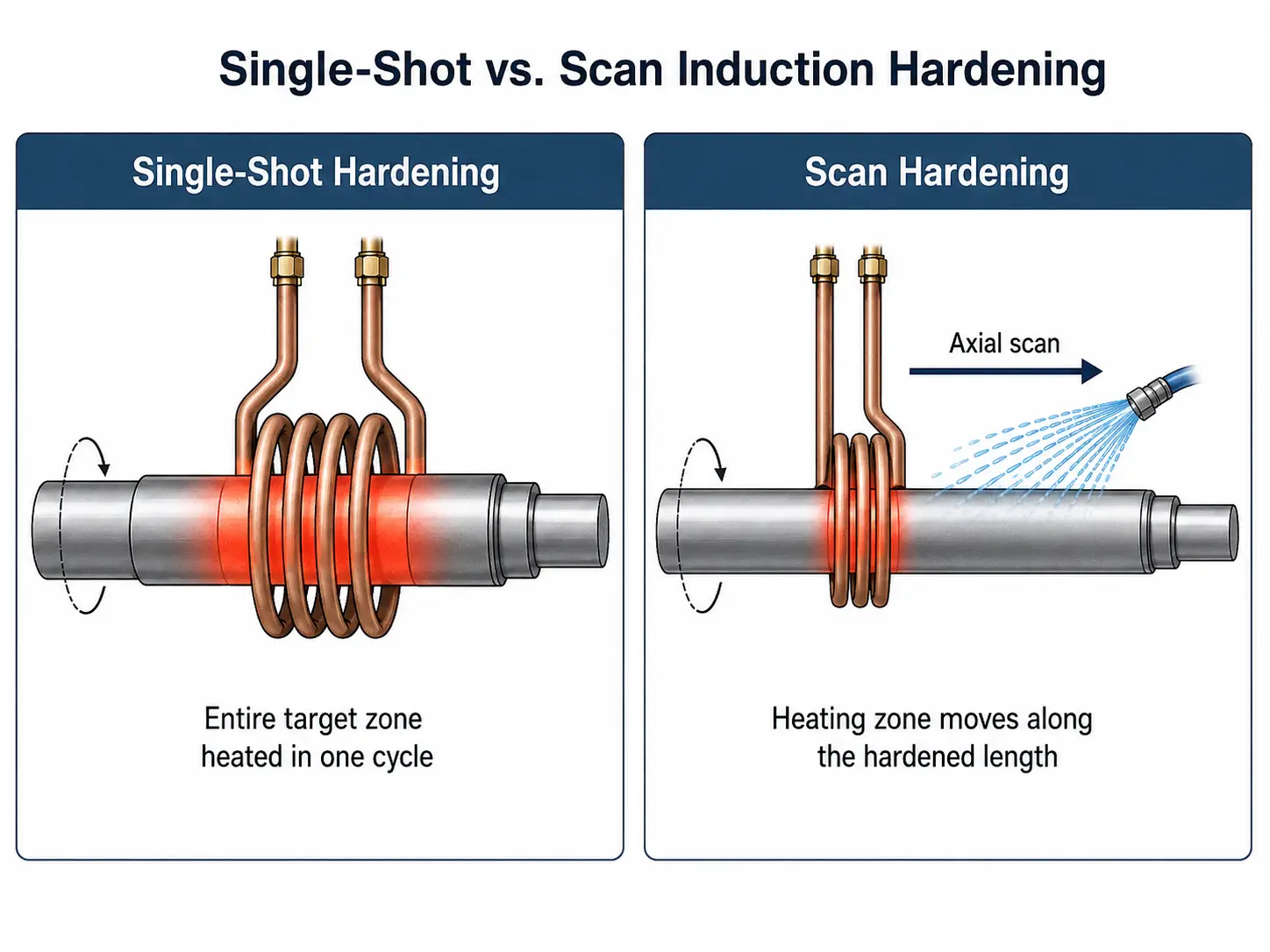
In single-shot induction hardening, the entire target area is heated during one heating cycle. There is no axial scanning movement between the inductor and the workpiece during heating, although cylindrical parts are often rotated. The inductor is designed around the full area that must be hardened.
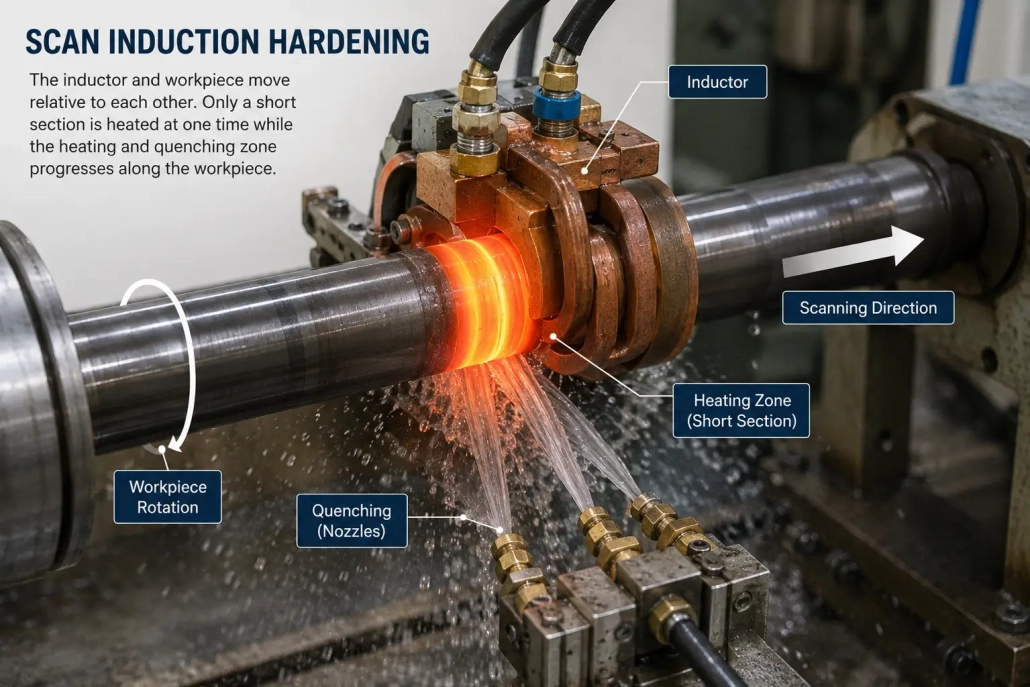
In scan induction hardening, the inductor and workpiece move linearly relative to each other. Only a relatively short section is heated at a given moment, and the heated surface is normally quenched as the process advances. This makes scanning well suited to long continuous hardened zones, especially on shafts, pins and other elongated components.
For machine selection, the practical distinction is straightforward: does the required hardened zone need to move through the heating zone, or can it be heated in position?
2. When Single-Shot Hardening Makes Sense
Single-shot hardening is worth considering when the area to be hardened can reasonably be covered by one purpose-designed inductor. A typical example is a shaft with a localized working surface rather than a long hardened length. The inductor surrounds or follows the required zone, the part is heated, and quenching follows.
A specially profiled inductor can be designed around changes in diameter, shoulders, fillets or other geometric features. This matters because these features change electromagnetic coupling and heat distribution — a simple scanning coil that works well on a straight cylindrical section may behave very differently when it approaches a large shoulder or a sudden diameter change. This is one reason inductor design and part geometry must be evaluated together.
Single-shot hardening is therefore often considered for:
- Localized or moderate-length hardened zones
- Stepped shafts and parts with several diameter changes within the heated area
- Cylindrical components that can rotate during heating
There is also a power consideration. Because the full target area is being heated at the same time, a single-shot process may require substantially more instantaneous power than a scanning process treating the same total hardened length progressively. The decision cannot be made from the part shape alone.
3. When Scan Induction Hardening Is More Practical
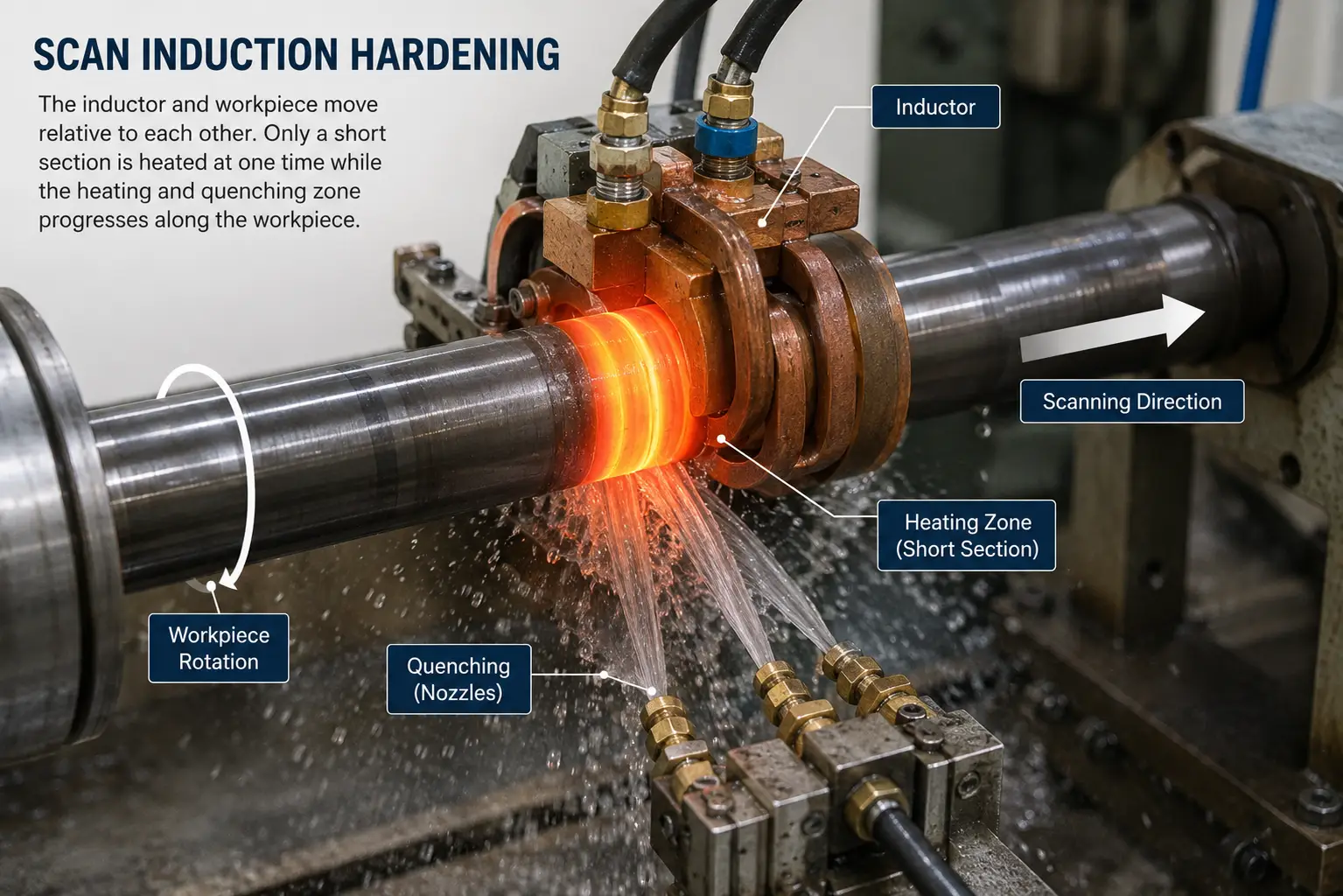
Now consider a long shaft with a continuous hardened surface running along a substantial part of its length. Trying to cover that entire area with one inductor may not be practical. With scanning, the induction system concentrates its heating capacity on a smaller area and moves the heating zone along the workpiece. For cylindrical components, rotation is also commonly used during scanning to help obtain the required circumferential heating pattern.
Scan hardening is commonly considered for:
- Long shafts and cylindrical components with extended hardened sections
- Rollers and similar elongated parts
- Applications where heating the entire target length at once would require an impractical coil or power level
Scan speed matters. If the relationship between power and travel speed changes, the thermal cycle experienced by the surface also changes. Quench position and quench delay must match the heating process. Power, frequency, scan speed, rotation, inductor design and quenching have to work as one process. For repeated production, this is one reason a CNC induction hardening system is useful: position, travel distance, movement speed, rotation and the heating/quenching sequence can be controlled as part of the machine program.
4. Single-Shot vs. Scan Hardening at a Glance
| Factor | Single-Shot Hardening | Scan Hardening |
|---|---|---|
| Heating method | Complete target zone heated in one cycle | Target zone hardened progressively |
| Axial movement during heating | Normally no axial relative movement | Relative linear movement is required |
| Workpiece rotation | Often used for cylindrical parts | Often used for cylindrical parts |
| Typical hardened zone | Localized to moderate-length areas | Long continuous areas |
| Inductor | Usually designed around the complete target zone | Usually heats a shorter moving section |
| Power requirement | Can require higher instantaneous power | Heating power is concentrated on a smaller area |
| Machine motion | Relatively limited during heating | Scan position and speed are process variables |
| Complex diameter changes | A profiled inductor may be advantageous | Coupling can become difficult where geometry changes significantly |
| Main process challenge | Coil design, positioning and heating uniformity | Coordinating heating, movement and quenching |
This table is useful for an initial comparison, but it should not be used as a final selection chart. A long part can still have a short local area suited to single-shot hardening. A short part can have a geometry or hardened pattern that makes another method more appropriate. The length of the part is not the same thing as the length and shape of the area being hardened.
5. What If the Part Has Several Separate Hardened Zones?
Some components do not fit neatly into a single-shot-versus-continuous-scan comparison. Consider a shaft with three bearing journals that require hardening, while the sections between them should remain untreated.
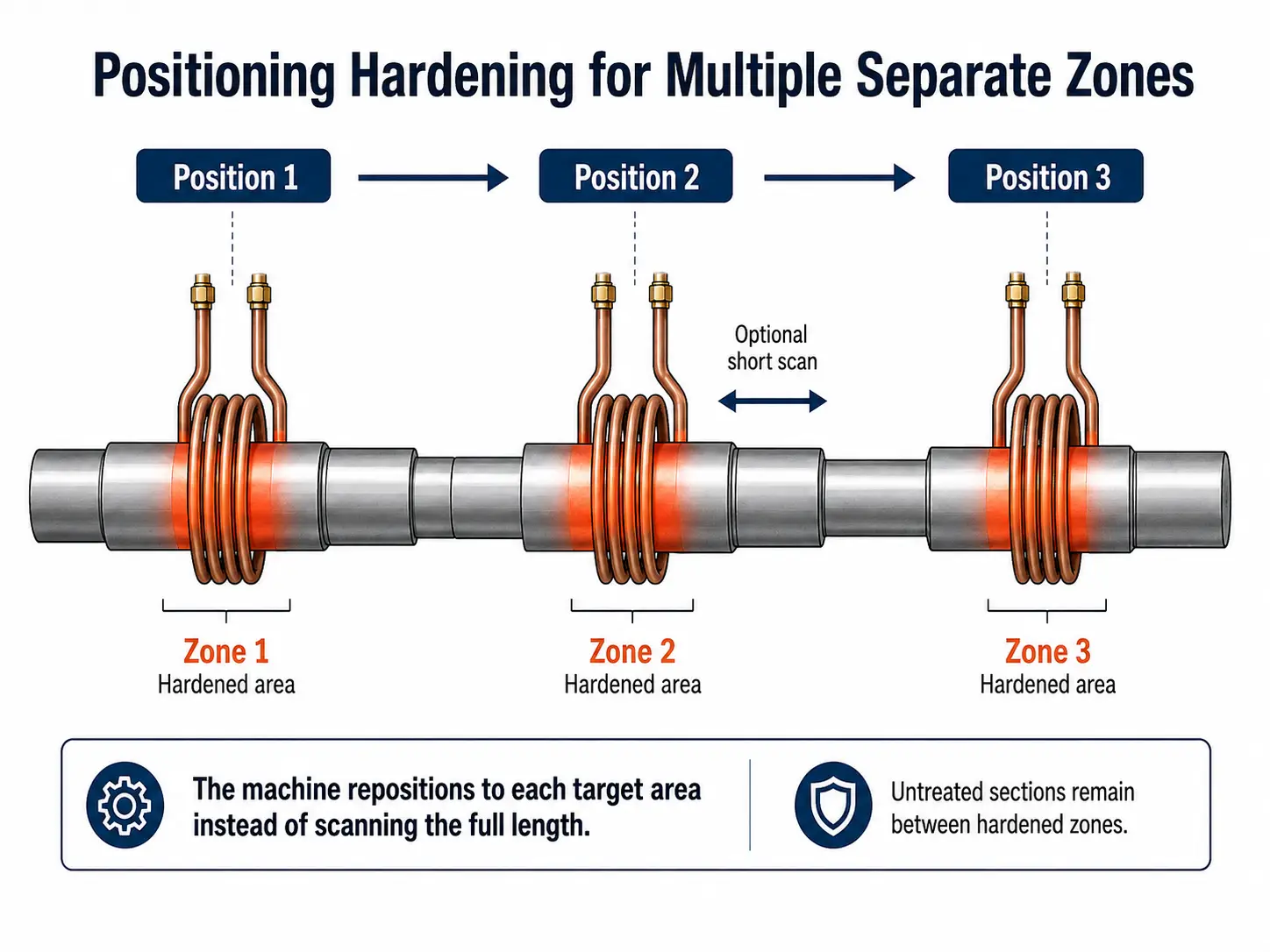
There is little reason to scan continuously across areas that do not require hardening. Instead, a CNC machine can move to the first hardened zone, perform the required heating and quenching cycle, reposition to the next zone, and repeat the process. Depending on the geometry, each selected zone may be hardened in position or by a short scanning movement. This is what we mean by positioning or positioning-scanning in the context of a CNC hardening machine.
Typical applications include components with:
- Several separate bearing surfaces or multiple journals
- Selected spline or working areas with untreated sections between them
- Different hardening requirements along the same workpiece
This is one of the reasons programmable positioning is useful on a CNC quenching machine: the machine does not have to treat the component as one continuous surface.
6. Do Not Choose the Process From Geometry Alone
It is tempting to turn the selection into a simple rule: short hardened area = single-shot, long hardened area = scanning. That is useful as a first impression, but two shafts with similar dimensions may require different hardening methods because their material, case-depth requirement or production conditions are different. The main factors should be considered together.
Workpiece geometry
Diameter, hardened length, shoulders, grooves, fillets, splines and changes in cross-section all affect inductor design and electromagnetic coupling. Shaft geometry in particular can introduce coupling variations that a scanning coil must accommodate.
Required hardened pattern
The question is not only how long the part is — the exact start and stop positions of the hardened zone matter. A drawing with the required hardening area marked is much more useful than an overall shaft length.
Material, power and frequency
Steel grade and prior material condition affect how the part responds to the heating and quenching cycle. A large area heated simultaneously can impose a very different power requirement from a small area being heated progressively — this is one reason single-shot and scanning systems should not be compared only by machine size or rated power. Frequency affects the electromagnetic and thermal behavior of the process, but should not be selected from a simple “frequency equals case depth” rule: geometry, heating time, power density and material response also matter. The same machine setting should not be assumed to produce the same case depth on different components.
Quenching
A correctly heated part can still produce an unacceptable result if the quenching arrangement does not match the geometry and heating pattern. This is particularly important around shoulders, diameter transitions and other areas where spray access or heat distribution changes. Common quenching-related defects often trace back to a mismatch between the heating pattern and quench delivery.
Production requirement
Cycle time, batch size, tooling changes and the number of part types also influence the practical choice. A process that works metallurgically is not automatically the best production system.
If you are still determining power, frequency, case depth, machine arrangement and process requirements, see our guide on how to select an induction hardening system.
7. Three Common Shaft Scenarios
The difference becomes easier to see with actual part layouts.
1. One local bearing surface on a shaft
Only a limited section needs hardening. If the geometry, required case depth and available power allow the complete target zone to be heated uniformly, a single-shot or other fixed-position process may be a practical starting point. There is no benefit in scanning the entire shaft when most of it does not require treatment.
2. A long continuous hardened section
A large portion of the shaft surface must have a continuous hardened layer. Scanning is often the more practical approach because the inductor treats the surface progressively rather than heating the full length simultaneously. Here, scan speed and quenching become important process parameters.
3. Several separated bearing journals
The shaft has multiple hardened zones with untreated sections between them. A positioning process may be more appropriate. The machine moves from one journal to the next and runs the required hardening cycle at each location. If an individual zone is too long for fixed-position heating, that zone can also be scanned.
These three parts may all be called “shafts,” yet they can require three different machine programs. For more on shaft-specific hardening challenges, see our article on shaft induction hardening.
8. Gears Need a Separate Discussion
Gears are a special case. Depending on gear diameter, tooth geometry, required hardness pattern and available power, induction hardening may involve encircling treatment or tooth-by-tooth processing — decisions different enough from shaft scan hardening that they warrant separate treatment. This distinction is especially important for large construction-machinery drive wheels; see our comparison of single-shot vs. tooth-by-tooth scanning for drive wheels.
9. Start With the Hardened Area, Not the Machine Model
If you are trying to decide between single-shot, scanning and positioning hardening, begin with the part drawing. Mark exactly where the hardened surface should start and stop. Then define the material, workpiece dimensions, required hardened area, surface hardness, effective case depth, production quantity and any areas that must not be hardened.
From there, the heating method, power, frequency, inductor, quenching arrangement and machine movement can be considered together. The objective is not to choose single-shot or scanning because one method sounds more advanced — it is to use the simplest process that can reliably produce the required hardened pattern on the actual part.
Key Takeaway
● Single-shot hardening heats the complete target area in one cycle. Best suited to localized or moderate-length zones where one purpose-designed inductor can cover the required area, and where available power supports simultaneous heating.
● Scan hardening heats the surface progressively by moving the inductor and workpiece relative to each other. More practical for long continuous hardened zones, especially on shafts and elongated parts.
● Positioning hardening processes several separate zones in sequence. Used when a component has multiple hardened areas with untreated sections between them.
● The decision starts with the part drawing, not with the machine model. Material, geometry, case depth, power, frequency, quenching and production requirements must be evaluated together.
Frequently Asked Questions
+ What is the difference between single-shot and scan induction hardening?
In single-shot hardening, the entire target area is heated in one cycle with no axial movement between the inductor and workpiece. In scan hardening, the inductor and workpiece move linearly relative to each other, heating only a short section at any given moment while the heated surface is quenched progressively. Single-shot is typically used for localized zones; scanning is more practical for long continuous hardened surfaces.
+ Can one CNC machine perform both single-shot and scanning processes?
Yes. A CNC induction hardening machine can be programmed for fixed-position heating, continuous scanning, or positioning-scanning with multiple zones. The machine movement, power, rotation and quenching sequence are set according to the part program, allowing different methods to be used on the same equipment.
+ When should I use positioning hardening instead of continuous scanning?
Positioning hardening is appropriate when a component has several separated zones that require hardening, with untreated sections between them. Rather than scanning the entire length, the CNC machine moves from one zone to the next and runs the required hardening cycle at each location. If an individual zone is too long for fixed-position heating, that zone can also be scanned.
+ Does part length determine whether to use single-shot or scanning?
Part length gives a first impression, but it should not be the only factor. A long part can have a short local area suited to single-shot hardening. A short part can have a geometry or hardened pattern that makes scanning more appropriate. Material, case depth, power availability, frequency and production requirements must all be considered together — the length of the part is not the same thing as the length and shape of the area being hardened.
Need Help Selecting the Right Hardening Process?
Send us your part drawing with the required hardened area marked. Our engineers will evaluate the geometry, material and production requirements to recommend a suitable heating method and machine configuration.


