Inclined Vertical Raceway CNC Quenching Machine
I.Why Large Raceway Hardening Requires a Different Machine
Unlike shafts or gears, slewing bearings combine a large diameter with relatively narrow raceways. During induction hardening, the workpiece must rotate smoothly while the induction coil maintains a consistent gap along the entire raceway. Any instability in support, rotation, or coil position can lead to uneven heating and inconsistent hardening.
The machine is designed around these process requirements rather than simply increasing machine size. Every major component, from the inclined frame to the roller support and tracking system, is intended to improve process stability throughout the scanning cycle.
II.Why Use a 70° Inclined Structure?
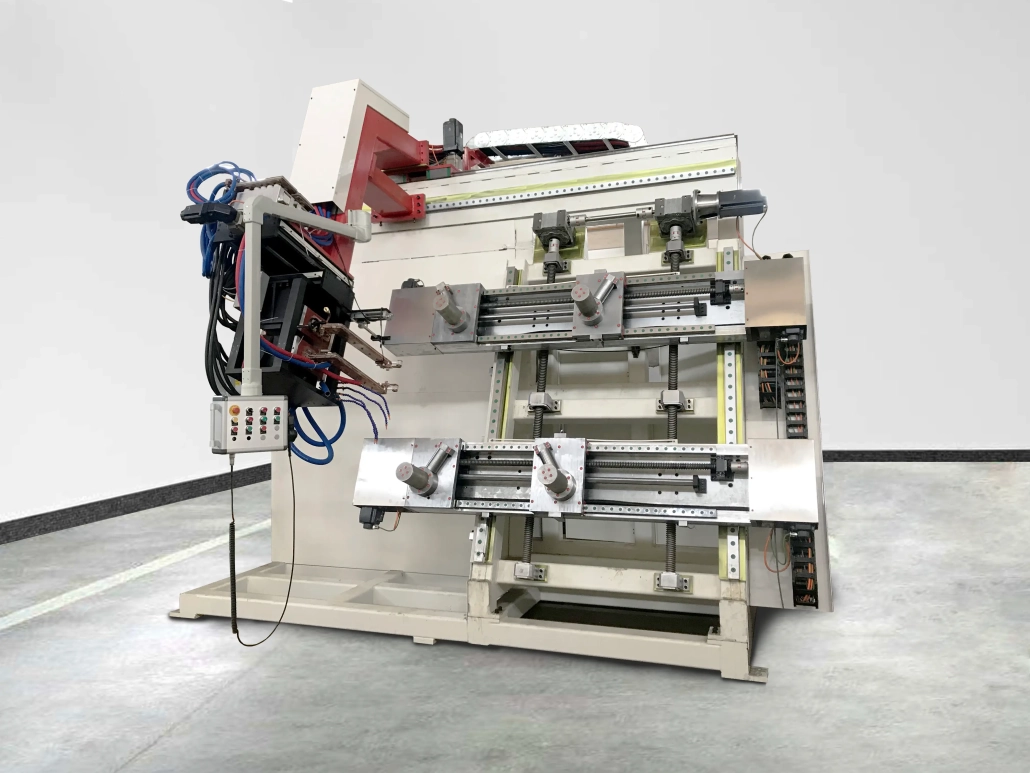
The workpiece is positioned at an inclination of approximately 70° instead of being placed horizontally.
This layout allows gravity to keep the raceway firmly seated against the support rollers, improving radial positioning accuracy during rotation. The inclined arrangement also provides better access for the induction coil and quenching system while allowing cooling liquid to drain more efficiently after spraying.
For large slewing bearings, this configuration helps maintain stable processing conditions without requiring excessive clamping force.
III.How the Machine Works
- The bearing is loaded onto the dual-beam four-roller support system.
- The upper and lower beams automatically adjust to the workpiece diameter.
- Servo-driven rollers rotate the bearing at the programmed speed.
- The floating induction head automatically follows the raceway in both radial and axial directions.
- Induction heating and spray quenching are performed continuously during scanning.
- Process parameters are recorded for future production batches.
IV.Key Design Features
1.Dual-Beam Four-Roller Support
Large bearings require stable support throughout the hardening cycle. The machine uses four support rollers mounted on synchronized upper and lower beams to keep the workpiece centered during rotation.
The adjustable roller arrangement allows different bearing diameters to be accommodated without changing the basic support structure.
2.Dual Induction Heating Heads
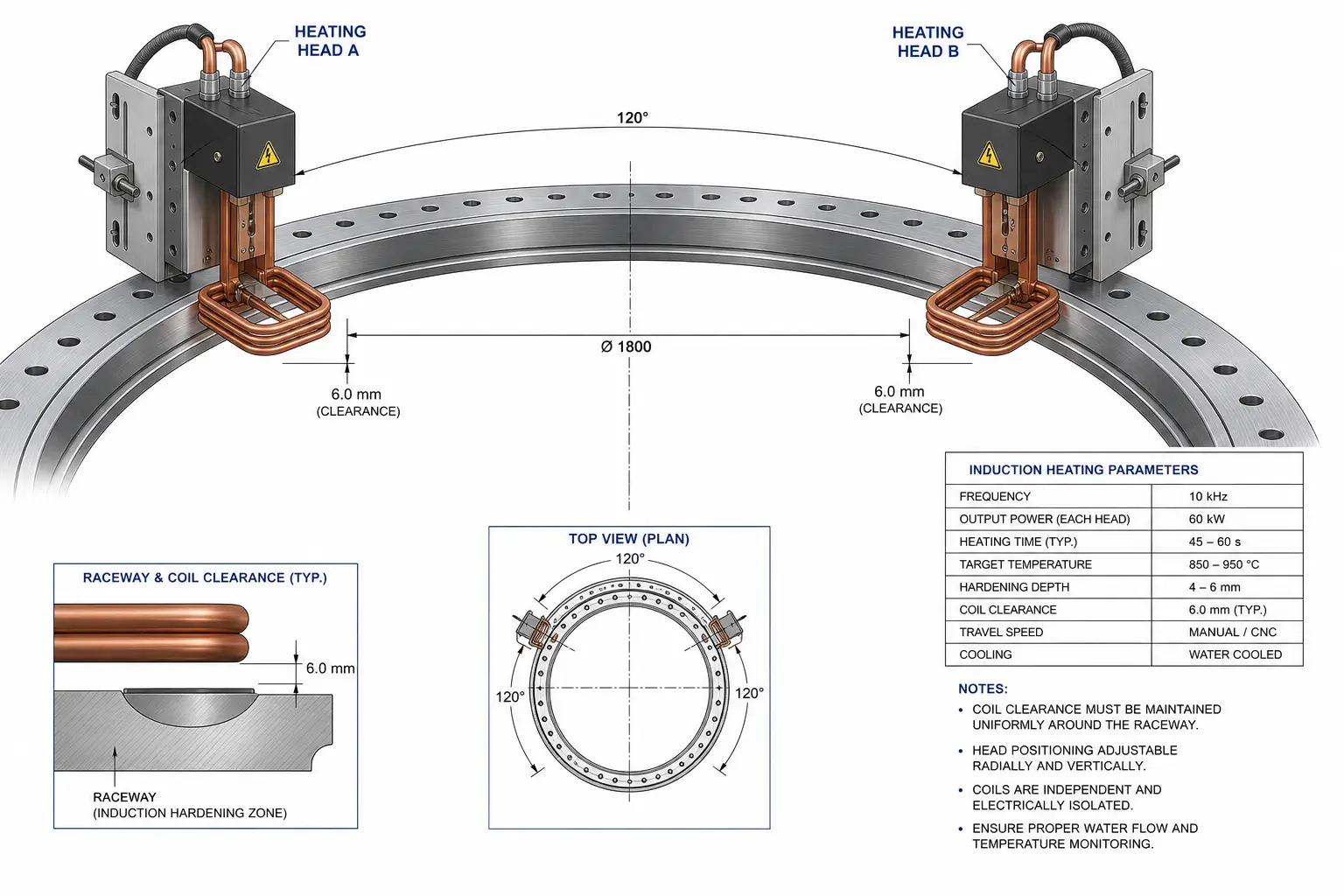
The machine can be equipped with two induction heating heads operating either simultaneously or alternately.
Simultaneous operation helps reduce cycle time, while alternate operation provides greater flexibility for different raceway configurations and production schedules.
3.Automatic Raceway Tracking
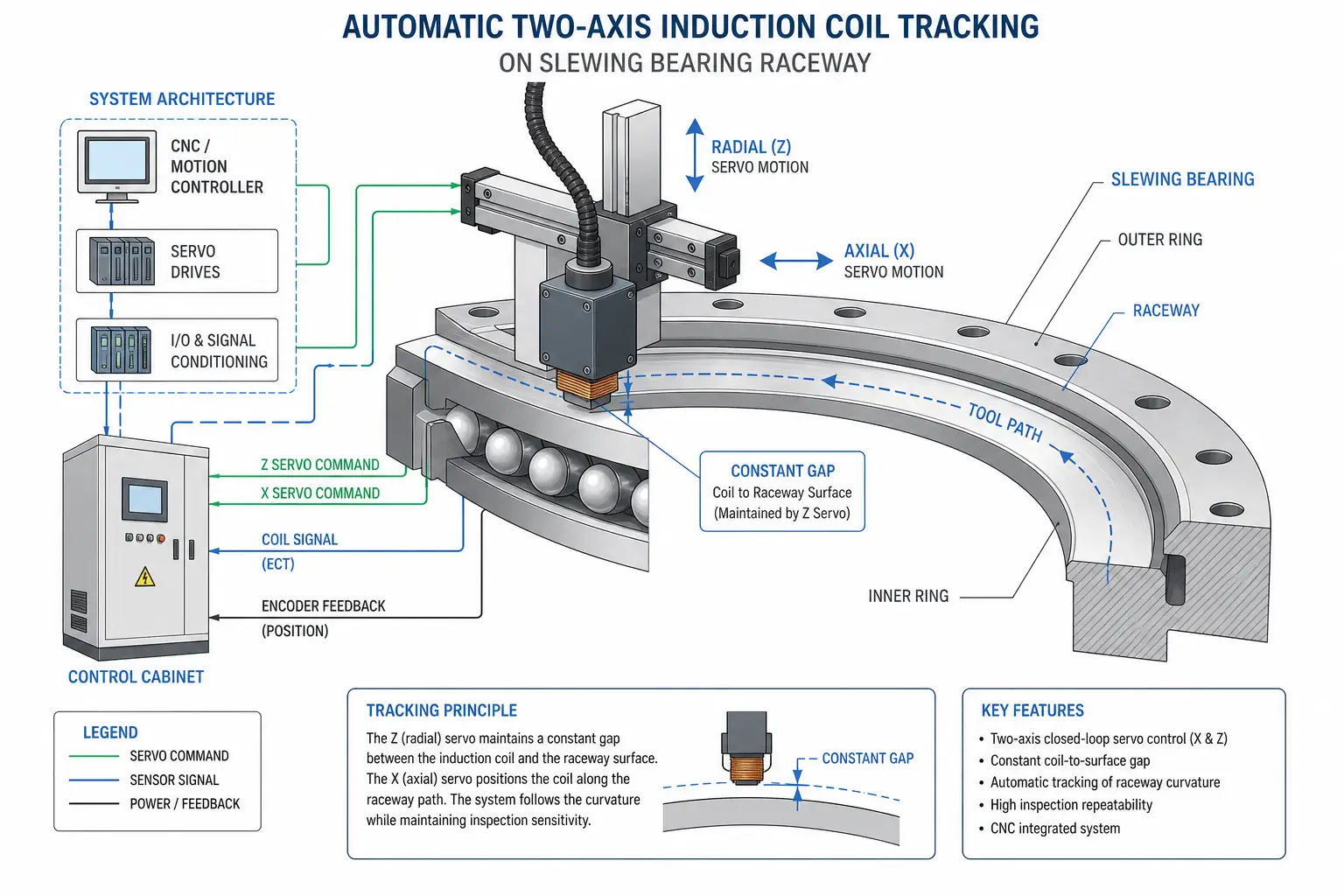
The induction coil is mounted on a floating mechanism combined with servo-controlled cross slides.
During scanning, the system automatically compensates for small dimensional variations, maintaining a consistent coil-to-workpiece distance and improving heating uniformity.
4.CNC Motion Control
Machine motion is coordinated through the Siemens 840DSL CNC system.
Workpiece rotation, induction head movement, scanning speed, and positioning are managed from a single control platform. Once the process has been optimized, production parameters can be stored and recalled for repeat manufacturing.
5.Flexible Cooling Connections
The cooling circuit uses external piping with quick-connect fittings, simplifying maintenance and reducing downtime during routine servicing or induction coil replacement.
V.Keeping the Process Stable
Stable induction hardening depends on more than accurate positioning. The machine continuously monitors operating conditions throughout the production cycle.
An encoder checks workpiece rotation to ensure the programmed speed is maintained. If rotation slows unexpectedly, heating stops automatically to prevent local overheating.
A dedicated protection circuit monitors contact between the induction coil and the workpiece. If accidental collision occurs, power is immediately disconnected to protect both the coil and the component.
Voltage and current are also monitored continuously. Any abnormal electrical condition triggers an alarm and safely interrupts the hardening process.
VI.Process Monitoring and Quality Control
Optional process monitoring software records key production data, including power, voltage, current, frequency, heating temperature, cooling water conditions, and quenching fluid status.
Reference process curves from qualified parts can be stored within the system and compared with future production runs. This helps operators identify process deviations quickly while improving production consistency and product traceability.
VII.Typical Applications
The machine is suitable for induction hardening of various large ring-shaped components, including:
- Slewing bearings for excavators
- Wind turbine yaw and pitch bearings
- Crane slewing bearings
- Port machinery bearings
- Heavy construction equipment bearings
- Large industrial turntable bearings
VIII.Frequently Asked Questions
1.What size slewing bearings can this machine process?
The standard configuration supports raceway diameters from Ø1000 mm to Ø3000 mm. Customized solutions are available for larger workpieces.
2.Why is an inclined vertical structure used for raceway hardening?
The inclined structure improves workpiece support stability and provides better access for induction heating and quenching during raceway scanning.
3.Can the machine automatically track the raceway position?
Yes. The servo-controlled tracking system adjusts the induction head position in radial and axial directions to maintain a stable heating gap.
4.Can the machine be customized according to different production requirements?
Yes. The machine configuration can be adapted according to bearing dimensions, hardening depth requirements, production capacity, and automation level.