
Local Induction Heating in Roll Forming: Edge Heating, Formability and Process Control
Roll forming is a continuous metal forming process used to produce profiles with specific cross-sectional shapes. When processing high-strength steel or profiles with demanding edge and corner geometries, conventional cold forming may involve high forming resistance, localized strain concentration, and dimensional deviations.
Local induction heating in roll forming provides a way to heat selected deformation areas before they enter the forming section. By concentrating thermal energy in specific regions, the process can change local material properties and improve forming conditions without necessarily heating the entire workpiece.
This approach has been investigated in the production of high-strength square tubes and can also be applied to specialized metal profile forming operations that require localized edge heating.
However, these applications do not necessarily use the same heating arrangement. Heating the corners of a square tube and heating the longitudinal edges of a notched metal support profile involve different workpiece geometries and inductor configurations.
This article examines the principles of localized induction heating in roll forming, its effects on formability and springback, and the factors that influence heating consistency and finished profile quality.
2. Why Is Localized Heating Used in Roll Forming?
3. Where Is Local Induction Heating Applied?
4. How Local Heating Affects Formability and Springback
5. Factors Affecting Heating and Roll Forming Consistency
6. Material Considerations and Process Limitations
7. Process Monitoring and Forming Quality Inspection
8. When Is Induction-Assisted Roll Forming Suitable?
1. What Is Local Induction Heating in Roll Forming?
Local induction heating in roll forming combines electromagnetic heating with mechanical deformation through rolling equipment.
An induction coil generates an alternating magnetic field, inducing electrical currents within the conductive workpiece. Electrical resistance converts this energy into heat in the selected region.
Unlike conventional furnace heating, the process does not require the entire workpiece to reach the same temperature.
Depending on the application, the heating section may be installed before a forming station or integrated into a continuous production line.
A typical process sequence includes:
①Feeding and positioning the metal profile.
②Applying induction heating to the selected deformation area.
③Moving the heated region toward the forming rolls.
④Applying mechanical force to produce the required geometry.
⑤Inspecting the finished profile.
In research literature, related processes are often described as Partial Heating Roll Forming (PHRF) or local induction heating-assisted roll forming.
These terms describe related approaches, but they should not automatically be treated as identical. Partial heating describes the localized heating strategy, while induction heating identifies the energy source.
It is also important to distinguish roll forming from hot rolling. Roll forming progressively bends metal through forming rolls to create a specified cross-section, whereas hot rolling primarily uses compressive deformation to change the thickness or cross-section of metal.
2. Why Is Localized Heating Used in Roll Forming?
Localized heating is considered when certain areas of a metal profile require improved forming conditions.
It is not necessary for every roll forming application. Conventional cold roll forming remains suitable for many materials and profile geometries.
2.1 Reducing Local Forming Resistance
The mechanical properties of steel change with temperature. Under suitable conditions, heating reduces the material’s resistance to plastic deformation.
This can be beneficial when a forming operation involves:
•High-strength steel with relatively limited room-temperature formability
•Tight corner geometries
•Localized edge deformation
•High strain concentration in selected forming regions
By heating the deformation area, the forming operation can take advantage of the material’s temperature-dependent mechanical behavior.
The objective is to improve the conditions in the region undergoing deformation rather than unnecessarily heating the entire profile.
2.2 Improving Local Formability
Formability describes the ability of a material to undergo plastic deformation without developing unacceptable defects.
During roll forming, deformation is not distributed uniformly across the entire profile. Corners, bending regions, and edges may experience greater local strain than relatively flat sections.
When the material’s ductility is insufficient for the required deformation, localized heating can help reduce the risk of forming-related damage.
Research by Peng et al. in the Chinese Journal of Engineering investigated induction heating of high-strength square tube corners before secondary roll forming. The study reported improved corner formability through localized heating while maintaining the properties of the undeformed regions.
The findings apply to the specific high-strength steel tube and experimental conditions investigated, rather than establishing a universal result for all roll forming operations.
2.3 Avoiding Unnecessary Heating of the Entire Profile
Some profiles require deformation mainly along selected edges or corners.
Heating the entire cross-section may therefore be unnecessary.
Localized induction heating allows the heating arrangement to focus on the regions that need additional formability, while surrounding areas remain outside the primary heating zone.
This approach can be particularly useful when the profile geometry and production sequence allow the heating section to be integrated with the mechanical forming equipment.
3. Where Is Local Induction Heating Applied?
The heating location depends on the profile geometry and the type of deformation required.
Two different configurations are particularly relevant: corner heating for high-strength square tubes and longitudinal edge heating for specialized metal support profiles.
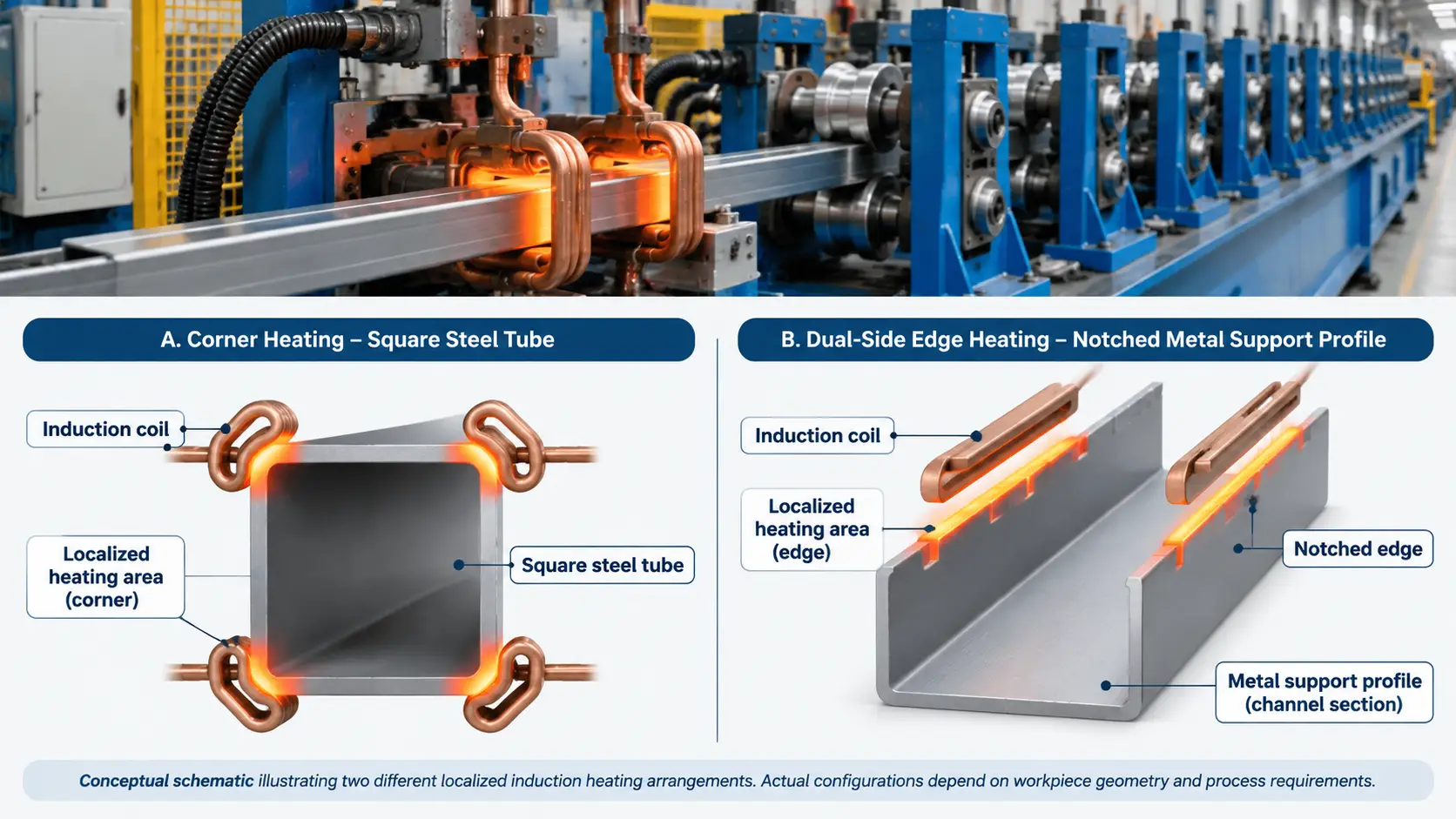
3.1 Corner Heating in High-Strength Square Tubes
In square and rectangular hollow steel sections, the corners are important deformation regions.
During roll forming, the material undergoes bending and plastic deformation around these areas. High-strength steel may experience significant strain hardening and localized forming resistance.
Local induction heating can be applied to the corner regions before a subsequent forming operation.
Research by Peng et al. examined this approach using induction coils positioned to heat the corners of high-strength square tubes.
The study reported improved corner formability, but also identified important process considerations, including metal accumulation around the outer corners and microcrack development under certain forming conditions.
A separate study by Wang et al. investigated the effects of induction heating temperature on the microstructure and mechanical properties of HSLA square tubes.
The research examined different heating temperature ranges and their influence on corner microstructure, mechanical properties, and forming performance.
These studies demonstrate that heating temperature is not simply a matter of increasing formability. It also influences microstructural evolution and the mechanical properties of the finished section.
The appropriate heating conditions must therefore be established for the specific steel grade, original material condition, and forming sequence.
3.2 Longitudinal Edge Heating in Notched Metal Support Profiles
Another application involves metal support profiles whose longitudinal edges require localized deformation.
A practical industrial configuration uses two induction coils positioned on opposite sides of the profile.
The general arrangement includes:
•A channel-shaped metal support profile with regularly spaced edge notches
•Two inductors positioned near the longitudinal edges
•Localized heating of both edge regions
•A feeding and guiding mechanism
•Rolling equipment that forms the heated edges
As the profile moves forward, both longitudinal edges pass through their respective heating regions before entering the rolling section.
The central part of the profile remains outside the primary heating areas.
This arrangement differs from corner heating in square tubes. The target regions, workpiece geometry, and inductor positioning are different.
A real industrial example is the Induction-Assisted Roll Forming Line for Metal Support Profiles.
The demonstrated equipment combines dual-side induction edge heating, continuous feeding, workpiece guidance, and mechanical edge rolling.
The notches introduce an additional design consideration. As the interrupted edges move through the induction heating region, the amount and geometry of metal beneath the inductors change. This can affect local electromagnetic coupling.
The inductor arrangement and rolling tools must therefore be designed around the actual profile dimensions and notch geometry.
The equipment demonstration establishes the heating and rolling arrangement, but does not by itself establish a universal operating temperature, production speed, or dimensional tolerance.
4. How Local Heating Affects Formability and Springback
Localized heating changes the mechanical response of the material during forming. Two important considerations are formability and springback.
4.1 Effect on Formability
Heating can reduce deformation resistance and change the material’s ability to accommodate plastic strain.
For high-strength steel profiles, this can be important in areas where conventional cold forming produces severe strain concentration.
The effect depends on several variables:
•Steel grade and initial microstructure
•Heating temperature
•Heating rate
•Time between heating and deformation
•Local strain and forming geometry
The study by Wang et al. on HSLA square tubes demonstrated that different induction heating temperature ranges produced different microstructural and mechanical responses.
The results highlight why heating conditions should be developed for the material and forming operation rather than selected from a general temperature recommendation.
4.2 Effect on Springback
Springback occurs when elastic deformation is released after the forming force is removed.
It can cause the finished profile to deviate from the intended angle, curvature, or cross-sectional dimensions.
The amount of springback is influenced by:
•Material strength and elastic properties
•Profile thickness
•Bending radius
•Forming angle
•Roll geometry
•Forming sequence
•Temperature during deformation
Partial heating roll forming has also been investigated as a method of influencing springback in high-strength steel.
For example, Mehari and Han studied the effects of partial heating roll forming on springback in high-strength steel sections.
This research provides relevant evidence about localized heating-assisted forming, but its conclusions should be interpreted within the specific process and material conditions studied.
Localized heating may influence springback, but it does not automatically eliminate dimensional recovery after forming.
4.3 Balancing Formability and Material Properties
Improving formability is only one part of the process.
Excessive heating may change the microstructure, mechanical properties, and surface condition of the material.
For some high-strength steels, the temperature range required to improve forming behavior must also be evaluated against the original material condition and the required properties of the finished component.
The objective is to establish a suitable balance between deformation requirements and material performance.
5. Factors Affecting Heating and Roll Forming Consistency
Heating and mechanical forming must be considered as one coordinated process.
Several variables influence whether the selected regions receive consistent heating and whether the finished profile meets the required geometry.
5.1 Material Grade and Thickness
Different steel grades have different electrical, magnetic, thermal, and mechanical properties.
These properties affect electromagnetic coupling, heating behavior, and the material’s response to deformation.
Thickness also influences heat transfer and temperature distribution through the section.
An inductor arrangement and operating condition developed for one material should not automatically be applied to another steel grade or profile thickness.
5.2 Inductor Geometry and Clearance
The inductor must be designed around the target heating region and the actual workpiece geometry.
Important considerations include:
•Inductor shape and dimensions
•Distance between the inductor and workpiece
•Profile cross-section
•Edge or corner position
•Notch geometry
•Workpiece alignment
The clearance must allow the profile to move through the heating section without mechanical interference.
At the same time, electromagnetic coupling must remain suitable for the intended heating operation.
For notched profiles, the changing edge geometry makes inductor design particularly important.
5.3 Distance Between Heating and Rolling Sections
After leaving the induction heating region, the workpiece begins cooling.
The distance between the heating section and forming rolls therefore influences the temperature at which deformation takes place.
If the distance is too large for the intended process, the material may lose a significant amount of heat before reaching the forming station.
The equipment layout should account for the required forming temperature, workpiece movement, and available installation space.
5.4 Feeding Speed and Heating Power
In continuous production, feeding speed determines how long each section of the profile remains within the effective heating region.
At a given absorbed power and heating arrangement, increasing line speed generally reduces the energy supplied per unit length.
Heating power and feeding speed must therefore be coordinated.
Other relevant variables include:
•Effective heating length
•Workpiece positioning
•Material thickness
•Inlet material temperature
•Electromagnetic coupling
A stable production process requires repeatable operating conditions rather than relying on heating power alone.
5.5 Rolling Tool Geometry and Alignment
The rolling section determines how mechanical force is applied to the heated material.
The main considerations include:
•Roll profile
•Roll clearance
•Tool alignment
•Forming sequence
•Required finished edge geometry
For profiles with regularly spaced notches, the rolling arrangement must accommodate the interrupted edges while maintaining the required workpiece position.
Even when heating conditions are consistent, unsuitable roll geometry or incorrect alignment can produce dimensional deviations and uneven deformation.
Heating and rolling should therefore be developed together for the same workpiece specification.
6. Material Considerations and Process Limitations
Localized induction heating is not suitable for every material or forming operation.
Several limitations should be evaluated before introducing the process.
Material properties
High-strength and heat-treated steels may be sensitive to thermal cycles. Excessive heating can change their microstructure and mechanical properties.
Surface oxidation
Depending on the material and heating conditions, oxidation and surface scale may develop in the heated region.
Uneven heating
Changes in inductor clearance, workpiece positioning, or profile geometry can affect heating consistency.
Complex profile geometry
Notches, sharp corners, and changing cross-sections can influence electromagnetic coupling and mechanical clearance.
Forming limitations
Localized heating cannot compensate for fundamentally unsuitable roll geometry, incorrect tooling, or an inappropriate forming sequence.
There is no universal heating temperature, frequency, or power setting for all induction-assisted roll forming applications.
The process must be established according to the actual material, profile dimensions, deformation requirements, and production conditions.
7. Process Monitoring and Forming Quality Inspection
Process monitoring is necessary to determine whether the heating and forming operations remain consistent during production.
The inspection approach should cover both the heating stage and the finished profile.
7.1 Checking Heating Conditions
Important process variables may include:
•Induction power output
•Operating frequency
•Workpiece feeding speed
•Heating time or effective heating length
•Inductor-to-workpiece clearance
•Temperature in the intended forming region
Where temperature feedback is required, an appropriate calibrated measuring instrument should be used.
Infrared temperature measurement can be useful for moving profiles, but the measurement setup must account for surface condition, emissivity, and the position of the measurement area.
7.2 Inspecting Finished Profile Geometry
The finished profile should be checked against its specified drawing.
Depending on the application, inspection may include:
•Overall profile dimensions
•Edge position and forming angle
•Corner radius
•Cross-sectional geometry
•Symmetry between the two edges
•Dimensional consistency along the profile length
For profiles with notches, the formed edges should also be inspected around the interrupted sections.
7.3 Checking Surface and Material Condition
Visual inspection can identify surface oxidation, scale, and visible forming damage.
For critical high-strength steel applications, additional material evaluation may be required if the heating cycle could affect the original mechanical properties.
The inspection requirements should be established according to the material specification and final component requirements.
The purpose of process monitoring is not simply to maintain a particular heating temperature. It is to ensure that the heating and forming conditions consistently produce the required finished profile.
8. When Is Induction-Assisted Roll Forming Suitable?
Induction-assisted roll forming is worth considering when conventional forming conditions are insufficient for a particular material or profile geometry.
Potential applications include:
•High-strength steel sections requiring improved local formability
•Square and rectangular hollow sections with demanding corner deformation
•Metal profiles requiring localized longitudinal edge forming
•Notched support profiles requiring specialized edge rolling
•Continuous production lines where heating can be integrated with feeding and forming equipment
Before selecting the process, manufacturers should evaluate:
①Material grade and original material condition.
②Profile cross-section and thickness.
③Target heating regions.
④Required finished geometry.
⑤Forming force and tooling arrangement.
⑥Target production speed.
⑦Inspection and dimensional requirements.
Workpiece drawings and material specifications are particularly useful when evaluating a new application.
For specialized metal support profiles, the finished edge drawing should also show the notch dimensions and required edge deformation.
9. Frequently Asked Questions
Does induction heating improve roll forming?
It can improve local forming conditions by changing the material’s mechanical response in selected deformation regions.
The actual benefit depends on material properties, heating conditions, and profile geometry.
Is the entire metal profile heated during induction-assisted roll forming?
No. Local induction heating is designed to concentrate energy in selected regions.
Depending on the application, these may be square tube corners, bending regions, or longitudinal profile edges.
Can induction heating reduce springback in roll forming?
Localized heating can influence springback by changing the material’s mechanical response during forming.
Research has investigated partial heating roll forming as a method of controlling springback in high-strength steel. However, the result is dependent on the specific material and process conditions.
How does feeding speed affect induction heating?
Feeding speed influences the time each section of the workpiece spends within the effective heating region.
At a given absorbed power, higher line speed generally reduces energy input per unit length. Heating power and feeding speed must therefore be coordinated.
Can induction heating be integrated with existing roll forming equipment?
In some applications, an induction heating section can be integrated with existing feeding and rolling equipment.
However, feasibility depends on available installation space, profile geometry, inductor clearance, electrical requirements, and the required forming sequence.
10. Conclusion
Local induction heating in roll forming provides a way to improve the forming conditions of selected metal profile regions without necessarily heating the entire workpiece.
By concentrating electromagnetic heating in specific corners or edges, the process can influence local formability, deformation resistance, and springback behavior.
However, consistent results require more than selecting an appropriate induction power supply. Material properties, inductor geometry, workpiece positioning, feeding speed, heating-to-rolling distance, and rolling tool design must be considered together.
For manufacturers processing high-strength steel sections or specialized metal support profiles, induction-assisted roll forming can provide an alternative when conventional forming conditions are insufficient.
The most suitable solution is developed around the actual workpiece geometry, material specification, required forming result, and production conditions.
Need a Customized Induction-Assisted Roll Forming Setup?
Share your profile drawing and material specification. We can evaluate whether localized induction heating fits your forming process.


