
Induction Straightening of Steel Structures: Process, Applications and Key Considerations
Introduction
Steel structures can develop distortion during welding, fabrication, assembly, and service. Large steel plates may become uneven, welded panels may develop angular distortion, and structural members may lose their intended alignment.
Induction straightening is a thermal correction method that uses localized electromagnetic heating to correct selected types of deformation in steel structures. Depending on the process, controlled thermal expansion and contraction, sometimes combined with mechanical force applied while the steel is hot, help restore the required geometry.
Unlike conventional flame straightening, induction heating generates heat electromagnetically within the conductive workpiece, allowing selected areas to be heated without an open flame.
Successful straightening depends on the original deformation, material properties, heating location, inductor configuration, and process control.
2. How Localized Induction Heating Corrects Steel Deformation
3. Common Applications of Induction Straightening
4. Inductor Configuration and Heating Area Selection
5. Key Factors Affecting Straightening Results
6. Induction Straightening vs. Flame Straightening
7. Process Monitoring and Dimensional Inspection
8. Limitations and Material Considerations
1. What Is Induction Straightening?
Induction straightening uses electromagnetic induction to heat selected areas of a deformed metal structure.
When a localized area of steel is heated, it attempts to expand. The surrounding cooler material restricts this expansion, creating internal stresses. Because the yield strength of steel decreases as its temperature rises, localized plastic deformation can occur under suitable conditions.
During cooling, the heated region contracts. This dimensional change contributes to correcting the overall geometry.
Some systems also apply controlled mechanical force while the steel is hot.
Typical applications include:
•Ship deck and bulkhead straightening
•Steel plate distortion correction
•Welded assembly correction
•Structural beam straightening
•Railway and heavy vehicle structural components
Induction straightening should be distinguished from two other processes:
Induction bending: Intentionally creates a specified curvature.
Post-weld heat treatment (PWHT): Addresses specified metallurgical or residual-stress requirements rather than primarily correcting geometry.
2. How Localized Induction Heating Corrects Steel Deformation
The correction mechanism involves restricted thermal expansion, localized plastic deformation, and contraction during cooling.
2.1 Thermal Expansion and Plastic Deformation
The inductor is positioned near the selected correction area. Electromagnetic energy generates heat within the conductive steel.
As the temperature increases, the heated area attempts to expand. The surrounding cooler material restricts part of this expansion.
Under suitable conditions, the reduced yield strength at elevated temperature allows localized plastic deformation to occur.
This is an important part of the thermal straightening mechanism. The correction is not simply the result of heating and subsequent shrinkage.
2.2 Contraction During Cooling
As the heated region cools, it contracts. Its dimensional change interacts with the surrounding material and structural constraints, contributing to the final correction.
The result depends on the heating location, thermal cycle, material properties, and restraint conditions.
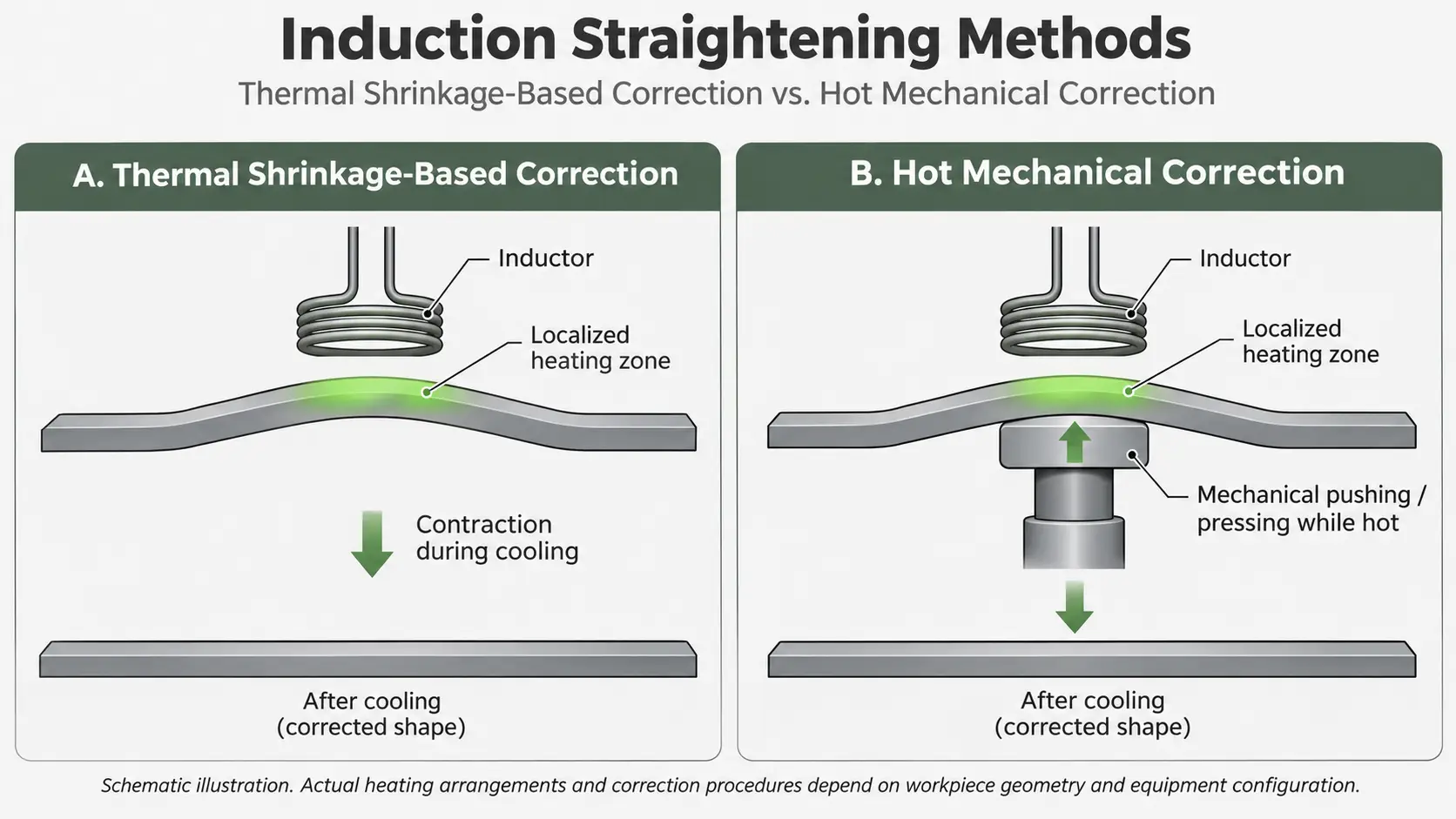
2.3 Thermal Shrinkage and Hot Mechanical Correction
Two general approaches should be distinguished.
Thermal shrinkage-based correction
Selected areas are heated so that restricted expansion and subsequent contraction produce the required dimensional change.
Hot mechanical correction
Some specialized systems combine localized induction heating with controlled pushing or pressing while the steel is hot. The corrected shape is then retained after cooling.
For example, the ENRX TERAC deck straightening system uses induction heating together with mechanical correction.
These methods should not be treated as interchangeable. The actual process depends on the equipment configuration and approved procedure.
3. Common Applications of Induction Straightening
3.1 Ship Deck and Bulkhead Straightening
Shipbuilding is an established application of induction straightening.
Welding large deck plates, stiffeners, and structural assemblies can introduce local and overall deformation.
Typical problems include:
•Uneven deck surfaces
•Local plate distortion
•Angular deformation around welded assemblies
•Distortion of vertical bulkhead panels
Specialized induction straightening systems can heat selected areas of large steel plates. Some are designed to operate from one side, which is useful when access to the opposite surface is restricted.
3.2 Steel Plate and Welded Assembly Correction
Steel plates may develop deformation during welding and fabrication.
The extent and direction of distortion are influenced by welding sequence, heat input, plate dimensions, stiffener configuration, and restraint conditions.
Induction straightening can be considered when localized thermal correction is appropriate for the material and structure.
3.3 Structural Beam Straightening
Structural beams and fabricated sections can develop bending or twisting during manufacturing, transportation, installation, or service.
An I-beam, channel, and flat plate respond differently to thermal correction because of their cross-sectional geometry and stiffness.
The heating arrangement must therefore account for the structural section and the direction of deformation.
3.4 Railway and Heavy Vehicle Structures
Other potential applications include railway rolling stock components, locomotive structural assemblies, and heavy vehicle structures.
Dimensional tolerances and nearby heat-sensitive components must be considered when planning the correction process.
4. Inductor Configuration and Heating Area Selection
The heating area and inductor configuration determine where electromagnetic energy is applied.
There is no universal inductor geometry or heating pattern suitable for every steel structure.
4.1 Identifying the Deformation
Before selecting the heating area, the original deformation should be measured and classified.
Common conditions include:
•Local plate buckling
•Angular distortion
•Overall plate curvature
•Beam bending
•Structural twisting
The most visibly deformed area is not necessarily the only area that should be heated. The correction location must be selected according to the deformation mechanism and intended correction direction.
4.2 Inductor Geometry and Position
Important design considerations include:
•Inductor footprint
•Distance between the inductor and workpiece
•Heating direction and movement
•Workpiece thickness and geometry
•Power and operating frequency
The inductor must provide a suitable heating footprint for the intended correction area.
Traditional thermal straightening literature describes spot, line, and wedge-shaped heating patterns. However, these patterns should not automatically be treated as standard induction coil geometries.
The actual heating distribution depends on inductor design, electromagnetic coupling, workpiece geometry, and operating conditions.
5. Key Factors Affecting Straightening Results
5.1 Steel Grade and Original Material Condition
Different steel grades respond differently to localized heating.
Carbon steel, high-strength low-alloy steel, quenched-and-tempered steel, and thermomechanically processed steel may have different temperature limitations.
For quenched-and-tempered (Q&T) steels, the permitted heating temperature must be considered in relation to the original tempering temperature.
Heating above the relevant limit may alter the mechanical properties developed during the original heat treatment.
Other high-strength and thermomechanically processed steels also require material-specific evaluation.
There is no universal maximum temperature suitable for every induction straightening application. The permitted temperature must be established according to the steel grade, original material condition, governing specifications, and approved procedure.
5.2 Plate Thickness and Structural Geometry
Plate thickness influences heat transfer and the temperature difference between the surface and interior.
Thin plates may be particularly sensitive to excessive localized heating, which can introduce additional buckling or distortion.
Thicker sections may require different inductor arrangements and heating conditions.
Stiffeners, welded connections, and nearby structural elements also influence the thermal and mechanical response.
5.3 Restraint and Heating Sequence
The original deformation and structural constraints determine whether external restraint or mechanical correction is required.
Incorrectly positioned restraint or excessive mechanical force may introduce additional deformation.
Larger structures may require multiple heating operations. Each correction cycle should be evaluated before the next heating location or operating condition is selected.
5.4 Power, Frequency, and Heating Time
Power, frequency, and heating duration influence the energy delivered to the workpiece.
Higher power does not automatically produce better straightening results.
The operating conditions must be matched to the steel thickness, material properties, inductor geometry, coupling distance, and intended heating area.
6. Induction Straightening vs. Flame Straightening
Both methods use localized heating to correct steel deformation, but their heating methods and operational characteristics differ.
| Comparison | Induction Straightening | Flame Straightening |
|---|---|---|
| Heat source | Electromagnetic induction | Combustion flame |
| Heat generation | Within conductive workpiece | External flame |
| Heating control | Induction system settings | Torch operation and technique |
| Open flame | Not required | Required |
| Repeatability | Can be highly repeatable with a developed process | More dependent on operator technique |
| Heating arrangement | Inductor configuration | Torch-based heating patterns |
| Working environment | No combustion products from the heat source | Combustion products generated |
Induction heating can be advantageous when controlled heating locations, repeatability, and reduced open-flame hazards are important.
Flame straightening remains useful where equipment portability, access, or established working procedures favor conventional heating.
Neither method is automatically suitable for every structure. Selection depends on the material, geometry, correction requirements, and working environment.
7. Process Monitoring and Dimensional Inspection
Dimensional inspection is essential because the objective is to achieve a specified geometric correction, not simply reach a particular heating temperature.
A typical process-control approach includes:
① Initial inspection
Measure the original deformation using suitable dimensional gauges, straightedges, laser measurement systems, or surveying equipment.
② Process planning
Determine the heating locations, inductor arrangement, operating conditions, and correction sequence.
③ Controlled heating
Apply induction heating while monitoring relevant conditions such as power, heating duration, inductor position, and temperature.
Temperature should be measured using an appropriate calibrated instrument, such as a suitable pyrometer. Steel color alone should not be used as the primary temperature measurement method.
④ Mechanical correction and cooling
Where required by the process, apply controlled mechanical force while the steel is hot. Allow the workpiece to cool according to the approved procedure.
Water cooling should not be assumed to be a universal requirement.
⑤ Dimensional remeasurement
After the workpiece reaches the specified inspection condition, measure the geometry again and compare it with the required tolerance.
⑥ Final inspection
Confirm dimensional compliance and perform any additional inspection required for critical structural components.
Induction straightening does not repair cracks or defective welds. These conditions require separate evaluation.
8. Limitations and Material Considerations
Induction straightening is not suitable for every type of deformation or material condition.
Important limitations include:
Material sensitivity: High-strength and heat-treated steels may be affected by excessive heating.
Complex deformation: Structures with multiple interacting deformation modes may require detailed engineering assessment.
Additional distortion: Incorrect heating locations or sequences may introduce new deformation.
Structural integrity: Existing cracks, defective welds, and structural damage require separate inspection.
Equipment access: Complex geometry and restricted access may affect inductor positioning and process feasibility.
For critical structural components, the correction procedure should be reviewed and approved by qualified engineering personnel.
Frequently Asked Questions
Click a question to expand the answer.
Can induction straightening correct welding distortion?
Yes. It can correct certain types of welding-related distortion in steel plates, decks, bulkheads, and structural assemblies. Suitability depends on the deformation geometry, material condition, structural constraints, and permitted heating conditions.
Is induction straightening the same as post-weld heat treatment?
No. Post-weld heat treatment addresses specified metallurgical or residual-stress requirements, while induction straightening primarily corrects geometric deformation.
Does induction straightening require access to both sides of a steel plate?
Not necessarily. Some specialized induction deck straightening systems are designed to operate from one side of the plate. This is useful for large ship decks and bulkheads where access to the opposite surface is restricted.
Can induction straightening change the mechanical properties of steel?
Yes. Heating beyond the permitted temperature for a particular steel grade and original material condition may affect its microstructure and mechanical properties. This is especially important for quenched-and-tempered and other high-strength structural steels.
Conclusion
Induction straightening is a thermal correction method for selected industrial steel structures, including ship decks, bulkheads, steel plates, and structural beams.
By applying localized electromagnetic heating, the process uses controlled thermal expansion, plastic deformation, and cooling contraction to correct unwanted geometry. Some systems also combine heating with mechanical correction while the steel is hot.
Successful results depend on selecting suitable heating locations, configuring the inductor correctly, respecting material temperature limits, and verifying dimensional changes through inspection.
Induction straightening should therefore be treated as a controlled dimensional correction process rather than simply another method of heating steel.
Need Induction Straightening Process Support?
Tell us your steel structure, material grade and the type of deformation you need to correct. Kechuang can help you evaluate the right induction heating approach and equipment configuration.


