
Induction Hardening Cast Iron: Mastering 3 Critical Types & Their Distinct Process Requirements
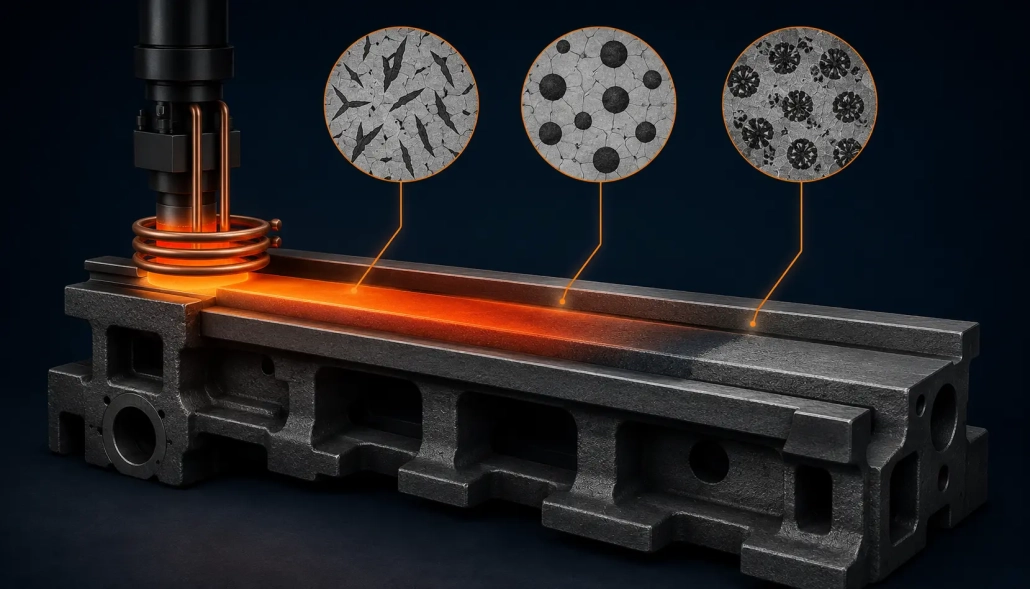
Walk into any heat treating shop that handles cast iron, and the first question is never just “what hardness do you need?” It is “what kind of cast iron is it?” Because induction hardening cast iron is not one process — it is three distinct processes, each demanding its own frequency, power input, heating rate, and cooling strategy. Treat gray iron like ductile iron, and you risk quench cracking. Treat ductile iron like malleable iron, and the hardness falls short. This guide breaks down the process requirements for all three cast iron types so you can harden each one correctly — first time, every time.
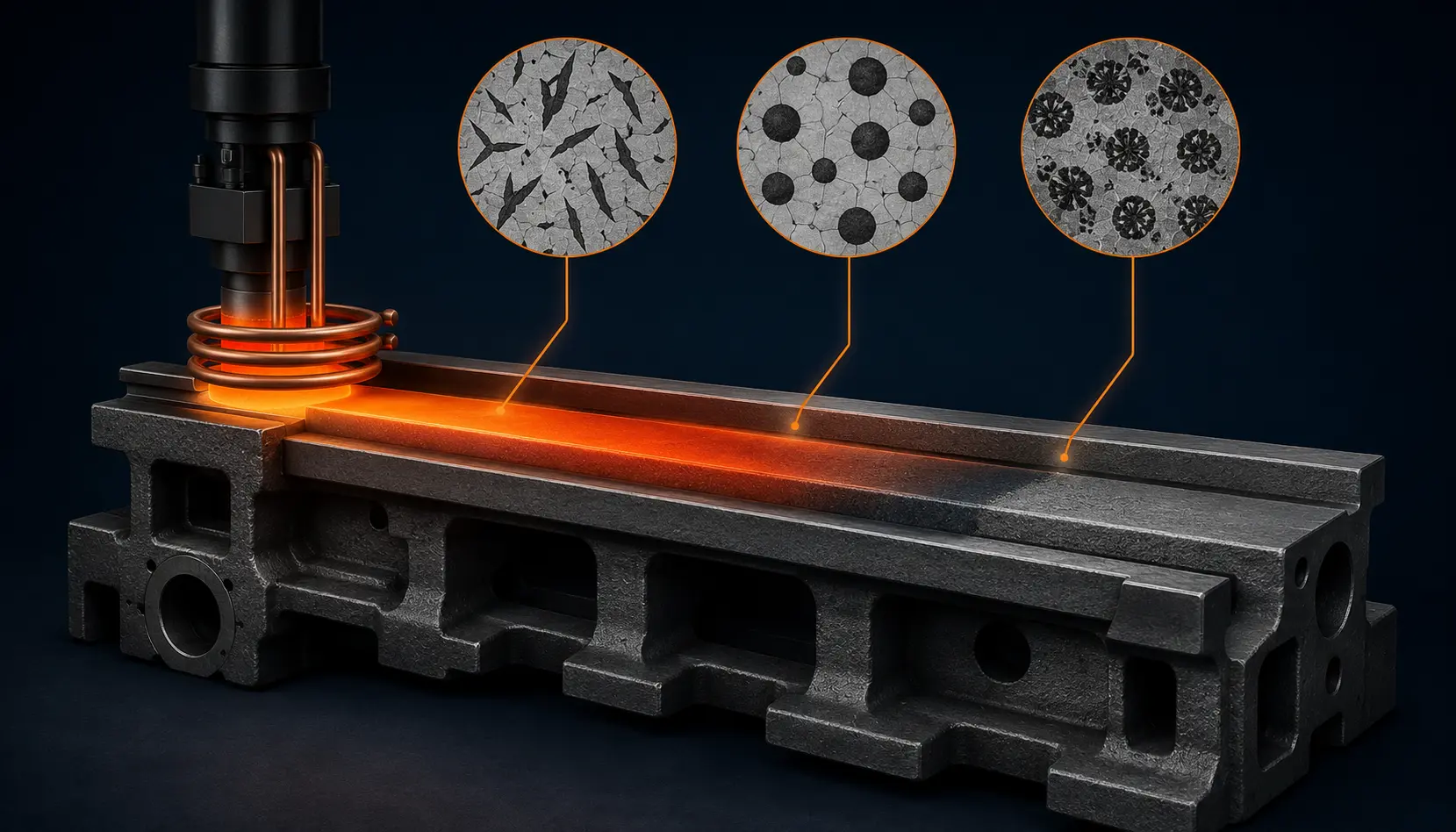
Table of Contents
1. Why Cast Iron Induction Hardening Is Different from Steel
Cast iron is not simply “steel with more carbon.” It is a family of iron-carbon-silicon alloys whose behavior during induction heating is governed by the shape, size, and distribution of graphite — not just the carbon content. Steel dissolves its carbon into austenite uniformly during heating. Cast iron must contend with graphite particles that act as carbon reservoirs, releasing carbon into the matrix at different rates depending on their morphology. This is the fundamental reason why induction hardening cast iron demands type-specific parameters.
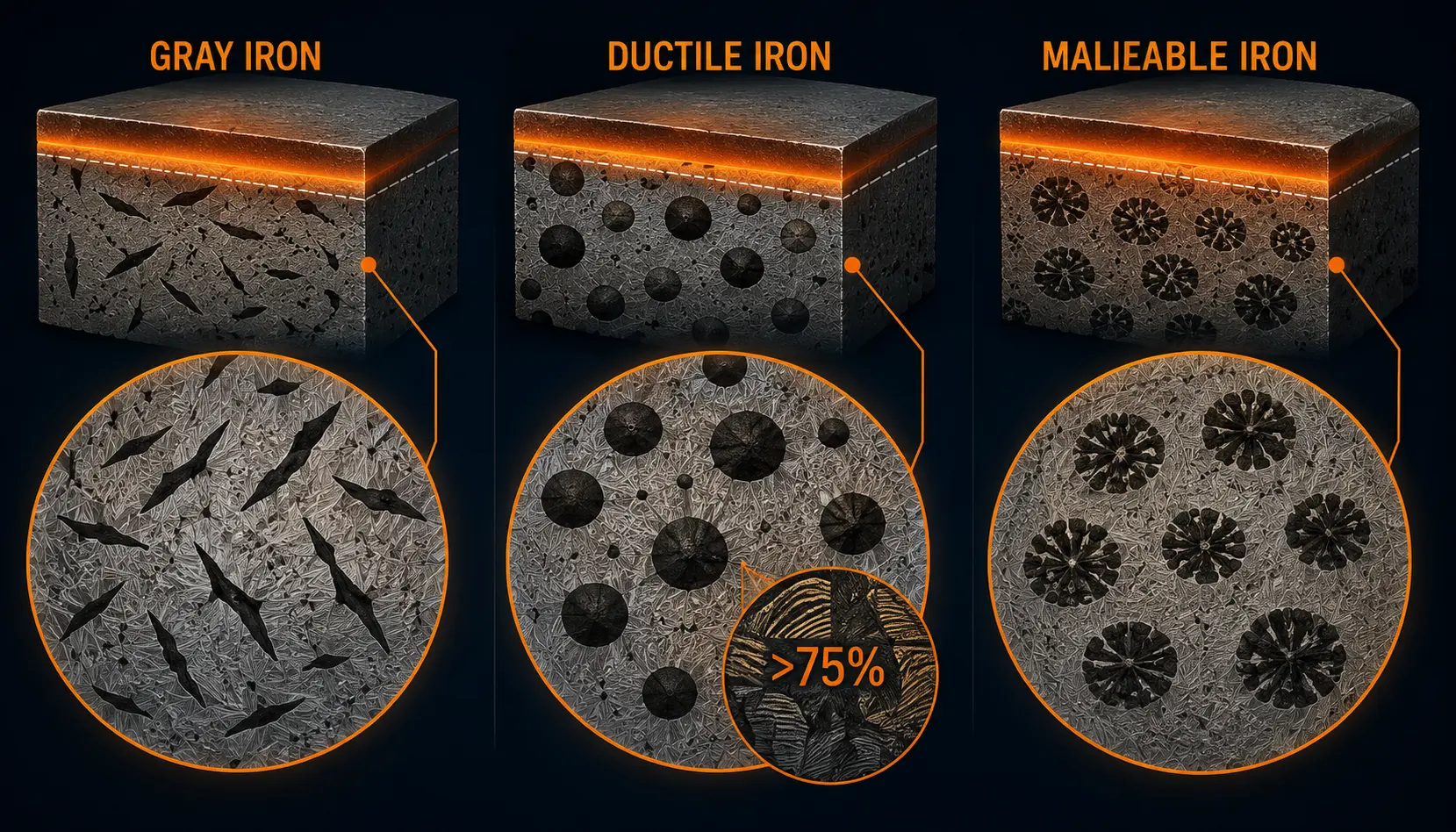
The three cast iron types encountered in induction hardening practice are distinguished by graphite morphology: gray iron has graphite flakes, ductile iron has graphite nodules (spheroids), and malleable iron has graphite rosettes (temper carbon). Each morphology affects how quickly carbon dissolves during the short heating cycle — typically 2 to 30 seconds in induction hardening. This directly controls the achievable hardness, the risk of cracking, and the required prior microstructure. For background on the induction hardening process itself, see our guide to what is induction hardening.
2. Gray Iron: Slow and Controlled
Gray iron is the most common cast iron in machine tool and industrial component manufacturing, and it is also the most sensitive to process parameters during induction hardening. The graphite flakes that give gray iron its excellent damping capacity and machinability also create stress concentration points — sharp-edged graphite particles embedded in the metal matrix. Heat too fast or quench too aggressively, and these flakes become crack initiation sites.
Four process rules for gray iron induction hardening:
Rule 1 — Medium Frequency. Gray iron demands medium frequency (1–10 kHz), not high frequency. The deeper current penetration of medium frequency produces a more gradual thermal gradient from surface to core. This reduces thermal stress during both heating and quenching. High frequency concentrates energy in a very thin surface layer and creates a steep temperature drop-off — exactly what you want to avoid with flake graphite iron. For a complete explanation of frequency effects, see how frequency affects induction heating.
Rule 2 — Low Power Input, Slow Heating Rate. The power density for gray iron should be at the lower end of the standard hardening range — approximately 0.4–0.7 kW/cm². A slow heating rate gives carbon time to diffuse from the graphite flakes into the surrounding austenite, building the carbon level needed for full hardness. Rushing the heating cycle with high power input produces inadequate surface hardness because insufficient carbon has dissolved into the matrix.
Rule 3 — Lower Austenitizing Temperature. Target 850–900°C, roughly 50°C lower than a typical steel hardening temperature. The higher silicon content of gray iron (typically 1.5–2.5%) raises the critical transformation temperature slightly, but the graphite flakes supply abundant carbon — so full austenitization is achieved at a modest temperature. Overheating risks retained austenite formation and grain coarsening in the matrix, both of which reduce hardness and wear resistance.
Rule 4 — Slow Cooling. This is the most important rule and the easiest to violate. Gray iron must be quenched gently — polymer quenchants at moderate concentration, warm oil, or even forced air cooling for some compositions, rather than a direct water or brine quench that would be routine for medium-carbon steel. The goal is to achieve martensitic transformation without exceeding the fracture stress at the graphite flake tips. Quench cracking in gray iron is almost always due to cooling that is too fast, not heating that is too aggressive. For more on quenching considerations in induction hardening, see our guide on shaft induction hardening challenges — many of the thermal stress principles apply equally to cast iron components.
3. Ductile Iron: Pearlite Content Is Everything
Ductile iron (also called nodular iron or spheroidal graphite iron) is fundamentally different from gray iron in its response to induction hardening — and the single most important variable is not the induction parameters themselves, but the prior microstructure of the part before it ever sees a magnetic field.
The Pearlite Rule: >75% Minimum. For induction hardening to produce acceptable surface hardness and case depth in ductile iron, the matrix microstructure must contain at least 75% pearlite. Below this threshold — if the matrix is predominantly ferritic — there is simply not enough carbon available in the matrix to form martensite during the rapid heating and quenching cycle. Graphite nodules are spherical, compact, and slow to dissolve compared to flakes; they cannot supply carbon to the surrounding austenite fast enough during a 3–10 second induction heating pulse.
Preliminary Heat Treatment. If the as-cast ductile iron has a ferritic or ferritic-pearlitic matrix with low pearlite content (common in thin-section castings that cooled slowly in the mold), a normalizing or austenitizing-and-controlled-cooling treatment is mandatory before induction hardening. This preliminary heat treatment dissolves carbon from the nodules into the matrix and, upon controlled cooling, reprecipitates it as pearlite. Only then does the induction hardening step have the carbon reservoir it needs. Skipping this step is the most common cause of low and inconsistent hardness in induction-hardened ductile iron parts.
Hardened Microstructure Grading. The quality of induction-hardened ductile iron is assessed by metallographic examination against established grading standards (such as ISO 16112 or company-specific specifications). Key grading criteria include martensite fraction, retained austenite percentage, undissolved ferrite content, graphite nodule count and nodularity in the hardened case, and the presence of carbides at graphite-matrix interfaces. A properly hardened ductile iron part shows a martensitic matrix with well-distributed graphite nodules, minimal retained austenite, and complete absence of undissolved ferrite in the case.
Bainitic Structures: A Specialized Application. An advanced variant worth noting: ductile iron can be induction hardened to produce a bainitic structure rather than the conventional martensitic case. This is achieved by controlling the cooling rate — cooling fast enough to avoid pearlite formation but holding in the bainite transformation range (typically 250–450°C) long enough for the bainitic reaction to complete. The resulting microstructure combines high hardness with improved toughness compared to fully martensitic structures. Austempered ductile iron (ADI) parts that undergo localized induction hardening to create a bainitic case represent a niche but growing application area, particularly in gears and wear components where both surface durability and core toughness are critical. For more on gear-specific hardening considerations, see our guide on gear induction hardening defects.
4. Malleable Iron: The Straightforward One
Of the three cast iron types, malleable iron is the least demanding when it comes to induction hardening. Its graphite exists as temper carbon rosettes — compact, rounded aggregates that produce far lower stress concentration than graphite flakes and dissolve carbon more readily than ductile iron nodules. The result is a material that behaves more like a medium-carbon steel during induction heating than like either gray or ductile iron.
No Special Process Restrictions. Malleable iron can be induction hardened using standard parameters developed for steel of similar carbon content. Medium frequency (1–10 kHz) is typical, power density follows the standard 0.5–1.0 kW/cm² range for surface hardening, and conventional quenchants — water, polymer, or oil — are selected based on part geometry rather than metallurgical constraints. The temper carbon rosettes do not create the cracking sensitivity of gray iron flakes, nor do they impose the pearlite content prerequisite of ductile iron nodules.
The practical implication is significant: if your shop already induction hardens medium-carbon steel parts, you can take on malleable iron work with minimal parameter changes. The same frequency ranges, similar power densities, and your existing quenchant selection methodology all apply. The only additional check is to confirm that the malleable iron part has been fully malleabilized — that the original white iron casting has been completely converted through the annealing cycle, leaving no residual cementite in the microstructure that could produce hard spots or uneven case depth. For a broader overview of how induction hardening differs from other surface hardening methods, see what is induction hardening.
5. Side-by-Side Process Comparison
The table below summarizes the distinct process parameters for each cast iron type. Use it as a quick reference when setting up a new job or troubleshooting an existing one.
| Parameter | Gray Iron | Ductile Iron | Malleable Iron |
|---|---|---|---|
| Graphite morphology | Flakes (sharp, stress-raising) | Nodules/spheroids (compact) | Temper carbon rosettes (rounded) |
| Frequency | Medium (1–10 kHz) | Medium (1–10 kHz), HF for shallow case | Medium (1–10 kHz) — same as steel |
| Power density | Low: 0.4–0.7 kW/cm² | Standard: 0.5–1.0 kW/cm² | Standard: 0.5–1.0 kW/cm² |
| Heating rate | Slow — allow carbon diffusion | Moderate — nodule dissolution is rate-limiting | Standard — no special restriction |
| Austenitizing temp. | 850–900°C (lower end) | 870–930°C | 850–920°C (steel-equivalent) |
| Quenching | Gentle: polymer, warm oil, or forced air | Moderate: polymer or oil | Standard: water, polymer, or oil (geometry-dependent) |
| Preliminary heat treatment | Not typically required (as-cast pearlitic matrix is common) | Critical: normalize if pearlite < 75% | Confirm full malleabilization only |
| Cracking risk | High — graphite flakes are stress raisers | Low to moderate | Low — similar to steel |
6. Common Applications
Each cast iron type dominates specific application categories, driven by the combination of its mechanical properties and its induction hardening behavior.
Gray Iron — Machine Tool Guideways. This is the classic and most common induction hardening cast iron application. Machine tool beds, columns, and guideways are cast in gray iron for vibration damping and dimensional stability, then the ways are induction hardened using scanning hardening to produce a wear-resistant surface track (typically 55–62 HRC, 1–3 mm case depth) while the surrounding cast structure remains machinable and dimensionally stable. The scanning method — where the induction coil traverses along the guideway surface at a controlled speed — naturally suits the long, linear geometry of machine tool ways. Cylinder liners, hydraulic pump bodies, and compressor housings are also common gray iron applications.
Ductile Iron — Automotive and Engineering Components. Crankshafts, camshafts, gears, steering knuckles, and suspension arms in ductile iron benefit from induction hardening of bearing journals, gear teeth, and wear surfaces. The combination of a tough, ductile core (from the nodular graphite structure) and a hard, wear-resistant case makes ductile iron an attractive alternative to forged and case-hardened steel in many medium-stress applications. The bainitic hardening variant — producing an austempered ductile iron (ADI) case on a pearlitic-ferritic core — is gaining traction in gear applications where pitting resistance and bending fatigue strength are the primary failure modes. For more on automotive component hardening, see our guides on cam lobe and shift fork induction hardening and angular groove hub bearing induction hardening.
Malleable Iron — General Industrial. Pipe fittings, valve bodies, conveyor chain links, and agricultural machinery components in malleable iron are induction hardened where localized wear resistance is needed. The simplicity of the process — effectively treating malleable iron like a medium-carbon steel — makes it attractive for job shops that do not want to maintain separate process parameter sets for different cast iron types.
Regardless of the application, IGBT induction power supplies are the standard choice for cast iron induction hardening across all three material types. Their precise power control, fast response to load changes, and ability to maintain consistent frequency throughout the heating cycle are essential for the controlled heating rates that cast iron demands. For more on power supply selection, see our guide on induction heating power selection and our power calculation method in how much power for induction heating.
7. Summary & Quick Reference
Induction hardening cast iron succeeds or fails at the process parameter level. The three cast iron types — distinguished by graphite morphology — each demand a distinct combination of frequency, power, heating rate, and quench severity. Gray iron requires the most conservative approach. Ductile iron demands metallurgical preparation before hardening. Malleable iron asks for nothing special. Recognize which one is on your fixture, and the parameters follow naturally.
🔑 Cast Iron Induction Hardening — Quick Decision Guide
| Gray iron part? | → Medium frequency, low power density (0.4–0.7 kW/cm²), slow heating, low temperature, gentle quench. Never use water. |
| Ductile iron part? | → Check pearlite content first. If <75%, normalize before hardening. Standard power density, moderate quench. Consider bainitic hardening for toughness-critical applications. |
| Malleable iron part? | → Use your standard steel induction hardening parameters. Confirm full malleabilization. No special restrictions. |
For application-specific hardening guidance, explore our detailed guides on internal bore induction hardening, gear induction hardening defects, and shaft induction hardening challenges. For equipment-related questions, browse our product range or visit the induction hardening solutions page.
Frequently Asked Questions
Why does gray iron crack during induction hardening?
Gray iron cracks during induction hardening for one dominant reason: the quench is too severe. Graphite flakes act as internal stress concentrators — sharp-edged discontinuities in the metal matrix. When the austenitized surface layer transforms to martensite, it expands. If this transformation occurs too rapidly (as with a water or cold polymer quench), the tensile stresses at the flake tips exceed the fracture strength of the surrounding matrix. The fix is almost always to reduce quench severity: switch from water to a warm polymer solution, raise the quenchant temperature, or use a slower-cooling oil. Reducing the heating rate and using a lower austenitizing temperature also help by minimizing the thermal gradient before quenching begins.
How much pearlite does ductile iron need before induction hardening?
A minimum of 75% pearlite in the matrix is the industry-accepted threshold. Below this, the ferrite fraction is too high — ferrite contains negligible dissolved carbon and cannot transform to martensite. Since graphite nodules dissolve too slowly during the short induction heating cycle to supply carbon to ferritic regions, those regions remain soft after quenching, producing low and inconsistent hardness readings. If the as-cast pearlite content is below 75%, a normalizing heat treatment must be performed before induction hardening to dissolve carbon from the nodules and reprecipitate it as pearlite throughout the matrix.
Can I induction harden cast iron with a handheld machine?
For small, localized hardening of cast iron components — such as the edge of a guideway or a specific wear point on a gray iron housing — a handheld induction heater in the 15–30 kW range at medium frequency can be effective, provided you can control the heating rate and quench application manually. However, for production hardening of cast iron parts where consistent case depth, hardness, and freedom from cracking are required, a fixed machine with CNC-controlled scanning or rotary indexing is strongly preferred. Manual process variation is the enemy of repeatable cast iron hardening — especially gray iron, where a few seconds of overheating or an extra-second delay before quenching can be the difference between a good part and a cracked one.
Need Help Hardening Your Cast Iron Parts?
Tell us your cast iron grade, part geometry, target hardness, and case depth. Our engineering team will recommend the right frequency, power level, coil design, and quench method — free technical consultation with no obligation.


