
How Much Power Do You Need for Induction Heating? 6 Critical Factors & a Proven Calculation Method
Ask any induction heating engineer the first question they need answered, and it is almost always the same: how much power for induction heating does this application require? Get the number wrong — too low — and the part never reaches temperature. Too high, and you overspend on equipment you do not need. This guide breaks down the six factors that determine power requirements, gives you real wattage ranges by application, and walks through a practical calculation method you can use today to size your system correctly.
Table of Contents
1. Why Getting the Power Right Matters
Power is the engine of induction heating. It determines three things: how fast the part reaches temperature, how deep the heat penetrates in a given time, and what you can and cannot heat with your equipment. A 15 kW benchtop machine will never through-heat a 100 mm steel billet for forging — not because the machine is defective, but because the physics of heat loss to the environment outruns the power input at that scale. Conversely, a 300 kW system heating small bearing rings at a few seconds per part is money left on the table if a 50 kW machine would do the same job.
The cost curve is steep. A portable 15 kW induction heater might cost a few thousand dollars. A 300 kW industrial cabinet system with closed-loop cooling and automation integration can run well into six figures. The difference between correctly sizing your power supply and guessing is the difference between a profitable process and an expensive mistake. This is also why induction heating power selection is one of the most searched topics among equipment buyers.
2. Six Factors That Determine Power Requirements
Six variables ultimately control how much power for induction heating any given job demands. Change any one of them, and the power number moves. Here they are, in order of impact.
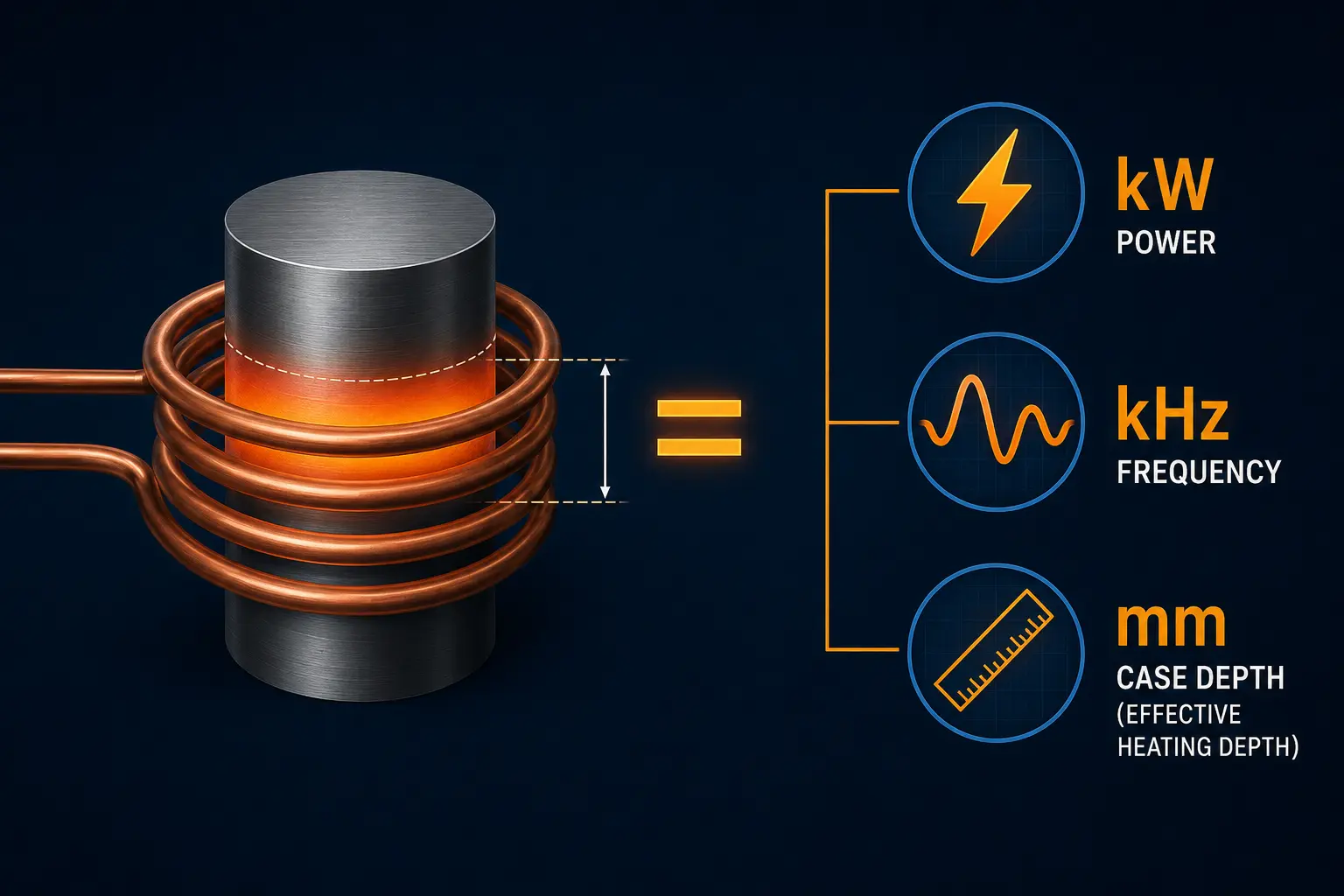
Factor 1 — Heated Mass. This is the dominant variable. Power requirement scales roughly linearly with the mass of metal you are heating. A 50-gram gear tooth tip needs far less power than a 50-kilogram shaft. The heated mass is not the entire part — it is only the volume of material that must reach the target temperature within the heating cycle. For surface hardening, this is the case depth × heated surface area. For through-heating, this is the total part volume.
Factor 2 — Target Temperature. The higher the target temperature, the more energy — and therefore power — required. Heating steel to 850°C for hardening takes roughly twice the energy of heating it to 400°C for tempering. Forging temperatures (1200–1250°C for steel) demand the highest power levels because you are pushing against increasingly steep radiation and convection losses as temperature climbs.
Factor 3 — Cycle Time. Power is energy per unit time. The same part heated to the same temperature in 5 seconds requires 6 times the power of a 30-second cycle. Production lines that run one part every few seconds push power requirements up dramatically — and this is exactly where induction shines, because the power is delivered directly to the part rather than lost to a furnace cavity.
Factor 4 — Material Properties. Magnetic steels heat more efficiently than non-magnetic materials because hysteresis contributes additional heating below the Curie point (≈770°C). As explained in our guide to eddy currents vs. hysteresis, this bonus disappears above the Curie temperature — which is why the last 400°C of heating to forging temperature requires disproportionately more power. Aluminum, copper, and brass — all non-magnetic with low electrical resistivity — demand significantly higher power densities to achieve the same heating rate as carbon steel.
Factor 5 — Frequency and Case Depth. Frequency determines how deep the induced current penetrates. A shallow case depth (0.5–1 mm) requires high frequency (100–400 kHz) and a very high power density concentrated in a thin surface layer. A deep case or through-heating application uses lower frequency (1–10 kHz) and spreads the power over a larger volume. For a complete explanation, see our article on how frequency affects induction heating.
Factor 6 — Coil Efficiency and Coupling. Not all the power leaving the power supply reaches the workpiece. Coil losses (I²R heating in the copper), magnetic field leakage, and poor coupling (large air gap between coil and part) all steal power. A well-designed coil with tight coupling achieves 80–90% transfer efficiency. A poorly designed coil — large gap, wrong geometry — may deliver less than 50% of the power supply’s output to the part. This is why how induction coils work matters as much as the power supply rating.
3. Power Density: The Core Rule of Thumb
The most practical way to think about induction heating power is through power density — kilowatts per square centimeter (kW/cm²) or kilowatts per square inch (kW/in²) of heated surface area. This single number captures the combined effect of material, temperature, and cycle time in a way that translates directly to equipment sizing.
Here are the industry-standard power density ranges for common processes:
| Process | Power Density (kW/cm²) | Power Density (kW/in²) | Typical Target |
|---|---|---|---|
| Surface hardening (shallow, ≤1 mm) | 1.0–2.0 | 6.5–13 | Fast surface austenitizing, minimal heat spread |
| Surface hardening (deep, 2–5 mm) | 0.5–1.0 | 3.2–6.5 | Deeper case with controlled thermal profile |
| Through-heating for forging | 0.3–0.8 | 1.9–5.2 | Uniform core temperature, 1200–1250°C |
| Brazing / soldering | 0.3–0.8 | 1.9–5.2 | Filler flow temperature (450–850°C), localized joint |
| Shrink fitting / bearing heating | 0.1–0.3 | 0.6–1.9 | Modest temperature (80–250°C), uniform expansion |
| Bolt heating / disassembly | 0.05–0.2 | 0.3–1.3 | Thermal expansion for loosening, no metallurgical change |
These ranges assume carbon or low-alloy steel and a well-coupled coil. For aluminum or copper, multiply by 1.5–2.5× — their lower resistivity and non-magnetic nature demand more power for the same heating rate. For stainless steel (austenitic grades like 304/316), use the upper end of the range due to higher resistivity combined with no magnetic contribution.
4. Real Power Ranges by Application
Moving from power density to total machine power, here is what the numbers look like for real-world applications. These are machine output power ratings, not input electrical service requirements (which are typically 10–15% higher due to power supply efficiency losses).
| Application | Typical Part Size | Power Required | Frequency | Machine Type |
|---|---|---|---|---|
| Small bolt removal | M8–M20 bolts | 1–5 kW | 10–50 kHz | Portable handheld |
| Bearing mounting (small) | Bore 20–100 mm | 2–10 kW | 10–30 kHz | Portable / benchtop |
| Small-part hardening | Pins, small gears, cutting edges | 5–30 kW | 100–400 kHz | High-frequency benchtop |
| Brazing (copper/steel joints) | Tube Ø6–50 mm, fittings | 5–40 kW | 30–200 kHz | Benchtop / medium-freq |
| Gear hardening (automotive) | Module 2–6, Ø50–250 mm | 50–300 kW | 1–10 kHz (MF) or 100–400 kHz (HF) | MF or HF industrial |
| Shaft hardening (scanning) | Ø25–150 mm, various lengths | 50–400 kW | 1–10 kHz | MF industrial with scanning |
| Bearing ring hardening | Ø50–500 mm rings | 50–300 kW | 1–10 kHz | MF industrial with rotary feed |
| Billet heating for forging | Ø20–150 mm billets | 100–1000+ kW | 0.5–10 kHz | MF/low-freq dedicated system |
| Strip / wire heating | Continuous strip, wire | 50–2000+ kW | 1–400 kHz (app-dependent) | Dedicated in-line system |
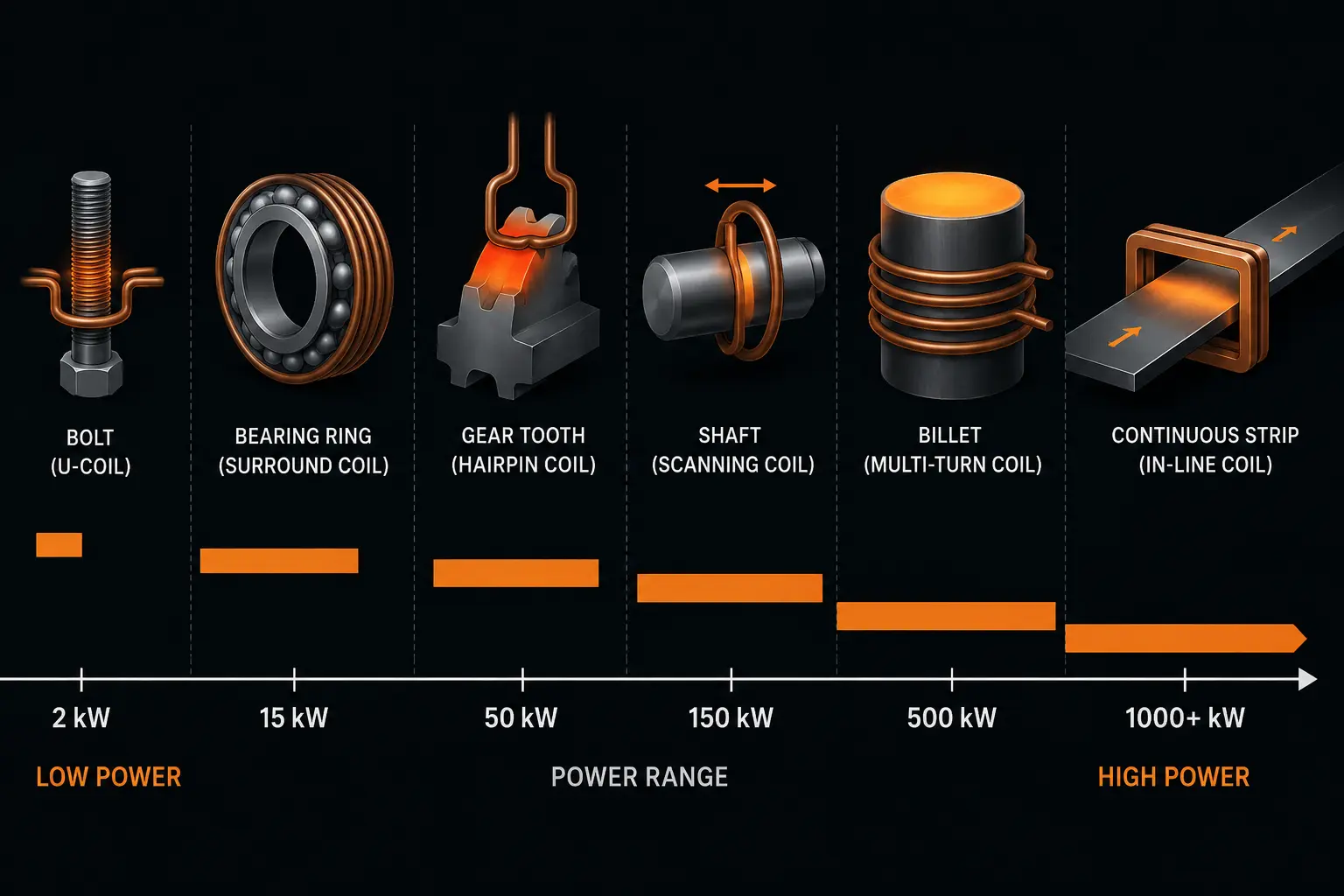
A note on the jump from benchtop to industrial: the gap between 30 kW and 50 kW is where the machine architecture changes fundamentally — from air-cooled single-phase benchtop units to water-cooled three-phase industrial cabinets. If your calculated requirement falls in the 30–50 kW range, err toward the industrial platform. Running a benchtop machine at its maximum rated power continuously will shorten component life and limit your duty cycle. For more on machine types and selection, see our induction heating machine guide.
5. Step-by-Step Power Calculation Method
Here is a practical four-step method to estimate how much power for induction heating your specific application needs — no finite element software required. This gives you a solid starting point for equipment selection; final process development with a coil prototype will refine the number.
Step 1 — Calculate the Heated Mass
For surface hardening: heated volume = case depth × heated surface area. For example, hardening the tooth flank area of a gear — if the total heated surface is 80 cm² and you need a 2 mm (0.2 cm) case depth, the heated volume is 80 × 0.2 = 16 cm³. Multiply by steel density (7.85 g/cm³) to get heated mass ≈ 126 grams.
For through-heating: use the full part volume. A steel billet Ø50 mm × 150 mm long has a volume of π × (2.5)² × 15 = 295 cm³, giving a heated mass ≈ 2.3 kg.
Step 2 — Calculate the Required Energy
Energy (kJ) = mass (kg) × specific heat capacity (kJ/kg·°C) × temperature rise (°C). For steel, specific heat capacity is approximately 0.46 kJ/kg·°C below the Curie point and roughly 0.62 kJ/kg·°C above it. For a practical estimate, use an average of 0.55 kJ/kg·°C for heating from room temperature to 900°C.
Using the gear example above: 0.126 kg × 0.55 × (900 − 20)°C = 0.126 × 0.55 × 880 ≈ 61 kJ of energy required.
For the 2.3 kg billet to forging temperature (1220°C): 2.3 × 0.55 × (1220 − 20) = 2.3 × 0.55 × 1200 ≈ 1,518 kJ.
Step 3 — Convert to Power Using Cycle Time
Power (kW) = Energy (kJ) ÷ cycle time (seconds). For the gear hardening example with a 5-second heating cycle: 61 kJ ÷ 5 s = 12.2 kW at the part surface.
For the forging billet with a 60-second cycle (continuous feed, one billet per minute): 1,518 kJ ÷ 60 s = 25.3 kW. If you need one billet every 15 seconds: 1,518 ÷ 15 = 101 kW. This is why production rate drives power requirements so dramatically.
Step 4 — Apply Efficiency Factors
Divide by coil efficiency and power supply efficiency to get the machine rating. A well-designed coil delivers 80% efficiency; the power supply itself is typically 90–95% efficient.
Required machine power = Part surface power ÷ (coil efficiency × power supply efficiency)
For the gear example: 12.2 kW ÷ (0.80 × 0.92) ≈ 16.6 kW machine power. A 20 kW benchtop high-frequency machine would handle this with comfortable headroom. For the forging billet at one per minute: 25.3 ÷ (0.80 × 0.92) ≈ 34.4 kW. A 40–50 kW medium-frequency industrial machine would be correctly sized.
Always add a 15–20% safety margin above your calculated number. This accounts for coil aging (copper work-hardens and resistivity increases over time), part-to-part variation in mass and geometry, and the reality that your next job may be slightly larger than your current one. The cost of a modest power reserve is small compared to the cost of a machine that cannot complete the cycle.
6. Summary & Quick Reference
Getting the power right for induction heating is a matter of physics, not guesswork. The mass of metal, the target temperature, the cycle time, the material properties, the frequency-driven case depth, and the coil coupling efficiency — these six factors, applied in sequence, give you a number you can trust.
🔑 Power Selection Quick Reference
| Surface hardening (shallow case) | → 1.0–2.0 kW/cm², high frequency, 5–30 kW for small parts, 50–300 kW for gears/shafts |
| Through-heating (forging) | → 0.3–0.8 kW/cm², low-medium frequency, 100–1000+ kW depending on billet size and rate |
| Brazing / soldering | → 0.3–0.8 kW/cm², medium-high frequency, 5–40 kW |
| Bearing / shrink fitting | → 0.1–0.3 kW/cm², low-medium frequency, 2–10 kW for small bearings |
| Calculation formula | → kW = mass(kg) × 0.55 × ΔT(°C) ÷ cycle(s) ÷ 0.74 × 1.2 safety |
| Non-magnetic metals (Al, Cu, SS) | → Multiply power by 1.5–2.5× vs. carbon steel values |
For a deeper dive into matching frequency and power to specific materials and part geometries, explore our full induction heating power selection guide. If you are ready to size a machine, our induction heating machine overview covers the five main equipment types and how to match them to your application.
Frequently Asked Questions
How many watts do I need for effective induction heating?
The wattage depends on your application. For small bolt removal or bearing mounting, 1–5 kW (1,000–5,000 watts) is sufficient. Small-part surface hardening typically needs 5–30 kW. Industrial gear and shaft hardening requires 50–300 kW. Forging billet heating demands 100–1,000+ kW depending on billet size and production rate. The power density method described above — matching kW/cm² to your process — is the most reliable way to determine the right wattage.
Can I use a 15 kW induction heater for hardening gears?
A 15 kW machine can harden very small gears — think module 1–2, under 50 mm diameter, with a shallow case depth requirement. For automotive transmission gears (module 3–6, 100–200 mm diameter), you typically need 80–200 kW at medium frequency, because the heated surface area is much larger and the required power density (0.5–1.0 kW/cm²) demands proportionally more total power. Attempting to harden a large gear with a 15 kW machine will result in insufficient case depth and unacceptably long cycle times.
How do I calculate induction heating power for a new application?
Use the four-step method: (1) calculate heated mass from case depth × area or total part volume, (2) calculate required energy using mass × specific heat × temperature rise (0.55 kJ/kg·°C for steel), (3) divide by cycle time in seconds to get power at the part surface, (4) divide by combined coil and power supply efficiency (~0.74) and add a 20% safety margin. This gives you the minimum machine power rating to specify.
Need Help Sizing Your Induction Heating Power Supply?
Tell us your part material, dimensions, target temperature, and desired cycle time. Our applications team will calculate the power requirement and recommend a matched machine and coil configuration — free, no obligation.


