
Induction Heating for Hot Heading: Fastener Wire Preheating and Production Control
Introduction
Hot heading is a metal forming process used to manufacture bolts, screws and other fasteners with enlarged heads. During the process, a selected section of metal stock is heated and compressed in a die to produce the required head geometry.
For fastener manufacturers, induction heating provides a way to prepare the required material section before the heading operation. Depending on the production arrangement, heating can be applied to continuously fed steel wire or to individual cut blanks before they enter the heading machine.
Unlike conventional furnace heating, induction can concentrate energy in a selected region of the workpiece. This is particularly useful when only the material intended for head formation needs to reach the required processing temperature.
However, successful fastener heating involves more than reaching a target temperature. The amount of material available for head formation, the location of the heated section, the transfer sequence and the operating cycle of the heading machine all influence the production process.
This article examines how induction heating is integrated into fastener hot heading, including wire preheating, heated-section requirements, material preparation and production coordination.
2. Wire Feeding vs. Individual Blank Heating
3. Determining the Heated Section for Bolt Head Formation
4. Coordinating Heating, Cutoff and Heading Operations
5. Temperature Verification and Production Consistency
6. Establishing an Induction Heating Process for Fastener Production
1. Understanding Hot and Warm Heading in Fastener Manufacturing
1.1 Cold Heading, Warm Heading and Hot Heading
Fastener head formation can be performed under different temperature conditions.
| Process | General characteristics |
|---|---|
| Cold Heading | Material is formed at or near room temperature without deliberate heating |
| Warm Heading | Material is heated to an intermediate temperature before forming |
| Hot Heading | Material is heated to a higher hot-working temperature before upsetting |
The choice depends on material properties, fastener dimensions, required deformation and production requirements.
Cold heading is widely used for high-volume fastener manufacturing. However, as material strength, blank diameter or forming difficulty increases, the loads imposed on the tooling may become a concern.
Warm or hot heading can reduce the resistance to deformation by heating the material before forming.
For suitable applications, induction heating can provide this preheating without requiring the entire workpiece to pass through a conventional heating furnace.
1.2 Heating Temperature Depends on the Forming Process
There is no universal temperature for induction heating before fastener heading.
According to the technical paper Induction Heating and Heat Treating of Fasteners by Inductotherm Group, typical temperatures for steel fasteners before hot working, such as upset forging or hot heading, are approximately 1,050–1,150°C.
The same paper identifies a lower range of approximately 340–550°C for certain warm-working applications.
These are industry reference ranges, not fixed specifications for every fastener.
Material grade, cross-sectional dimensions, deformation requirements and the intended forming process must determine the actual target temperature.
It is also important to distinguish conventional hot working from lower-temperature preheating.
For example, Ambrell published a fastener application in which 5.4 mm steel wire was heated to approximately 177°C before a heading operation. The purpose was to reduce the tooling burden associated with cold forming.
Although the application is described as hot heading in the manufacturer’s case study, its reported temperature should not be interpreted as a general hot-heading temperature or as a typical warm-working specification.
The actual thermal objective must always be defined by the forming process.
1.3 Why Use Induction Preheating for Fasteners?
Induction preheating can provide several advantages in suitable fastener manufacturing applications:
•Localized heating of the material section required for forming
•Rapid heating without waiting for a large furnace to reach operating temperature
•Repeatable heating conditions between successive workpieces
•Integration with automatic wire feeding and material handling
•Reduced exposure of surrounding equipment to combustion heat
•Flexible heating arrangements for different fastener sizes and production requirements
An important consideration is tooling life.
When a manufacturer changes from cold heading to a suitable heated forming process, the reduced resistance to deformation may help lower forming loads and reduce tooling stress.
The actual improvement depends on the material, forming temperature, die design and production conditions.
2. Wire Feeding vs. Individual Blank Heating
The way material enters the induction heating station determines much of the production arrangement.
Two configurations should be considered separately.
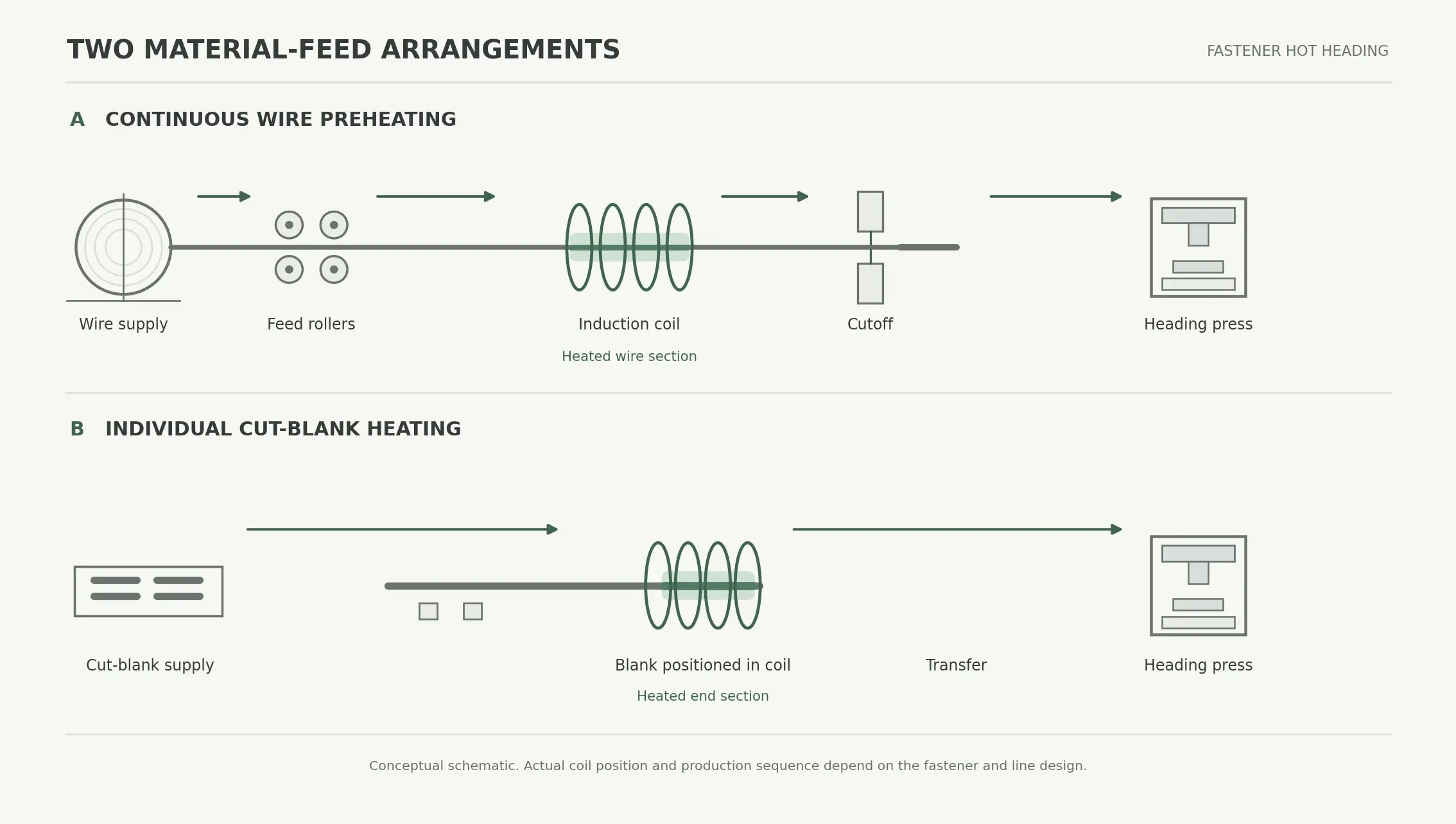
2.1 Continuous Steel Wire Preheating
In some fastener manufacturing lines, steel wire is supplied from a coil and advanced continuously through a feeding system.
An induction coil can be positioned along the wire path to heat the required material section before the subsequent cutoff and heading operations.
A typical production sequence may include:
①Wire feeding and straightening.
②Induction preheating.
③Transfer to the cutoff position.
④Cutting the wire into individual blanks.
⑤Delivery to the heading operation.
The exact sequence depends on the machine layout and the required forming process.
Continuous wire preheating is particularly relevant when the production line requires a stable feeding speed and a consistent thermal condition before cutoff.
The heating arrangement must be coordinated with the wire feed rate, target temperature and distance between the coil and cutoff station.
2.2 Individual Cut Blank Heating
Another possible arrangement is to cut the material into individual blanks before induction heating.
Each blank is then positioned in the heating station, where the required end section is heated before transfer to the heading machine.
This configuration can be considered when the production line uses individual workpiece handling or when the heating arrangement needs to be integrated with an existing blank-feeding system.
Important considerations include:
•Blank length and diameter
•Workpiece orientation
•Heating position
•Loading and unloading time
•Transfer to the heading machine
•Repeatability between individual blanks
Compared with continuous wire heating, individual blank heating introduces additional handling and positioning requirements.
The appropriate arrangement should be selected according to the existing production line rather than assuming that one configuration is suitable for all fastener applications.
2.3 Choosing Between the Two Arrangements
| Consideration | Continuous Wire Heating | Individual Blank Heating |
|---|---|---|
| Incoming material | Coiled or straightened wire | Cut blanks |
| Material movement | Continuous or indexed feeding | Individual workpiece handling |
| Heating position | Defined section along the wire path | Defined position for each blank |
| Main control requirement | Feed speed and heating consistency | Positioning and cycle repeatability |
| Production integration | Wire-processing line | Blank-handling and heading line |
The main difference is not simply the coil design.
It is how the heating station fits into the complete material preparation and forming sequence.
3. Determining the Heated Section for Bolt Head Formation
3.1 Understanding Material Volume During Upsetting
When a cylindrical bolt blank is upset, material from the original shank section flows into the die cavity to form the enlarged head.
The amount of material required depends on the final head geometry.
For an approximately cylindrical head, its theoretical volume can be estimated as:
Vh ≈ π Dh2 Hh / 4
Where:
— Vh = approximate head volume
— Dh = head diameter
— Hh = head height
For a cylindrical starting blank with diameter Db, the corresponding theoretical material length is:
Lb ≈ Vh / (π Db2/4)
Or:
Lb ≈ Dh2 Hh / Db2
This calculation provides an initial estimate of the material length consumed in forming the head.
Actual fastener geometry may include hexagonal profiles, flanges, underhead radii, chamfers and other features. For these shapes, the actual CAD volume or drawing-based volume calculation is more appropriate than the cylindrical approximation.
The calculation also does not directly define the required induction heating length.
The heated section must be established according to the forming sequence, material flow, die design and validated temperature distribution.
3.2 Matching the Heated Section to the Forming Operation
The heating region should correspond to the material that needs to undergo deformation.
If the heated section is too short, part of the material required for head formation may not reach the intended thermal condition.
If the heated section is unnecessarily long, additional material may experience thermal exposure without contributing directly to the intended forming operation.
The correct arrangement depends on:
•Original blank diameter
•Required head dimensions
•Material volume
•Forming reduction
•Number of heading stages
•Die geometry
•Material grade
•Transfer conditions
The relationship between heated length and head geometry should therefore be established using the actual fastener drawing and representative forming trials.
3.3 The Transition Between Heated and Cooler Material
Localized heating creates a transition between the intended forming region and the adjoining material.
This transition influences how the blank behaves during upsetting.
The objective is to prepare the required material section for deformation while avoiding unnecessary heating of the remaining stock.
The temperature transition is affected by the heating arrangement, material dimensions, operating conditions and elapsed time before forming.
For a fastener application, the relevant question is whether the material entering the die has the required thermal condition throughout the section involved in deformation.
The general relationship between coil geometry, workpiece dimensions and heated-zone development is explained in our related article on what determines the heated zone in bar end induction heating.
That article covers the general heating-zone principles. This article focuses on their application to fastener head formation.
4. Coordinating Heating, Cutoff and Heading Operations
4.1 Heating Time Is Only One Part of the Production Cycle
For a high-volume fastener line, the induction heating station must operate in coordination with the material feeding and forming equipment.
The production sequence may involve:
•Wire feeding
•Material positioning
•Induction heating
•Cutoff
•Workpiece transfer
•Heading machine loading
•Upsetting and unloading
The total production cycle cannot be determined from heating time alone.
For example, a heating cycle lasting less than one second may still require additional time for material movement and transfer to the next operation.
The overall line capacity depends on the interaction between these stages.
4.2 Why Transfer Time Matters
After leaving the induction coil, the workpiece begins losing heat to its surroundings.
The temperature at the heading machine may therefore differ from the temperature measured immediately after heating.
This is particularly important for applications involving high forming temperatures or relatively small workpieces with short transfer distances.
The transfer arrangement should maintain a repeatable interval between heating and forming.
In an automated system, this requires coordination between:
•Induction heating control
•Wire feeding or blank positioning
•Cutoff mechanism
•Mechanical transfer
•Heading machine timing
The target is not simply to heat each blank quickly, but to deliver it to the forming operation under consistent conditions.
4.3 A Published Fastener Wire Preheating Example
Ambrell published an application involving the preheating of steel wire before screw heading.
The reported test conditions included:
| Parameter | Published value |
|---|---|
| Steel wire diameter | 5.4 mm |
| Induction power supply | 30 kW |
| Operating frequency | 94 kHz |
| Target temperature | Approximately 177°C |
| Heating time | 0.5 seconds |
| Transfer time to cutoff position | Approximately 3 seconds |
The application used a custom-designed multi-turn helical coil.
Temperature-indicating paint and a thermocouple were used during testing.
The manufacturer reported that the wire maintained the required temperature during the three-second movement from the induction coil to the cutoff position.
These figures describe one specific low-temperature preheating application. They are not recommended settings for conventional hot heading or other wire diameters.
The case is useful because it demonstrates how heating time and transfer time must be evaluated together.
Source: Ambrell – Induction Hot Heading Steel Wire for the Fastener Industry
4.4 Matching Heating Capacity to Heading Press Output
The induction station should be sized according to the required production rate and the operating cycle of the downstream heading machine.
Several arrangements may be considered.
Single-position heating
A single-position arrangement may be suitable when the heating cycle and material handling can match the required production rate.
Multi-position heating
Multiple heating positions can allow different workpieces to be processed within an overlapping production sequence.
This may be useful when the heating time is longer than the available loading or transfer interval.
Channel-type heating
For suitable continuous wire or rod applications, a channel-type inductor can provide a defined heating path through which material is continuously or progressively advanced.
The final choice depends on workpiece geometry, material feed method, heating requirements and available production space.
A faster heating station does not necessarily increase overall output if the heading machine or material handling system remains the bottleneck.
5. Temperature Verification and Production Consistency
5.1 Verifying the Required Temperature
Temperature measurement should be selected according to the target temperature, material and production arrangement.
Possible methods include:
— Contact thermocouples during process development.
— Temperature-indicating paints or materials.
— Validated temperature-monitoring systems.
The measurement location is important.
A surface temperature measurement does not automatically confirm that the center of a larger workpiece has reached the required temperature.
During initial process development, representative samples can be evaluated to establish the relationship between surface temperature and the internal thermal condition.
This is particularly important when the forming operation involves substantial deformation through the workpiece cross-section.
5.2 Factors Affecting Heating Consistency
The following factors should be considered when establishing a repeatable fastener heating process.
Material grade
Different steel grades have different electrical, thermal and forming characteristics. The target temperature should follow the applicable material and forming requirements.
Wire or blank diameter
A larger cross-section represents a greater thermal mass and may require a different heating cycle to achieve the required internal temperature.
Incoming material temperature
Changes in material temperature between production runs can influence the heating response.
Feeding and positioning
Variation in material speed, insertion depth or workpiece position can change the relationship between the coil and the intended heating section.
Transfer interval
Different transfer times can result in different temperatures when the workpiece reaches the heading machine.
Heating recipe
Power, frequency and heating duration should be established together rather than adjusted independently without evaluating the resulting workpiece condition.
5.3 Process Monitoring and Production Records
For production applications, recording the main process conditions can help identify changes between workpieces and production runs.
Useful information includes:
•Material grade and batch
•Wire or blank diameter
•Workpiece length
•Heating recipe
•Power and frequency settings
•Heating duration
•Feeding speed
•Measured exit temperature
•Transfer time
•Heading machine cycle
These records can help distinguish heating-related variations from problems originating in material preparation or the forming equipment.
5.4 Investigating Forming Variation
Not every problem in bolt head formation originates from induction heating.
For example:
| Observed condition | Areas to investigate |
|---|---|
| Incomplete head formation | Available material volume, blank dimensions, material temperature and die filling |
| Variation in head dimensions | Blank consistency, material positioning, die condition and forming sequence |
| Inconsistent forming between successive blanks | Heating repeatability, incoming material variation and press operation |
| Excessive surface scale | Temperature, time at elevated temperature and surrounding atmosphere |
| Misaligned head formation | Blank positioning, transfer alignment and heading tooling |
These observations are starting points for investigation, not automatic diagnoses.
The heating process should be evaluated together with the actual forming operation before changing process parameters.
6. Establishing an Induction Heating Process for Fastener Production
Before selecting an induction heating arrangement, the manufacturer should define the fastener and production requirements.
| Application information | Purpose |
|---|---|
| Material grade | Establishes material-specific heating requirements |
| Incoming material form | Determines wire or individual blank handling |
| Wire or blank diameter | Influences thermal mass and heating response |
| Blank length | Affects feeding and positioning |
| Required head geometry | Helps estimate the material needed for upsetting |
| Required heated section | Defines the intended forming region |
| Target forming temperature | Establishes the thermal objective |
| Production rate | Determines required heating capacity |
| Heading machine cycle | Defines downstream processing requirements |
| Transfer arrangement | Helps evaluate temperature loss before forming |
The induction heating configuration should then be developed around these conditions.
A dedicated coil may be appropriate for a particular wire or blank size. Multi-position arrangements may be considered for higher production requirements, while channel-type configurations may be suitable for continuous material feeding.
The final heating cycle should be validated using representative production material.
A complete application test should verify:
•The intended heated-section position
•The required temperature condition
•Repeatability between successive workpieces
•Transfer conditions
•Compatibility with the heading machine cycle
•The resulting forming quality
The objective is to establish a repeatable heating-to-forming process rather than simply achieve a temperature reading on an individual sample.
Frequently Asked Questions
Click a question to expand the answer.
What temperature is required for induction heating before hot heading?
The required temperature depends on the material and forming process. For steel fasteners, Inductotherm Group reports typical hot-working temperatures of approximately 1,050–1,150°C, while certain warm-working applications use lower temperatures. The actual process specification must be established for the particular material and fastener design.
Can induction heating be used before cold heading?
Induction preheating can be used in certain applications where a manufacturer wants to reduce forming loads or tooling stress compared with conventional cold forming. However, the resulting process should be defined according to the actual temperature and forming requirements rather than automatically classified as conventional hot heading.
Does the entire bolt blank need to be heated?
Not necessarily. Induction heating can concentrate energy in the section required for head formation. The appropriate heated length depends on the blank geometry, head dimensions and forming sequence.
Why is transfer time important in fastener hot heading?
The workpiece loses heat after leaving the induction coil. A change in transfer time can therefore change the temperature at the heading machine. Heating and material handling should be coordinated to maintain consistent forming conditions.
Can the same induction heating arrangement process different bolt sizes?
Different wire diameters, blank lengths and head geometries can require different coil arrangements and heating conditions. A common heating system may accommodate multiple sizes, but its suitability should be verified through application testing.
Conclusion
Induction heating provides a flexible method for preparing wire and bolt blanks before fastener heading.
Its value comes from the ability to heat a selected material section and integrate the heating operation with wire feeding, cutoff and downstream forming equipment.
For fastener manufacturers, the important considerations extend beyond heating time. The available material volume, required forming temperature, heated-section location and transfer sequence all influence the final production process.
A reliable induction heating arrangement should therefore be developed using the actual fastener drawing, material specification and heading machine requirements.
By evaluating heating and forming as connected production operations, manufacturers can establish more consistent conditions for bolt head formation and high-volume fastener manufacturing.
Need an Induction Heating Process for Fastener Hot Heading?
Tell us your material grade, wire or blank dimensions, required head geometry and production rate. Kechuang can help you evaluate the right induction heating arrangement for your fastener production.


