
Concrete Pump Pipe Induction Hardening Machine
Automatic Inner Wall Induction Hardening Line for Straight Concrete Pump Pipes
This automatic concrete pump pipe induction hardening machine is used for continuous hardening of the inner surface of straight pump pipes.
The liny que combines pipe conveying, rotation, induction heating, internal water-spraenching and centralized process control. The project shown here uses a 250 kW DSP digital induction heating power supply with an operating frequency of 5–20 kHz.
Different pump pipe models can run with their own heating programs. Once the required process has been set, power output and quenching sequences can be called through the control system when production changes from one established pipe model to another.
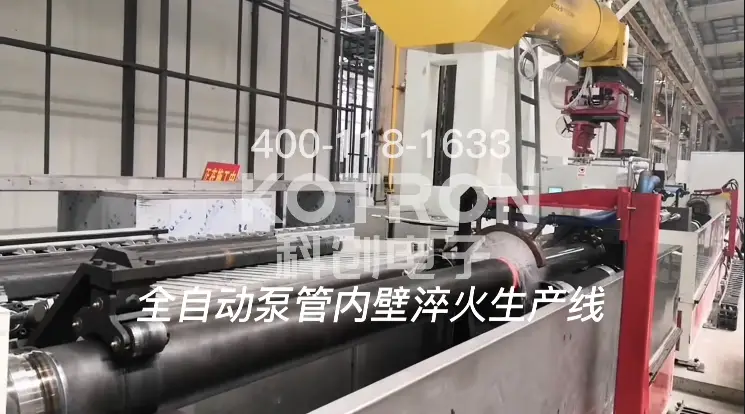
Ⅰ. Watch the Automatic Hardening Line in Operation
The video shows the actual production line running with straight concrete pump pipes.
The pipe is supported along its length, moved through the working area and rotated during hardening. Heating takes place on the inner surface, followed by water-spray quenching according to the selected process program.
For a long hollow workpiece such as a pump pipe, the working sequence is easier to understand from the running line than from a stationary machine photo.
Ⅱ. Inner Wall Hardening for Straight Concrete Pump Pipes
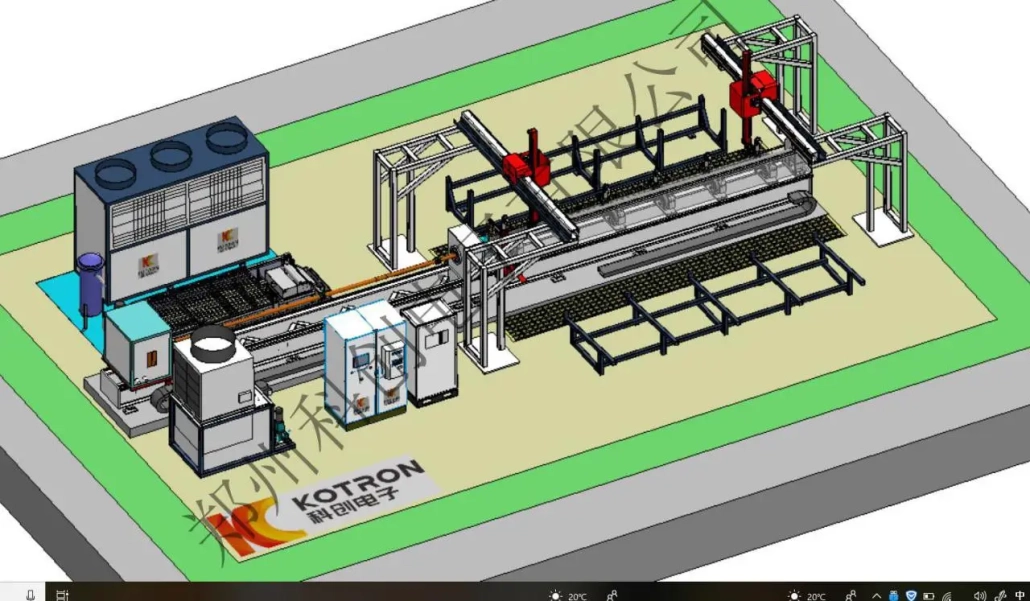
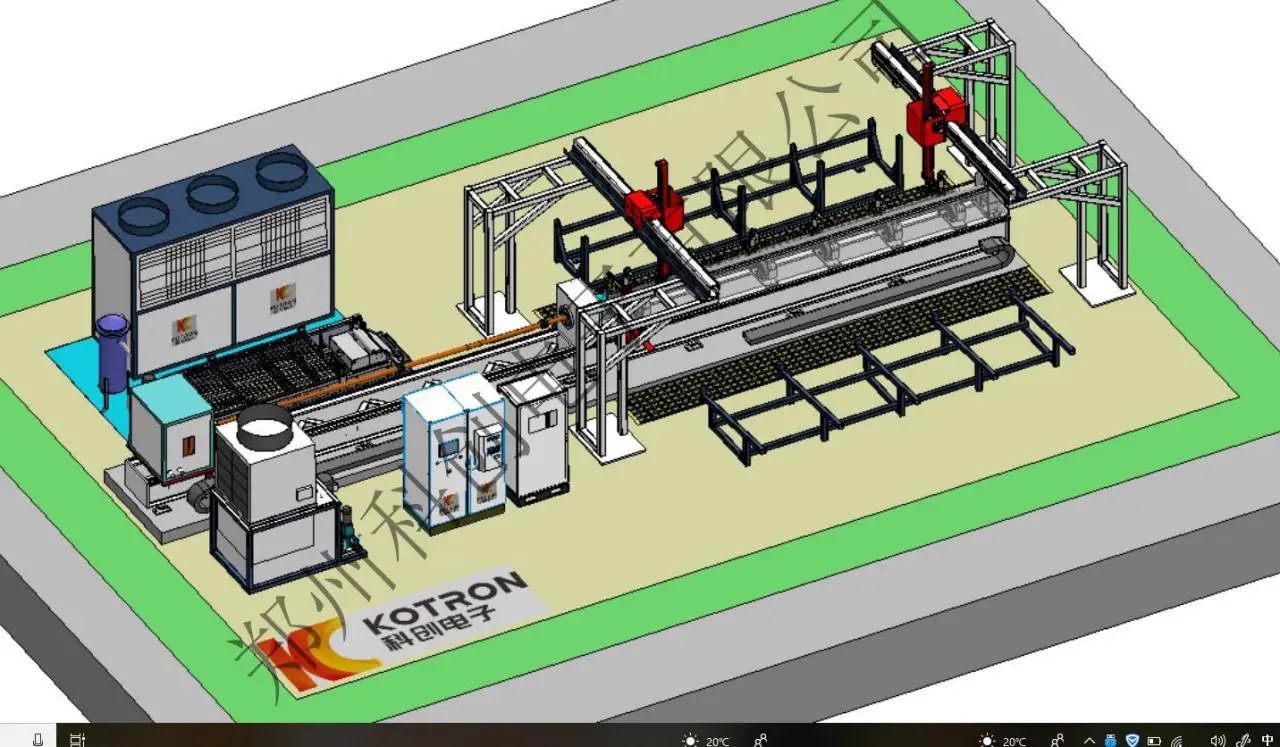
This line is built around the geometry of the pump pipe.
Unlike shaft or gear hardening, the heating load works inside a long hollow workpiece. The inductor, pipe supports, rotation system, axial movement and water-spray arrangement are therefore configured as one process.
The machine supplied for this project has a maximum stroke of 3300 mm and is intended for straight pipe processing.
Pipe size, wall thickness and the required hardening process should be reviewed before a new line is configured.
Ⅲ. How the Hardening Process Runs
The process can be summarized as:
The induction quenching coil is fitted with a water-spraying device.
During production, the inner wall is heated by induction while the pipe and heating assembly move according to the programmed process. Cooling follows the heating operation through the internal spray arrangement.
The line can switch between established hardening programs from the central control system.
Ⅳ. Pipe Movement, Rotation and Support
Straight-pipe movement is driven by a high-power servo motor.
During heating, the pipe is rotated by a variable-frequency motor and supported by multiple rollers along its length. The specified rotation range for this project is 20–100 r/min.
The project also includes an internal-hole heating load moving platform as part of the heating arrangement.
Stable support is important on a 3 m class workpiece. The pipe has to rotate and travel through the hardening process without losing the required working position.
Ⅴ. Automatic Changeover Between Pipe Models
Different pump pipe specifications may require different heating settings.
The DSP power supply supports digital power adjustment according to the selected process. Heating output for different workpiece models can be set through the machine control system.
The central control center can switch between different hardening programs without manual intervention during program changeover.
Water-spray cooling is controlled in the same way. When another established pipe model is selected, the corresponding heating and quenching sequence can be called from the control system.
This arrangement is useful when several pump pipe models are produced on the same line.
Ⅵ. 250 kW DSP Digital Induction Heating
The heating source used in this project is an XZZ-250SCN DSP digital induction heating power supply.
Rated output is 250 kW, with a working frequency of 5–20 kHz. Power is adjustable from 1% to 100%, and the project specification gives a power control accuracy of ±0.2%.
DSP adaptive frequency tracking is used in the power supply. Control can be switched between internal and remote operation.
An industrial touchscreen and buttons are provided for operation, with RS485 communication available for connection with the machine control system.
These functions allow the induction power supply to operate as part of the production line instead of as an independent heating unit.
Ⅶ. Internal Water-Spray Quenching and Cooling
The quenching coil includes an internal water-spray device.
Heating and cooling are therefore carried out within the same production sequence, with the spray process controlled according to the selected workpiece program.
The project includes a separate quenching-fluid circuit, industrial chiller, plate heat exchanger and stainless-steel water tank.
The cooling arrangement serves both the induction equipment and the quenching process.
Ⅷ. Production Reference for a 3 m Pump Pipe
For the 3-meter straight pipe used in this project, the specified process requirement is:
6 min/pc, including loading and unloading.
This figure belongs to the supplied project and should not be treated as a fixed production rate for every pump pipe.
Actual cycle time depends on the workpiece and the hardening process used for that pipe.
For production planning, pipe dimensions and required output should be provided together.
Ⅸ. Main Line Configuration
The project configuration includes the main equipment required for heating, movement, quenching and cooling:
— XZZ-250SCN DSP digital induction heating power supply
— Induction heating load
— Main and auxiliary resonant cables
— Quenching induction coil
— KCZG-WS-3000 induction quenching machine for straight pipe
— Internal-hole heating load moving platform
— KCLD-20 industrial chiller
— Plate heat exchanger
— Stainless-steel water tank
— Quenching-fluid circulation system
— Central machine control
The induction power supply is one part of the line. Mechanical handling, quenching and cooling are configured with it as a complete project.
Ⅹ. Technical Specifications
| Power Supply | |
| Induction Power Supply | XZZ-250SCN |
| Rated Power | 250 kW |
| Rated Voltage | AC 380 V, 50 Hz |
| Output Frequency | 5–20 kHz |
| Power Regulation | 1%–100% |
| Power Control Accuracy | ±0.2% |
| Frequency Control | DSP Adaptive Frequency Tracking |
| Core Control | TI DSP Processor |
| Control Interface | Industrial Touchscreen + Buttons |
| Communication | RS485 |
| Protection Level | IP54 |
| Machine | |
| Maximum Machine Stroke | 3300 mm |
| Maximum Workpiece Turning Diameter | 150 mm |
| Maximum Workpiece Weight | 200 kg |
| Workpiece Rotation Speed | 20–100 r/min |
| Repeated Positioning Accuracy | ≤±0.2 mm |
| Quenching & Cooling | |
| Quenching Fluid Tank | 4.0 m³ |
| Quenching Fluid Flow | ≥300 L/min |
| Quenching Fluid Pressure | ≥0.3 MPa |
| External Circulation Inlet Water Temperature | ≤30°C |
The project also includes a 2 m³ stainless-steel auxiliary water tank with a 1.5 kW water pump.
These specifications describe this particular production-line configuration. Power, tooling and mechanical dimensions for another project should be confirmed from the actual pump pipe.
Ⅺ. What We Need Before Configuring a New Line
A new concrete pump pipe induction hardening line should start with the workpiece.
Please provide:
— Pump pipe drawing
— Pipe length
— Outside diameter
— Inside diameter or wall thickness
— Material
— Required hardening area
— Hardening requirement
— Pipe models to be produced
— Required production rate
If several pipe sizes will run on the same line, send all main specifications together.
The pipe data is used to evaluate the induction coil, heating settings, machine travel, support arrangement and process program.
Ⅻ. Frequently Asked Questions
Can one line process different concrete pump pipe sizes?
Yes, provided the pipe sizes fall within the mechanical and process range of the selected line. Different models can use separate heating programs and power settings. A coil or tooling change may still be required when the dimensions change significantly.
Does the machine harden the inside or outside of the pipe?
This line is for inner-wall induction hardening of straight concrete pump pipes. The induction quenching coil works with an internal water-spray arrangement.
Is 250 kW suitable for every pump pipe?
No. The 250 kW XZZ-250SCN is the power supply used in the project shown on this page. Other pipe sizes and hardening requirements should be evaluated separately.
Can different hardening processes be changed automatically?
The supplied control system supports automatic switching between established hardening programs. Heating power and water-spray quenching can be matched to the selected workpiece model through the control system.
ⅩⅢ. Send Us Your Pump Pipe Drawing
The fastest way to evaluate a concrete pump pipe hardening project is to start with the pipe itself.
Send us the drawing, dimensions, material, hardening requirement and production target. If several pipe models will share the same line, include them in the same inquiry.
From this information, the induction power, coil, mechanical arrangement, quenching system and control program can be evaluated together.
Related Products
Click here to add your own text


