
Induction Heating for Hot Stamping: How Fast and Precise Heating Improves Automotive Part Quality
Table of Contents
Hot stamping has become one of the most important manufacturing processes for producing lightweight, high-strength automotive components. By heating boron steel sheets—typically 22MnB5—to austenitizing temperature and rapidly forming and cooling them in a single die stroke, manufacturers achieve tensile strengths above 1,500 MPa while reducing vehicle weight.
Traditional roller furnaces get the job done, but they bring long cycles, heavy oxidation, and sluggish temperature response. Induction heating takes a different route: electromagnetic energy generates heat directly inside the steel, cutting cycle time and tightening temperature control. For automotive lines chasing higher throughput and tighter part consistency, that difference matters.
1.What Is Hot Stamping and Why Does Heating Matter?
Hot stamping, also called press hardening, converts medium-strength boron steel blanks into ultra-high-strength formed parts. The standard material is 22MnB5, typically supplied with a ferritic-pearlitic microstructure at around 500–600 MPa tensile strength. After the full hot stamping cycle, the finished part reaches 1,500+ MPa.
The process follows four steps:
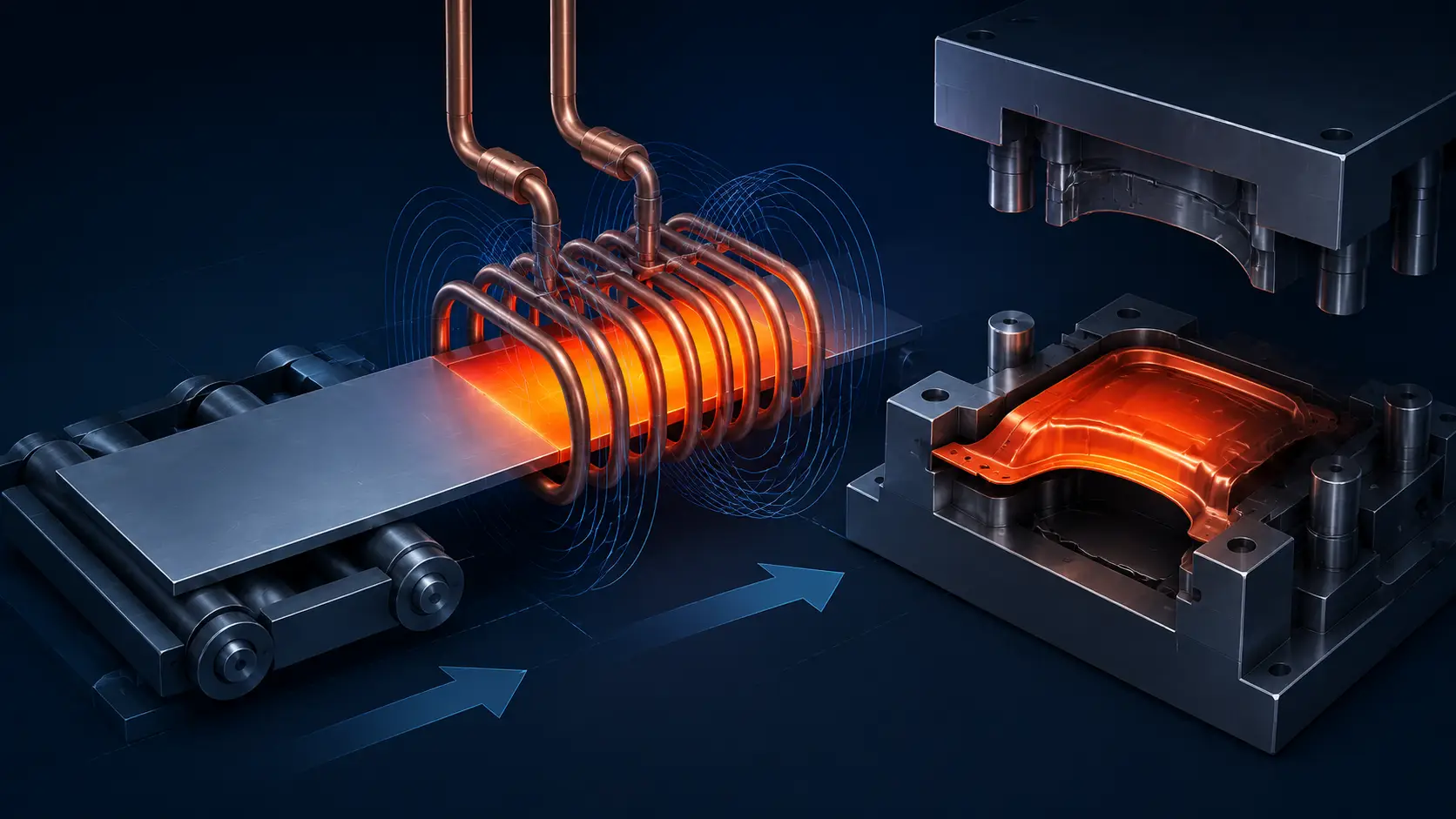
- Heating. Blanks are heated to 900–950°C to achieve a fully austenitic structure.
- Transfer. The heated blank moves from the heating system to the forming press, typically within 3–5 seconds.
- Forming and quenching. The blank is shaped and rapidly cooled inside water-cooled dies at 30–100 K/s, transforming austenite to martensite.
- Finished part. The component exits with full martensitic microstructure, delivering high strength and crash resistance.
The heating stage directly controls the final microstructure. Uneven heating produces inconsistent austenitization, which leads to mixed microstructures, dimensional variation, and compromised crash performance. The heating system is not just a pre-step—it sets the metallurgical baseline for everything that follows.
2.Traditional Furnace Heating vs Induction Heating for Hot Stamping
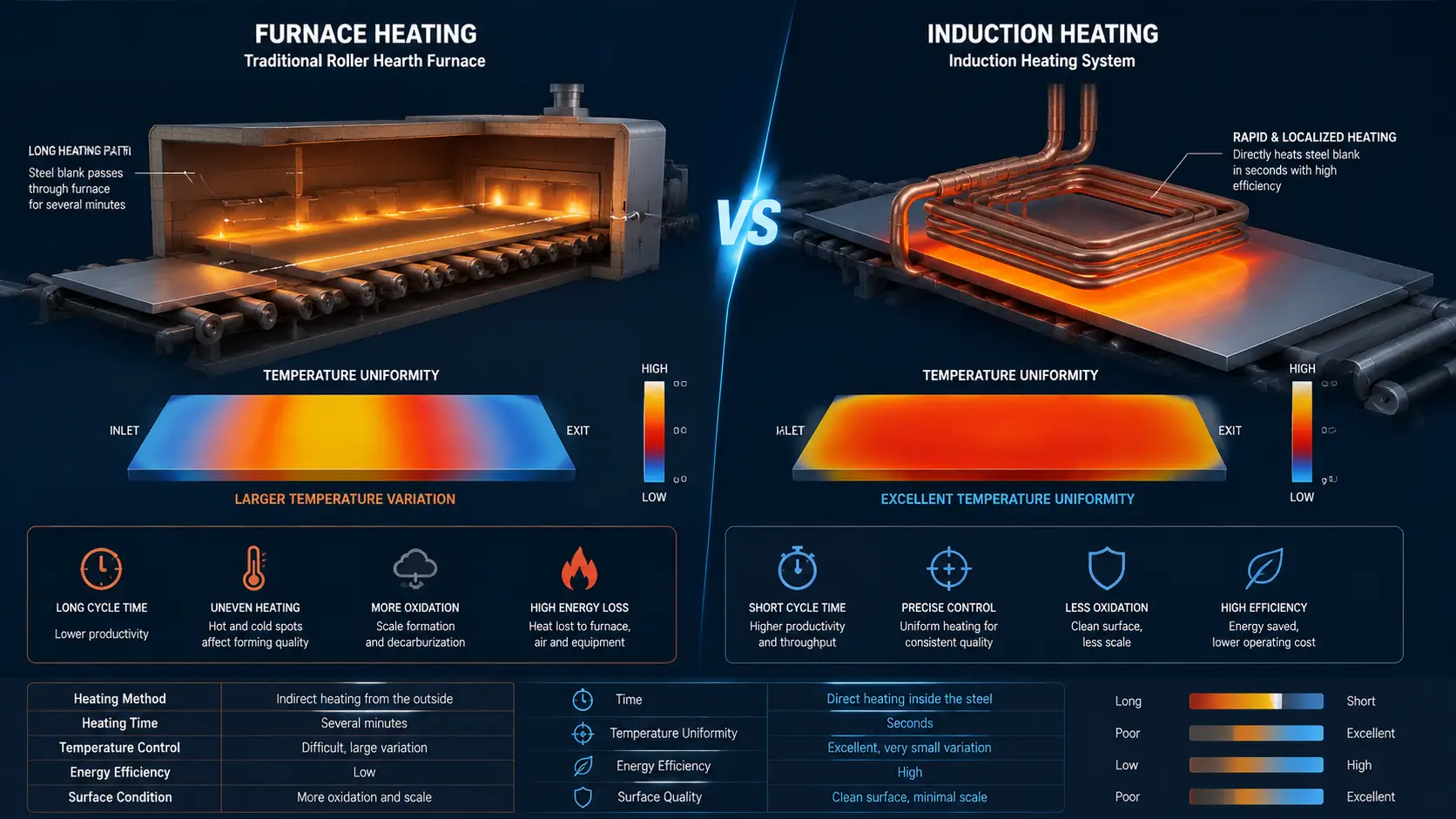
Roller furnaces are the incumbent technology in most hot stamping lines. Blanks travel through a gas-fired or electrically heated chamber on ceramic rollers, gradually reaching temperature over several minutes. The approach is proven and scales well, but it has structural drawbacks: the entire blank mass—including areas that do not require full austenitization—absorbs heat, and temperature gradients across the blank width are common.
Induction heating flips the mechanism. Instead of relying on radiation and convection from the furnace atmosphere, an alternating magnetic field induces eddy currents directly in the steel. Heat originates inside the material, not at the surface. This changes the practical outcomes in five areas:
| Factor | Furnace Heating | Induction Heating |
|---|---|---|
| Heating Time | 3–8 minutes | 15–60 seconds |
| Temperature Uniformity | Moderate; gradients along blank length common | High; multi-zone coil arrays balance edge-to-center |
| Oxidation / Scale | Significant; extended time at temperature | Reduced; short exposure + optional inert atmosphere |
| Energy at Idle | Continuous; furnace must stay hot between cycles | On-demand; energy only when blanks are present |
| Production Flexibility | Fixed cycle; difficult to vary per blank | Separate heating zones; different blanks, different recipes |
For a broader comparison of induction versus combustion-based heating, see induction heating vs gas furnace.
3.Advantages of Induction Heating for Hot Stamping
1. Faster Heating Cycle
Induction brings a boron steel blank from room temperature to 930°C in under 60 seconds. Heat generates directly within the workpiece—no waiting for a furnace chamber to transfer energy through radiation and convection. For high-volume lines processing 4–6 blanks per minute, this speed translates directly to throughput. See how induction heating works for the underlying physics.
2. Precise Temperature Control
Hot stamping operates within a narrow window: above Ac3 (~850°C for 22MnB5) to ensure full austenitization, but below ~950°C to avoid excessive grain growth and Al-Si coating degradation. Induction systems integrate pyrometers or thermal cameras with closed-loop power control to hold each blank within that band. Multi-zone coil arrays can independently adjust power to edges and centers, compensating for geometry-driven heat loss differences—something a single-zone furnace cannot do.
3. Reduced Oxidation and Surface Scale
Furnace heating exposes blanks to high temperature for several minutes, building oxide scale that must be removed before welding or painting. Induction heating completes the thermal cycle in tens of seconds, reducing oxide growth by roughly an order of magnitude. When paired with an inert gas shroud over the coil zone, scale formation drops to near zero. This saves material, eliminates descaling operations, and preserves the Al-Si coating integrity on coated blanks. For a deeper discussion of oxidation control, see oxidation prevention during induction heating.
4. Improved Energy Efficiency
A roller furnace must heat its entire internal volume—chamber, rollers, atmosphere—and maintain that temperature between cycles. Induction delivers energy only to the blank, on demand. When no blank is in the coil, power draw drops to zero. For lines running partial shifts or varying throughput, this idle-time savings is a meaningful cost difference. Less waste heat also improves the workplace environment on the shop floor.
5. Flexible Heating for Complex Components
Automotive hot stamping produces a wide family of parts: B-pillars, door impact beams, roof rails, tunnel reinforcements, battery tray structures. Each has a different geometry, thickness profile, and heating requirement. Induction coil arrays can be configured per part number—adjusting zone lengths, power per zone, and edge compensation—whereas a furnace runs one temperature profile for everything. This enables mixed-part production and faster changeover on the same line.
4.Challenges of Using Induction Heating in Hot Stamping
Induction heating for hot stamping is not a drop-in replacement. Each of these factors must be engineered for the specific part and production rate.
- Coil design. Complex part geometries demand customized coil arrays to deliver uniform heating. Poor coil geometry creates hot spots at edges, cold centers, and inconsistent austenitization. See how induction coils work for design principles.
- Frequency selection. The operating frequency sets the eddy current penetration depth in the blank. Higher frequencies (~100–400 kHz) heat thin-gauge blanks efficiently; lower frequencies (~10–50 kHz) suit thicker sections. Mismatched frequency wastes power or leaves the core under-heated. See how frequency affects induction heating.
- Temperature monitoring. Pyrometer line-of-sight, emissivity variation across blank surfaces, and the speed of feedback to the power supply all affect control accuracy. Production systems combine optical pyrometers, multi-point scanning, and predictive power ramping to hold each blank within the austenitizing window.
5.Applications in Automotive Hot Stamping
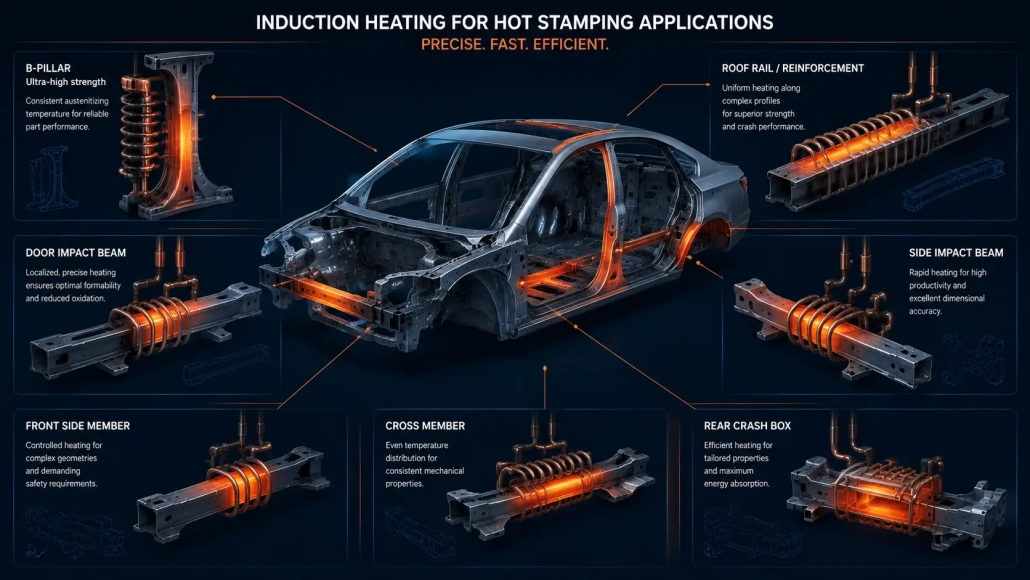
Induction heating supports the full range of hot-stamped automotive structural components, including:
- B-pillars and A-pillar reinforcements
- Side impact door beams
- Roof rail and header reinforcements
- Tunnel and floor cross-members
- EV battery tray structures and underbody protection
- Front and rear bumper reinforcements
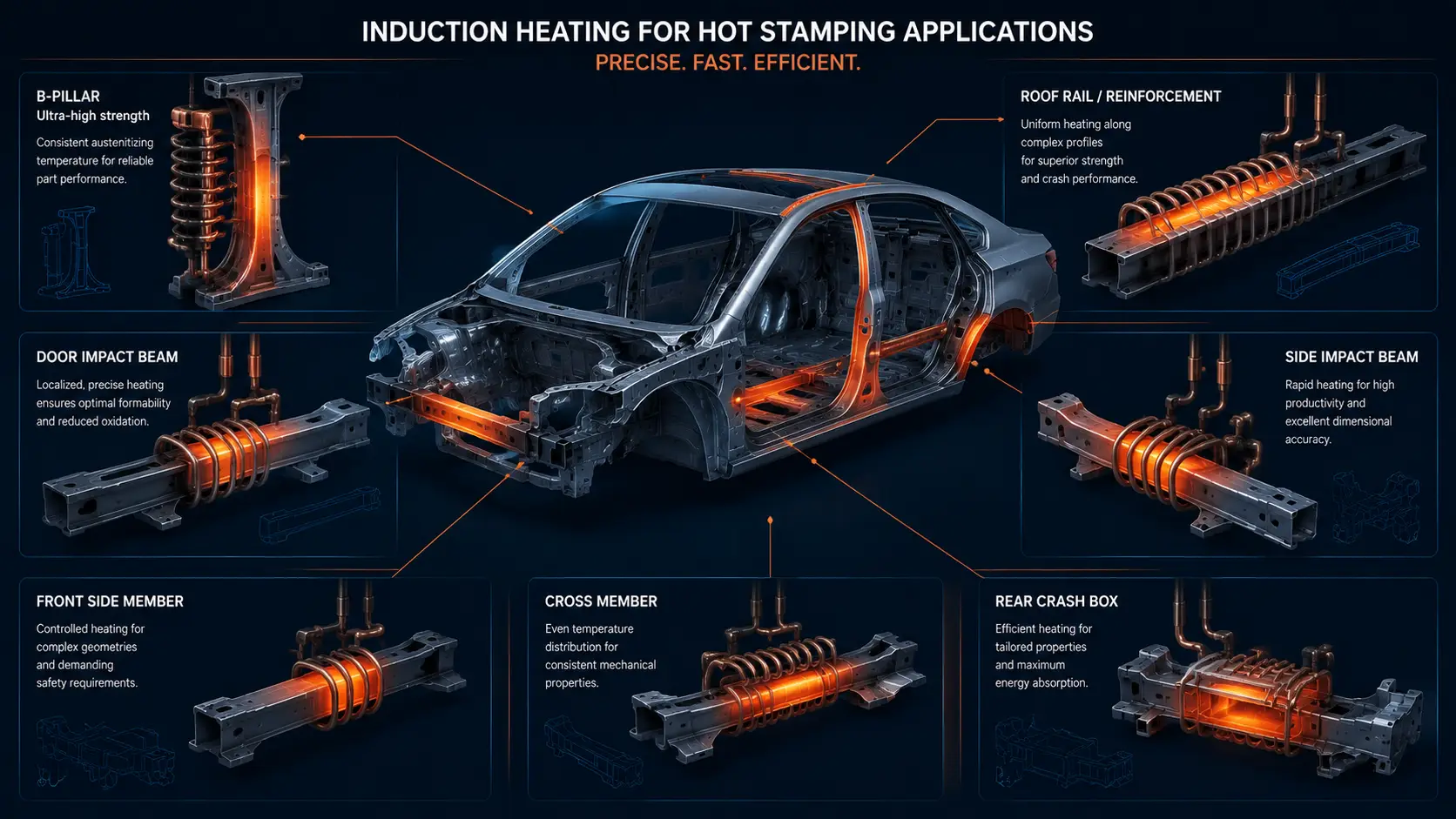
As vehicle platforms shift toward mixed-material lightweight body structures and EV architectures add battery protection requirements, demand for efficient, controllable blank heating continues to grow. For a broader look at automotive applications, see our automotive parts buyer’s guide.
6.Conclusion
Induction heating brings three things to hot stamping that furnace heating struggles to deliver: speed, precision, and on-demand energy. Blanks reach austenitizing temperature in under a minute rather than several. Temperature control is per-blank and per-zone rather than averaging across a furnace chamber. Power draws only when a blank is present.
For automotive manufacturers producing B-pillars, door beams, roof rails, and other high-strength structural parts, induction heating tightens process control while cutting cycle time and reducing oxide scale. The engineering investment—coil design, frequency selection, and temperature monitoring—pays back in throughput and part consistency.
FAQ
Q: What steel grades are used in hot stamping with induction heating?
A: The most common grade is 22MnB5, a boron-alloyed steel designed for press hardening. Induction heating is also compatible with other boron grades and emerging higher-ductility variants such as 20MnB8 and 30MnB5. The critical factor is reaching full austenitization (850–950°C depending on grade) uniformly across the blank.
Q: How does induction heating handle Al-Si coated blanks (e.g., Usibor)?
A: Al-Si coatings require controlled heating to allow Fe-Al-Si interdiffusion without melting the coating layer. Induction’s short heating time can be an advantage—the coating spends less time at high temperature, reducing the risk of liquation. Process parameters (power ramp rate, soak time, and peak temperature) must be validated for the specific coating type and thickness.
Explore Induction Heating for Your Hot Stamping Line
Share your blank geometry, material grade, target cycle time, and production volume. Our engineering team can help evaluate frequency, coil design, and power requirements for a practical induction hot stamping heating solution.


