
Induction Heating for Superalloys: 6 Critical Factors for Process Control
Induction heating for superalloys is not steel heating at a higher setpoint. Nickel- and cobalt-based superalloys retain mechanical strength at temperatures where carbon steel has already lost half its stiffness, and that same heat resistance makes them unforgiving during processing. The temperature window between “hot enough to form” and “hot enough to damage the microstructure” can be as narrow as 30°C. Induction works here because it delivers energy fast, locally, and under closed-loop control—but only if the frequency, coil, atmosphere, and ramp profile are engineered for the specific alloy. Six factors determine whether the process runs repeatably or generates expensive scrap.
1. Why Superalloys Heat Differently
Superalloys exist because they keep their strength at temperatures that soften ordinary steels. Inconel 718 holds useful mechanical properties past 650°C. AISI 1045 begins losing strength above 300°C. This high-temperature performance comes from carefully balanced chemistry and precipitation hardening—and it is precisely what makes thermal processing difficult. Overheat a superalloy by a few tens of degrees past its solution treatment window and grain boundary liquation begins. Undershoot and the forming load doubles. The process window is narrow, and it does not forgive guesswork.
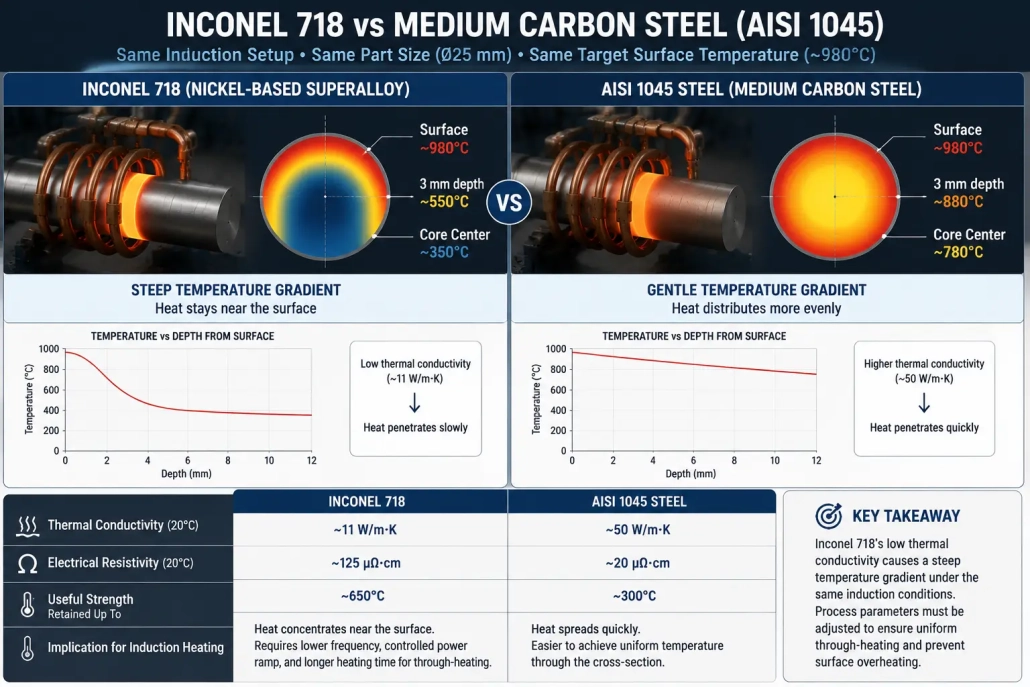
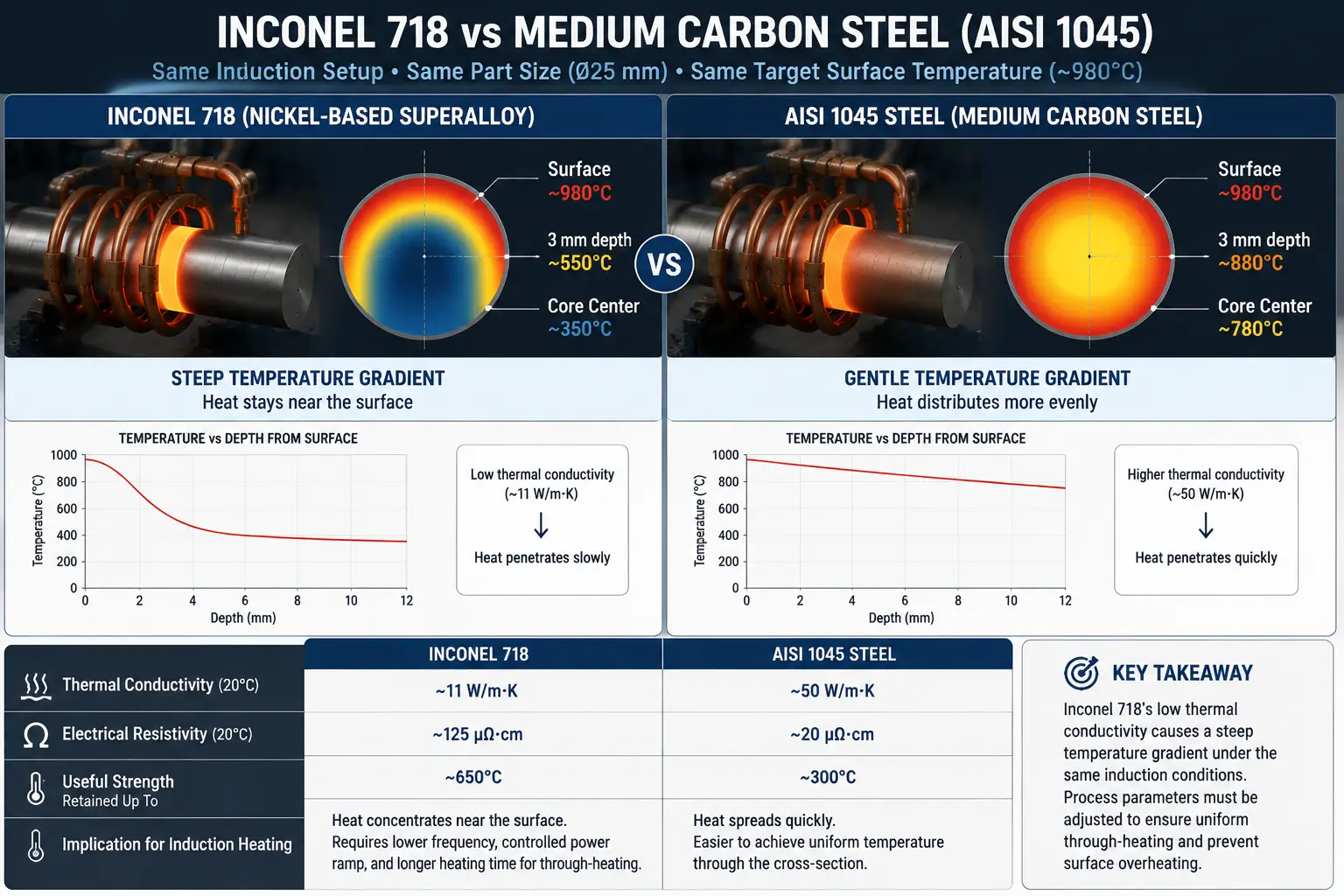
Thermal conductivity adds a second constraint. Inconel 718 conducts heat at roughly 11 W/m·K—about one-fifth the rate of medium-carbon steel. Apply induction energy to the surface and the temperature gradient through the wall stays steep. This matters for every operation that requires through-heating: forging billets, ring rolling preforms, bar end heating. The numbers show the gap.
| Property | Inconel 718 | AISI 1045 Steel |
|---|---|---|
| Thermal conductivity at 20°C | ~11 W/m·K | ~50 W/m·K |
| Electrical resistivity | ~125 µΩ·cm | ~20 µΩ·cm |
| Useful strength retained up to | ~650°C | ~300°C |
| Typical solution treatment range | 940–980°C | N/A |
| Oxidation threshold | ~980°C | ~500°C |
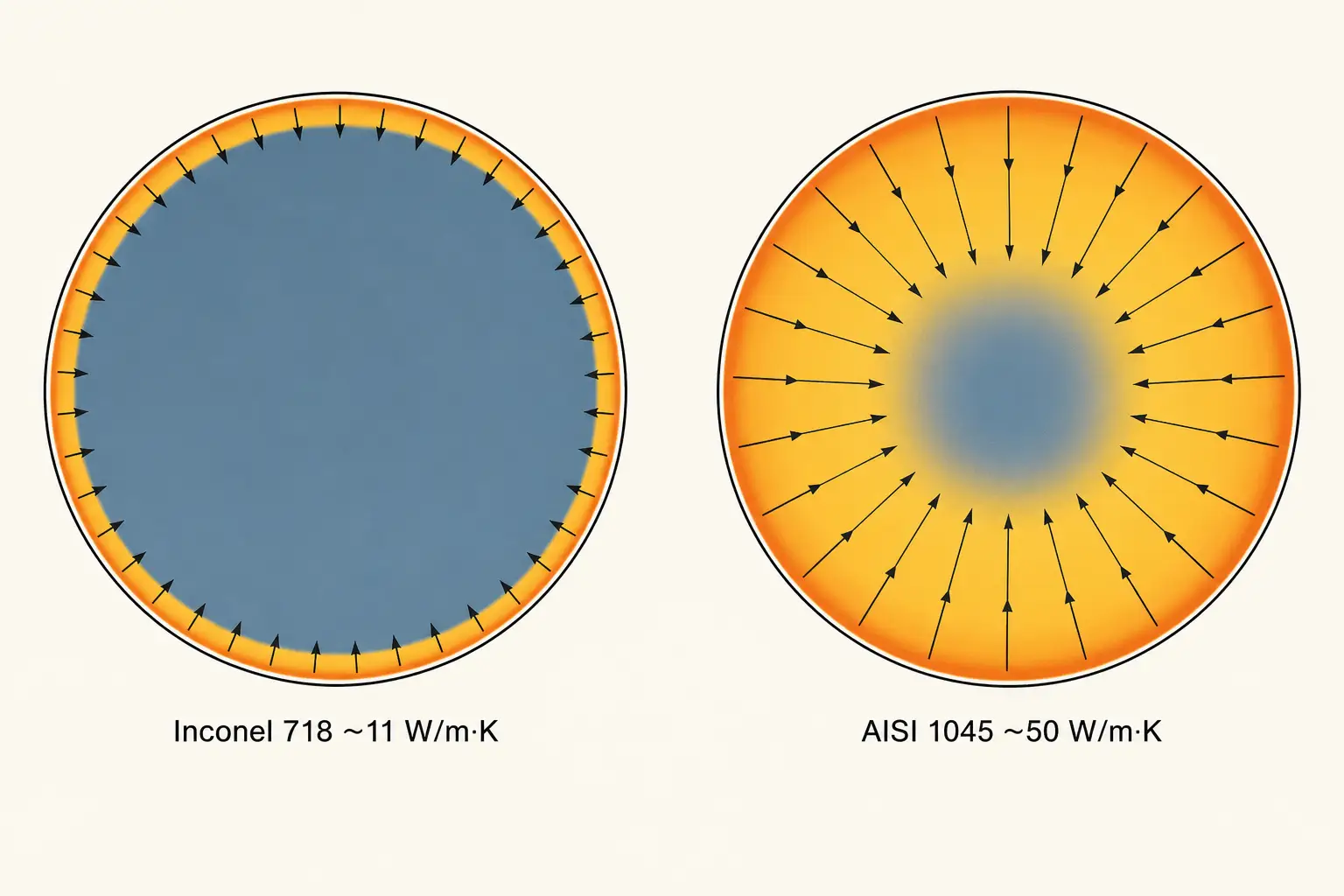
Higher electrical resistivity is an advantage in one respect: superalloys couple more efficiently with the induction field than steel of the same diameter, so less energy is lost in the coil. The counterweight is that heat stays concentrated near the surface. For localized operations—brazing a tube joint, heating a hub for shrink fitting—this works in your favor. For through-heating a forging billet, the gradient must be managed with frequency, power ramp, and part rotation.
Induction’s speed is an asset here. Shorter time at temperature means less grain growth, less oxidation, and less chance of drifting outside the process window. The physics of how electromagnetic fields generate heat inside a conductive workpiece applies across alloy families—see how induction heating works for the fundamentals. For a parallel discussion focused on titanium, which shares the low-conductivity challenge but differs in chemistry and failure modes, see induction heating for titanium alloys.
2. Frequency and Power Selection
Frequency and power are not independent knobs. Together they control current penetration depth, heating rate, and surface-to-core temperature difference. Get the combination wrong and the part is scrap before it reaches the forming press or braze station.
Frequency selection for superalloys follows the same physics as other conductive materials but the numbers shift. Higher resistivity in nickel-based alloys means the induced current penetrates slightly deeper at a given frequency than it would in steel of the same diameter. A 25 mm Inconel 718 bar heats acceptably at 10 kHz where a 25 mm 1045 bar needs 3 kHz for the same depth profile. But the thermal conductivity difference pulls the other way—deeper current penetration does not help if the heat cannot spread fast enough to reach the core. Testing with representative parts is the only way to confirm. For selection methodology, see how frequency affects induction heating.
Power density matters more than the kilowatt number on the nameplate. A 150 kW supply might be correctly sized for a steel billet of a given diameter and completely wrong for an Inconel billet of the same diameter. The symptom is the same as with titanium: pyrometer reads 980°C on the surface, contact thermocouple at 3 mm depth reads 550°C. The fix is lower power density, longer heat time, or part rotation—sometimes all three.
Controlled power ramping beats maximum power for most superalloy applications. A stepped profile—moderate power to bring the part toward temperature, reduced power for the final approach and soak—gives the heat time to distribute through the cross-section and prevents overshoot. Superalloys with narrow solution treatment windows (Inconel 718: 940–980°C) particularly benefit from this approach. For the full equipment sizing method, see induction heating power calculation.
3. Coil Design for Superalloy Parts
Coil geometry determines heating pattern. A mismatched coil creates hot spots at edges and cold bands in the middle—even when the power supply is correctly sized. Superalloy components tend toward complex geometries: turbine disks with varying web thickness, rings with flanges, tubes with welded bosses. Each feature interacts differently with the electromagnetic field. Higher resistivity improves coupling efficiency compared with steel, but low thermal conductivity means the heat stays where the field generates it. A coil that produces acceptable uniformity on a steel part creates hot spots on the same geometry in Inconel or Hastelloy. Basic coil types and design principles are material-independent—see how induction coils work for the foundations.
- Flux concentrators redirect field lines toward the part and away from surrounding metal. They are particularly useful around shoulders, grooves, and section changes where the electromagnetic field would otherwise concentrate on the sharp edge.
- Part rotation at 60–120 RPM averages out circumferential temperature variation. A superalloy ring or tube rotating inside a stationary coil distributes heat far more evenly than a static setup.
- Coil-to-part gap must account for thermal expansion. Inconel 718 expands roughly 1.3% from room temperature to 980°C. A 2 mm gap at ambient shrinks to under 1.5 mm at process temperature on a 50 mm diameter part.
- Fixture material selection matters more than it does for steel. Conductive fixtures near the coil absorb energy and distort the heating pattern. Ceramics, water-cooled stainless steel, or composite tooling boards isolate the part thermally and electrically. A stable induction heating water cooling system keeps coil impedance stable across the shift and prevents the drift that causes part-to-part variation.
4. Temperature Measurement and Atmosphere Control
Temperature measurement on superalloys is harder than it looks. A freshly machined Inconel surface is bright and reflective. After ten seconds at 900°C under argon, it is dull gray. The same pyrometer setting cannot read both surfaces accurately. A process validated on clean, polished development samples drifts the moment it hits production parts with residual forming scale or oxidation from the previous operation.
The fix is correlation, not a better pyrometer. During process development, instrument a test part with contact thermocouples at multiple depths and surface locations. Run the induction cycle and record pyrometer output against thermocouple readings. Use that correlation to lock in the emissivity setting, wavelength, sight path, and target spot. Once validated, non-contact pyrometry holds ±10°C on production parts. Closed-loop control then adjusts power in real time based on measured temperature rather than running a blind time-and-power recipe. For superalloy parts with a 30°C process window, closed-loop control is not optional—it is the difference between a validated process and a guessing game.
Atmosphere control follows the same logic as with titanium, but the temperature is higher and the stakes are different. Superalloys oxidize above roughly 980°C, forming complex oxide scales that interfere with brazing, welding, coating, and inspection. Argon shielding directed at the heating zone displaces air and is sufficient for most applications below that threshold. For brazing operations where oxide-free surfaces are mandatory, the entire joint area sits inside an argon-purged enclosure or vacuum chamber. Flux protects braze joints at lower temperatures but breaks down above roughly 1,000°C. For broader oxidation control principles, see reducing oxidation during induction heating.
5. Common Industrial Applications
Induction heating serves superalloy manufacturing wherever heat must be fast, local, and repeatable. Five application categories account for most production demand.
- Brazing of superalloy assemblies. Induction brazing of Inconel and Hastelloy tubes, fittings, honeycomb seals, and sensor housings. The process heats only the joint area, reducing thermal exposure to adjacent features. Joint clearance, filler metal alloy, heating uniformity, and atmosphere determine braze quality. For aerospace and power generation parts, destructive testing and metallographic inspection validate the process before production begins.
- Preheating before welding and repair. Controlled preheat applied to a defined zone before TIG welding, laser cladding, or repair welding. Induction replaces manual torch heating where part-to-part consistency matters and torch variation becomes a quality concern. Preheat temperature and ramp rate follow the weld procedure specification for the alloy grade.
- Hot forming and forging preparation. Superalloy billets, rings, and preforms resist deformation at low temperature. Induction brings the working section to forming temperature in seconds rather than furnace minutes. Temperature uniformity through the cross-section is the controlling requirement—lower frequency, staged heating, and part rotation address the gradient for larger sections.
- Shrink fitting for high-performance assemblies. Controlled expansion of superalloy rings, sleeves, and collars for interference-fit assembly. Induction heats only the component that must grow, protecting adjacent temperature-sensitive parts from unnecessary exposure.
- Aerospace and power generation components. Turbine disks, blades, combustion chamber parts, and structural superalloy assemblies account for the largest share of production induction heating. These parts are expensive, the process windows are narrow, and the quality documentation requirements are extensive. For the broader aerospace manufacturing context, see induction heating in aerospace manufacturing.
6. Processing Risks and How to Control Them
Superalloy components are expensive. The scrap cost of a single mishandled turbine disk justifies careful process engineering. Four failure modes account for most induction heating problems.
- Incipient melting and grain boundary liquation. Some superalloys contain low-melting-point phases at grain boundaries. Exceed the solution treatment temperature by 20–30°C and these phases melt locally, permanently degrading mechanical properties. The damage is invisible to the naked eye and passes visual inspection. Only metallography confirms it—and by then the part is scrap. Prevention: validated temperature measurement, conservative power ramp, and thermal uniformity verified on test parts before production.
- Thermal cracking from steep gradients. Thin-to-thick transitions, sharp corners, and as-cast surfaces concentrate thermal stress. A 300°C surface-to-core gradient on a superalloy ring with an abrupt section change generates enough stress to initiate cracks before the part ever reaches the forming press. Prevention: control ramp rate, use part rotation, profile the coil to match the geometry, and preheat larger areas when the part design permits.
- Oxidation and surface contamination. Oxide films formed at high temperature interfere with brazing, welding, coating adhesion, and fluorescent penetrant inspection. Induction shortens exposure time compared with furnace cycles, but a superalloy surface at 1,000°C oxidizes in seconds. Prevention: argon shielding, localized inert gas flow, or vacuum enclosure for critical operations.
- Pyrometer error. Emissivity changes when the superalloy surface oxidizes during heating. A reading that was accurate on a bright machined surface drifts as the surface dulls. The result: the controller thinks the part is 20°C cooler than it actually is and continues applying power. Prevention: emissivity validated against contact thermocouples on production-surface-condition parts, not on polished lab samples.
Every one of these failure modes traces back to the same root cause: steel heating assumptions applied to superalloy parts. Fix the assumptions and the process stabilizes.
Key Takeaway
Induction heating for superalloys works when the process is built around the material—not adapted from a steel recipe. Validate frequency against your actual part diameter. Control ramp rate to keep the surface-to-core gradient inside the process limit. Lock in pyrometer correlation against contact thermocouples, not lab-surface assumptions. Shield the heating zone or accept the rework. Superalloy scrap is too expensive for guesswork.
FAQ
Q: Which superalloys can be induction heated?
A: Most electrically conductive nickel-, cobalt-, and iron-based superalloys respond to induction heating. Common grades include Inconel 718 and 625, Hastelloy C-276 and X, Waspaloy, and various Haynes and Rene alloys. Each alloy grade requires validated frequency, power density, and temperature parameters. Do not assume a process developed for Inconel 718 transfers directly to Hastelloy X.
Q: Does superalloy induction heating require argon shielding?
A: Below roughly 980°C and with short exposure times, open-air heating is often acceptable. Above 980°C, or for brazing operations where oxide-free surfaces are mandatory, argon shielding or a controlled atmosphere is standard practice. The decision depends on the alloy, temperature, exposure time, and what the part specification or downstream process requires from the surface.
Q: Why does Inconel 718 crack during induction heating when the same process works on steel?
A: Three possible causes, alone or in combination. First, thermal gradient: Inconel conducts heat at about one-fifth the rate of steel, so a power ramp that produces a gentle gradient in steel creates a steep one in Inconel, and the resulting thermal stress cracks thin-to-thick transitions. Second, incipient melting: low-melting-point phases at grain boundaries liquefy if the part overshoots the solution treatment window by more than 20–30°C. Third, pyrometer error: emissivity shifts as the surface oxidizes, causing the controller to overshoot. Reduce power density, slow the ramp, validate pyrometer correlation on production-condition surfaces, and verify thermal uniformity on a test part.
Need a Superalloy Heating Process Evaluated?
Send us your alloy grade, part geometry, target temperature, and production rate. Our engineering team will recommend an induction heating system approach matched to your material and process requirements.


