
Titanium Alloy Induction Heating: 6 Key Factors for Precise Temperature Control and Reliable Results
Induction heating for titanium alloys demands a different approach than heating steel. Titanium’s low thermal conductivity, high reactivity above 500°C, and narrow beta-transus window make it one of the more demanding materials to heat predictably. Get the frequency, atmosphere, and ramp rate right and you hold tight tolerances on a six-second cycle. Get one wrong and the part oxidizes, develops alpha case, or cracks at the next forming step. This article walks through six process factors that determine whether your titanium induction heating operation produces reliable parts or consistent scrap.
1. Why Titanium Alloys Heat Differently
Titanium conducts heat roughly seven times slower than medium-carbon steel. Apply induction energy to the surface and the temperature gradient through the wall stays steep. The surface can reach 950°C while the core is still below 400°C. In steel, the same power input produces a far shallower gradient because heat spreads through the cross-section faster. This single physical fact drives nearly every process decision for induction heating for titanium alloys.
The numbers make the difference concrete.
| Property | Ti-6Al-4V | AISI 1045 Steel |
|---|---|---|
| Thermal conductivity | ~7 W/m·K | ~50 W/m·K |
| Electrical resistivity | ~170 µΩ·cm | ~20 µΩ·cm |
| Reactivity above 500°C | High — O, N, H absorption, alpha case risk | Moderate — oxide scale formation |
| Beta transus (Ti-6Al-4V) | ~980°C | N/A |
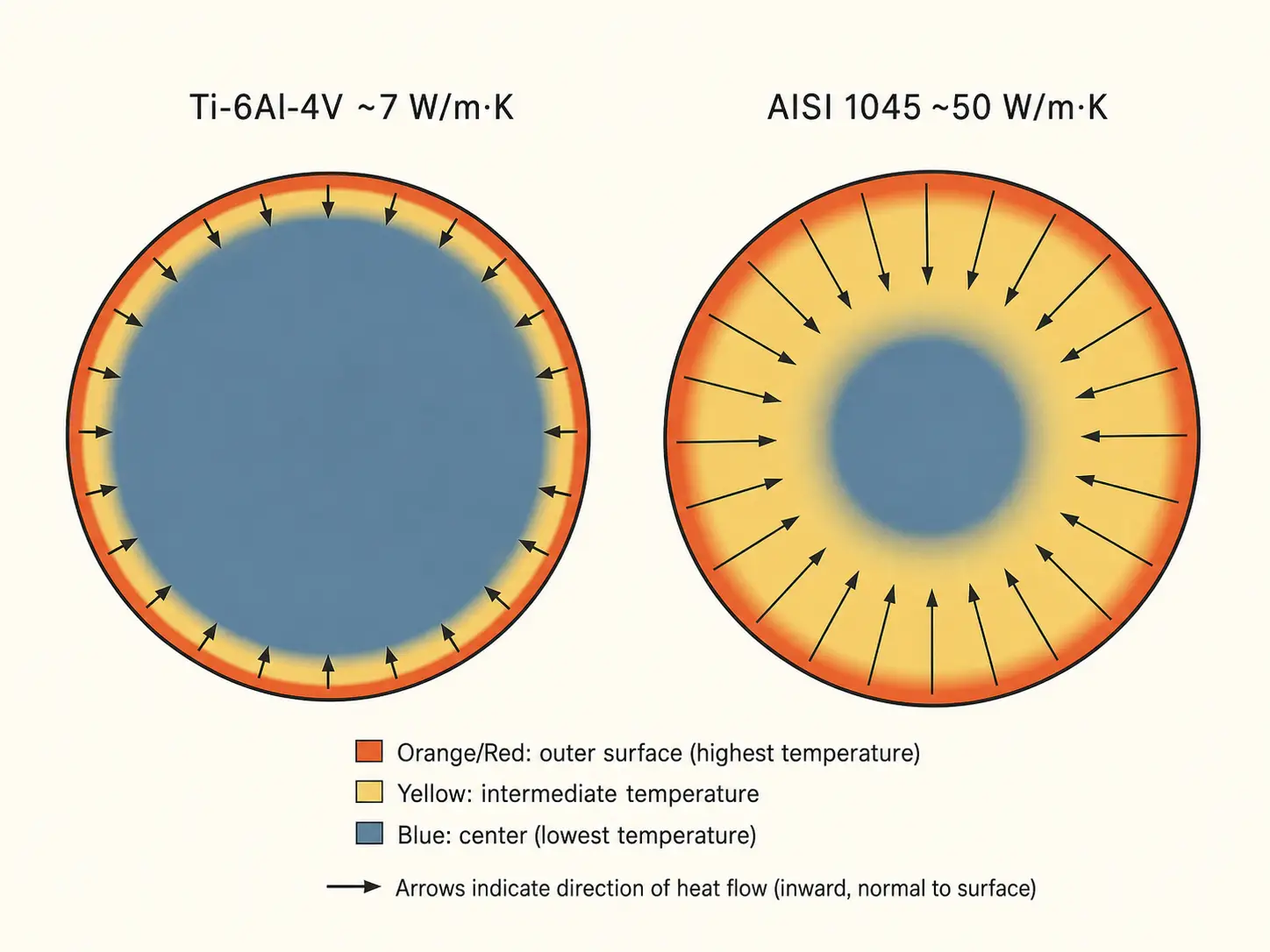
Higher electrical resistivity is a small silver lining. Titanium couples more efficiently with the induction field than steel of the same diameter, so less power is wasted in the coil. The trade-off is that the heat you do generate stays concentrated near the surface. For applications that need through-heating—forging billets, thick-walled rings, large-diameter bar ends—you must manage that gradient deliberately. For localized heating—tube ends, brazing joints, shrink-fit zones—it works in your favor.
The metallurgical stakes are higher than with steel, too. Exceed the beta transus by 30°C for more than a few seconds and grain growth becomes irreversible. Hold the part above 500°C in open air and you are growing an oxygen-enriched alpha case layer that must be machined off later. Induction’s speed helps here: shorter time at temperature means less oxidation and less grain coarsening. But speed alone does not solve the problem—it just shrinks the window you have to get everything else right. For a deeper look at the underlying physics, see how induction heating works.
2. Frequency and Power Selection
Frequency and power are not independent knobs. Together they determine how deep the current penetrates, how fast the part heats, and whether the surface-to-core temperature difference stays within your process limit.
Higher frequencies concentrate current in a thinner surface layer. For a 12 mm titanium bar end you might run 30–100 kHz and heat only the last 30 mm for forming. A 100 mm forging billet needing uniform through-heating might need 1–3 kHz and a slower ramp. Between those extremes, the right frequency matches the part diameter, wall thickness, target depth, and allowable gradient. Detailed guidance on matching frequency to your part geometry is covered in how frequency affects induction heating.
Power density matters more than total kilowatts on the nameplate. Titanium’s poor thermal conductivity means surface overheating arrives fast if power density is too high. A 100 kW supply might be the right size for a steel billet of a given diameter, and completely wrong for a titanium billet of the same diameter because the heat cannot escape the surface quickly enough. The symptom: pyrometer reads 960°C on the surface, but a contact thermocouple at 3 mm depth shows 600°C. The fix: lower power density, longer heating time, or part rotation—sometimes all three.
For production sizing, start with the part mass, specific heat, target temperature rise, and required cycle time. Then derate for titanium. A conservative ramp that takes two seconds longer per part produces far less scrap than an aggressive ramp that overshoots temperature on every tenth cycle. See induction heating power calculation for the full sizing methodology.
3. Coil Design for Titanium Parts
Coil geometry determines heating pattern, and heating pattern determines scrap rate. A poorly matched coil produces hot spots at edges and cold bands in the middle even when the power supply is correctly sized.
Round multi-turn coils handle shafts, tubes, and billets well when the part diameter is consistent. Pancake coils work for flat faces and flange surfaces. Single-turn coils deliver concentrated heat to narrow zones but couple less efficiently on titanium than on steel of the same dimension because titanium’s higher resistivity shifts the electromagnetic coupling behavior. Flux concentrators can redirect field lines toward the part and improve uniformity—especially useful around shoulders, grooves, and section changes where the electromagnetic field would otherwise favor the sharp edge and overheat it.
Coil-to-part gap deserves more attention than it usually gets. A consistent 2–4 mm gap around the circumference keeps coupling uniform. But titanium parts expand during heating. A gap that is correct at room temperature will close enough to cause a short or rub at 900°C. Account for thermal expansion in the coil ID, and build in enough clearance for part tolerances and loading variation. In automated cells, coil damage is more often caused by part misalignment than by electrical overload. Basic coil principles apply across materials—see how induction coils work for the foundations.
Part rotation solves many uniformity problems at relatively low cost. A titanium tube or bar rotating at 60–120 RPM inside a stationary coil averages out circumferential temperature variation. For complex geometries—eccentric flanges, rectangular cross-sections, asymmetrical bosses—coil profiling combined with rotation usually beats either technique alone.
4. Atmosphere and Oxidation Control
Above 500°C, titanium dissolves oxygen, nitrogen, and hydrogen into its surface. The result is alpha case—a hard, brittle, oxygen-enriched layer that reduces fatigue life and must be removed by machining or chemical milling. Induction heating shortens exposure time compared with furnace cycles, but the temperatures are the same, so the atmosphere still matters.
Argon shielding is the most common industrial solution. A continuous argon flow directed at the heating zone displaces air and keeps oxygen away from the hot surface. For critical aerospace and medical parts, the entire heating zone sits inside an argon-purged chamber with oxygen monitoring. Some shops use argon-flooded coil assemblies where the gas flows through the coil body itself, bathing the part in inert gas exactly where it is hottest.
Open-air heating has its place. If exposure time is under 10–15 seconds, temperature stays below 700°C, and the part gets machined afterward, the alpha case depth typically falls within the machining allowance. The decision hinges on what the part specification allows and what downstream operations can remove. For a deeper discussion of oxidation mechanisms across materials, see reducing oxidation during induction heating.
5. Temperature Control and Process Repeatability
Visual temperature judgment does not work on titanium. The surface color shifts from silver to straw to blue to gray across a temperature range that is too narrow for the human eye to resolve reliably, and shop lighting changes everything. Closed-loop pyrometer control is the minimum for production repeatability.
Pyrometer setup on titanium is trickier than on steel because emissivity changes with surface condition. A polished as-machined titanium surface and an oxidized one from a previous heating step can read 40–60°C apart on the same pyrometer setting. During process development, correlate pyrometer readings against contact thermocouples at multiple temperatures and surface conditions. Lock in the validated emissivity setting, sight path, and target spot location. Once the correlation is established, non-contact pyrometry can hold ±10°C on production parts.
Recipe-based control turns a skilled operator’s best judgment into a repeatable process. A recipe stores power ramp profile, target temperature, hold duration, rotation speed, gas flow rate, and alarm limits for each part number. When the operator scans a barcode or selects a part number, the system loads the validated parameters. Manual knob-twiddling between shifts disappears. For systems with multiple stations, recipe control also simplifies integration with induction heating system components like PLCs, part presence sensors, and reject gates.
Cooling stability underpins electrical stability. A drifting coolant temperature changes coil impedance, which shifts the power delivery even if the generator setpoint stays the same. Closed-loop induction heating water cooling system design—with temperature-regulated flow, conductivity monitoring, and filtration—keeps the electrical parameters stable across an eight-hour shift.
6. Common Industrial Applications
Induction heating earns its place in titanium processing wherever heat must be fast, local, and repeatable. Five application categories account for most production use.
- Forging and forming preheat. Titanium billets, bars, and preforms heated inline before press forming. Induction cuts heat-up time from furnace minutes to seconds and integrates directly with automated press feed systems. The main challenge: avoiding an excessive surface-to-core gradient in larger sections. Lower frequency, staged heating, or part rotation addresses this.
- Tube and pipe end heating. Localized heating for flaring, swaging, bending, or end forming. Induction heats only the working zone, so the rest of the tube stays cool. Less distortion, faster cycle, and no open flame on the shop floor.
- Brazing and joining. Induction brazing of titanium demands precise temperature control and argon or vacuum atmosphere. The filler metal wets reliably only if the joint area reaches temperature uniformly and stays protected from oxygen. Induction delivers the localized heat; the process engineer delivers the atmosphere and joint design.
- Shrink fitting and interference assembly. Heating a titanium hub or ring for bearing installation or precision shaft assembly. Induction expands only the component that needs to grow, not the entire assembly. Faster than an oven and gentler on adjacent temperature-sensitive parts.
- Aerospace structural and engine components. Titanium dominates aerospace hot-section applications. Induction handles localized stress relief, preheating before welding, and thermal forming of sheet and plate. The process fits automated aerospace production cells where traceability and repeatability are non-negotiable. For a broader view, see induction heating in aerospace manufacturing.
Key Takeaway
Induction heating for titanium alloys works when the process is engineered around titanium’s physics—low conductivity, high reactivity, narrow temperature window. Pick the frequency for your part diameter, not your steel experience. Control the atmosphere or budget for machining the alpha case off. Lock in validated recipes and stop tweaking knobs between shifts. The power supply matters less than how you integrate coil, gas, pyrometer, and part handling into one repeatable system.
FAQ
Q: Can all titanium alloys be induction heated?
A: Yes. Commercially pure titanium, Ti-6Al-4V, Ti-6Al-4V ELI, and most beta and near-alpha titanium alloys respond to induction heating. The process parameters—frequency, power density, ramp rate, and atmosphere—must be validated for each alloy grade. What works for Ti-6Al-4V at 950°C may over-age a beta alloy at the same temperature.
Q: Does titanium induction heating always require argon shielding?
A: Not always, but it depends on temperature, time, and what the part specification allows. Below 500°C, oxidation is slow enough that open-air heating is often acceptable. Above 700°C for more than a few seconds, argon shielding or a controlled atmosphere prevents alpha case formation. For aerospace and medical parts, shielding is standard practice.
Q: Why does my titanium part show a 300°C gradient from surface to core?
A: Titanium’s thermal conductivity is about one-seventh that of steel. Heat generated at the surface by the induced current does not spread inward quickly. If your process requires tighter uniformity, try reducing power density, switching to a lower frequency for deeper current penetration, adding part rotation, or using staged heating with a brief soak between ramp steps.
Need a Titanium Heating Process Reviewed?
Send us your alloy grade, part drawing, target temperature, and production rate. Our engineering team will evaluate the application and recommend an induction heating system approach matched to your process.


