
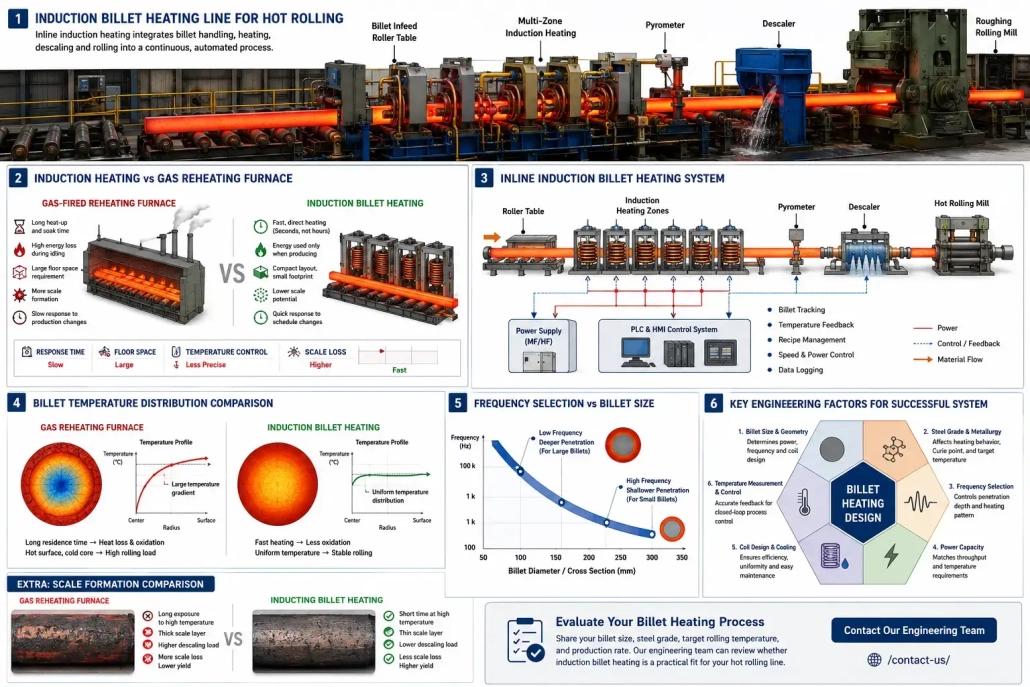
Why Rolling Mills Use Induction Billet Heating
Induction Billet Heating has moved from niche application to mainstream alternative in hot rolling — driven by three pressures that gas-fired and resistance furnaces were never designed to solve: production flexibility, temperature precision, and floor space constraints.
Billet heating determines scale loss, metallurgical quality, mill availability, yield, operating cost, and downstream dimensional consistency. Get the heating method wrong and the entire line pays for it. Every shift. Every campaign.
1. What Changed in Billet Heating
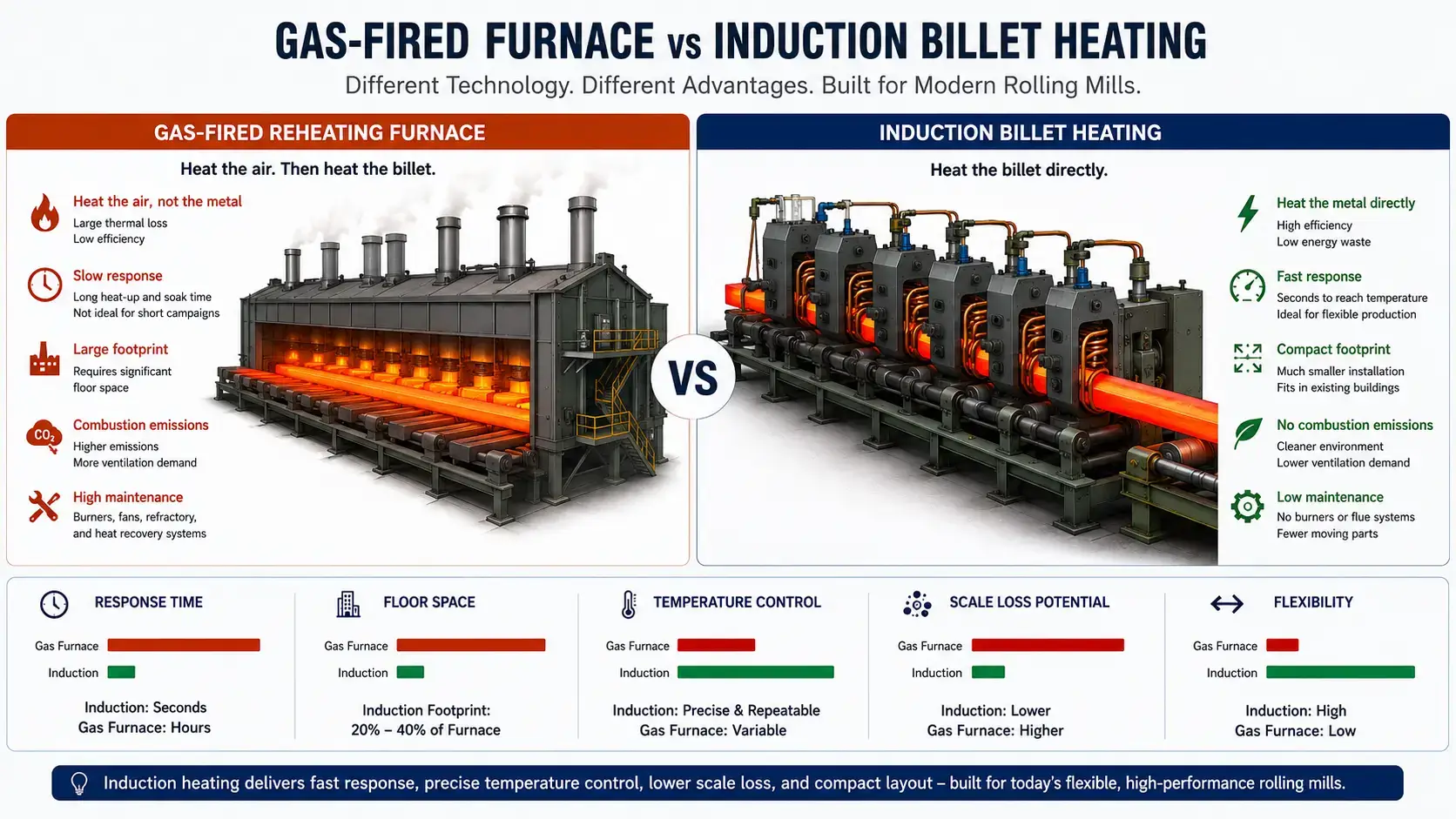
Most rolling mills were built around long gas-fired reheating furnaces. That made sense when billet sizes, steel grades, and production schedules stayed stable for years. Few mills operate that way now.
Shorter campaigns. More product variants. Tighter delivery schedules. Higher energy costs. In one plant after another, the heating system has become the bottleneck — not the rolling stands, not the finishing line, not the cooling bed. The furnace.
Traditional furnaces still work in high-volume, single-grade, steady-state production. They bleed efficiency the moment production involves frequent size changes, intermittent operation, or partial-load running. Heat-up time, soak time, scale formation, combustion control, and furnace maintenance eat into margin at every step.
Induction heats the billet directly. Electromagnetic energy deposited inside the metal. No combustion gases. No furnace atmosphere.
2. Why Induction Fits Modern Rolling Lines
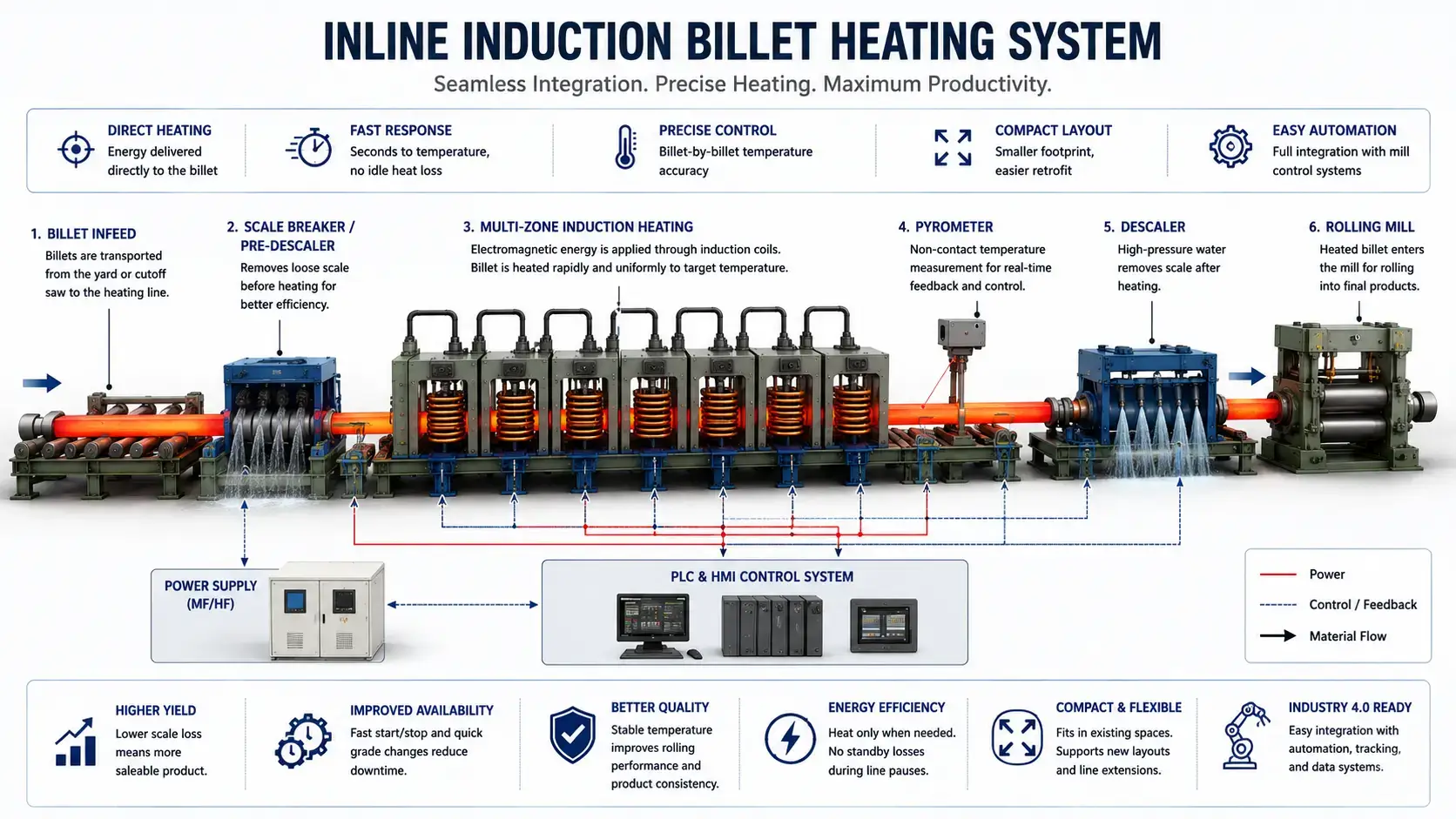
Induction billet heating integrates inline. Billet handling, descaling, rolling stands, automation — all connected. No batch staging between furnace and mill.
A gas furnace sits at temperature whether billets pass through or not. Shift changes, die changes, grade transitions — fuel keeps burning. An induction billet heater starts and stops with the line. For mills running short campaigns or unpredictable schedules, idle energy loss drops to near zero.
Temperature repeatability drives rolling quality directly. Billets too cold — higher rolling loads, potential defects. Billets too hot — scale loss, decarburization, grain growth, surface damage. Which of these dominates depends on the grade. Induction systems lock in heating conditions via power setpoints, pyrometer feedback, billet tracking, and PLC recipes. One billet to the next, one shift to the next.
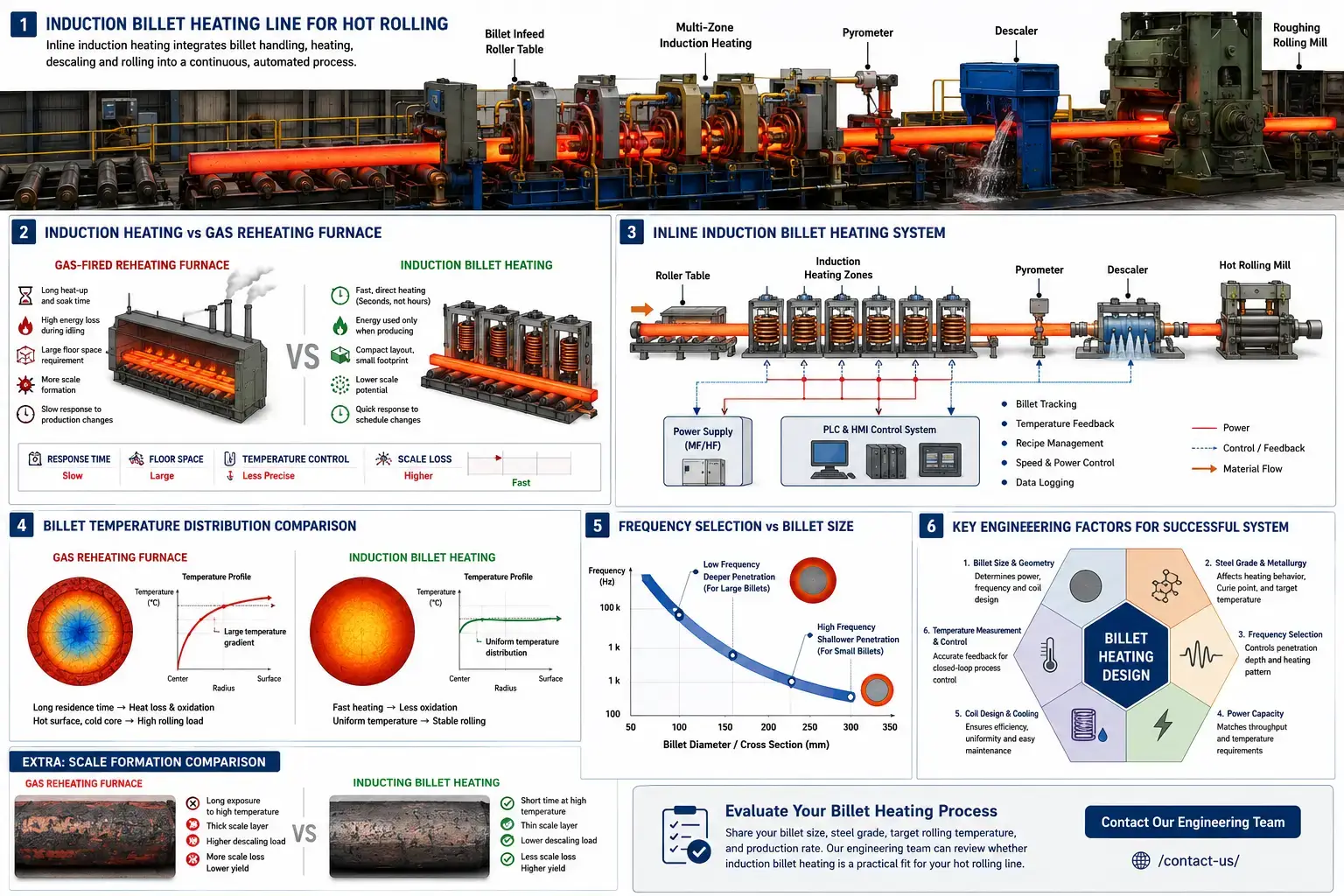
Floor space seals the decision in many brownfield projects. A conventional reheating furnace consumes substantial area with long soak zones and material handling. Induction systems are compact. When the mill is being upgraded inside an existing building, available space, crane access, foundation conditions, and line elevation constrain the options. Induction fits where a furnace will not.
3. Process Advantages vs Conventional Furnaces
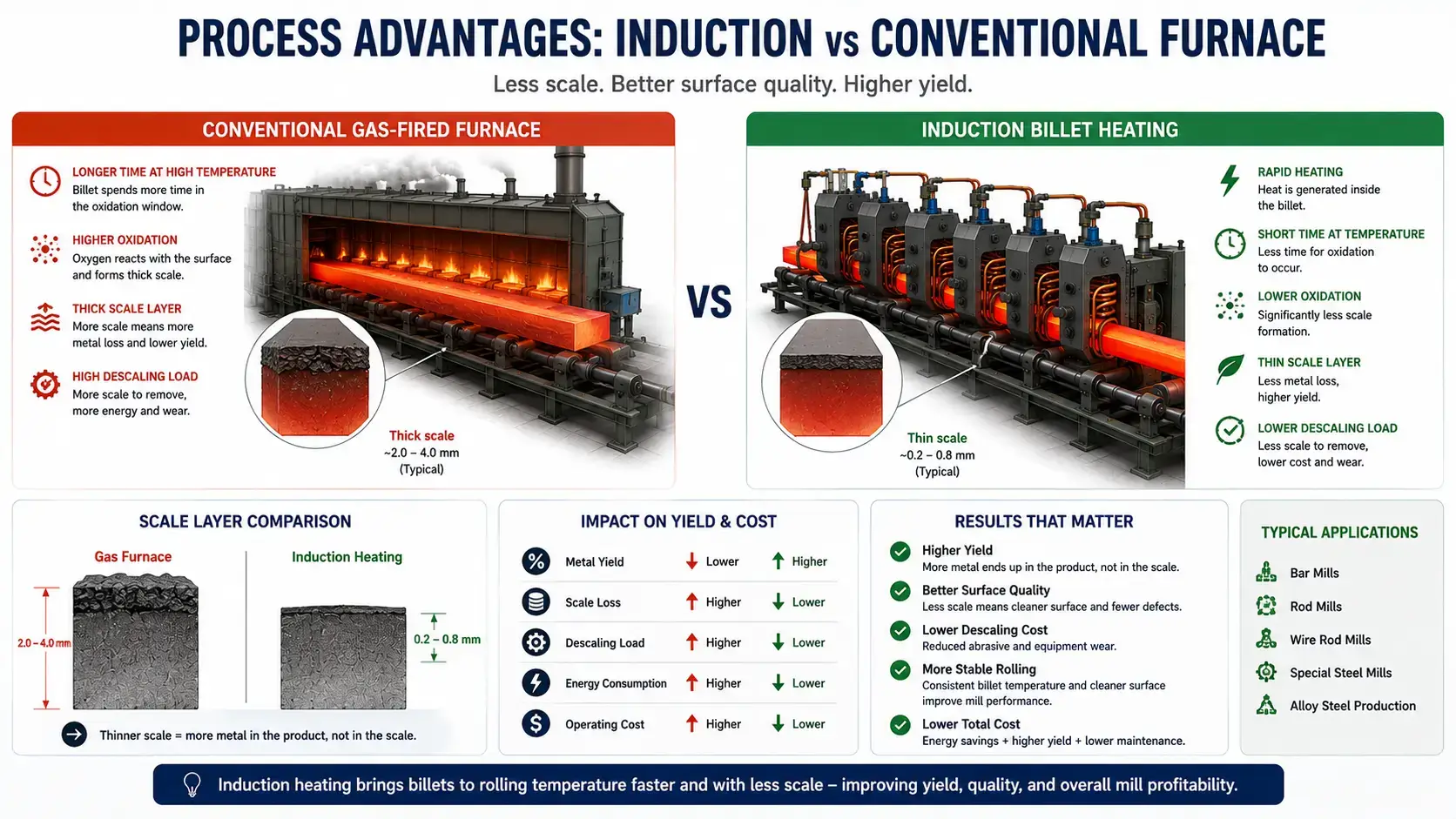
Measure the decision against what the rolling line actually needs — not a spreadsheet comparison of energy ratings. Induction Billet Heating changes the whole process, not just the heating step.
| Factor | Induction Billet Heating | Conventional Furnace |
|---|---|---|
| Scale Formation | Billets reach rolling temperature in minutes. Short time in the oxidation window. Typical scale loss 0.5–1% of billet weight. | Hours of residence time at high temperature, combustion atmosphere accelerates oxidation. Typical scale loss 2–4%. |
| Production Flexibility | Recipes changed in software. Operators adjust power, speed, and heating zones per billet section. No thermal inertia to wait out between grade changes. | Furnace atmosphere, zone temperatures, and soak times require stabilization between product changes. Mixed-temperature transition zones risk off-spec billets. |
| Thermal Impact on Plant | Heat concentrated in workpiece and coil area. Controlled work environment, lower ventilation load. | Radiant and convective heat released into surrounding area. Affects operator comfort, nearby equipment, building heat load. |
| Automation Compatibility | Clean PLC and HMI integration. Power supplies accept production recipes, adjust output on billet presence or pyrometer feedback. Closed-loop control billet by billet. | Combustion control, zone temperature management, and atmosphere regulation add control layers. Integration possible but more complex. |
For mills running multiple products, variable schedules, or tight dimensional specs, the frequency selection, power capacity, and coil configuration must match the billet program — the fundamentals are covered in how induction heating works. Get these three variables right and the process advantages in the table translate directly to the mill floor. Miss one and the gap between induction and furnace closes fast.
4. Engineering Decisions Before Switching
Five decisions. Get any one wrong and the system underperforms. Get two wrong and you are buying a second machine within two years.
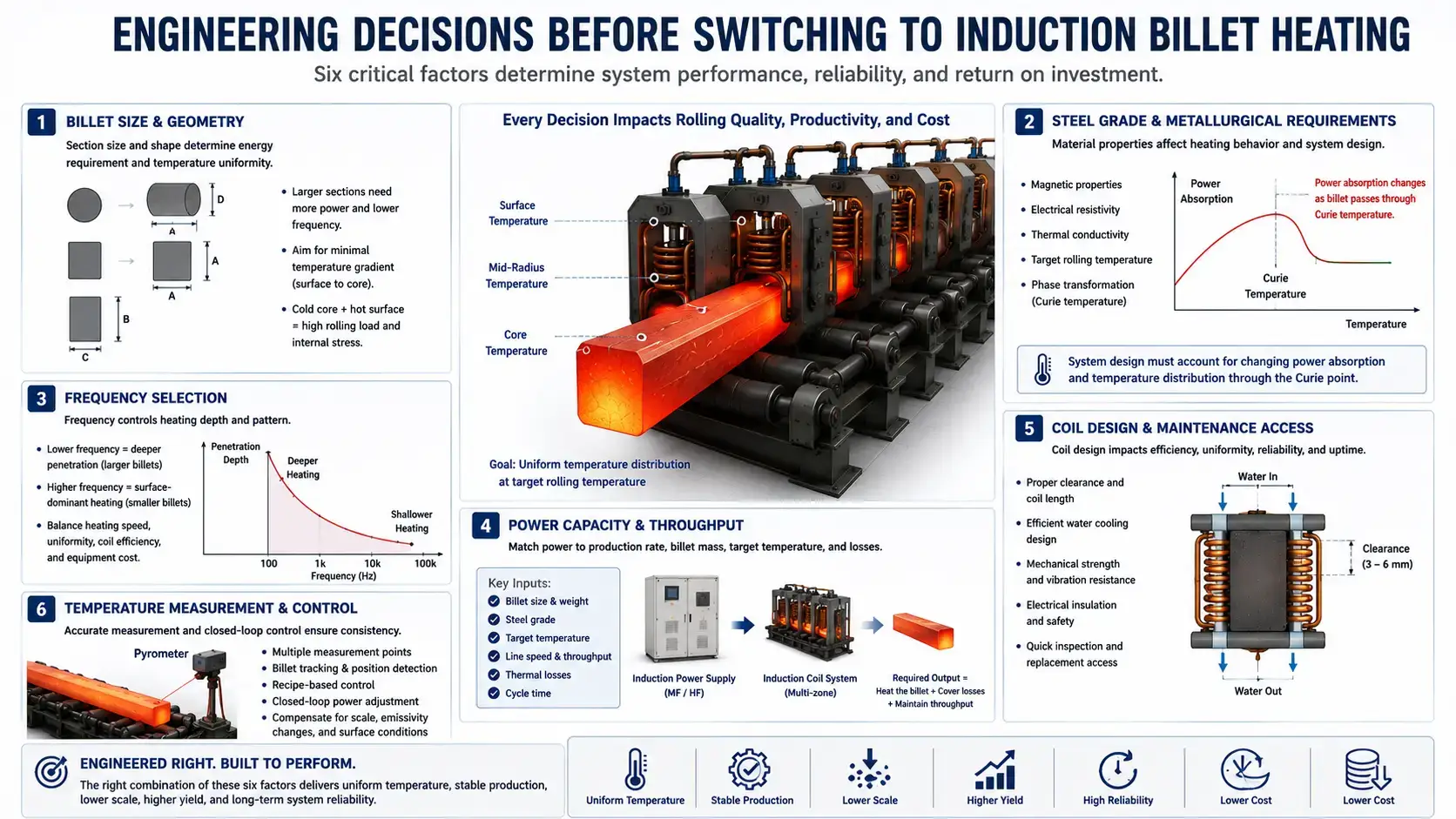
Billet specification and steel grade. Round, square, and rectangular sections couple differently with the induction coil. Larger sections demand more energy and tighter surface-to-core temperature management. Layer material on top of geometry — carbon steel, alloy steel, stainless steel, copper, and aluminum each have their own magnetic properties, electrical resistivity, thermal conductivity, and target rolling temperature. For steel billets, the game changes at the Curie point. Power absorption shifts. Temperature distribution shifts. Frequency selection, power control, and heating zone design must account for this transition. Treat the billet as a uniform block and the temperature profile at the mill entry will prove you wrong.
Frequency selection. Frequency determines induced current depth and therefore heating pattern. Lower frequencies produce deeper heating, critical for larger billets. Higher frequencies deliver surface-dominant heating, usable for smaller sections. For billet heating before hot rolling, frequency selection balances heating speed, temperature uniformity, coil efficiency, and equipment cost. Get it wrong and no amount of power compensates.
A practical frequency study needs seven inputs:
— Billet diameter or cross-section
— Material grade
— Required discharge temperature
— Allowable temperature gradient
— Line speed and production rate
— Available power supply range
— Coil length and number of heating zones
All mandatory.
Power capacity and throughput. Start from the required production rate. Calculate billet mass, specific heat, target temperature rise, thermal losses, and desired cycle time. Undersized power means slow heating, unstable production, excessive temperature gradients. Oversized equipment wastes capital cost and complicates control if zoning and regulation are not designed for the headroom. When the mill handles multiple billet sizes or grades, validate with process calculations and heating trials.
Coil design and maintenance access. The induction coil is a process tool — it governs heating efficiency, temperature uniformity, reliability, and maintainability. Design must account for billet clearance, scale management, cooling flow, mechanical support, electrical insulation, and quick replacement. Rolling mill environments subject coils to vibration, heat, water, scale, and mechanical abuse. If inspection access requires a ladder, a mirror, and three hex keys, the coil design failed.
Related: coil design fundamentals, water cooling systems.
Temperature measurement and control. Pyrometers monitor billet temperature. Scale, emissivity changes, water spray, billet movement, and surface condition all interfere with readings. A robust control system uses multiple measurement points, billet tracking, recipe-based control, and closed-loop power adjustment. Measure the temperature that matters to the process — not the easiest surface point to reach with a sensor.
5. Where Induction Delivers the Fastest Payback
Bar, rod, and wire rod mills get the most from induction when billet size ranges are manageable and throughput matches available power.
Specialty steel and alloy producers run smaller batches and more frequent grade changes than commodity mills. Furnace scheduling and thermal transitions create downtime between products. Induction cuts that downtime by switching recipes in software — no furnace atmosphere to recondition, no thermal inertia to wait out.
Inline boost heating solves a narrower problem. The existing furnace stays. Induction sits downstream as a booster, compensating for temperature loss between stands or supporting higher rolling speed when the furnace alone falls short.
Partial and end heating cover the remaining cases — forging, localized forming, upset preparation. A conventional furnace cannot deliver selective heating. Induction does. That is why it dominates forging, forming, induction brazing, induction hardening, and heat treatment.
6. What the Induction Billet Heating Conversation Gets Wrong
The induction heating conversation is cluttered with oversimplified claims.
“Induction always costs less to operate.” Induction cuts energy waste where furnaces idle for long periods or run below capacity. But electricity cost, power demand charges, utilization rate, and heating efficiency all affect operating cost. Stack up fuel, electricity, scale loss, maintenance, start-up time, labor, ventilation, emissions compliance, and production flexibility. Often the process benefits outweigh the energy comparison — but the spreadsheet does not always tilt one direction.
“Heating speed is the main reason to switch.” Speed matters. Temperature control, automation compatibility, lower scale loss, reduced floor space, and faster production changeovers matter just as much. For a rolling mill, the metric is stable mill entry temperature at required throughput with acceptable metallurgical results. Speed serves that metric. It is not the metric.
“Any induction power supply can heat billets.” Billet heating demands a power supply, coil system, cooling system, controls, and material handling built for heavy-duty continuous operation. Rolling mills are unforgiving — continuous operation, scale, heat, water exposure, electrical noise, mechanical impact. Industrial design details separate a machine that runs for years from one that dies in six months.
“Induction eliminates all temperature gradients.” It does not. Gradients depend on section size, frequency, power density, heating time, and material properties. Design for the process requirement, not the catalog claim.
Key Takeaway
Rolling mills switch to Induction Billet Heating for faster response, tighter temperature control, reduced scale potential, and compact layouts that fit existing buildings. The system delivers when engineered around billet size, grade mix, throughput, frequency, power capacity, coil design, cooling, and temperature feedback. Buy it as a standalone heater and you miss the point — and the performance.
FAQ
Q: Is induction billet heating suitable for all hot rolling mills?
A: No. Large sections and extremely high continuous tonnage still justify a detailed comparison against furnace-based heating. Induction works where billet size, production rate, available electrical power, and temperature requirements align.
Q: Can induction billet heating reduce scale loss?
A: In most applications, yes — sometimes by enough to justify the capital cost on yield improvement alone. Because induction heats billets quickly and cuts time at high temperature, oxidation drops compared with long furnace residence times. Actual reduction depends on steel grade, temperature, heating cycle, surface condition, and process atmosphere.
Q: What frequency is used for induction billet heating?
A: Larger billets need lower frequencies for deeper heating. Smaller sections run higher frequencies. Final selection must be based on heating calculations, production targets, and coil design — not a rule of thumb.
Q: Can induction be added to an existing rolling mill?
A: Yes. Induction systems install as inline heaters, boost heaters, or replacements for older equipment. Brownfield induction retrofits are among the most common projects in the sector right now. The project must evaluate floor space, billet handling, electrical infrastructure, cooling water, automation integration, and safety guarding.
Evaluate Your Billet Heating Process
Share your billet size, steel grade, target rolling temperature, and production rate. Our engineering team can review whether induction billet heating is a practical fit for your hot rolling line.


