5 Critical Factors for Selecting an Induction Annealing Machine
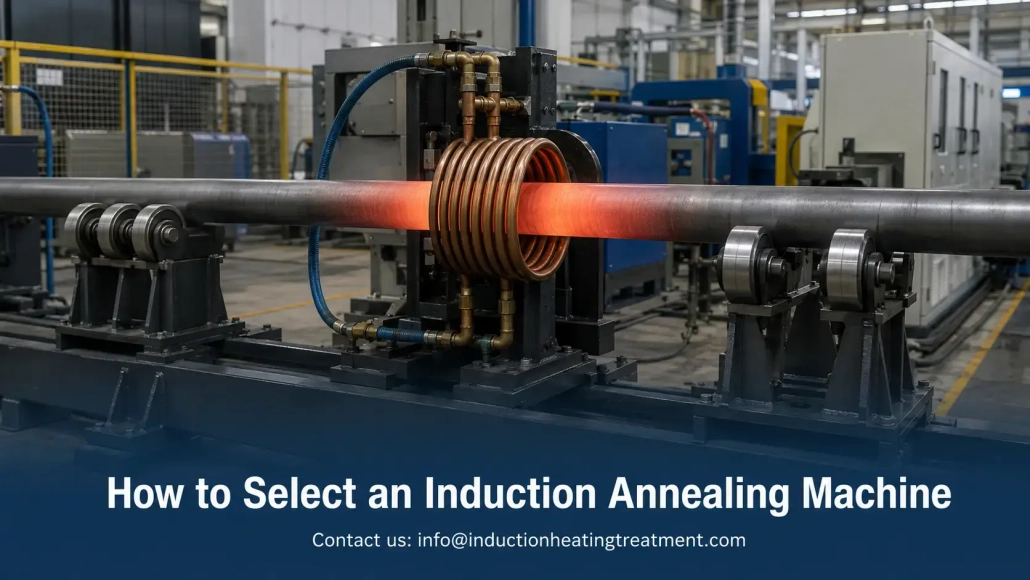
Selecting an induction annealing machine is not about finding the highest-wattage power supply or the cheapest quote. It is about matching the equipment to three things that conventional furnace annealing cannot deliver simultaneously: localized heating, controlled cooling, and in-line throughput. A well-specified machine softens cold-worked metal, relieves weld-zone stress, and restores ductility — in seconds per part instead of hours per batch. A poorly matched one leaves you with inconsistent grain structure, surface oxidation, and a capital asset that never integrates with the rest of the line.
Annealing is fundamentally different from hardening and tempering. It operates at higher temperatures, demands control over the cooling rate — not just the heating rate — and serves an entirely different set of production workflows: wire drawing, tube forming, cold heading, and post-weld stress relief. The five factors below are the decision points that separate a machine that fits your process from one that fights it.
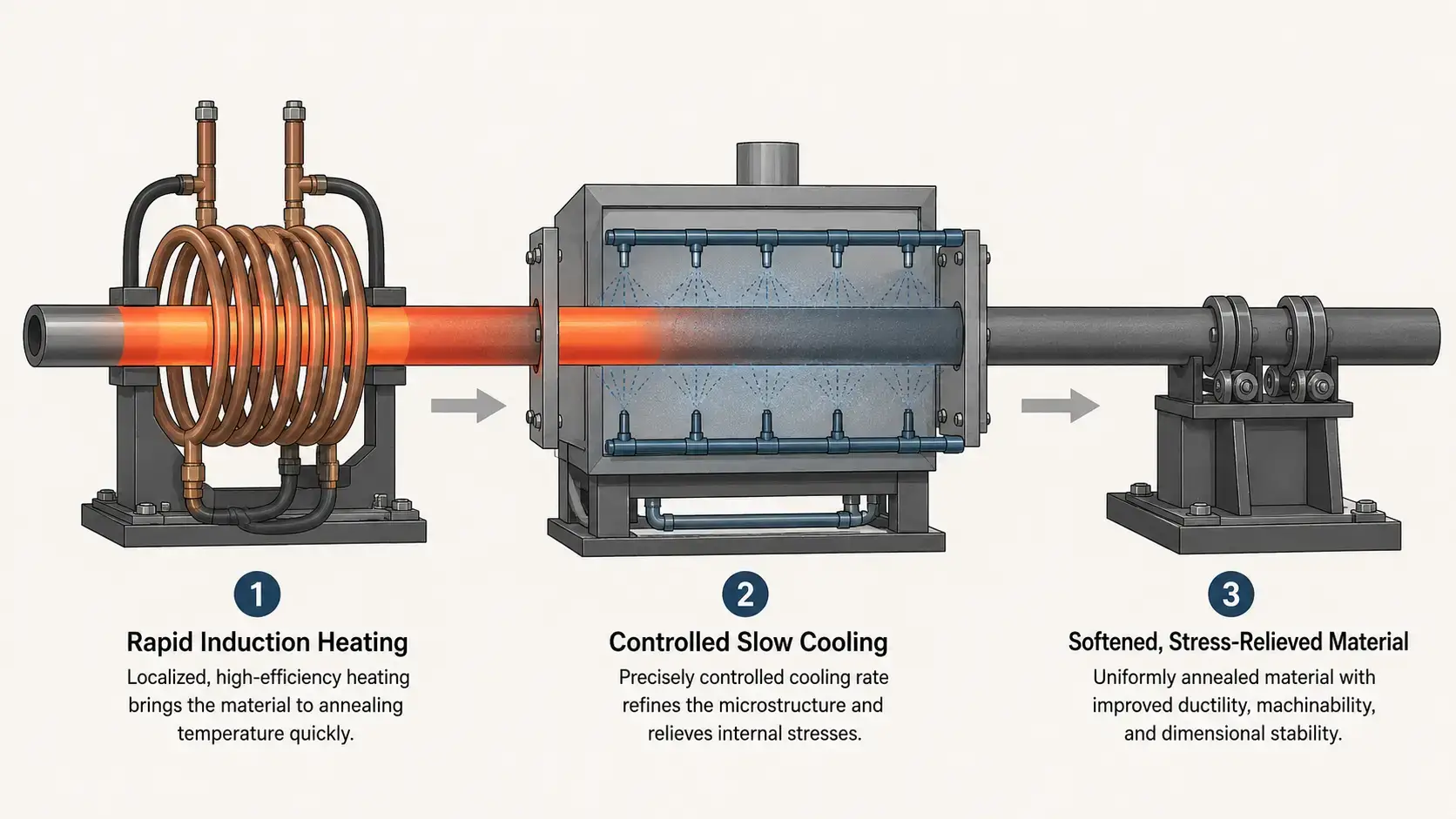
Table of Contents
1. Define Your Annealing Application
Annealing is not one process — it is a family of processes, and the machine you need depends entirely on which one you are running. Unlike induction tempering, which almost always follows hardening, annealing shows up at multiple points in the production chain: after cold drawing, between forming stages, after welding, or as a final stress-relief step before machining.
Start by identifying which application type you are dealing with:
— Wire and strand annealing: Continuous wire drawing work-hardens the material. In-line induction annealing between drawing passes restores ductility without stopping the line. The coil design here is typically a multi-turn tunnel coil that the wire passes through at speed.
— Tube and pipe annealing: Tube forming, bending, and welding introduce residual stress. Induction annealing can target specific zones — the weld seam, the bend radius, or the full cross-section — with far less oxidation than a furnace.
— Bar and rod annealing: Cold-headed or cold-drawn bar stock often needs full-cross-section softening before the next forming operation. Medium-frequency systems deliver the penetration depth required for solid sections.
— Weld-zone annealing: After TIG, MIG, or laser welding, the heat-affected zone (HAZ) contains residual stress that can cause cracking. Localized induction annealing treats only the HAZ, leaving the rest of the part unchanged — something a furnace cannot do.
— Full-length continuous annealing: Long products like wire, strip, or tubing running at constant speed through a fixed coil. The machine must maintain a steady thermal profile over hours of continuous operation.
An induction annealing machine designed for continuous wire at 200 meters per minute is a completely different system from one built for localized post-weld treatment on a batch of fabricated assemblies. Define the application first, then spec the machine around it.
2. Power, Frequency & Cooling Control
Power and frequency determine how fast and how deep the part heats. But for annealing, there is a third variable that matters just as much: cooling rate control. Unlike hardening — where you quench — and tempering — where you usually air-cool — annealing demands a controlled slow cool to allow grain structure to reform properly. A machine that heats perfectly but cools too fast will leave the material harder than it started.
The three parameters to evaluate together:
— Power level: Annealing temperatures are higher than tempering — typically 700–900°C for steels, compared to 150–650°C for tempering. This means higher specific power per kilogram of workpiece. Refer to standard power requirements for estimating your baseline, but expect annealing loads at the upper end of the range for a given part mass.
— Frequency selection: Medium frequency (1–10 kHz) suits solid sections like bar and thick-walled tube where the heat must penetrate to the core. Higher frequency (10–50 kHz) suits thin-gauge tube, wire, and surface-layer annealing. The rule is the same as for all induction heating: smaller cross-section → higher frequency.
— Controlled cooling section: This is where induction annealing equipment fundamentally differs from other induction machines. After the heating coil, the workpiece must pass through a controlled cooling zone — an insulated tunnel, a temperature-regulated jacket, or a precisely timed air gap — that brings the temperature down slowly enough to achieve full recrystallization. Ask the supplier how the cooling rate is managed, not just how the heating is delivered.
A supplier who only talks about kilowatts and kilohertz without addressing cooling control is treating annealing like hardening with a lower temperature setpoint. It is not the same thing.
3. Temperature Precision & Uniformity
Annealing temperature control is demanding for two reasons that do not apply to hardening or tempering. First, the target temperature window is narrow relative to the absolute temperature — holding at 850°C ±10°C requires tighter proportional control than holding at 400°C ±10°C, because thermal losses to the surroundings scale with the fourth power of absolute temperature. Second, if the temperature overshoots too far, grain growth accelerates and the material’s mechanical properties degrade permanently — you cannot “un-grow” coarse grains by cooling more slowly.
Key temperature control features to evaluate in an induction annealing system:
— Dual-wavelength or ratio pyrometry: Standard IR pyrometers can drift with emissivity changes as the part surface oxidizes at annealing temperatures. A dual-wavelength sensor compensates for this, delivering accurate readings even as the surface condition changes during heating.
— Closed-loop power control with fast response: The system must adjust output within milliseconds to compensate for line-speed fluctuations, incoming material temperature variations, and coil impedance drift as the coil heats up over a production run.
— Multi-zone monitoring for continuous processes: In wire or tube annealing lines, temperature should be measured at the coil exit and at the cooling-zone exit. The difference between these two readings tells you whether the cooling rate is on target.
— Recipe management with material-specific profiles: Annealing parameters for 304 stainless steel tube are completely different from those for C1020 carbon steel wire. The machine should store, recall, and lock validated profiles so operators do not need to re-tune for every material change.
If a supplier cannot demonstrate temperature uniformity across your specific workpiece with your specific material, keep looking. Process validation on your actual parts is the only proof that matters.
4. Automation & Production Capacity
Annealing lines fall into two broad categories, and the automation requirements for each are completely different. Continuous-process lines — wire drawing, tube mill annealing, strip processing — need the induction system to synchronize with an existing line speed that may already be fixed. Batch-annealing workstations — post-weld treatment cells, pre-machining stress relief stations — need fast part changeover and flexible fixturing.
Match the automation level to your production profile:
— Continuous in-line annealing: The induction coil and cooling section are integrated directly into the wire-drawing, tube-welding, or strip-rolling line. The control system must communicate with the line PLC to adjust power in real time as line speed changes. A two-second communication lag at 100 meters per minute means three meters of scrap.
— Semi-automatic batch cells: An operator loads the part into a fixture, initiates the cycle, and removes the finished part. Suitable for weld-zone annealing of fabricated assemblies or pre-machining stress relief of forgings. Cycle time consistency depends on part placement repeatability — the fixture should locate the workpiece precisely relative to the coil every time.
— Fully automatic robotic cells: A robot loads parts into the coil, the annealing cycle runs, and the robot unloads. This configuration works well for medium-to-high volumes of discrete parts where labor cost or cycle-time consistency justifies the automation investment. The same design logic applies as when selecting an induction hardening system with robotic handling.
— Quick-change tooling: If you anneal multiple SKUs on the same machine, the coil, guides, and cooling-zone inserts should be replaceable in minutes, not hours. Every minute of changeover is lost production capacity.
For continuous lines, specify the machine for the highest line speed you expect to run in the next three years, not the speed you run today. Retrofitting a faster power supply later is more expensive than buying the right capacity upfront.
5. Supplier Experience & Process Know-How
Annealing is the induction process where supplier experience matters most. Hardening is relatively forgiving: heat above the transformation temperature, quench, done. Tempering is straightforward: heat to a lower target, hold, air-cool. Annealing adds a dimension — controlled cooling — that requires the supplier to understand metallurgy, not just electrical engineering. A supplier who knows power electronics but not phase transformation kinetics will spec a machine that heats beautifully and ruins the material on the way down.
When evaluating suppliers, probe beyond the equipment catalog:
— Material-specific process experience: Has the supplier built annealing systems for your material family — carbon steels, stainless steels, copper alloys, aluminum? Each has different transformation temperatures, emissivity characteristics, and cooling-rate sensitivities. Ask for a reference from a customer running a similar material.
— Coil design for annealing: Annealing coils often run at higher temperatures for longer duty cycles than hardening coils. The coil cooling system, insulation, and mechanical support structure must be designed for sustained thermal load, not intermittent duty. A hardening coil repurposed for annealing will fail prematurely.
— Cooling-zone engineering: This is the part of an induction heating system that most generic suppliers overlook. Ask to see how the cooling section is designed — length, insulation, temperature monitoring points, and whether it can be adjusted for different materials and line speeds.
— On-site process validation: The supplier should be willing to run your material through a test system and provide time-temperature curves, before-and-after hardness readings, and metallographic grain-structure images. A quote without process data is a gamble.
— After-sales support and spare parts: Annealing lines often run 24/7. Downtime costs are calculated per minute, not per day. Confirm spare-parts lead times and whether the supplier offers remote diagnostics for the power supply and control system.
A supplier worth working with asks about your annealing application before quoting a power rating. We evaluate every inquiry against the five factors above — application type, power and cooling requirements, temperature control, automation needs, and long-term process support — and deliver a configuration based on your material and production targets, not a catalog preset.
Induction vs. Conventional Furnace Annealing
For manufacturers currently using batch or continuous-belt furnaces for annealing, the question is whether induction delivers enough of an advantage to justify the switch. The table below compares the two methods on the dimensions that matter most in production.
| Induction Annealing | Conventional Furnace Annealing |
|---|---|
| Rapid localized heating — seconds to minutes | Slow batch heating — typically 1–6 hours |
| Controlled cooling rate — programmable slow-cool zone | Passive furnace cooling — limited rate control, depends on thermal mass |
| Minimal oxidation — short high-temperature exposure, inert gas compatible | More scale formation — prolonged exposure at temperature |
| Lower energy per part — only the target zone is heated | Higher energy use — furnace idling, heat loss to surroundings |
| In-line capable — continuous wire, tube, and strip processing | Batch-limited workflow — load, soak, cool, unload |
| Consistent grain refinement — repeatable thermal cycle per part | Temperature gradients inside furnace — variable results by zone |
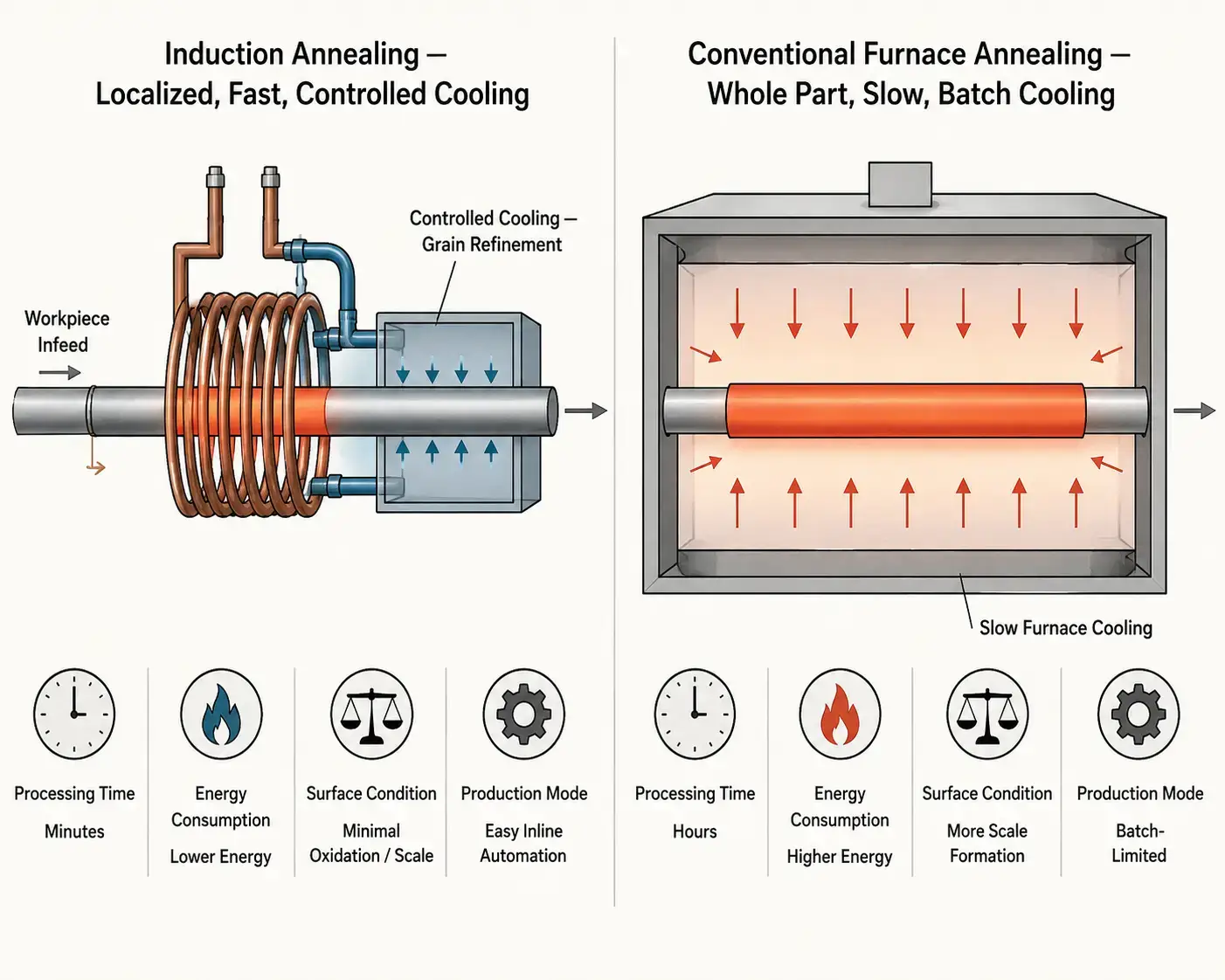
Induction annealing is not a universal furnace replacement. For job shops that anneal dozens of different part geometries in unpredictable batches, a conventional furnace remains the more versatile tool — load it, set the profile, and let it run. But for dedicated production lines processing wire, tube, bar, or repetitive weld-assembly annealing at medium-to-high volume, induction delivers faster cycles, lower energy per part, far less oxidation, and a level of cooling-rate control that a batch furnace cannot match. The economic crossover is clearest when the annealing step is the bottleneck on an otherwise continuous line.
Key Takeaway
Choosing an induction annealing machine comes down to five decisions, and the most important one is the first: defining exactly what you are annealing and why. The application — wire, tube, bar, or weld zone — determines the power, frequency, and coil geometry. The material determines the temperature target and the cooling rate you must hold. And the production volume determines whether you need a continuous in-line system, a semi-automatic cell, or a fully robotic workstation. A supplier who starts by asking about your material and your line speed, rather than quoting a machine from a catalog, is the difference between a system that works on day one and one that requires six months of re-tuning. The right machine specified correctly turns annealing from a batch-and-wait operation into a continuous, repeatable production step.
FAQ
Q: What is the difference between induction annealing and induction tempering?
A: The three key differences are temperature, cooling rate, and purpose. Annealing operates at higher temperatures (typically 700–900°C for steels) to fully recrystallize the grain structure and maximize softness and ductility. Tempering operates at lower temperatures (150–650°C) to reduce brittleness after hardening while retaining most of the hardness. Annealing requires controlled slow cooling to allow grain refinement; tempering is usually air-cooled. And they serve different points in the manufacturing chain: annealing often handles cold-worked or welded material, while tempering always follows a hardening step.
Q: What materials can be induction annealed?
A: Carbon steels, alloy steels, stainless steels, copper and copper alloys, aluminum alloys, and titanium can all be induction annealed, provided the power supply and frequency are matched to the material’s electrical resistivity and thermal conductivity. Non-ferrous metals like copper and aluminum require higher power densities because their lower electrical resistivity reduces inductive heating efficiency. The coil design and frequency must be adjusted for each material family — a system set up for steel will not anneal copper effectively without re-engineering.
Q: Can induction annealing replace a conventional annealing furnace?
A: For continuous production of wire, tube, strip, and bar, yes — induction annealing can replace the furnace entirely, delivering faster cycle times, lower energy cost, less oxidation, and far better cooling-rate control. For batch annealing of large, irregularly shaped fabrications or mixed-part workloads, a furnace is often still the more practical choice. Many manufacturers run a hybrid model: induction for the dedicated high-volume lines, furnace for the variable low-volume work.
Need Help Specifying an Induction Annealing System?
Tell us about your material, workpiece dimensions, target properties, and production volume. We will recommend an induction annealing configuration matched to your application.