How to Reduce Oxidation During Induction Heating: 8 Proven Strategies
Oxidation during induction heating is one of the first process issues manufacturers notice when moving from prototype to production. It shows up as surface scale, discoloration, decarburization, or poor braze wetting—and in many shops, it leads to extra cleaning, rework, or even scrapped parts. The good news: in most cases, oxidation is not a material problem. It is a process control problem—and the right combination of power supply, coil design, cycle timing, and atmosphere management can dramatically reduce it.
1. Why Oxidation Happens & Why Speed Matters
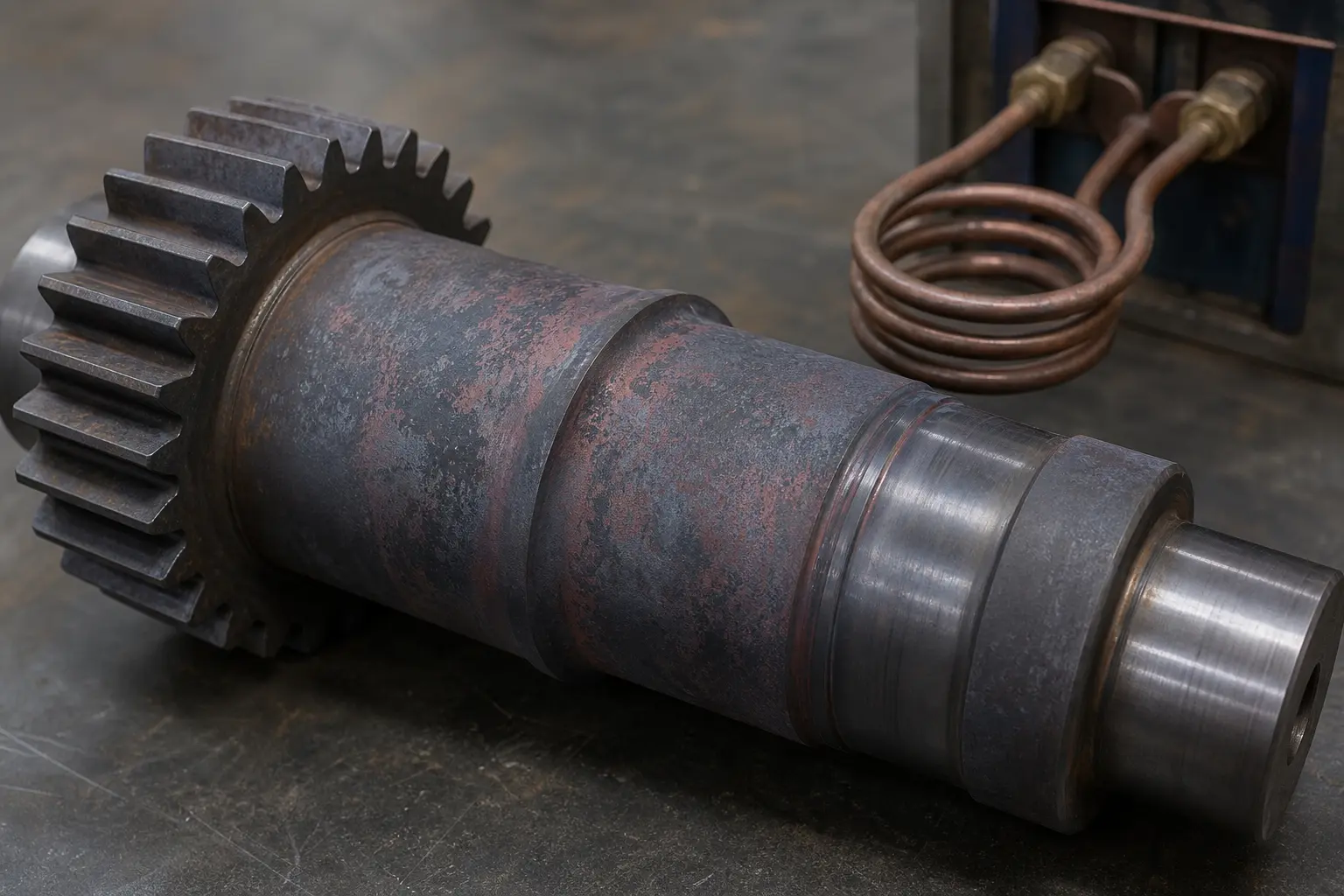
Oxidation is a simple chemical reaction: metal + oxygen + heat = oxide. The reaction rate increases with temperature and exposure time. This gives us two practical levers: keep peak temperature as low as the process allows, and minimize the time the part spends in the oxidation-prone range. This is exactly where induction heating has a fundamental advantage over conventional methods—it delivers heat quickly, locally, and only to the zone that needs it.
But the key word here is “can.” An induction system only delivers these benefits when the power supply, coil, and controls are properly matched to the part. If the frequency is wrong, if the cycle time drifts, or if the coil coupling is inconsistent, the oxidation window widens. So the first principle is simple: oxidation prevention starts with process design, not with add-ons. The power supply should never be evaluated in isolation—it belongs in the same conversation as the coil, cooling system, fixture, transfer method, and any atmosphere or shielding requirements.
2. Power Control: Fast Heating vs. Aggressive Heating
In production, faster heating generally reduces oxidation—but only if it is controlled. There is an important distinction between fast heating and aggressive heating:
Aggressive heating: Delivers too much power too quickly. The surface overheats before the core or joint area reaches target, creating hot spots that oxidize first and fastest.
Controlled fast heating: Uses the right power density and frequency for the part geometry, bringing the entire target zone to temperature uniformly and minimizing total time at elevated temperature.
Slow heating: Often from an undersized or poorly matched power supply, extends the time the part spends in the oxidation-prone range. Even if peak temperature is correct, the accumulated exposure can produce significant scale.
This is where a complete induction heating solution becomes important. When the power supply and coil are designed together, heat is delivered precisely where it is needed, unnecessary exposure is minimized, and results stay consistent across batches. For applications like induction hardening, brazing, shrink fitting, or preheating, repeatability matters just as much as peak temperature. If the heating profile varies from part to part, oxidation will vary too.
3. Protective Atmospheres: Choosing the Right Option
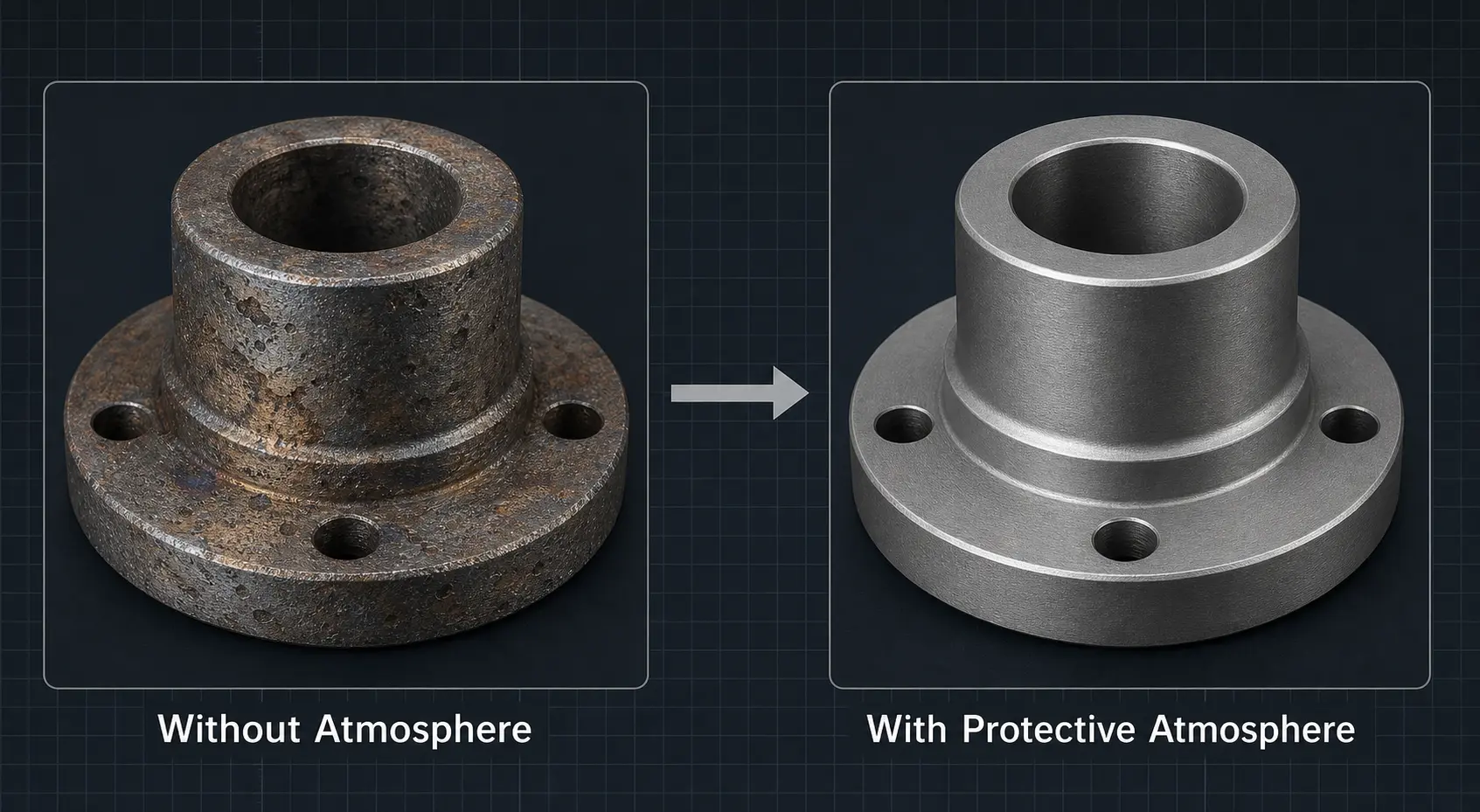
When surface finish is critical, a protective atmosphere can dramatically reduce or eliminate oxidation. But no single atmosphere is best for every application. The right choice depends on the material, temperature, production volume, and what level of surface quality the part actually requires. The table below compares the four most common options.
| Atmosphere | Cost | Effect | Best For | Key Considerations |
|---|---|---|---|---|
| Nitrogen (N2) | Low | Good | General steel and copper heating; enclosed or semi-enclosed setups | Most economical inert option; widely available; works well in most non-critical applications |
| Argon (Ar) | Medium | Better | High-value components; oxidation-sensitive alloys; titanium and nickel-based materials | Heavier than air, provides better blanket coverage; higher purity than bulk nitrogen in many supply chains |
| Forming Gas (N2/H2 blend) |
Medium | Good (reducing) | Applications needing reducing conditions; certain brazing and annealing processes | Hydrogen content introduces safety and ventilation requirements; must be designed carefully |
| Vacuum | High | Best | Critical surface quality; aerospace and medical components; oxidation-intolerant processes | Adds equipment cost, loading complexity, and cycle time; evaluate total business case |
For procurement teams, the decision should be based on the total business case, not just the desire for a cleaner surface. Compare equipment price alongside downstream cleaning cost, scrap risk, maintenance, and throughput. A more capable induction heating system with integrated atmosphere control can often reduce total cost over time—especially when oxidation is already affecting product quality or customer acceptance.
4. Flux, Coatings & Barrier Methods: When They Help
Beyond atmosphere control, several surface-protection methods can reduce oxidation in specific applications. The key is understanding what each method can and cannot do:
Flux (brazing): Essential for induction brazing, flux protects the joint area from oxidation and supports proper wetting by the filler metal. The right flux chemistry matters as much as the right heating cycle.
Anti-scale coatings: In hot forming and forging, specialized coatings can reduce oxidation during heating and transfer. They are a practical supplement—not a replacement—for good temperature control.
Simple shielding/enclosures: In many applications, a gas-purged enclosure or a local shield around the coil can significantly improve surface quality without the cost of a full vacuum system.
The important caveat: these methods work best as part of a complete process design. A coating alone will not solve an overheating problem. A gas shield alone will not compensate for a poorly tuned coil or unstable power output. If surface quality is tied directly to appearance, braze integrity, or downstream machining, the integration of power source, coil, enclosure, cooling, and controls is what separates a robust process from a fragile one.
5. Coil Design & Part Positioning: The Overlooked Variables
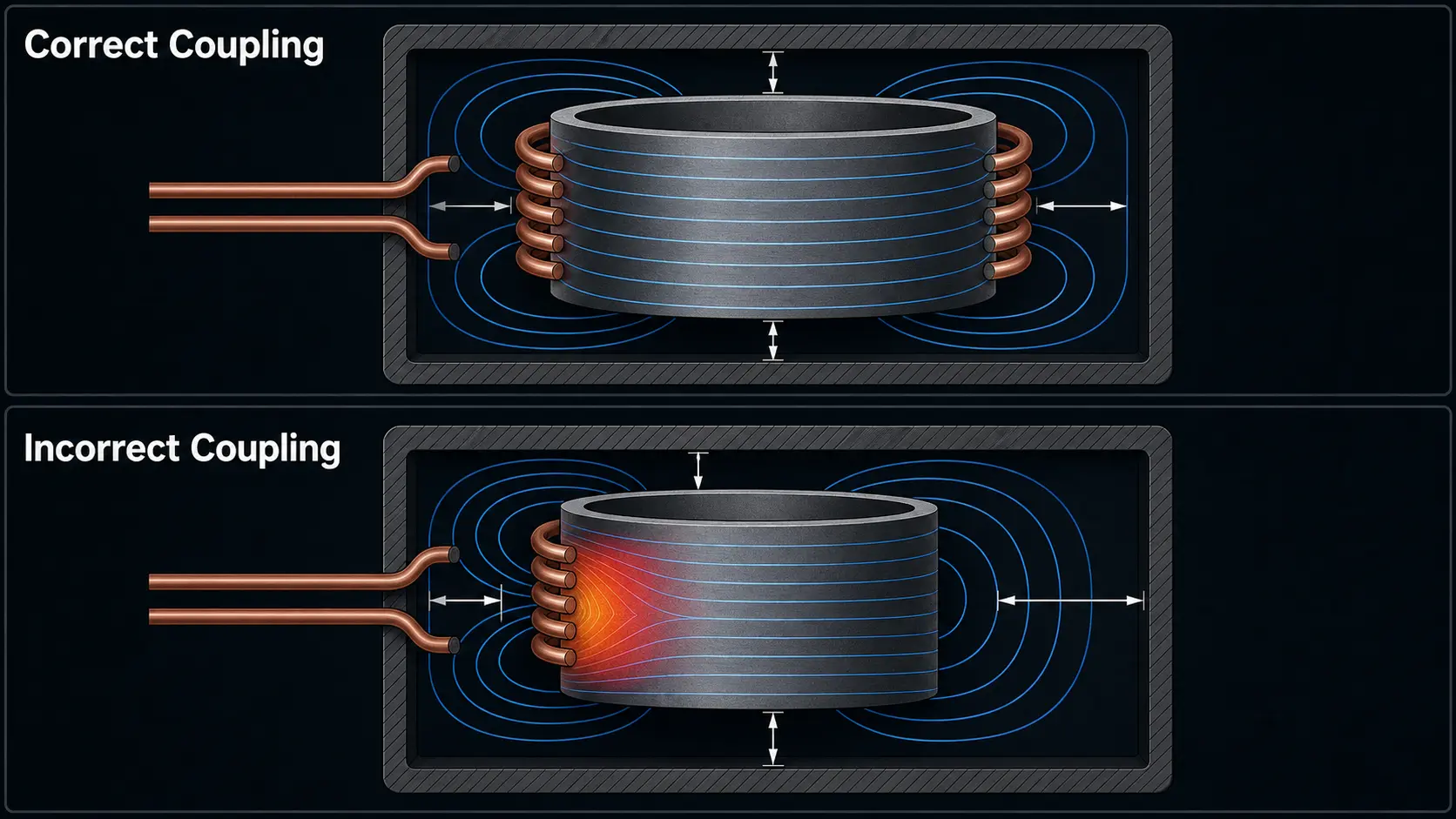
Coil design has a direct and often underestimated impact on oxidation. Localized overheating around edges, shoulders, holes, threads, or changes in section thickness creates repeatable scale patterns that look like a material issue but are actually a process issue. If the coil coupling distance varies, if parts are loaded inconsistently, or if the coil condition degrades over time, the heating pattern becomes uneven—and oxidation follows the hottest areas.
Practical stability factors that directly affect oxidation:
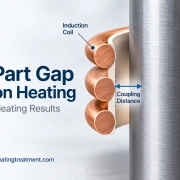
Consistent coupling distance: Even small variations in coil-to-part gap change the magnetic coupling and create temperature gradients.
Repeatable part loading: Manual loading inconsistency is one of the most common root causes of variable oxidation in mid-volume production.
Cooling system health: Degraded water cooling affects coil temperature, which shifts impedance and alters the heating profile over time.
Fixture integrity: Worn or misaligned fixtures change part position relative to the coil, introducing oxidation at predictable locations.
Coil condition monitoring: A coil that is wearing, arcing, or losing surface condition will gradually produce more oxidation—often detected only after scrap rates rise.
If oxidation appeared only after the system had been running for some time, it is rarely a sudden material change. It is more likely a sign that coil wear, cooling degradation, or alignment drift has shifted the process away from its validated window. A good equipment supplier should help monitor and control these variables, not just ship a power supply.
6. Oxidation Control in Induction Hardening
For induction hardening, oxidation control is especially tied to three process variables: austenitizing temperature, heating uniformity, and quench timing. If the surface is held above transformation temperature too long before quenching, oxidation increases and hardness results can also become less consistent.
A scan hardening setup that precisely controls the distance between the coil and quench ring—along with spray coverage, flow rate, and traverse speed—can significantly reduce surface scale. In many hardening projects:
Light discoloration may be acceptable if it does not affect dimensional control or downstream assembly.
Heavy scale interferes with crack inspection, dimensional tolerance, and post-process fit-up—it is never just cosmetic.
Safety-critical or high-value parts justify closed-loop control, better thermal repeatability, and protective atmosphere integration from the start.
The takeaway: evaluate oxidation as part of the full hardening system design, not as an afterthought. If the part has tight surface quality requirements, building those capabilities into the system upfront is almost always cheaper than retrofitting later.
7. Common Mistakes That Make Oxidation Worse
Many oxidation problems are not caused by a single wrong decision—they accumulate from small, correctable process gaps. Here are the mistakes our engineering team sees most often:
1. Compensating with more power or longer cycles. When parts come out oxidized, the instinct is to “go hotter and faster.” Without fixing the underlying cause (coil match, frequency, loading), this usually makes oxidation worse.
2. Assuming nitrogen solves everything. Nitrogen helps, but it cannot fix a process with poor temperature control, dirty incoming parts, or slow transfer after heating.
3. Ignoring surface cleanliness of incoming parts. Oil, cutting fluid residue, or rust on the part surface accelerates oxidation during heating. Clean-in means clean-out.
4. Slow part transfer after heating. If the heated part sits in open air before the next operation (quenching, forming, brazing), every second adds to the oxide layer.
5. Poor coil alignment or worn fixturing. Inconsistent part positioning creates variable heating and variable oxidation—often mistaken for material batch variation.
6. Retrofitting atmosphere control as an afterthought. Adding gas shielding to a line not designed for it rarely works as well as expected. If the application needs low oxidation, design for it from the beginning.
7. Evaluating power supply price in isolation. A lower upfront equipment cost that leads to higher scrap, more rework, and extra cleaning is not a saving. Compare total operating cost, not just purchase price.
8. Buying Criteria: What to Look for in an Oxidation-Resistant System
If your next project requires tight oxidation control, here is a practical checklist to guide equipment evaluation. Every item on this list directly or indirectly affects surface quality:
☐ Frequency match to part geometry. The right frequency ensures heat is generated at the correct depth, minimizing surface overheating and unnecessary exposure time.
☐ Control accuracy and repeatability. Closed-loop power control and temperature monitoring (pyrometer or thermocouple feedback) keep every cycle within the validated window.
☐ Coil customization and support. An off-the-shelf coil rarely produces optimal results. Look for a supplier that designs coils to your specific part geometry and production volume.
☐ Cooling system design. Adequate water cooling for both the power supply and the coil is essential for thermal stability and long-run consistency.
☐ Atmosphere compatibility. Even if you do not need gas shielding today, confirm the system can be integrated with an enclosure or local gas purge if requirements change.
☐ Fixture and loading repeatability. Consistent part positioning is as important as consistent power output. Ask about fixturing options and automation compatibility.
☐ Process validation support. A supplier that offers application testing and process development before delivery can identify oxidation risks early, when they are cheapest to fix.
☐ Total cost of ownership. Compare purchase price, energy efficiency, coil life, maintenance requirements, and the hidden cost of scrap and rework.
The best oxidation prevention strategy is rarely a single technology choice. It is a system-level decision that starts with defining the surface requirement and choosing the equipment around it—not the other way around.
Key Takeaway: Oxidation during induction heating is a process control problem, not a material problem. A well-engineered system—matching power supply, coil, cooling, fixturing, and atmosphere to the specific part and production environment—reduces oxidation, improves consistency, and lowers total operating cost. Define the surface requirement early, design the system around it, and choose equipment partners who understand the complete process, not just the power electronics.
FAQ: Oxidation During Induction Heating
Q: Is nitrogen enough, or do I need argon or vacuum?
A: For most general steel and copper heating applications, nitrogen provides adequate oxidation reduction at the lowest cost—especially in enclosed or semi-enclosed setups. Upgrade to argon when parts are high-value, made from oxidation-sensitive alloys (titanium, nickel-based), or when surface quality is tied to a customer specification. Vacuum is justified when surface integrity is critical to function or safety, such as in aerospace and medical components. The right question is not “which is best” but “what does this part actually require, and what is the cost of getting it wrong?”
Q: Can I retrofit atmosphere control to my existing induction heating system?
A: In many cases, yes—but the results depend heavily on the existing setup. A simple gas-purged enclosure or local coil-area shield can be added to most systems and will provide meaningful improvement for moderate surface quality needs. However, if the system has fundamental issues with coil match, power stability, or part handling, adding gas alone will not deliver the results you expect. The most successful retrofits start with a process audit: identify the dominant oxidation source first, then add atmosphere control as one element of a broader fix rather than a standalone solution.
Q: How much oxidation is acceptable for hardening vs. brazing?
A: The acceptable threshold depends on what happens after heating, not just how the part looks. For hardening, light discoloration is often tolerable provided it does not affect dimensional control, crack inspection (fluorescent penetrant), or post-process assembly fit. Heavy scale that flakes, changes surface roughness, or masks inspection indicators is not acceptable. For brazing, the bar is higher: oxidation at the joint directly compromises filler metal wetting and joint integrity. Even light oxidation that would pass in a hardening context can cause braze failure. Define the acceptance criteria with your quality team before setting the oxidation control budget.
Dealing With Oxidation on Your Induction Heating Line?
Our engineering team can help evaluate your material, cycle time, coil design, and atmosphere requirements—and recommend whether a standard power supply or a complete integrated system will deliver the surface quality you need.