
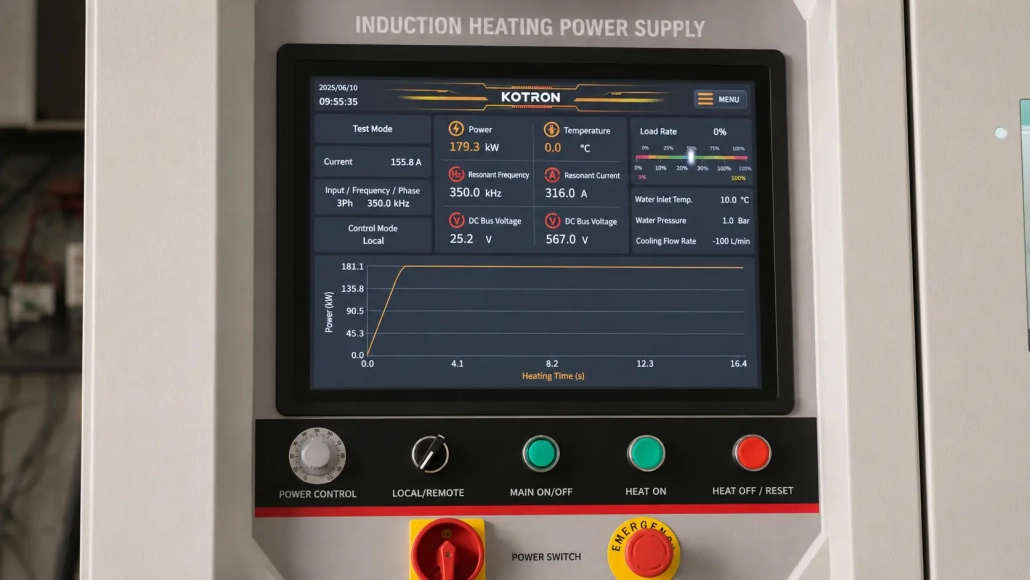
Digital Induction Heating Power Supply: The Complete B2B Buyer’s Guide for 2026
Industrial manufacturers are under continuous pressure to improve heating quality, reduce energy waste, and maintain stable production. A digital induction heating power supply is an important part of modern induction heating equipment because it provides controllable, repeatable, and efficient power for heat treatment, induction hardening, welding preheating, brazing, forging, and other industrial heating applications. For factory owners, production managers, and engineers, choosing the right induction heating system is not only about power rating — it is also about process stability, real-time power monitoring, energy monitoring, equipment reliability, and compatibility with existing production lines. This article explains the practical value of digital induction heating power supplies and what B2B buyers should consider before purchasing.
📋 Table of Contents
What Is a Digital Induction Heating Power Supply?
A digital induction heating power supply is an electronic power conversion unit used to generate high-frequency or medium-frequency current for an induction coil. When alternating current passes through the coil, it creates an electromagnetic field. The workpiece placed inside or near the coil generates heat internally through electromagnetic induction — this is the core principle of how induction heating works.
Compared with traditional heating methods such as flame heating, resistance heating, or furnace heating, induction heating can provide localized heating, fast temperature rise, and better process control. The digital control system helps operators set and monitor key parameters such as power, frequency, heating time, cooling time, and operating status — turning what was once an operator-dependent process into a repeatable, documented operation.
In industrial production, this type of equipment is widely used for metal heat treatment, surface hardening, shaft hardening, gear hardening, pipe preheating, bearing heating, fastener heating, brazing, and preheating before welding. The right configuration depends on the material, part size, heating depth, production volume, and automation requirements — factors we cover in our power selection guide.
Why Digital Control Matters in Induction Heating
Digital control is one of the main reasons many manufacturers are upgrading from older analog induction heating systems. A digital induction heating power supply allows more accurate parameter setting and better repeatability across batches. For industries such as automotive parts, construction machinery, metal processing, and tool manufacturing, process consistency is essential. The table below summarizes the key differences:
| Feature | Analog Systems | Digital Induction Heating Power Supply |
|---|---|---|
| Parameter Setting | Manual knobs, approximate values, operator-dependent | Digital input with precise numeric values, stored as recipes |
| Batch Repeatability | Varies by operator experience and shift | One-touch recipe recall, consistent results across shifts |
| Power Monitoring | Analog meter reading only, no data recording | Real-time digital display + optional data logging |
| Energy Tracking | Not available — energy cost per part is unknown | Per-cycle and per-batch energy monitoring supported |
| Fault Diagnosis | Manual inspection, longer downtime | Automatic fault code display + alarm, faster troubleshooting |
| Automation Integration | Limited or requires add-on hardware | PLC communication, fieldbus support, ready for robotic and automatic lines |
Stable Power Output
Stable power output helps maintain consistent heating results. In induction hardening or heat treatment, unstable power may cause uneven hardness, insufficient heating depth, or overheating. Digital control can help the power supply respond more effectively to load changes, coil conditions, and process requirements — an important factor when calculating power requirements for your specific application.
Real-Time Power Monitoring
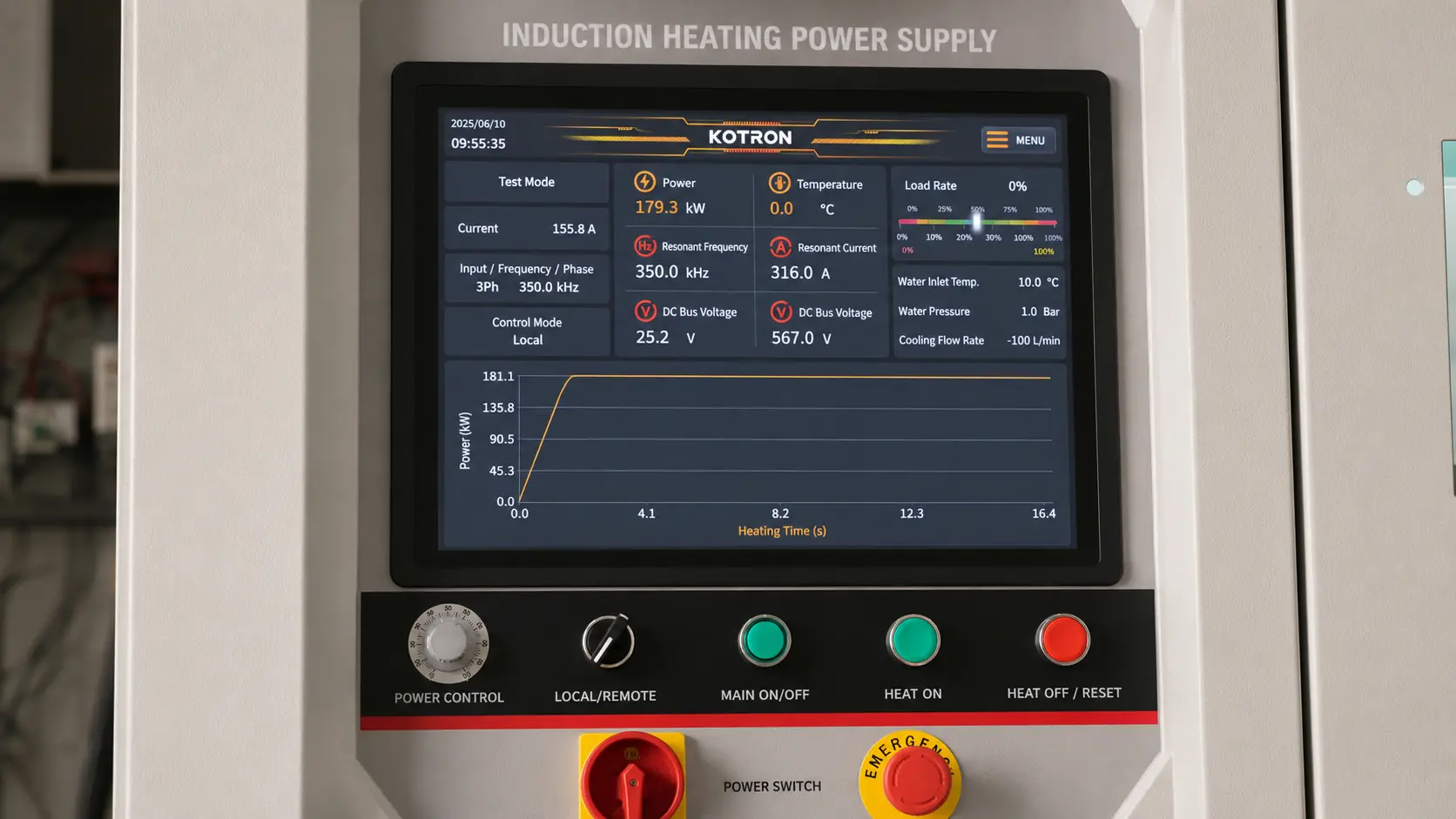
Real-time power monitoring allows operators to observe the actual operating status during heating. Instead of relying only on manual observation, users can track power, current, voltage, frequency, and working time on a digital display. This supports better production control and helps engineers identify abnormal conditions earlier — before they cause scrap parts or unplanned downtime.
Energy Monitoring and Process Optimization
Energy monitoring is increasingly important for factories that want to control operating costs. By recording energy consumption during heating cycles, production teams can compare different process settings, optimize heating time, and reduce unnecessary power usage. This is especially useful in high-volume production where small improvements can accumulate into significant annual savings over thousands of cycles.
Main Industrial Applications
A digital induction heating power supply can be applied to many industrial heating processes. The final system design usually includes the power supply, induction coil, cooling system, transformer if required, control interface, and sometimes automatic feeding or handling equipment. The table below shows common applications and their typical requirements:
| Application | Typical Frequency Range | Power Range Guidance | Key Consideration |
|---|---|---|---|
| Surface Induction Hardening | 100–400 kHz | 10–200 kW | Shallow case depth, fast scanning speed |
| Deep Case Hardening | 10–50 kHz | 50–500 kW | Larger parts, deeper hardened layer required |
| Brazing & Soldering | 50–400 kHz | 5–100 kW | Precise localized heating, short cycle times |
| Welding Preheating | 1–10 kHz | 20–200 kW | Uniform heating over weld zone, controlled ramp rate |
| Forging / Billet Heating | 1–10 kHz | 50–1000+ kW | High throughput, through-heating to core |
| Tempering / Stress Relieving | 1–20 kHz | 20–300 kW | Controlled temperature soak, lower power density |
Note: The frequency and power ranges above are general guidance. Actual requirements depend on workpiece material, dimensions, heating depth, and production rate. Consult with your equipment supplier for a specific recommendation based on your parts and process goals. For a deeper understanding of how frequency affects heating, see our guide on induction heating frequency classification.
Heat Treatment & Induction Hardening
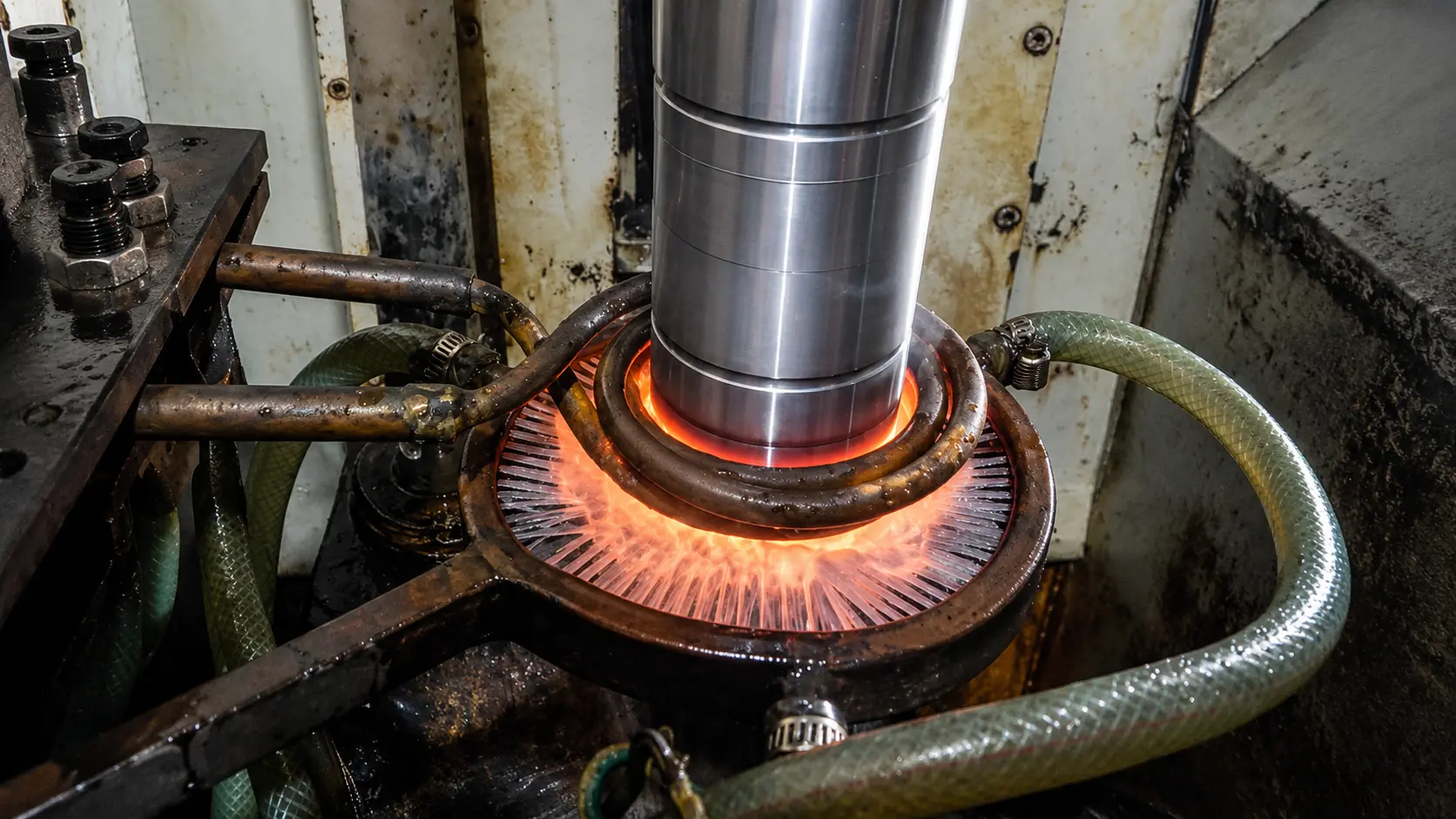
Heat treatment is one of the most common applications. Induction heating can be used for hardening, tempering, annealing, normalizing, and stress relieving depending on the material and process design. Induction hardening is widely used for shafts, gears, sprockets, pins, guide rails, rollers, and other wear-resistant components. The process heats the surface layer quickly and then quenches it to achieve the required hardness. Digital power control is valuable because heating depth, scanning speed, power level, and quenching timing all affect the final result.
Welding Preheating
Welding preheating is used to reduce thermal stress, improve weld quality, and support stable welding conditions for certain materials and part thicknesses. Induction preheating can provide controlled and uniform heating around weld areas without open flame. This is useful in pipeline fabrication, steel structure production, pressure vessel manufacturing, and heavy equipment repair.
Brazing, Forging, and Other Applications
Induction brazing provides fast and localized heating for joining metal parts in tools, copper components, HVAC parts, electrical components, and automotive assemblies. For forging applications, induction heating can rapidly heat billets, bars, and rods before forming — often reducing waiting time compared with conventional furnace processes and supporting more compact production layouts.
Key Features to Evaluate
When evaluating a digital induction heating power supply, buyers should look beyond the equipment appearance and rated output. The following features are important for long-term industrial use:
Power and Frequency Range
The required power and frequency depend on the workpiece material, diameter, heating depth, and production rate. Higher frequency generally creates shallower heating depth, while lower frequency is often used for deeper heating or larger workpieces. Buyers should discuss their part drawings, materials, and process goals with the supplier before selecting a model — referencing the application table above as a starting point.
Digital Control Interface
A clear control interface helps operators set parameters and monitor the process. Depending on the equipment configuration, the interface may support recipe storage, fault display, parameter adjustment, and communication with automation systems. For production lines with multiple product types, recipe management can reduce setup time and operator errors — a key advantage of induction heating over manual heating methods.
Real-Time Data Display
Real-time display of power, voltage, current, frequency, and operating status helps engineers understand the heating process. For factories implementing process traceability, data output and monitoring functions can be important. Buyers should confirm whether the power supply supports data communication or integration with plant management systems during the project discussion stage.
Protection Functions
Industrial induction heating equipment should include practical protection functions such as overcurrent protection, overvoltage protection, water pressure or water flow monitoring, overheating protection, phase loss protection, and fault alarms. These functions help protect both the equipment and production safety — reducing the risk of unexpected downtime and costly repairs.
Cooling Requirements
Induction heating systems require effective cooling for the power supply, coil, and related components. Buyers should confirm cooling water quality, flow rate, pressure, and temperature requirements with the supplier. In some factories, a closed-loop chiller may be preferred to reduce scaling and improve equipment reliability — we cover this topic in detail in our cooling system guide.
5 Key Benefits for Industrial Buyers
For B2B buyers, the value of a digital induction heating power supply is usually measured by production performance, consistency, maintainability, and total cost of ownership. Here are the five benefits that matter most in daily industrial operation:
1. Process consistency. Digital settings help operators repeat the same heating parameters across batches. This is important for quality control in automotive parts, construction machinery components, tools, and precision metal parts — where one inconsistent batch can cause customer returns.
2. Localized heating. Induction heating can focus energy on the required heating area. This may reduce unnecessary heating of surrounding sections and help protect part geometry when properly designed — saving energy and reducing post-heating correction work.
3. Automation compatibility. Digital power supplies are easier to integrate into automatic loading, scanning hardening machines, robotic systems, or production lines. Communication options and control signals should be discussed during the project stage to ensure future expandability.
4. Cleaner working environment. Induction heating does not require open flame in many applications and can reduce smoke or combustion-related issues compared with some traditional methods. However, proper ventilation and safety design are still required according to the specific process.
5. Energy awareness. With energy monitoring, factories can better understand consumption per cycle or per batch. This supports continuous improvement initiatives and accurate cost analysis — turning energy from a fixed overhead into a manageable variable.
Buyer’s Guide: 6-Step Selection Checklist
Selecting an induction heating system requires technical communication between the buyer and supplier. A suitable recommendation depends on real production conditions, not only a general power rating. Use this six-step checklist to prepare before choosing induction heating equipment:
Step 1 — Define the application clearly. Start with the process: hardening, tempering, annealing, brazing, welding preheating, forging, or shrink fitting. Each application requires different heating speed, temperature control, coil design, and equipment configuration. Be specific about what you need the machine to do.
Step 2 — Provide workpiece information. Share material grade, dimensions, weight, heating area, target temperature, required heating depth, and production rate. Drawings, photos, and process descriptions help the supplier design a more suitable coil and power supply configuration — the more detail you provide, the more accurate the recommendation.
Step 3 — Confirm production volume. A system for occasional maintenance heating may be very different from a continuous production line. High-volume manufacturers may need automatic feeding, scanning mechanisms, quenching systems, data monitoring, and spare coil planning — all of which should be factored into the initial specification.
Step 4 — Evaluate control and monitoring needs. If your factory requires real-time power monitoring, energy monitoring, recipe storage, or communication with PLC systems, confirm these requirements before ordering. It is easier and more cost-effective to include control functions during the initial design than to retrofit them later.
Step 5 — Consider installation conditions. Check available power supply, floor space, cooling water conditions, ambient temperature, and operator access. Proper installation affects equipment stability and service life — overlooking these practical factors is a common cause of post-installation problems.
Step 6 — Review maintenance and support. Ask about spare parts availability, coil replacement procedures, fault diagnosis capabilities, operator training, and technical documentation. Industrial heating equipment should be selected with long-term maintenance in mind — a lower upfront price means little if support is unavailable when you need it.
3 Common Mistakes to Avoid
Mistake #1 — Choosing by maximum power only. A higher power rating does not automatically mean better results. Frequency, coil design, impedance matching, cooling, and process control are equally critical. A well-matched 100 kW system can outperform a poorly matched 200 kW system on the same part.
Mistake #2 — Ignoring the induction coil. The coil is not a simple accessory; it directly affects heating efficiency, uniformity, and repeatability. For complex parts, customized coil design may be necessary. Treat the coil as a precision tool, not a commodity consumable.
Mistake #3 — Underestimating cooling requirements. Poor water quality or insufficient cooling can cause downtime and shorten component life. It is equally important to train operators so they understand parameter setting, safety procedures, and daily inspection routines — equipment is only as reliable as the people running it.
🔑 Key Takeaway
A digital induction heating power supply is not just a power source — it is a process control platform. The right system delivers consistent heating results batch after batch, provides visibility into energy consumption, integrates with automation, and protects itself through built-in diagnostics. Taking time to specify the right configuration upfront saves far more than it costs.
Frequently Asked Questions
1. What is the main advantage of a digital induction heating power supply over analog?
The main advantage is improved control, monitoring, and repeatability. Digital systems allow precise parameter setting with numeric values, store heating recipes for different parts, display real-time operating data, provide automatic fault diagnosis, and integrate more easily with automated production equipment. Analog systems rely on manual knob adjustments and operator experience, which introduces variability between shifts and operators.
2. How do I determine the right power rating for my application?
The required power depends on material type, part size, heating area, target temperature, heating time, and production volume. It is best to provide detailed workpiece information to the supplier for technical evaluation rather than guessing from a catalog. Our power requirements guide covers the key calculation factors in detail.
3. Can a digital induction heating power supply be used for welding preheating?
Yes. Induction heating is widely used for welding preheating because it can provide controlled, uniform, and localized heating without direct flame. It is suitable for many pipe, plate, and structural welding applications where consistent preheat temperature is critical for weld quality.
4. What information should I prepare before requesting a quotation?
You should prepare: the specific application (hardening, brazing, forging, etc.), workpiece material and dimensions, heating area and target temperature, required production rate (parts per hour or shift), available power supply at your facility, whether automation or data monitoring is needed, and any special requirements such as cooling water conditions or space constraints. Photos and part drawings are highly valuable for the supplier’s technical evaluation.
Need a Digital Induction Heating Solution for Your Production Line?
Tell us about your application, workpiece specifications, and production goals — our engineering team will recommend a system configured for your actual process, not just a catalog number.


