How to Select an Induction Power Supply for Brazing: 7 Critical Factors for Engineers & Buyers
How to select an induction power supply for brazing is a question every production engineer faces when moving from torch-based brazing to induction—or when scaling up an existing induction brazing line. The power supply is the heart of the system. Pick the wrong one, and you get inconsistent joint quality, slow cycle times, or a machine that trips every afternoon. This guide walks through the 7 critical factors, with practical data for copper tube and carbide tool brazing, so you can specify the right power supply the first time.
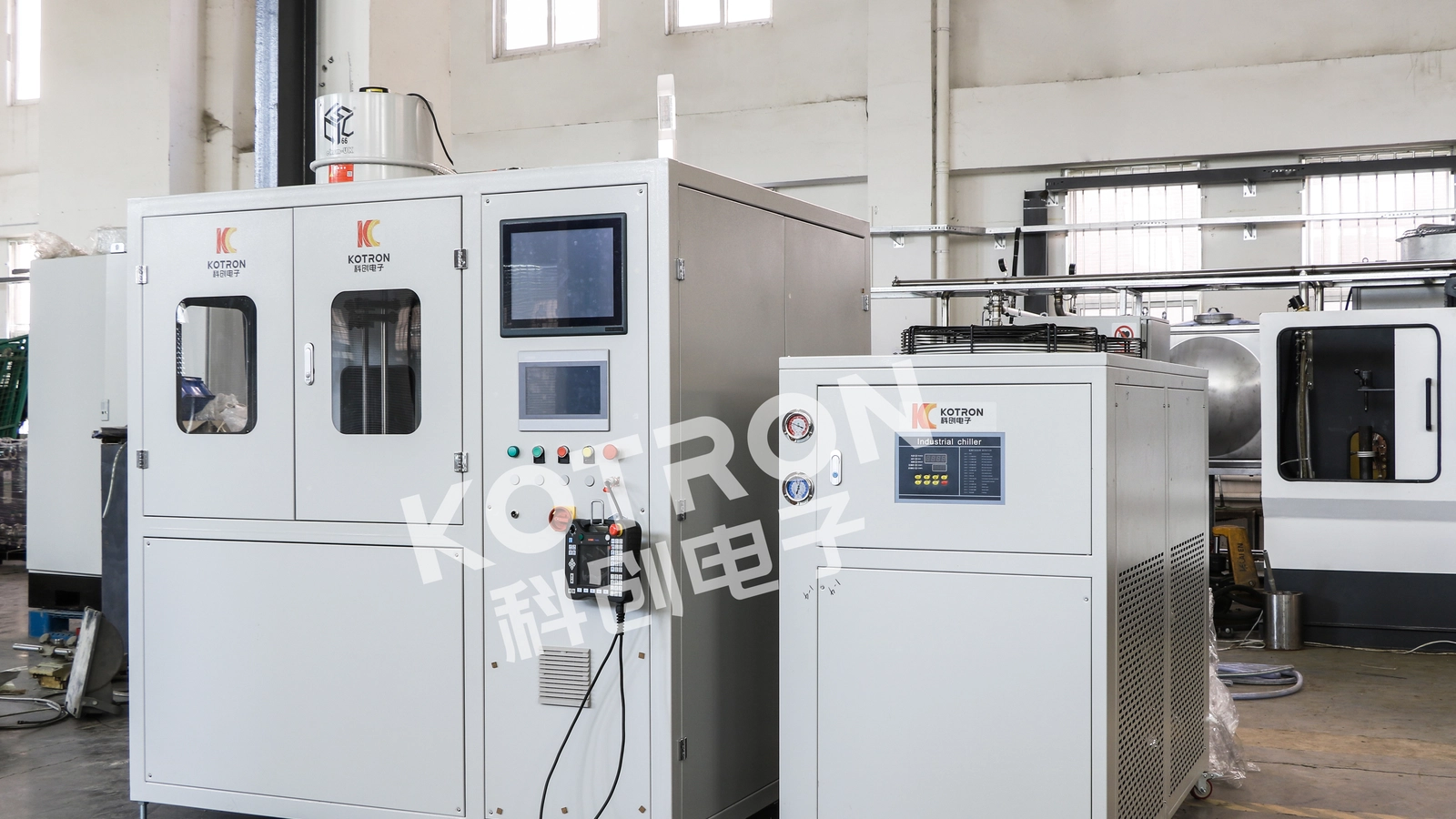
1. Why the Power Supply Defines Brazing Quality
In induction brazing, heat is generated by alternating current flowing through a work coil, which induces eddy currents in the workpiece. The power supply determines the frequency, power level, and control precision of that current. These three parameters directly control heating rate, temperature uniformity, and repeatability.
Unlike torch brazing—where the operator visually judges temperature by color—induction brazing with a well-chosen power supply delivers the same thermal profile on every cycle. For manufacturers running 200+ joints per shift, that repeatability is the difference between a 0.2% reject rate and a 4% one.
If you are new to induction heating fundamentals, our How Does Induction Heating Work? guide covers the underlying physics in plain language.
2. Power Rating: Match the Workpiece Mass
The single most important number on a power supply datasheet is its rated output in kilowatts. For brazing, the required power depends on:
- Workpiece mass and material—heavier parts and high-conductivity metals (copper, aluminum) need more power to reach brazing temperature in a reasonable cycle time.
- Target cycle time—the same joint can be brazed with 5 kW or 15 kW; the difference is whether it takes 90 seconds or 25 seconds.
- Coil coupling efficiency—the fraction of the magnetic field that actually intercepts the workpiece. A well-designed coil with tight clearance (1–3 mm gap) couples 70–85% of output power into the part. A loose-fitting generic coil may couple only 40–50%, nearly doubling the required supply rating for the same heating result.
- Joint design—a tight interference fit heats differently than a loose slip fit with pre-placed filler metal.
| Application | Typical Part Mass | Recommended Power | Typical Cycle Time |
|---|---|---|---|
| Copper tube brazing (≤¾” OD) | 50–200 g | 5–10 kW | 15–30 s |
| Copper tube brazing (1–2″ OD) | 200–800 g | 10–20 kW | 20–45 s |
| Carbide tool brazing (small inserts) | 30–150 g | 5–10 kW | 10–25 s |
| Carbide tool brazing (large turning tools) | 150–600 g | 10–20 kW | 20–40 s |
| Automotive AC fitting brazing | 80–300 g | 10–15 kW | 12–25 s |
Buying tip: Size for your heaviest realistic part, not your average one. A power supply running at 90% capacity for 8 hours will have a shorter service life than one running at 60–70%. For a deeper dive into power calculations across applications, see our complete power selection guide.
3. Frequency: The Penetration Depth Lever
Frequency controls how deeply the induced current penetrates the workpiece—a phenomenon called skin effect. For brazing, frequency selection follows a simple rule:
- Higher frequency (100–400 kHz): Shallow penetration, fast surface heating. Best for small parts, thin-walled tubes, and carbide insert brazing where you want heat concentrated at the joint surface.
- Medium frequency (10–100 kHz): Moderate penetration. The workhorse range for general brazing of components up to 1″ cross-section.
- Lower frequency (1–10 kHz): Deep penetration. Used for large-section brazing or when you need heat to reach an internal joint through a thick outer wall.
| Frequency Range | Penetration Depth (Steel) | Best For |
|---|---|---|
| 1–10 kHz | 1.5–5.0 mm | Thick-section brazing, large fittings |
| 10–100 kHz | 0.5–1.5 mm | General brazing, copper tubes, tool shanks |
| 100–400 kHz | 0.2–0.5 mm | Small carbide inserts, thin-wall tubing, jewelry |
Important caveat: The penetration depths in the table above are calculated at room temperature. As the workpiece heats toward brazing temperature, electrical resistivity increases (by 4–5× for carbon steel from 20°C to 800°C), which increases the skin depth proportionally. The table values are reliable for the initial heating phase and preheat stage; at full brazing temperature, actual penetration is typically 2–2.5× deeper. For magnetic steels, the shift is even larger once the Curie point (~770°C) is crossed and the material becomes non-magnetic, causing a sudden jump in effective penetration depth.
For most brazing applications, a 15–50 kHz supply offers the best balance of penetration and heating speed. Read our frequency classification guide for a complete breakdown of how frequency affects every heating application.
4. Duty Cycle: Continuous vs. Intermittent Operation
Duty cycle describes the percentage of time a power supply can run at full rated power before it must rest to cool down. A 50% duty cycle at 15 kW means the supply can deliver 15 kW for, say, 5 minutes, then must idle for 5 minutes.
For production brazing, this matters enormously:
- Manual single-station brazing: 30–50% duty cycle is usually sufficient. The operator needs time to load and unload between cycles.
- Semi-automatic rotary table brazing: 70–80% duty cycle. Multiple stations mean the power supply is active on most table positions.
- Fully automated in-line brazing: 100% duty cycle (continuous rating). The supply must run nonstop for entire shifts.
If your process runs a 25-second heat cycle every 40 seconds (including load/unload), that is a 62.5% duty cycle. Buy a supply with at least 80% rating at your target power—not 65%—for three reasons: (1) ambient temperature derating: most supplies are rated at 25°C ambient; on a 38–42°C factory floor in summer, the effective duty cycle can drop by 15–20 percentage points, (2) production surges that temporarily increase cycle frequency, and (3) aging of cooling components that reduces heat removal efficiency over time. The cost difference between a 70% and 85% duty cycle unit is small compared to the cost of a production halt on a 35°C afternoon.
5. Control System: The Repeatability Factor
Modern induction brazing power supplies fall into three control tiers:
Tier 1—Basic manual control: A potentiometer for power adjustment and a mechanical timer. Inexpensive, but every parameter change requires a screwdriver or knob turn. Suitable for job shops brazing 5–10 different part numbers per day.
Tier 2—Digital programmable control: Stores 20–100 recipe profiles, each with preset power, time, and sometimes temperature ramp. Operators select a part number and press start. This is the minimum for any shop running more than 20 different joints.
Tier 3—Closed-loop temperature control: Uses an infrared pyrometer or thermocouple feedback to regulate power in real time, maintaining the joint within ±5°C of the target brazing temperature. Essential for aerospace, medical device, and any application requiring process traceability.
For most industrial brazing operations, Tier 2 offers the best cost-to-capability ratio. The payback over Tier 1—through reduced setup time and fewer scrap joints—typically arrives within 3–6 months.
6. Cooling System: Don’t Overlook the Water
Every induction power supply generates waste heat that must be removed. The cooling system is not an accessory—it directly affects uptime and component life. The two options:
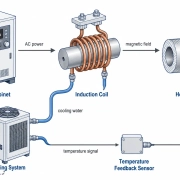
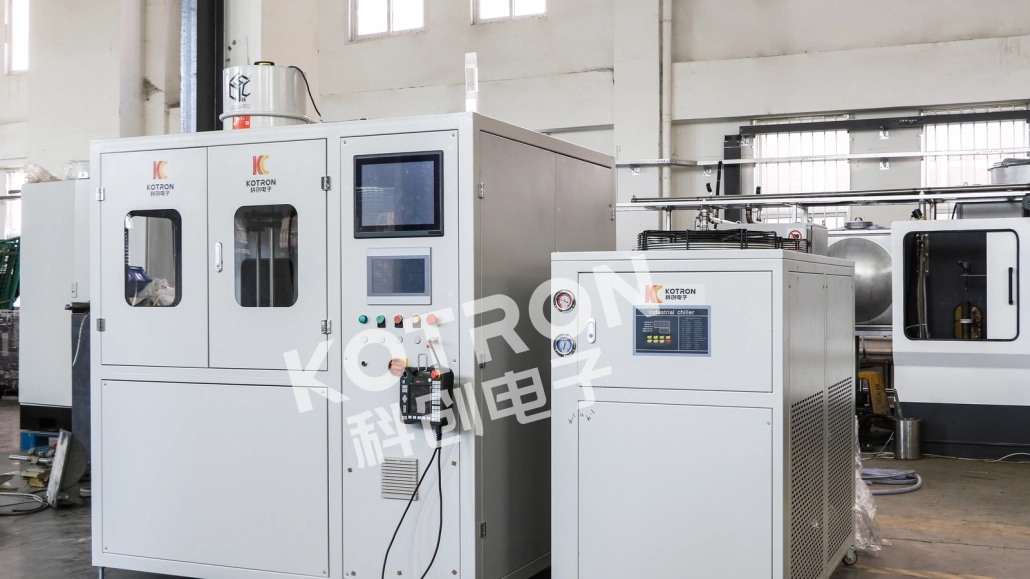
- Water-cooled: The industry standard for supplies above 10 kW. Requires a closed-loop chiller or facility water. More infrastructure but superior heat removal. See our complete water cooling guide for system sizing.
- Air-cooled: Available up to ~15 kW. Self-contained, no plumbing required. Good for portable or lab setups. Our air-cooled induction heating article covers the trade-offs in detail.
If your facility already has a process water loop, water-cooled is the straightforward choice. If you are setting up a new cell and want minimal installation, an air-cooled supply under 15 kW keeps things simple.
7. Coil Compatibility and Output Matching
The power supply and the work coil form a resonant circuit. The supply must be able to match to the coil’s inductance across the range of parts you will braze. Key considerations:
- Transformer ratio: Supplies with a multi-tap output transformer can match a wider range of coil inductances. This is important if you braze parts ranging from small fittings to large assemblies.
- Remote heat station: Some supplies support a remote output transformer connected by flexible cables, letting you place the coil up to 3–5 meters from the power cabinet. Critical for integrating into an assembly line.
- Quick-change coil connectors: If you change coils between part numbers, look for supplies with tool-less quick-disconnect output terminals. Each minute saved on changeover adds up over a year of production.
Two Real-World Brazing Scenarios
Scenario A: Copper Tube Brazing for HVAC
A manufacturer brazes 3/4″ copper tube assemblies for heat pump reversing valves. Each joint uses a pre-formed BCuP-5 silver-phosphorus ring. The target is 720°C, with a 20-second cycle and one joint every 35 seconds including load/unload.
Recommended induction power supply specs: 10–12 kW, 20–30 kHz, water-cooled, digital programmable control storing 8 recipe profiles (one per tube diameter). Duty cycle requirement: 57%. A 10 kW supply rated for 70% duty cycle matches perfectly.
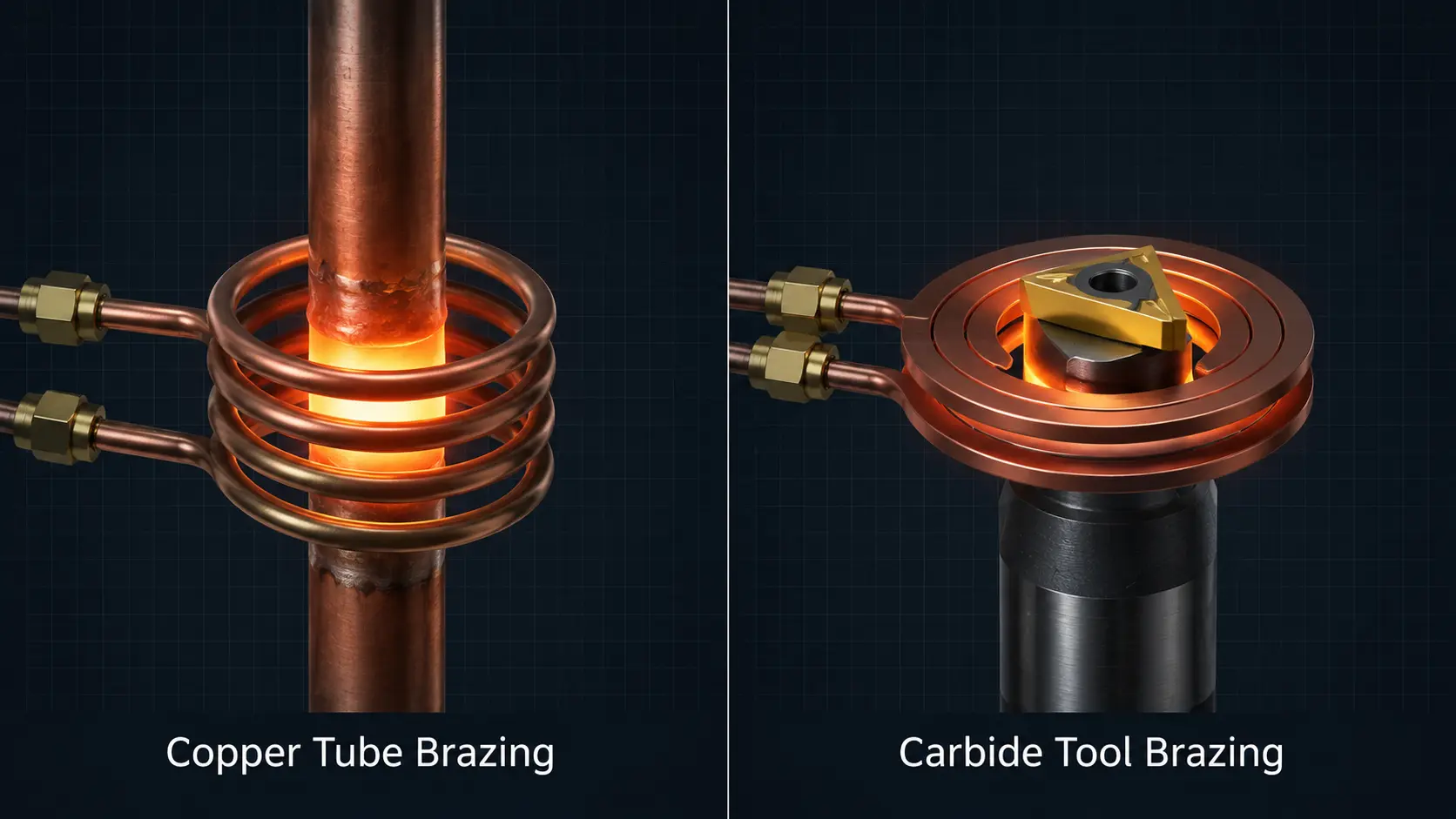
Scenario B: Carbide Tool Brazing
A cutting tool manufacturer brazes tungsten carbide inserts onto alloy steel shanks using BAg-24 silver filler. Brazing temperature is 680°C. The joint area is small but the steel shank acts as a heat sink, pulling heat away from the joint.
Recommended induction power supply specs: 7–10 kW, 150–250 kHz, water-cooled, closed-loop IR temperature control. The higher frequency keeps heat concentrated at the carbide-steel interface rather than soaking the entire shank. Temperature feedback prevents overheating the carbide, which can cause micro-cracking.
Key Takeaway
Selecting an induction brazing power supply comes down to four decisions, in order: (1) power level based on your heaviest part, (2) frequency based on joint geometry and material, (3) duty cycle based on your production cadence, and (4) control tier based on your quality requirements. Get these four right, and the rest—cooling, coil compatibility, physical footprint—falls into place naturally.
Frequently Asked Questions
Can I use the same induction power supply for brazing and hardening?
Yes, if the power and frequency ranges overlap both applications. A 10–30 kHz, 15–25 kW supply can handle general brazing and medium-depth case hardening. However, dedicated brazing supplies often include features such as temperature ramp control and timed filler flow windows that general-purpose hardening supplies lack. If brazing is 80%+ of your work, buy a brazing-optimized supply.
What is the difference between a brazing power supply and a general induction heating power supply?
The core technology is the same, but brazing-dedicated supplies typically include: (1) finer power resolution at the low end for precise temperature soaking, (2) timed output stages for preheat-soak-braze sequences, and (3) temperature input channels for pyrometer feedback. A general-purpose supply can braze, but a dedicated induction brazing machine makes the process more repeatable.
How do I calculate the payback period for switching from torch to induction brazing?
The three variables are: (1) filler metal savings—induction uses precisely the right amount, typically saving 15–25% versus torch, (2) reduced scrap from over/under-heated joints, and (3) labor—induction brazing is faster per joint. Most manufacturers recover the equipment cost within 12–18 months on filler metal and scrap reduction alone, before accounting for throughput gains.
Does induction brazing work with aluminum?
Yes, but it is challenging for two reasons. First, aluminum’s extremely high thermal conductivity (~237 W/m·K, roughly 4× that of carbon steel) rapidly pulls heat away from the joint, requiring 2–3× the power of an equivalent steel or copper part to maintain brazing temperature. Second, aluminum is non-magnetic, so it generates no hysteresis heating—all heat comes from eddy current resistance alone, which is less efficient than the dual-mechanism heating available with ferromagnetic materials. Aluminum also has a narrow brazing temperature window (typically 580–620°C), so closed-loop temperature control is strongly recommended. A 20–50 kHz frequency range works well for most aluminum brazing applications.
What maintenance does an induction brazing power supply require?
Routine maintenance is minimal: check coolant level and quality weekly, clean or replace air filters monthly (for air-cooled units), and inspect electrical connections for tightness quarterly. The IGBT or MOSFET power modules are sealed and maintenance-free but have a typical service life of 7–10 years under normal operation. Most unplanned downtime comes from coolant issues, not electrical failure—so maintain the cooling system first.
Induction Brazing Equipment for Production Environments
At inductionheatingtreatment.com, we supply induction heating systems and induction brazing power supplies ranging from 5 kW to 160 kW, with frequency options from 1 kHz to 400 kHz. Our brazing-dedicated supplies include digital programmable control with recipe storage, closed-loop temperature feedback capability, and remote heat station configurations for production line integration.
Whether you are brazing copper tubes, carbide cutting tools, or complex automotive assemblies, we can match a power supply and coil set to your specific joint geometry and production volume. Browse our induction heating power selection resources or reach out directly to discuss your application.
Need Help Specifying Your Brazing Power Supply?
Tell us your workpiece material, joint geometry, and target cycle time—our engineers will recommend a power supply and coil configuration matched to your production needs.