
How Does Induction Heating Work? A Simple Guide to the Principle & Applications
If you’ve ever watched a pan heat up on an induction cooktop without a flame touching it, you’ve seen the same physics that hardens gears in a factory. Induction heating uses magnetism to generate heat directly inside a metal part — no flame, no heating element, no contact. It’s fast, precise, and the dominant heating method in modern heat treating. This article explains how it works, why factories choose it, and where it’s used — in plain language, no physics degree required.
Table of Contents
1. What Is Induction Heating?
Induction heating is a way to heat electrically conductive materials — mostly metals — using electromagnetic fields instead of a flame, a heating element, or a furnace. The heat is generated inside the part itself, not transferred from outside.
The easiest analogy: an induction cooktop in your kitchen. Place a steel pan on the glass surface, turn it on, and the pan gets hot while the cooktop stays cool. There is no flame under the pan. What is heating it is an invisible magnetic field generated by a coil underneath the glass. The pan essentially becomes its own heater.
Industrial induction heating works on exactly the same principle — just scaled up in power, frequency, and precision. The pan is replaced by a gear, a bearing ring, a shaft, or a cam lobe. The coil under the glass is replaced by a purpose-built copper inductor designed for the specific part geometry. But the core physics is identical.
2. How Does Induction Heating Work?
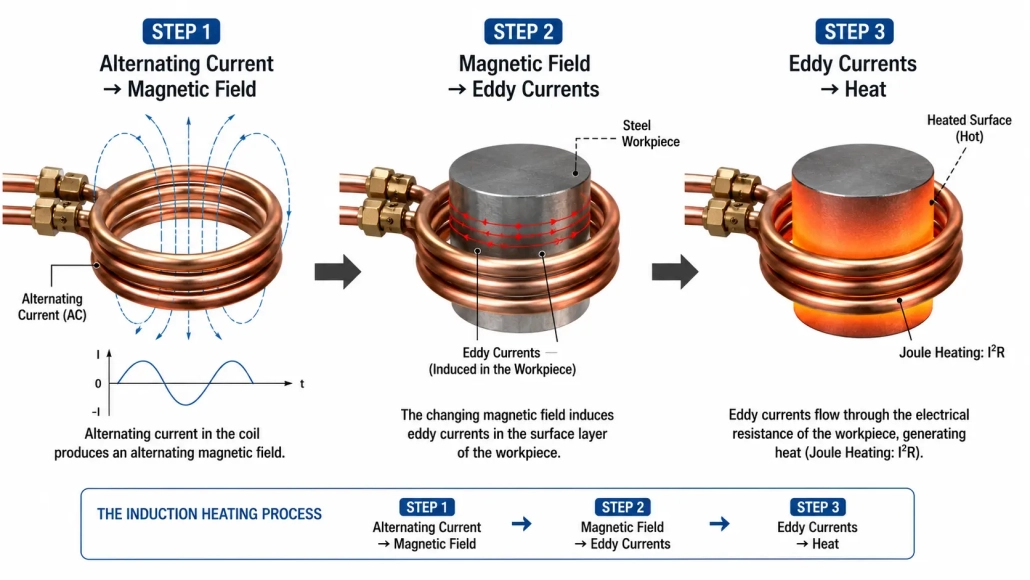
The entire process happens in three steps. Each step is a physical phenomenon that flows naturally into the next.
Step 1: Alternating Current Creates a Magnetic Field
An alternating current (AC) flows through a copper coil — the inductor — at a specific frequency, typically anywhere from 1,000 to 400,000 cycles per second (1 kHz to 400 kHz). Any wire carrying current generates a magnetic field around it. Because the current is alternating — changing direction rapidly — the magnetic field alternates too, expanding and collapsing at the same frequency.
Step 2: The Magnetic Field Induces Eddy Currents
When a conductive metal part is placed inside this alternating magnetic field, the field penetrates the surface of the metal. According to Faraday’s law of induction, a changing magnetic field induces an electric current in any nearby conductor. So circular electric currents — called eddy currents — begin flowing within the surface layer of the workpiece. The currents run in closed loops, following the geometry of the magnetic field and the part itself.
Step 3: Electrical Resistance Turns Current into Heat
The metal workpiece has electrical resistance — it is not a perfect conductor. As eddy currents flow through this resistive material, electrical energy is converted into thermal energy, following the same Joule heating principle (I²R loss) that makes any wire carrying current get warm. The result: the part heats from within, and it heats fast. The depth to which the eddy currents penetrate — and therefore where the heat is generated — is determined by the frequency: higher frequency produces shallower heating, lower frequency goes deeper. This is the fundamental relationship behind induction heating frequency classification.
For magnetic materials like carbon steel, there’s an additional heating mechanism: magnetic hysteresis. As the alternating magnetic field repeatedly magnetizes and demagnetizes the material at the atomic level, friction between magnetic domains generates extra heat. This effect disappears once the material reaches its Curie temperature — around 770°C (1,418°F) for steel — above which the material becomes non-magnetic and only eddy current heating remains.
3. Why Use Induction Heating?
Factories choose induction heating over flame heating, gas furnaces, or resistance heating for four practical reasons.
Speed. Induction heating can bring a steel surface to 900°C in seconds, not minutes. The heat is generated directly in the part — there’s no waiting for a furnace to warm up or for heat to conduct through from an external source. For production lines running thousands of parts per day, this cycle-time advantage translates directly to throughput.
Precision. By controlling frequency, power, and coil geometry, you can heat a specific zone of a part to a precise depth and temperature profile — while leaving adjacent areas cold. This is why induction hardening can put a hard wear-resistant case on a gear tooth surface while keeping the gear core tough and ductile. Flame hardening cannot match this level of spatial control.
Cleanliness. No combustion gases, no open flame, no soot, no exhaust. Induction heating equipment runs on electricity and emits nothing at the point of use. The work environment stays cooler and cleaner than with gas-fired alternatives, and there are no emissions permits to manage.
Efficiency. Because heat is generated directly in the workpiece rather than transferred from a hot environment, induction heating wastes far less energy. A well-designed induction system can achieve 80–90% energy transfer efficiency from the power supply to the part surface — compared to 20–30% for a typical gas furnace where most of the energy goes up the flue.
4. Where Is Induction Heating Used?
Induction heating shows up in more places than most people realize. Here are the major industrial applications — each of which uses the same basic physics but adapts the equipment and process to a specific purpose.
Surface Hardening (Case Hardening)
The most common industrial use. A part’s surface is rapidly heated to austenitizing temperature, then immediately quenched (sprayed with water or oil-based coolant). The result is a hard, wear-resistant surface layer over a tough, ductile core. Applications include shaft induction hardening, gear hardening, bearing ring hardening, cam lobe hardening, and internal bore hardening for parts like CV joint outer races.
Bearing Heater Installation and Removal
Before mounting a bearing onto a shaft, the bearing is heated to expand its inner ring just enough to slide on freely — typically 80–120°C. Induction heating does this in under a minute with no open flame and no oil bath. The same principle works in reverse for disassembly: heat the outer ring to free a seized bearing.
Bolt Heating for Shrink Fit and Removal
Large bolts and studs in turbines, generators, and heavy machinery are tightened by heating them to expand, then allowing them to contract as they cool — creating a precise clamping force. Induction heating applies localized heat to the bolt without warming surrounding components, enabling controlled thermal expansion and, when needed, easier disassembly of rusted or seized fasteners.
Other Applications
Induction heating is also used for brazing and soldering, shrink fitting, annealing, tempering, and even melting metals in foundry applications. The versatility comes from the same fundamental advantage: you can deliver precise, controllable heat exactly where you want it, without heating everything else.
5. What Affects the Result?
Three main factors determine how well induction heating works for a given application — and understanding them is the difference between a successful process and a scrapped part.
Frequency
This is the single most important decision. Higher frequency concentrates heating at the very surface — ideal for shallow case depths on small parts. Lower frequency penetrates deeper — necessary for large parts or thicker hardened layers. Choosing the wrong frequency leads to either insufficient case depth or overheating the core. Induction heating frequency classification provides a complete reference for matching frequency to part size and application.
Material Properties
Not all metals respond the same way. Magnetic materials like carbon steel heat more efficiently because they benefit from both eddy currents and hysteresis heating below the Curie point. Non-magnetic materials — aluminum, copper, brass, austenitic stainless steel — rely solely on eddy currents, which means they require higher power and usually higher frequency to achieve comparable heating rates. Electrical resistivity and thermal conductivity also play a role: copper, with its extremely low resistivity, is inherently difficult to induction heat, while steel’s higher resistivity makes it an ideal candidate.
Coil and Power Supply Design
The inductor (coil) geometry determines where the magnetic field goes. A well-designed coil matches the part contour closely, minimizing the magnetic gap and maximizing energy transfer. The induction heating power supply must deliver the right combination of power, frequency, and duty cycle for the application. Coil design and power selection are deeply interdependent — changing one usually forces a reassessment of the other.
🔑 Key Takeaway
Induction heating works by passing alternating current through a copper coil to generate a magnetic field. That field induces eddy currents in a conductive metal workpiece, and electrical resistance converts those currents into heat — directly inside the part. No flame, no contact, no waiting.
Its four core advantages — speed, precision, cleanliness, and efficiency — make it the method of choice for surface hardening, bearing installation, bolt heating, and a growing range of industrial heating applications. And it all starts with understanding the three-step process: current → magnetic field → eddy currents → heat.
Questions About Induction Heating for Your Application?
Whether you’re evaluating induction for heat treating, bearing installation, or bolt heating, our engineering team can help with application-specific guidance on frequency, power, and inductor design.


