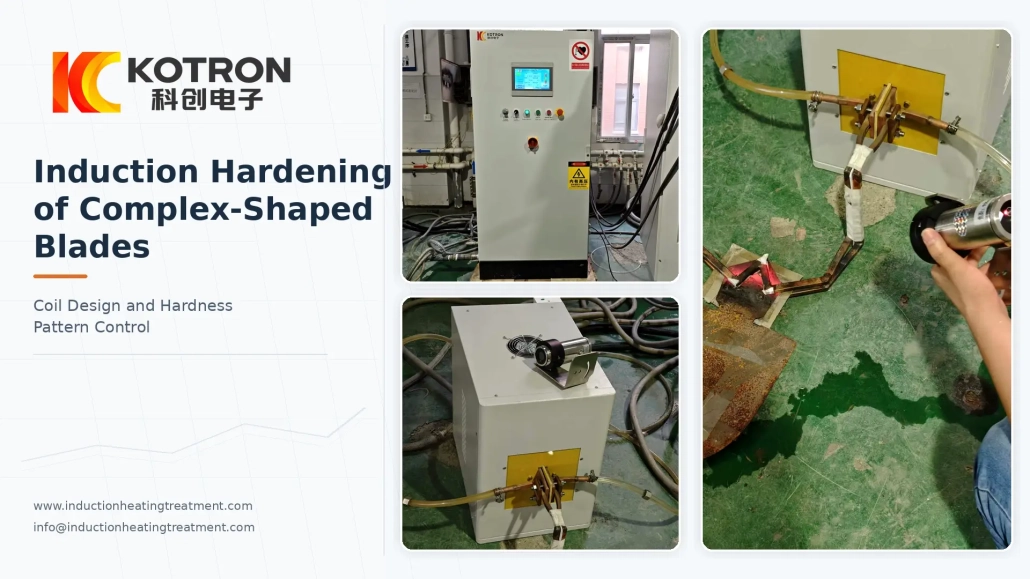
Induction Hardening of Complex-Shaped Blades: Coil Design and Hardness Pattern Control
How Complex Blade Geometry Affects Heating, Coil Design, Quenching and the Final Hardened Zone
Induction hardening becomes more difficult when a blade has a complex profile, changing section thickness, sharp transitions or a hardened zone that does not follow a simple circular or straight path.
For these parts, the challenge is not simply to reach hardening temperature. The heating pattern has to match the required hardened area, and the blade material must also have suitable hardenability for the required result.
Coil geometry, coupling distance, workpiece positioning and quenching therefore need to be developed around the actual blade rather than treated as independent settings.
2. Coil Design, Coupling Distance and Workpiece Positioning
3. Process Development and Temperature Checking
4. From Heating Pattern to Final Hardness Pattern
5. How the Hardening Result Is Verified
6. From Sample Testing to Production Equipment
7. What Information Is Needed for Process Evaluation?
1. Why Complex Blade Geometry Changes Induction Heating
A relatively uniform, axisymmetric part with a controlled concentric gap is easier to heat predictably than a blade whose profile changes along the edge.
Complex blades may include sharp corners, narrow sections, thickness transitions, holes, slots or curved cutting areas. These features change the relationship between the workpiece and the electromagnetic field. Heat conduction within the part also varies as the local section changes.
As a result, one area may heat faster than another even though both belong to the same required hardened zone.
A sharp corner, for example, may respond differently from a broad flat section. A narrow part of the blade may also reach temperature faster than a thicker adjoining region. These effects are not automatically defects, but they need to be considered when the required hardness pattern is defined.
The practical question is not whether the whole blade heats uniformly. It is whether the areas that need to be hardened receive the heating and cooling required to produce the specified result.
2. Coil Design, Coupling Distance and Workpiece Positioning
For a complex blade, the induction coil should be designed around the required hardened zone rather than simply copying the outside contour of the workpiece.
If only the cutting area requires hardening, the inductor needs to concentrate heating around that region while maintaining a workable relationship with the rest of the blade.
The coil-to-part gap, sometimes described as coupling distance, is particularly important. On a complex profile, this distance may change from one point to another. A section positioned much closer to the coil may respond differently from a section farther away.
Fixture design therefore becomes part of the heating process. It determines where the blade sits relative to the coil and whether that relationship can be repeated from part to part.
In some cases, a profiled or specially shaped inductor may be needed to follow the target zone. In others, changing the workpiece position or movement is more practical than making the coil closely follow every contour.
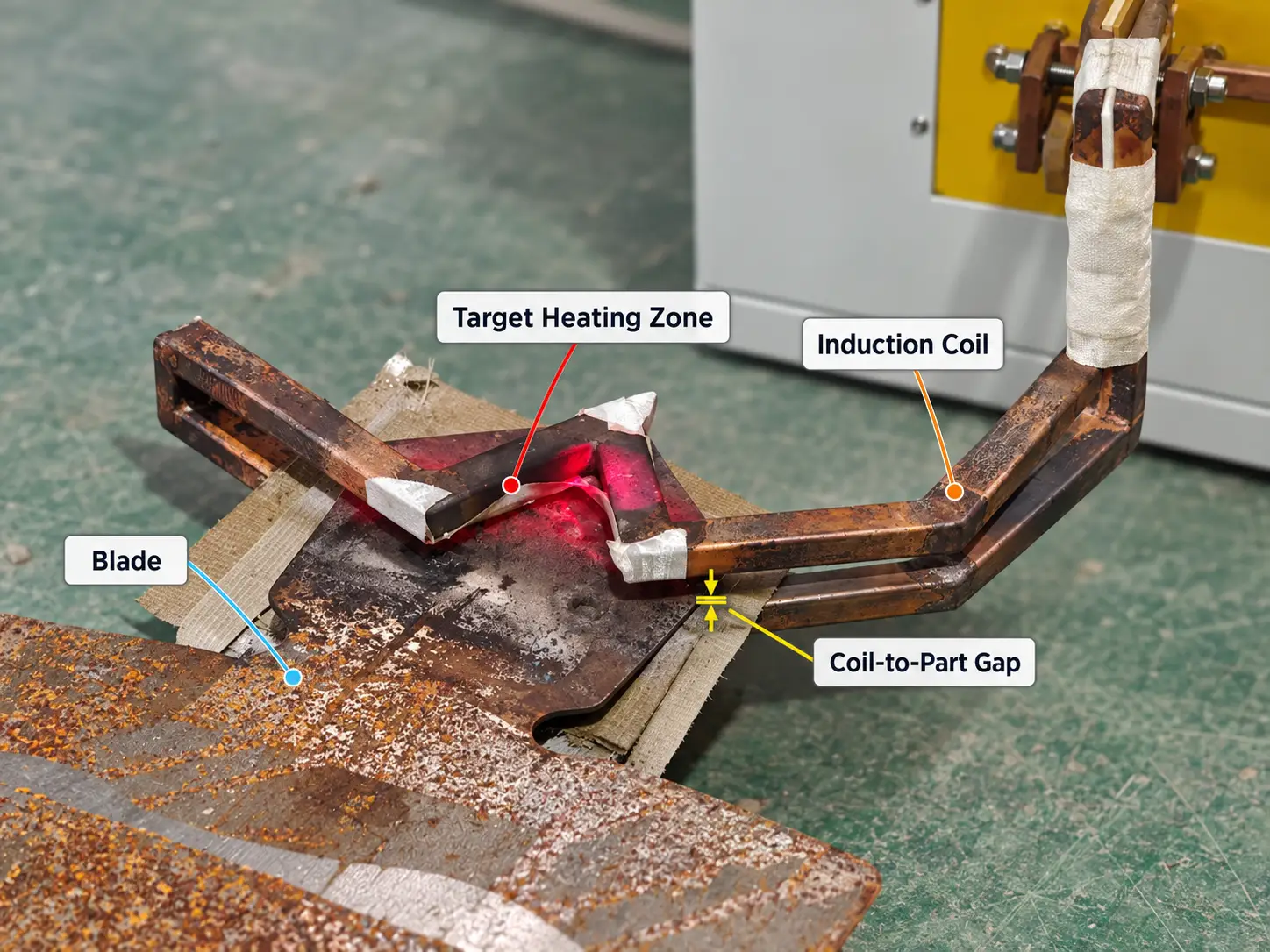
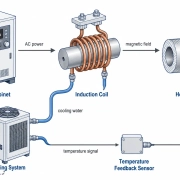
Localized induction heating of a complex blade profile during process development.
3. Process Development and Temperature Checking
Complex profiles usually require sample testing before the production process is finalized.
An initial setup may be evaluated by heating a sample and checking where heat develops relative to the required hardened zone. Coil position, power level, heating time or workpiece position can then be adjusted and tested again.
Temperature measurement can help during this stage, but it should not be treated as proof that the hardening process is correct. Surface condition, oxidation and measurement method can affect temperature readings, and similar surface temperatures do not necessarily produce the same case depth or final hardness.
The purpose of temperature checking is therefore to support process development, not replace hardness or metallurgical verification.
Operating frequency also affects the heating behavior and penetration depth, but it is normally considered as part of the equipment and process selection rather than as a parameter that can always be freely changed during production.
4. From Heating Pattern to Final Hardness Pattern
The area that appears hottest during induction heating is not automatically identical to the final hardened area.
The heating pattern describes how heat is distributed before quenching. The hardness pattern describes the final hardened zone after heating and cooling, including where the required surface hardness and, where specified, case depth are obtained.
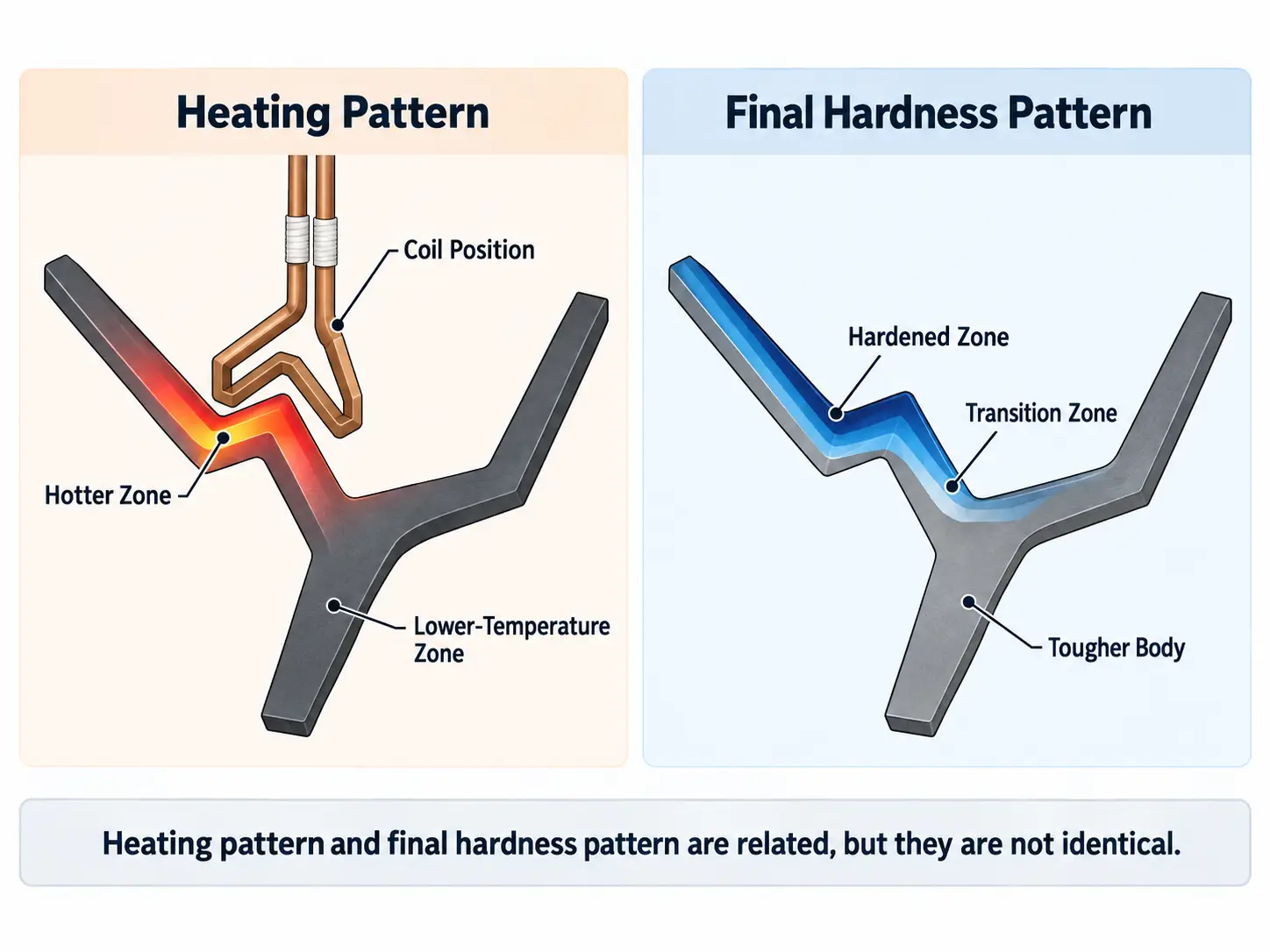
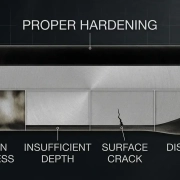
Heating pattern versus final hardness pattern in a complex blade.
Material composition and hardenability affect this result together with the heating cycle. Quenching conditions also matter.
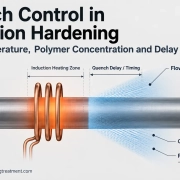
A good heating pattern can still produce an unsatisfactory result if the heated zone is not cooled in the required way. Complex blades may have surfaces that are difficult to reach uniformly with quench spray, and thin and thick sections can respond differently during cooling.
For that reason, the inductor and quenching arrangement should be developed as parts of the same process. The objective is the required hardness pattern on the blade, not simply an even red-hot appearance before quenching.
5. How the Hardening Result Is Verified
The final acceptance criteria should come from the blade specification.
For many applications, the most useful checks are the surface hardness, the location and extent of the hardened zone, and the effective case depth when a case-depth requirement has been specified.
Additional inspection may be required where the component specification calls for checks such as metallographic examination, distortion control or crack inspection.
The important point is that the required hardened area should be defined before the induction process is developed. A drawing with the target zone marked is usually more useful than providing only the blade length, width and thickness.
This also prevents a common misunderstanding: a process can produce a hard surface and still fail if the hardened area does not extend to the required location or extends into a region that should remain tougher.
6. From Sample Testing to Production Equipment
A process that works on one sample still needs to be made repeatable before it becomes a production process.
Once the coil, workpiece position and heating-and-quenching sequence have been established, the production equipment needs to reproduce those conditions from part to part. This may require a dedicated fixture, controlled positioning, repeatable heating time and coordinated quenching.
Different blade profiles may sometimes use the same induction power supply, but that does not mean they use the same complete setup. A different blade may require another coil, fixture or set of process parameters.
For related blade families, a common machine platform with interchangeable tooling may be practical. Where the blade geometry or hardened zone changes substantially, separate process setups may be more appropriate.
The level of automation should follow the production rate and handling requirement rather than being assumed at the beginning of process development.
7. What Information Is Needed for Process Evaluation?
A useful evaluation starts with the blade itself.
| Information | Why It Matters |
|---|---|
| Blade photo or drawing | Shows the actual profile and available coil access |
| Material | Determines whether the blade can achieve the required hardening response |
| Thickness and major section changes | Affect heating and cooling behavior |
| Required hardened area | Defines the target heating and hardness pattern |
| Target hardness, if specified | Defines the required surface result |
| Case depth, if specified | Influences process and equipment selection |
| Current heat-treatment method, if any | Helps identify the existing process condition |
| Production requirement | Helps determine fixture, handling and automation needs |
For a complex blade, a drawing with the required hardened zone marked is particularly useful.
Key Takeaway
Complex blade induction hardening is a matching problem, not a heating problem. The coil, coupling distance, workpiece position and quenching must be developed together to place the required hardness pattern exactly where the drawing specifies. Verify the result by surface hardness and case depth — not by how the blade looks while it is hot.
Frequently Asked Questions
Click a question to expand the answer.
Can one coil harden different blade profiles?
Generally no. A different blade profile usually requires a separate coil, fixture or set of process parameters, even when the same induction power supply is used.
Is the hottest area during heating always the final hardened area?
Not necessarily. The heating pattern and the final hardness pattern can differ, because material hardenability and quenching conditions also determine where the required surface hardness and case depth are obtained.
Does temperature checking replace hardness testing during process development?
No. Temperature measurement supports process development, but surface condition, oxidation and measurement method can affect readings. Final hardness and case depth still need to be verified by hardness or metallurgical checks.
What is the most useful starting information for a complex blade?
A drawing with the required hardened zone marked, together with the material and hardening requirement. A marked target zone is more useful than only the blade length, width and thickness.
Get a Hardening Process Evaluation for Your Blade
If you are developing a selective induction-hardening process for a blade with a complex profile, send us the workpiece drawing or a clear photo together with the material and hardening requirement. From that information, we can evaluate the induction coil, workpiece positioning, heating method, quenching arrangement and equipment configuration.