Continuous Wire Induction Annealing: How Line Speed, Power, and Temperature Affect Annealing Results
In continuous wire annealing, the result depends on the thermal history of the moving wire—not on temperature or power alone. Line speed, residence time, wire size, material and energy input have to be considered together when the finished wire is too hard, excessively softened or inconsistent along its length.
2. Why Wire Diameter and Material Change the Annealing Condition
3. What Temperature Measurement Can—and Cannot—Tell You
4. Troubleshooting Underannealing and Inconsistent Wire Properties
5. Where Continuous Annealing Fits After Wire Drawing
1. Line Speed, Residence Time, and Power Work Together
Wire moving through an induction heating zone is exposed to heat for a limited period. In practical terms:
Line speed → residence time → thermal exposure → annealing result
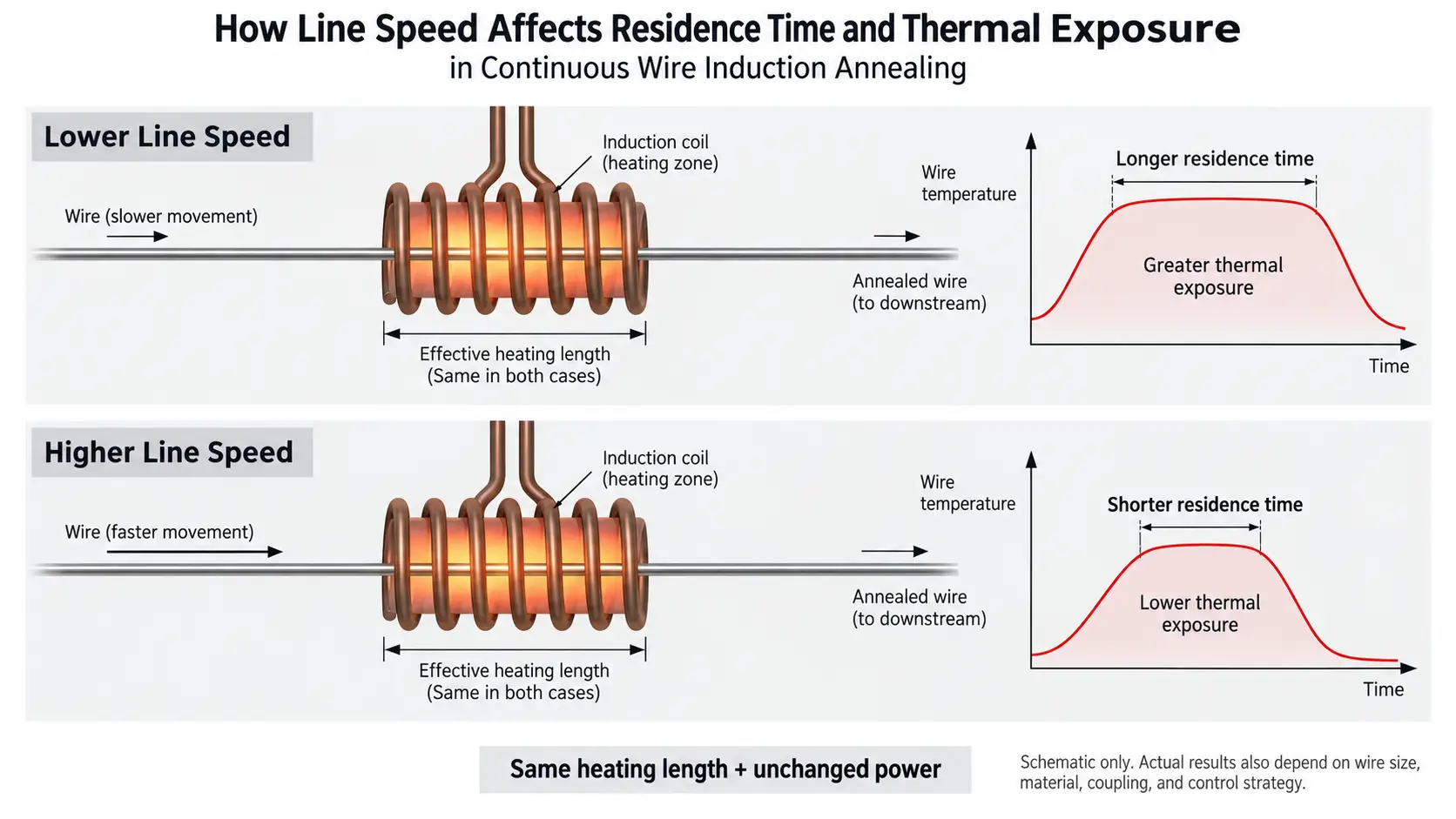
Increasing line speed shortens the time each section of wire remains within the effective heating zone. Reducing the speed increases that time.
Power determines how much energy is available during this period, but a power setting by itself does not define the annealing condition. The same electrical output can produce a different thermal result if the wire diameter, material, speed or heating length changes.
This is particularly important in continuous wire annealing, where production speed is part of the heat-treatment process rather than just a conveying parameter.
For a given application, the main variables include:
•line speed
•effective heating length
•induction power
•wire diameter
•wire material
•incoming material condition
•required annealed condition
Changing several of these variables at the same time makes troubleshooting difficult.
Cold-drawn wire also brings a metallurgical requirement into the process. Drawing introduces cold work and increases strength while reducing ductility. Depending on the alloy and process route, annealing may involve recovery and recrystallization to obtain the properties required for further processing.
There is therefore no single wire annealing temperature that applies to every material and production line.
2. Why Wire Diameter and Material Change the Annealing Condition
A recipe developed for one wire should not automatically be transferred to another diameter or material.
A larger wire contains more material to heat and can respond differently through its cross-section. A smaller wire has less thermal mass and can react more quickly to changes in power or line speed.
Material changes matter as well.
Steel wire and copper wire have different electrical, thermal and metallurgical behavior. Even two steel grades of the same diameter may require different annealing conditions because their composition and incoming cold-work state are different.
When a wire specification changes, engineers should therefore review the process condition rather than simply keep the previous settings.
Useful information includes:
•material and grade
•wire diameter
•incoming condition
•required final properties
•production speed
•available heating length
Frequency, inductor design and power level may then be selected or adjusted around the actual application.
The important point is not that one variable always needs to increase or decrease. It is that the previous process may no longer produce the same thermal cycle after the product changes.
3. What Temperature Measurement Can—and Cannot—Tell You
Temperature measurement is useful in induction annealing for wire, but a displayed temperature should not be treated as proof that the final wire condition is correct.
Infrared measurement can provide real-time information about the thermal condition of the moving wire. In a closed-loop system, that signal may also be used as part of the power-control strategy.
However, the measurement itself can be affected by:
— surface condition
— emissivity
— measurement spot size
— wire movement
— sensor position and viewing angle
These issues become more important as wire diameter becomes smaller.
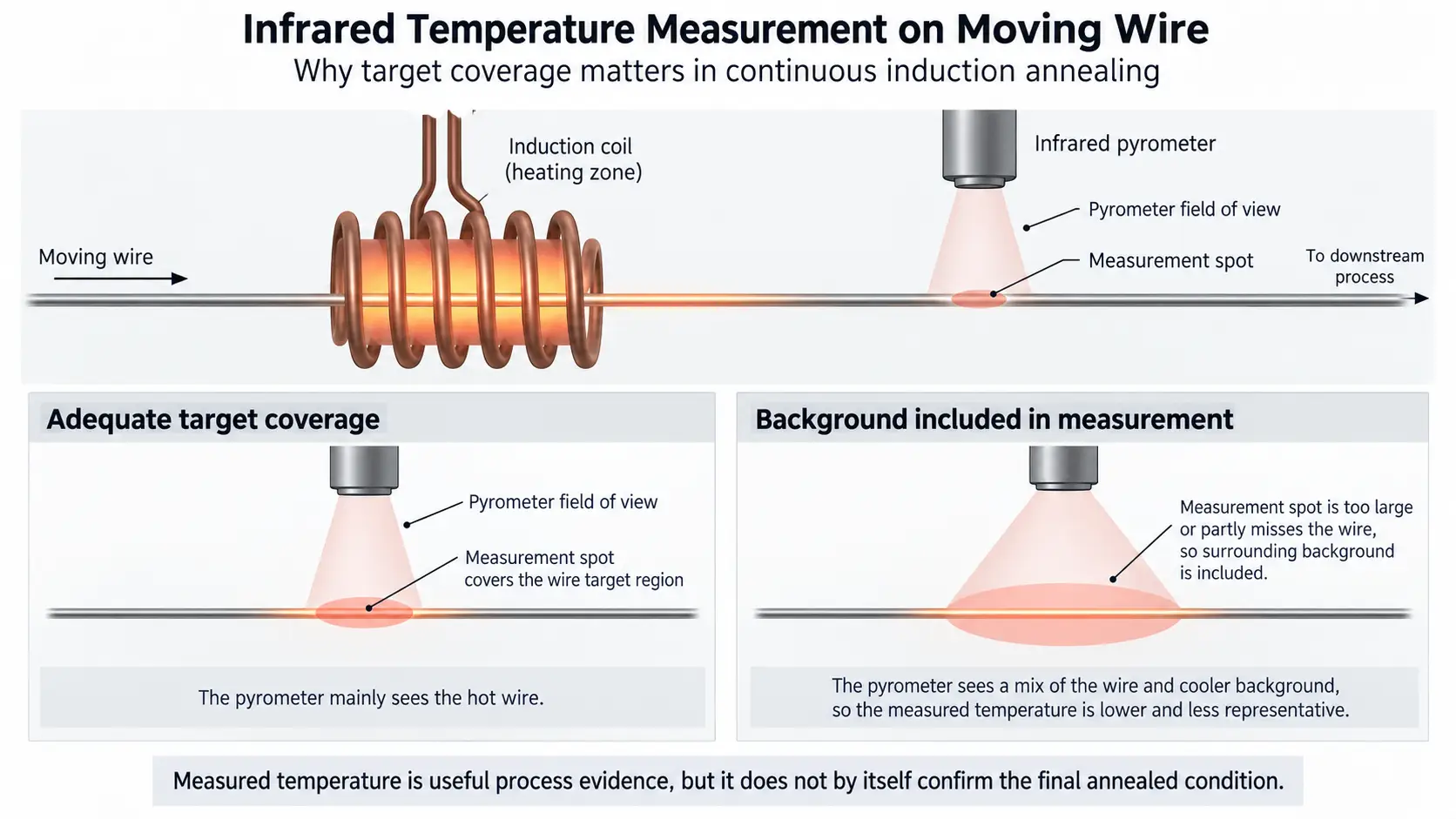
A measurement problem should also be separated from an actual annealing problem.
For example, an incorrect pyrometer reading does not automatically make the wire underannealed. It becomes a process cause only if the incorrect signal influences the control loop or leads the operator to apply an unsuitable setting.
For this reason, temperature trends should be compared with actual product results such as hardness, elongation, tensile properties or downstream processing behavior, depending on the wire specification.
A wire can reach a measured target temperature and still require further investigation if the final properties are outside the required range.
For a broader discussion of infrared measurement and closed-loop control, the general temperature-control principles are better treated separately from the wire-specific troubleshooting covered here.
4. Troubleshooting Underannealing and Inconsistent Wire Properties
Low ductility, excessive hardness or inconsistent elongation are symptoms. They do not identify the cause by themselves.
A useful troubleshooting approach is to compare the symptom with recent process changes and production data.
| Observed condition | Possible causes | What to check first |
|---|---|---|
| Wire remains too hard or elongation is lower than required | Insufficient thermal exposure, higher line speed, increased diameter, material change, inadequate power for the current condition | Actual line speed, temperature trend, product specification, incoming condition |
| Properties vary along the wire length | Speed fluctuation, changing wire position, unstable heating condition, load variation, inconsistent temperature measurement | Speed history, wire path, power/load data, temperature trend |
| Excessive softening or other property shift | Excessive thermal exposure, slower line speed, unsuitable power or temperature setting | Line speed, process recipe, temperature history |
| Indicated temperature changes but product properties remain stable | Measurement instability or surface/emissivity effects may be involved | Pyrometer target, spot size, viewing condition, surface condition |
| Product properties change while indicated temperature appears stable | Material variation, incorrect measurement location, changes in heating time or coupling | Incoming material, actual speed, wire position, process data |
These patterns are only starting points. They should not be treated as fault signatures.
① Check the Product First
Before changing the annealing parameters, confirm whether the wire itself has changed.
A new material grade, different diameter or different amount of prior cold work can alter the annealing response even if the machine settings are unchanged.
② Verify Actual Line Speed
Recipe speed and actual operating speed are not always the same.
Because line speed controls residence time, an unexpected speed change can alter the thermal cycle without an obvious change in induction power.
③ Review the Heating Zone
Check whether the wire is passing through the inductor as intended.
Position changes, inductor condition or changes in the effective heating length can alter coupling and heating behavior.
④ Compare Electrical and Temperature Data
Power, current, frequency and temperature trends can help identify when the process moved away from a previously stable condition.
Changing several parameters at once should be avoided during diagnosis because it becomes difficult to determine which adjustment affected the result.
⑤ Confirm the Result with the Relevant Product Test
The appropriate verification method depends on the product.
For some wire, hardness may be useful. For others, elongation, tensile properties, ductility or downstream drawing/forming performance may be more relevant.
This distinction matters when diagnosing suspected underannealing. A process should not be classified as underannealed solely because one machine parameter looks unusual.
Downstream cooling may also affect the final condition for some materials and processes. It should be considered separately where the alloy and required heat-treatment route make cooling behavior significant.
5. Where Continuous Annealing Fits After Wire Drawing
Wire annealing is often associated with drawing because cold drawing changes the mechanical condition of the material.
Depending on the manufacturing route, annealing may be carried out:
— between drawing stages as intermediate annealing
— after drawing as post-drawing annealing
— continuously as the wire passes through a dedicated heating section
For some steel-wire applications, continuous treatment is also referred to as strand annealing. The term describes the continuous processing format; it does not specify induction as the heating source.
Induction heating is one way to perform this treatment because it can provide a compact heating zone and adjustable energy input for a moving product. The process still has to be matched to material, wire size, line speed and required final properties.
Where the main question is how induction heating is used before or between drawing operations, that topic is better treated separately from the annealing diagnosis covered here.
Key Takeaway
Continuous wire induction annealing is therefore best evaluated as a thermal process rather than a fixed machine recipe. When results change, the most useful question is usually not “What power should I set?” but what changed in the wire, residence time, thermal exposure or measurement—and whether that change is reflected in the final wire properties.
Frequently Asked Questions
Click a question to expand the answer.
How does line speed affect the annealing result?
Line speed controls how long each section of wire stays in the heating zone. Higher speed means less thermal exposure; lower speed means more. Power alone does not define the annealing condition.
Can I use the same annealing recipe for a different wire diameter?
Not automatically. Larger wire has more thermal mass and responds differently through its cross-section, while smaller wire reacts faster to power or speed changes. Material composition and incoming cold-work state also matter.
Does a correct temperature reading guarantee correct annealing?
No. A displayed temperature is a thermal reference, not proof of the final condition. Compare temperature trends with hardness, elongation, tensile properties or downstream behavior.
What causes inconsistent wire properties along the length?
Speed fluctuation, changing wire position, unstable heating, load variation, or inconsistent temperature measurement. Check speed history, wire path, power/load data and the temperature trend first.
Where does annealing fit relative to wire drawing?
Between drawing stages (intermediate annealing), after drawing (post-drawing annealing), or continuously through a dedicated heating section.
Looking for a Continuous Wire Induction Annealing Line?
See how KOTRON configures the induction power supply, inductor and temperature control around your wire material, diameter and line speed.