Induction Preheating System for Excavator Bucket Welding
Ⅰ. Watch the Excavator Bucket Edge Preheating Process
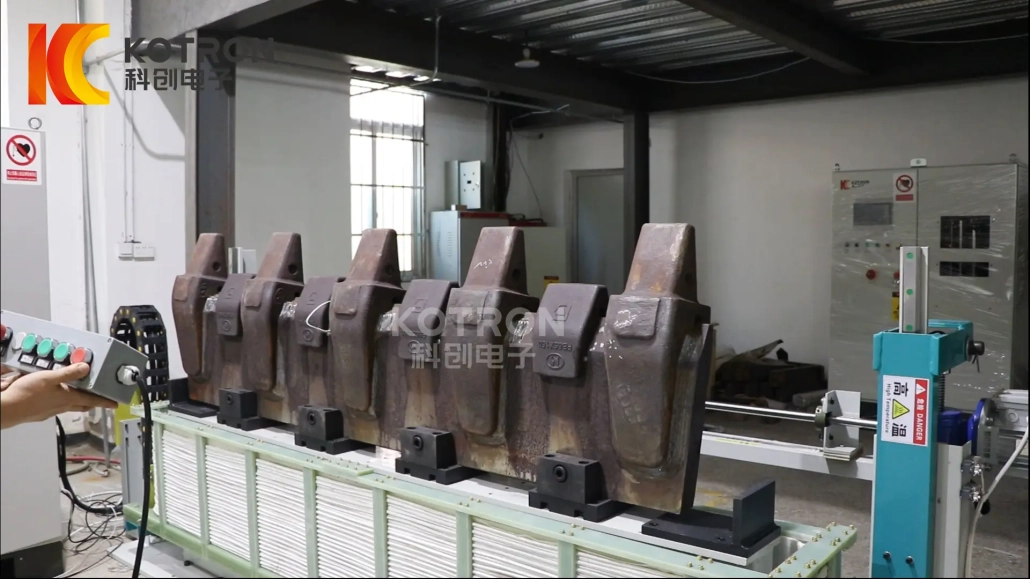
The video shows the actual heating stage of the system. A bucket edge assembly fitted with multiple weld-on adapters is placed on the dedicated support fixture. Instead of moving the heavy workpiece through the induction coil, the coil itself moves vertically into the heating position.
Once the inductor reaches the required position around the bucket assembly, the programmed heating cycle begins. This arrangement is particularly suitable for bucket adapter welding preheat where a relatively long section of the bucket edge or bucket lip has to be heated before welding.
Ⅱ. What Parts Are Being Preheated?
The workpiece shown on this page is a large excavator bucket edge assembly with several weld-on tooth adapters positioned along the edge. These adapters form the connection between the bucket edge or lip and the replaceable bucket teeth.
For this application, the heating requirement is different from heating one small adapter individually. The system has to handle a relatively large steel assembly and create the required preheating condition across the adapter welding area.
Similar induction preheating arrangements can be evaluated for:
The fixture and induction coil are still designed around the actual workpiece. A different bucket width, plate thickness or adapter arrangement may require different tooling.
Ⅲ. Why Preheat Excavator Bucket Adapters Before Welding?
The required preheat temperature comes from the welding process, not from the induction machine itself. For steels that are susceptible to hydrogen-assisted cold cracking, preheating can slow the cooling rate and give hydrogen more time to diffuse from the weld and heat-affected zone.
The actual requirement depends on factors such as steel grade, carbon equivalent, plate thickness, adapter material, joint design, welding consumables, hydrogen level, heat input, and the welding procedure specification.
For a large excavator bucket lip or edge, there is another practical issue: thermal mass. The surrounding steel removes heat from the welding area continuously. If individual adapter positions are heated manually, it can be difficult to reproduce the same temperature condition along the complete bucket edge.
A purpose-built bucket edge induction preheating system approaches the job differently. The inductor surrounds a larger section of the assembly, temperature is controlled by the heating system, and the part can remain under controlled heating for an equalization or holding stage before welding.
The objective is not simply fast heating. The useful result is a bucket edge and adapter welding zone that reaches the condition required by the approved welding process.
Ⅳ. How the Bucket Welding Preheating Station Works
The actual equipment uses a fixed workpiece with a vertically moving induction coil.
Load the Bucket Edge Assembly
A crane lifts the bucket edge assembly onto the dedicated fixture with the adapter side facing upward. The fixture is designed according to the workpiece dimensions so that the heavy part remains stable during the heating cycle.
Raise the Induction Coil
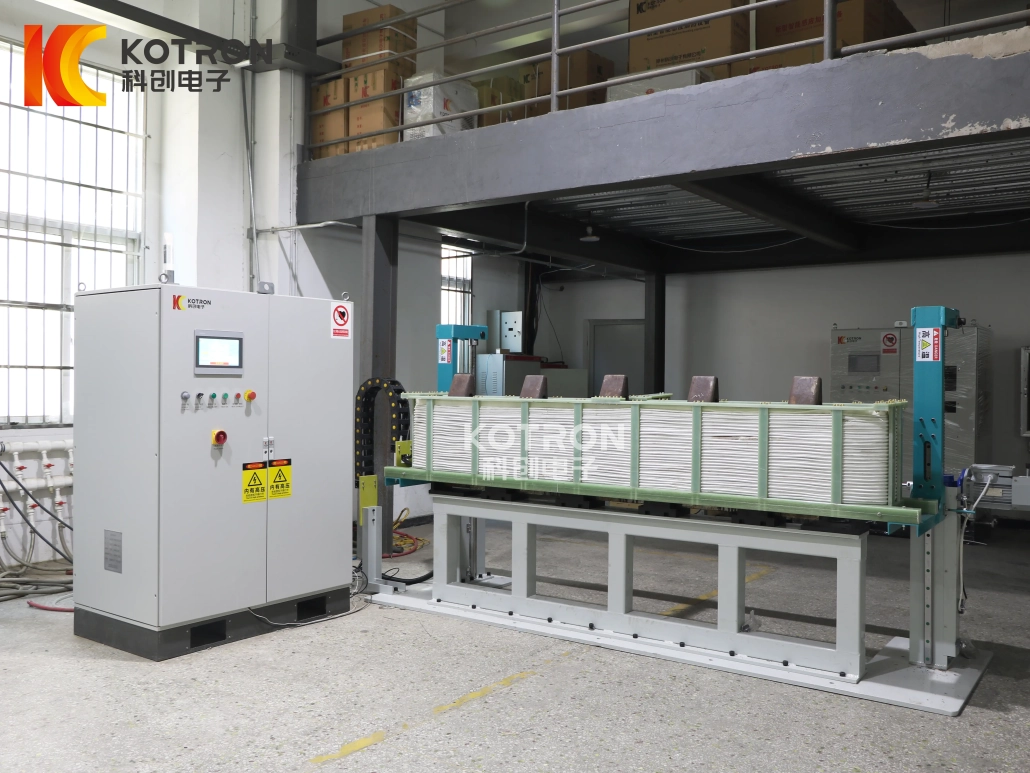
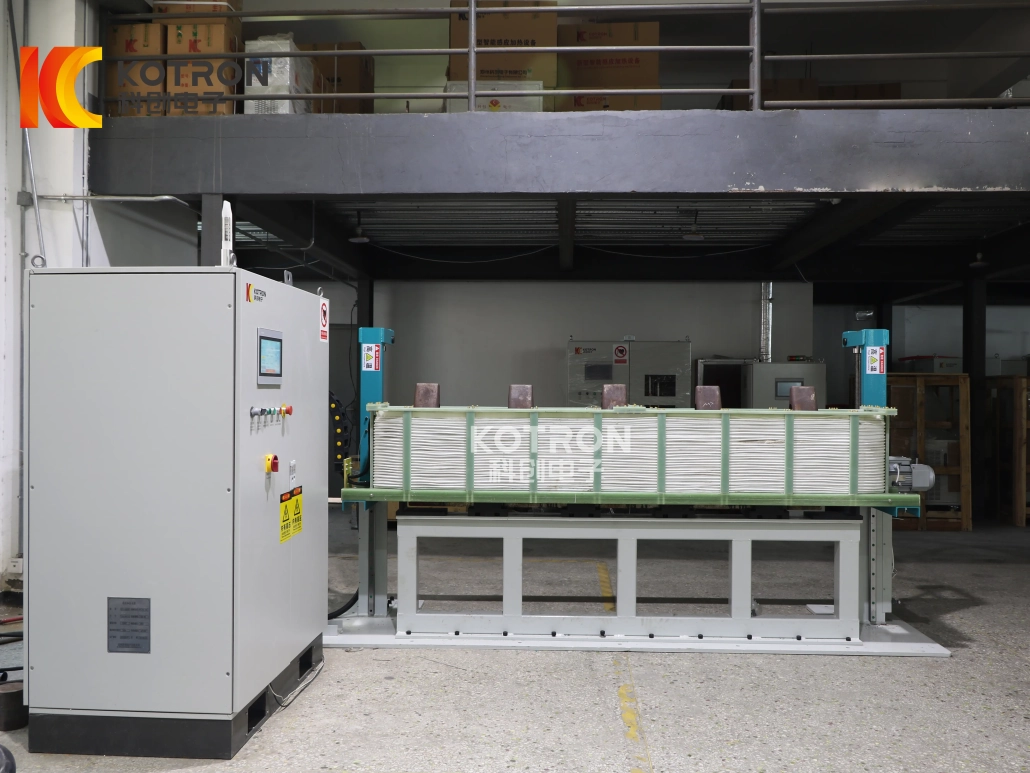
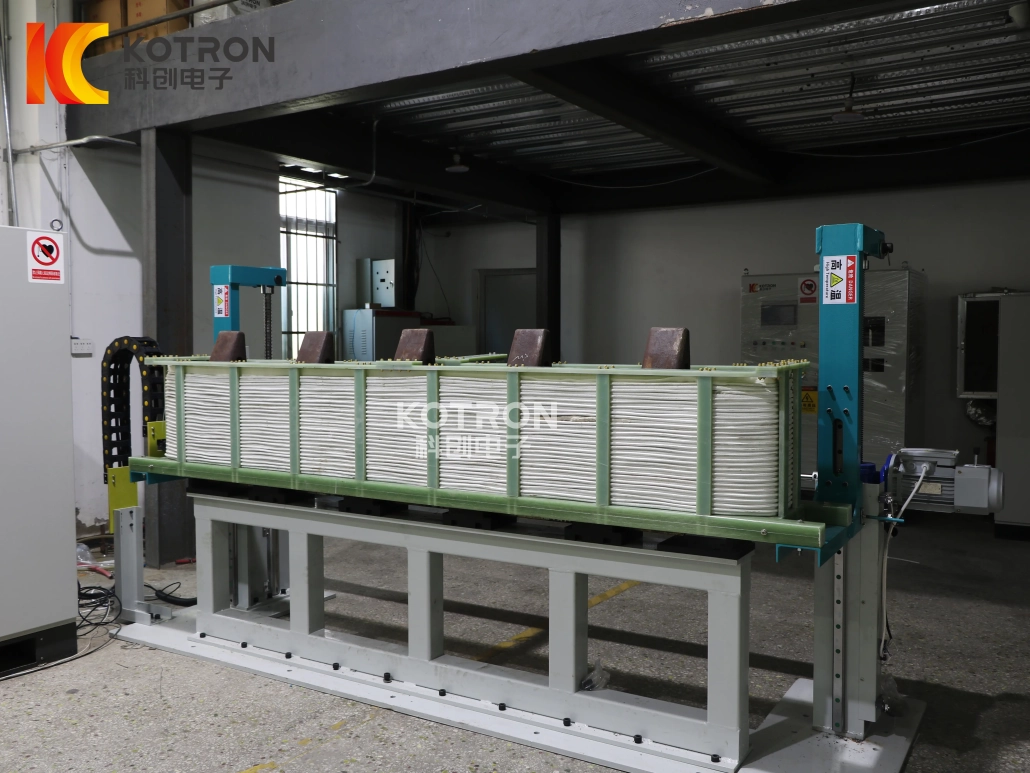
The lifting mechanism moves the large rectangular induction coil upward from below the fixture. The coil continues to rise until the required section of the bucket edge and adapter assembly is positioned inside the heating zone.
Start Induction Preheating
Once the coil reaches the heating position, the induction system starts the programmed cycle. The process can include heating, temperature control, temperature equalization and holding. The workpiece remains stationary throughout this stage.
Reach the Required Temperature
The system monitors the heating process according to the configured temperature control method. When the defined temperature condition is reached, a temperature-ready output signal is provided. The process can then continue into the required equalization or holding stage.
Lower the Inductor
After the preheating process is complete, induction heating stops and the coil is lowered away from the bucket assembly.
Transfer the Heated Workpiece
The preheated bucket edge is removed by crane and transferred to the welding position or insulation box. A new workpiece can then be loaded for the next heating cycle.
01
Loading
02
Coil Up
03
Induction Preheating
04
Temperature Ready
05
Coil Down
06
Transfer
Ⅴ. Large-Format Inductor for Bucket Edge and Bucket Lip Preheating
The induction coil is one of the most important parts of this system. A small handheld coil may be practical for local heating, but the equipment shown here is designed around a much larger heating zone.
The rectangular multi-turn inductor rises around the bucket assembly while the workpiece remains fixed. This arrangement allows a long section of the bucket edge or bucket lip to be heated within one station rather than heating each adapter position separately.
The coil is not a universal accessory. Its design has to consider bucket edge length, bucket lip width, adapter quantity, adapter spacing, steel thickness, required heating area, coil-to-workpiece distance, target temperature, required heating time, available induction power, and the fixture structure.
The induction coil and fixture should therefore be treated as part of the process tooling. For another bucket model, the main power equipment may remain similar while the inductor and support fixture change.
Ⅵ. Temperature Control, Equalization and Holding
Induction heating for welding preheat should not be controlled only by heater-on time. A large steel assembly can have considerable temperature differences during the early part of the heating cycle. Reaching the target temperature at one measuring point does not automatically mean that the complete required area is ready for welding.
For this reason, the heating program can include several stages.
Heating. The induction power raises the temperature of the selected bucket edge area.
Temperature Control. Heating is adjusted according to the process temperature setting instead of relying only on a fixed timer.
Temperature Equalization. The system allows the heated area to approach a more stable temperature condition before the part is released.
Holding. Where specified by the welding procedure, controlled heating can continue for a defined period.
The system also provides high-temperature alarm logic. If a monitored point reaches the configured alarm value, the corresponding signal can be generated.
Recorded Bucket Heating Applications
| Application | Recorded Temperature |
|---|---|
| Bucket weld preheat | 120°C |
| Bucket post-weld heat treatment | 400°C |
These figures are recorded application values, not universal welding temperatures. The correct preheat temperature, interpass temperature, post-heating temperature and holding time should be taken from the material specification, qualified WPS or other approved welding procedure. A different bucket steel or plate thickness may require a different process.
Ⅶ. Post-Weld Heating and Hydrogen Diffusion
Some bucket welding procedures require controlled heating to continue after welding. This post-weld heating stage can be used to keep the weldment at an elevated temperature for a defined period, allowing hydrogen additional time to diffuse from the weld metal and heat-affected zone before the assembly cools completely.
The appropriate process depends on the material, plate thickness, weld procedure, post-heating temperature, holding time, heated zone, temperature measurement position, and cooling requirement.
Post-heating for hydrogen diffusion should not automatically be described as stress-relief PWHT. Stress-relief treatment has its own temperature, holding-time and cooling requirements and should only be specified when required by the material or approved procedure.
For equipment configuration, the customer should provide the actual post-weld heating requirement rather than selecting a temperature from a general product page.
Ⅷ. Control Signals for Integration with the Heating Station
The induction heating unit can exchange several practical signals with the lifting station or an external control system.
| Signal | Function |
|---|---|
| External Start | Dry-contact input starts or stops heating |
| Temperature Reached | Output closes when the defined temperature condition is reached |
| High Temperature Alarm | Output is triggered when a monitored point reaches the high-temperature alarm value |
| Fault Alarm | Heating stops and a fault output is generated when equipment failure is detected |
These interfaces make the machine more useful as a dedicated bucket welding preheating station, rather than operating as an isolated heater. For example, the temperature-reached output can be incorporated into the operating sequence so that completion of the heating stage does not depend only on an operator watching the display. Likewise, the fault signal provides a clear machine status when the normal heating process cannot continue.
Ⅸ. Main Equipment Configuration
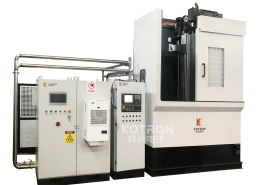
This is a workpiece-specific induction heating station. The correct power rating, frequency and tooling depend on the bucket and the required welding process.
| Item | Configuration |
|---|---|
| Equipment type | Fixed-station induction preheating system |
| Main application | Excavator bucket welding preheating |
| Additional process | Controlled post-weld heating |
| Typical workpiece | Bucket edge / bucket lip with weld-on adapters |
| Workpiece position | Fixed during heating |
| Loading and unloading | Crane |
| Inductor | Large rectangular multi-turn coil |
| Inductor movement | Powered vertical lifting |
| Fixture | Customized to workpiece |
| Heating sequence | Heating, control, equalization, holding |
| External start | Available |
| Temperature-ready output | Available |
| High-temperature alarm | Available |
| Fault alarm | Available |
| Induction power | Selected according to workpiece |
| Operating frequency | Selected according to heating requirement |
| Cooling system | Confirmed according to final configuration |
Power cannot be selected from bucket width alone. A thicker bucket lip with greater thermal mass may require a different heating arrangement from a smaller edge assembly, even when their overall length is similar. Coil geometry, heating time and required temperature all affect equipment selection.
Ⅹ. Frequently Asked Questions
Click a question to expand the answer.
Is this induction preheating system only for one excavator bucket model?
The photographed fixture and coil are designed around a specific workpiece range. Other bucket sizes can be evaluated, but another bucket lip or adapter arrangement may require different tooling.
Does the bucket move during induction heating?
No. In this equipment configuration, the bucket edge assembly remains fixed. The induction coil moves vertically into and out of the heating position.
Can several bucket adapters be preheated at the same time?
The equipment shown uses a large-format inductor around the bucket edge assembly rather than a small coil heating one adapter individually. The actual number of adapters covered in one cycle depends on the workpiece and coil design.
Is 120°C the standard bucket adapter welding preheat temperature?
No. 120°C is a recorded application value from company material. The actual preheat temperature must follow the bucket material and approved welding procedure.
Is 400°C always required for post-weld heating?
No. 400°C is also a recorded application value, not a universal setting. Another process may specify a different temperature, holding time or no post-heating stage at all.
Can this equipment perform PWHT?
That has to be evaluated from the actual heat-treatment requirement. Post-heating for hydrogen diffusion and stress-relief PWHT should not be treated as the same process.
How is the bucket preheating temperature controlled?
The documented system performs programmed temperature control and includes temperature-reached and high-temperature alarm outputs. The final temperature measurement method and sensor positions are selected according to the project.
Can the induction heater communicate with external equipment?
Yes. The documented configuration provides dry-contact interfaces for external start, temperature reached, high-temperature alarm and fault alarm.
Is this a fully automatic production line?
No. The photographed equipment is more accurately described as a fixed or semi-automatic induction preheating station for excavator bucket welding. The heating cycle and coil movement are controlled by the equipment, while the workpiece is loaded, unloaded and transferred using a crane.
Can induction heating replace flame preheating for bucket welding?
For suitable bucket components, induction heating provides a controlled alternative to manual flame heating. In this application, the main difference is the use of a purpose-built heating zone, temperature control and a repeatable heating sequence. The final choice still depends on the workpiece, welding procedure and production conditions.
Ⅺ. Send Us Your Bucket Drawing and Welding Procedure
A suitable bucket adapter welding preheat system cannot be selected from machine power alone. The induction power, heating coil, fixture and station layout all follow from the bucket geometry, the welding procedure and how the line will be used — the factors below are the ones that shape the proposal.
Bucket / Workpiece
• Bucket edge or bucket lip drawing
• Overall dimensions
• Steel grade
• Plate thickness
• Adapter quantity
• Adapter spacing
• Workpiece weight
• Available lifting method
Welding Process
• Welding Procedure Specification (WPS), if available
• Required preheat temperature
• Required heating zone
• Interpass temperature requirement
• Post-weld heating requirement
• Post-heating temperature
• Holding time
• Temperature measurement positions
• Cooling requirement
Production Conditions
• Parts per shift or per day
• Current bucket welding preheating method
• Available factory space
• Loading and unloading method
• Required automation level
• Required external control signals
Send us whatever you have — a full drawing, a qualified WPS, or simply the bucket dimensions and required preheat temperature. With those details, we can tailor the induction power, heating coil, fixture and station layout to your specific bucket and welding procedure, instead of starting from a standard power rating.
Ready to Pre-Heat Your Bucket Welding Operation?
Send your bucket drawing and welding procedure. We will evaluate the induction power, heating coil, fixture and station layout for your workpiece.