
Induction Heating in Railway Manufacturing: Applications, Process Control, and Equipment Selection
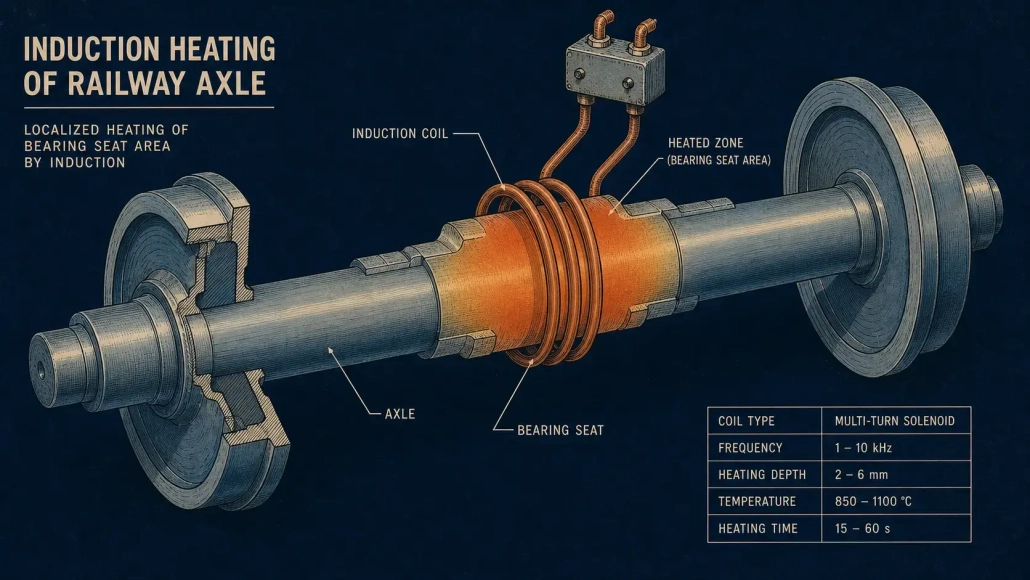
Railway parts are heavy and safety-critical. When they need heat, it’s usually in one specific area — a bearing seat, a wheel hub, a rail end. Not the whole component. Induction Heating Railway Manufacturing puts heat exactly where it’s needed through electromagnetic coupling: no flame, no furnace wait, no heating what doesn’t need to be hot. Induction heating fundamentals covers the physics.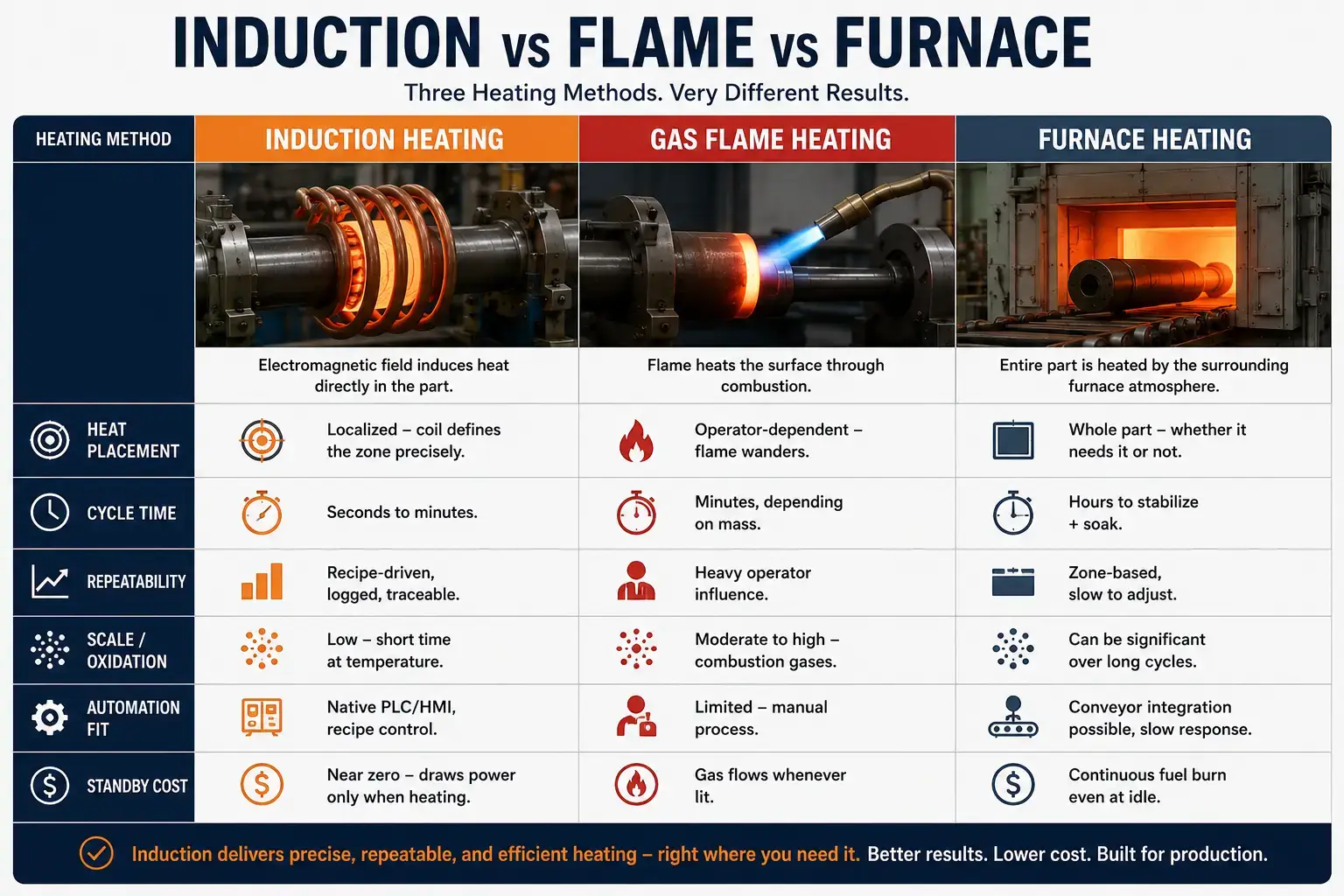
Flame still has its place — field repair, one-off jobs, anywhere portability matters more than precision. But if you need the same result tomorrow that you got today, and you need to prove it, induction is the tool for the job.
| 1. Why Induction Fits Railway Manufacturing | 2. Railway Applications |
| 3. Engineering Considerations | 4. Equipment Selection Factors |
| 5. When Induction Isn’t the Best Fit | FAQ |
1. Why Induction Heating Fits Railway Manufacturing
Induction targets the zone. Electromagnetic energy couples into the workpiece directly — no flame, no heat transfer through air. The pattern is a function of frequency, coil geometry, power level, and part position. Get those four variables right and the result repeats. Shift after shift. Axle after axle.
2. Common Railway Applications for Induction Heating
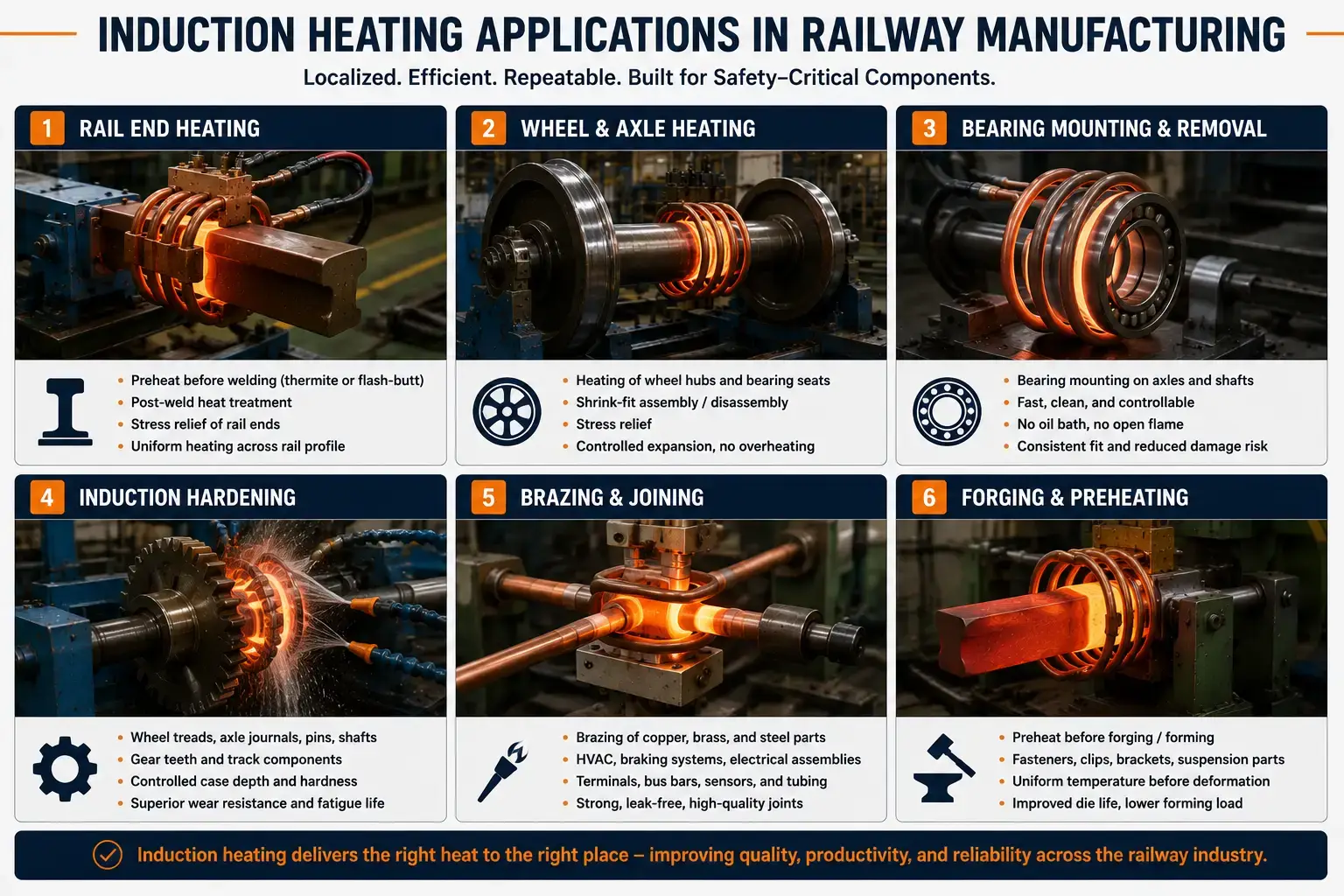
From rail welding and wheel shrink-fitting to bearing mounting, induction hardening of journals and treads, and induction brazing of electrical and fluid-system assemblies — induction shows up wherever controlled, localized heat matters in railway production and maintenance.
Rail end heating
Rail welding — thermite or flash-butt — needs controlled preheat and post-weld treatment. The challenge is the rail profile itself: thick head, thin web, wide base. Three different thermal masses in one cross-section. The coil has to balance all three.
3. Engineering Considerations for Reliable Production
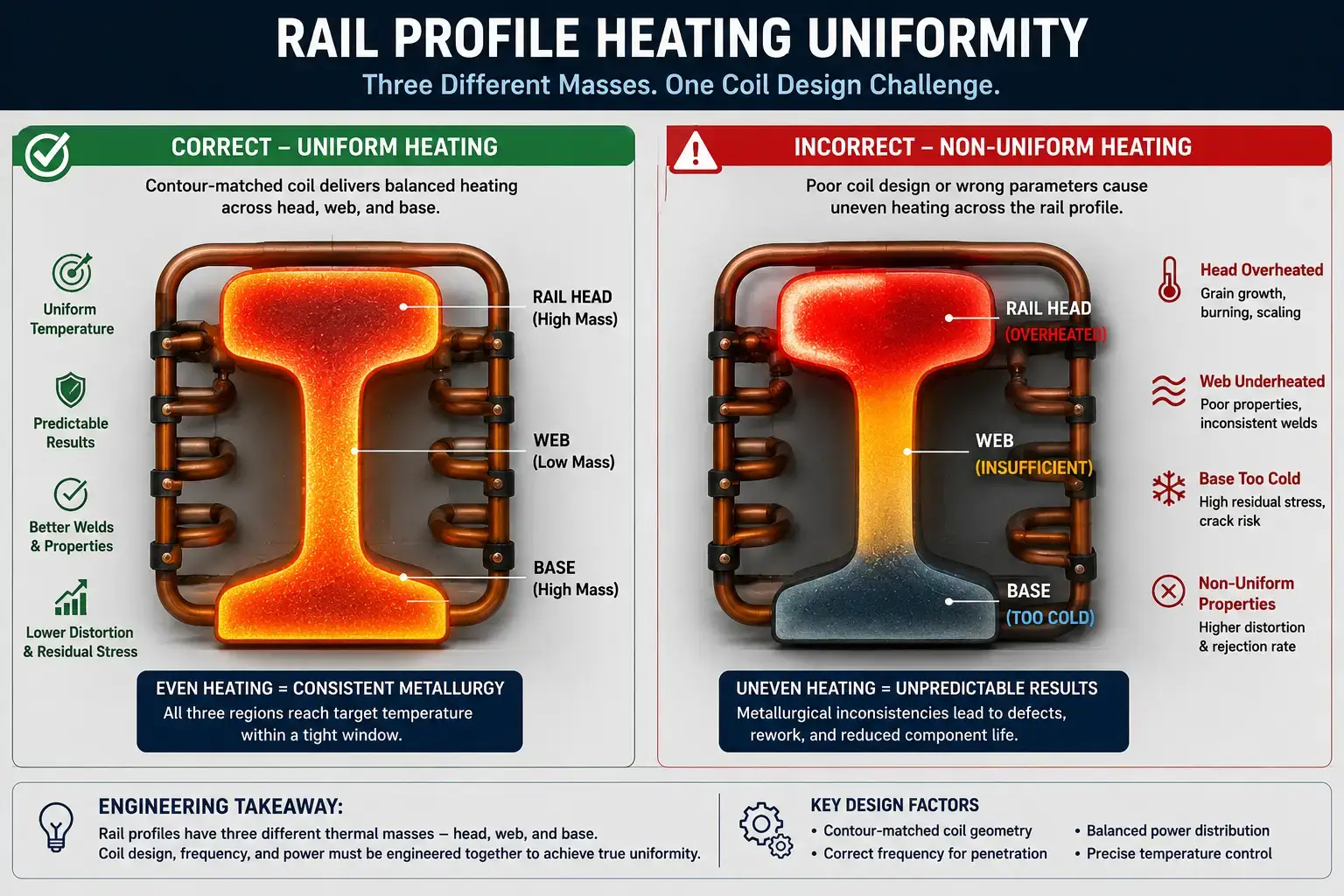
Take the rail profile as an example. Three different thermal masses in one cross-section — thick head, thin web, wide base — and induction doesn’t heat them equally by default. The coil has to compensate. That same geometry-awareness applies to every railway component: axles, wheels, bearing seats. Induction heating in railway manufacturing is a process, not a purchase order. Evaluate the part, the material, the production flow, and the quality requirement as one thing.
Material condition bites you if you ignore it. Steel chemistry, prior heat treatment, microstructure, surface condition — all of it changes how the part responds to induction. For hardening, carbon content and hardenability set the ceiling on what you can achieve. Rust, scale, oil, coatings: these mess with heating behavior and create fumes. Test with parts in their actual production condition. Not clean lab samples.
Temperature measurement has to survive the real environment. IR pyrometers need correct emissivity, clean sight lines, and protection from scale, steam, and smoke. A lab setup with perfect sight lines doesn’t represent a hot, wet, high-throughput maintenance depot. Validate under real conditions. And for hardening: the quench system matters as much as the heating. Spray pattern, flow, pressure, polymer concentration, temperature, timing — one of these drifting changes hardness, case depth, and distortion in ways that don’t always show up at final inspection.
Cracks from bad quenching surface in service, not at the test bench. Metallurgical testing during process development is not optional.
Fixtures near the coil become part of the process. Railway parts are heavy, so fixtures are substantial. If they’re magnetic or conductive, they heat up and distort the field — whether you meant them to or not. Nonmagnetic stainless, ceramics, water-cooled fixture elements help. But the fixture has to position the part consistently first. Everything else comes second.
Maintenance access: overlooked during specification, regretted during production. Coils, hoses, bus connections, sensors, quench components — all wear items. If swapping one takes half a shift and realignment is a guessing game, uptime disappears. Railway environments don’t forgive: scale, dust, coolant, vibration. Think about coil changeover time, spare availability, leak detection, and diagnostic alarms before the system is bolted down.
4. Key Equipment Selection Factors
Railway parts are big, heavy, and often thick-section. Equipment selection starts there — not with a catalog, not with a standard configuration.
Power supply. Large steel sections need real power to hit temperature in a production-relevant cycle time. Undersize and the process never reaches target, or takes so long the heat spreads where it shouldn’t. Oversize and you’ve spent money you didn’t need to — and potentially created control headaches on a narrow process window.
Sizing a power supply means stacking up part material, mass, target temperature, required heat depth, cycle time, heat losses, production rate, and duty cycle. Then asking: can this system deliver repeatable energy when the cooling water is 5°C warmer and the operator is on their third shift? Power selection covers the methodology.
Frequency. Frequency sets current penetration depth. Railway applications often involve thick steel sections — axles, wheels, rails — where deep, uniform heating matters. Lower frequencies push deeper. Higher frequencies concentrate at the surface. A rail head hardening process, an axle seat shrink-fit, and a bearing mount each want different frequency ranges. Pick the wrong one and you’re fighting the physics.
| Railway Application | Typical Frequency Range | Why |
|---|---|---|
| Axle / wheel deep heating | 1–10 kHz | Thick sections need deeper current penetration for uniform through-heating |
| Rail end preheat / stress relief | 1–10 kHz | Large profile cross-section; need heat through rail head depth |
| Bearing mounting | 10–50 kHz | Moderate penetration; thinner bearing rings heat efficiently in this range |
| Surface hardening (treads, journals) | 30–200 kHz | Shallow case depth; heat concentrated at wear surface |
| Small pins, fasteners, brazing | 100–400 kHz | Small cross-sections; high frequency for rapid surface-dominant heating |
Frequency selection goes deeper into the trade-offs. Test with real parts — the numbers get you in the ballpark, not on base.
Coil design. The coil is the business end. For railway work, coils have to handle large geometries, part positioning variation, magnetic flux concentration, cooling, mechanical durability, and access for loading and unloading. Encircling coils work for axles, shafts, and bearings. Split coils handle parts that can’t be threaded through. Contour coils follow rail profiles. Scan coils deliver progressive hardening along a length.
The right design balances uniformity, efficiency, and how long the coil survives before someone has to swap it. On high-value railway parts, a coil that drifts after 500 cycles is a quality problem waiting to happen.
Cooling. High-duty railway production generates real heat — in the coil, the leads, the capacitors, the power electronics. Cooling water isn’t an afterthought. Flow rate, pressure, water quality, conductivity, inlet temperature — spec them all. Closed-loop systems are common because they keep water chemistry under control and reduce scaling. When the cooling drifts, the faults are intermittent and hard to diagnose. Water cooling systems deserve their own line item in the spec.
Part handling. Railway components are heavy. Handling often determines whether the system works in practice, regardless of test-bench performance. Conveyors, robots, gantries, indexing tables, hydraulic loaders, custom fixtures — whatever moves the part has to position it consistently relative to the coil.
A few millimeters of position shift changes the coupling gap. The coupling gap changes the heat pattern. On a hardened journal or a rail profile, that’s enough to fail inspection.
5. When Induction Heating Isn’t the Best Fit
Induction isn’t always the answer. If the entire part needs uniform temperature and a long soak — batch annealing, stress relieving entire axle sets, normalizing large castings — a furnace is the simpler call. If you’re doing one-off field repairs somewhere without reliable power, a torch might be the only practical option.
The decision comes down to what the process actually needs:
— How tight is the temperature window, really?
— Does the whole part need heat, or just one zone?
— What’s the metallurgical spec — and can induction meet it?
— How many parts per shift? Is the volume there?
— Does the process need to be documented and traceable?
— What’s the total cost of running it, not just the purchase price?
For railway manufacturers and maintenance depots, the strongest business case for induction appears when repeatability, localized heating, speed, and process documentation all matter at once. That’s not every application. But it’s a lot of them.
Bottom line: Induction Heating Railway Manufacturing makes the most sense when large steel components need fast, localized, repeatable heating backed by controlled process documentation. Power and frequency selection, durable coil design, reliable cooling, proper handling — get those right and the system runs for years. Treat it as a complete thermal process, not a standalone heat source, and it’ll deliver what the railway industry actually needs: boring, predictable, documented results.
FAQ
Q: What railway components are most commonly heated with induction?
A: Rails and rail ends, wheels, axles, bearing seats, shafts, pins, fasteners, brake components, and forged parts. The process might be for shrink fitting, preheating before welding or forming, induction hardening, brazing, or stress relief — depends on the part and the spec.
Q: Is induction suitable for large railway axles and wheels?
A: Yes — with the right power, the right frequency (usually lower ranges for deeper penetration into thick sections), a robust coil that can handle the part mass, and a handling system that positions the part consistently. Testing on actual production parts is strongly recommended before final specification. A system that works on a 50 mm shaft won’t scale to a railway axle without re-engineering.
Discuss Your Railway Induction Heating Application
Share your part drawings, production requirements, and heating goals. Our engineering team can evaluate power, frequency, coil design, cooling, and automation options for a practical induction heating solution.


