Induction Heating vs Resistance Heating: Which Electric Heating Method Fits Your Process?
Induction heating vs resistance heating is a comparison that comes up whenever manufacturers need to choose an electric heating method for production. Both convert electricity into heat. Both can hit industrial temperatures. But they generate and deliver that heat in fundamentally different ways — and those differences ripple into cycle time, part quality, energy consumption, and how easily the process integrates into your line.
This guide compares both methods from an engineering and purchasing standpoint: how they work, where each excels, and how to decide which one fits your process.
1. How Each Technology Works
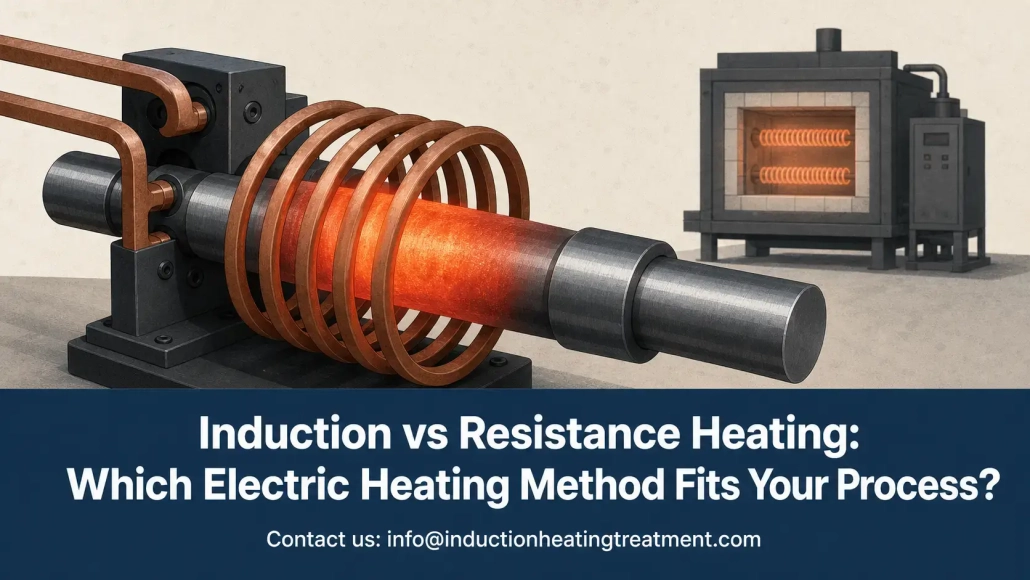
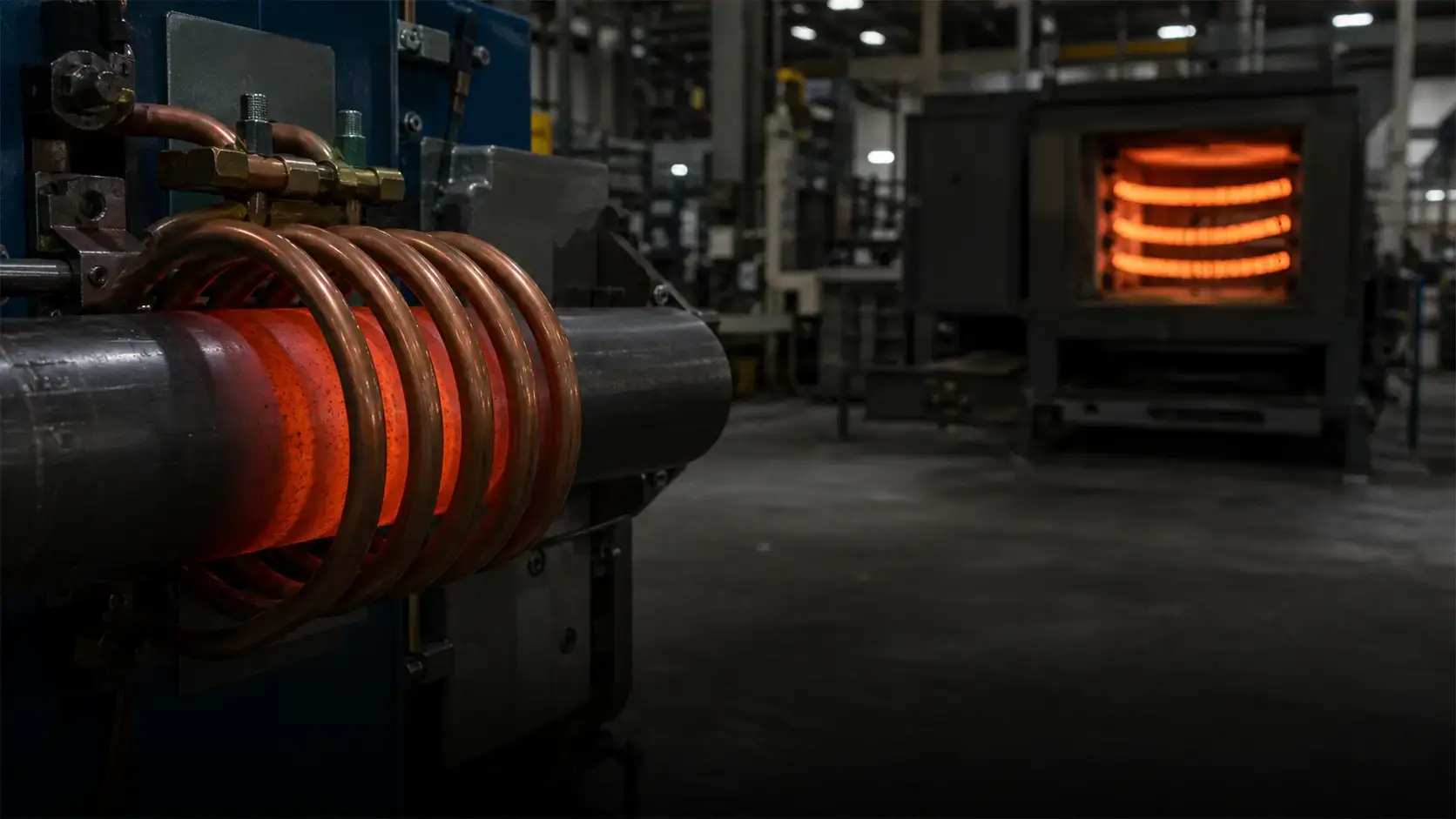
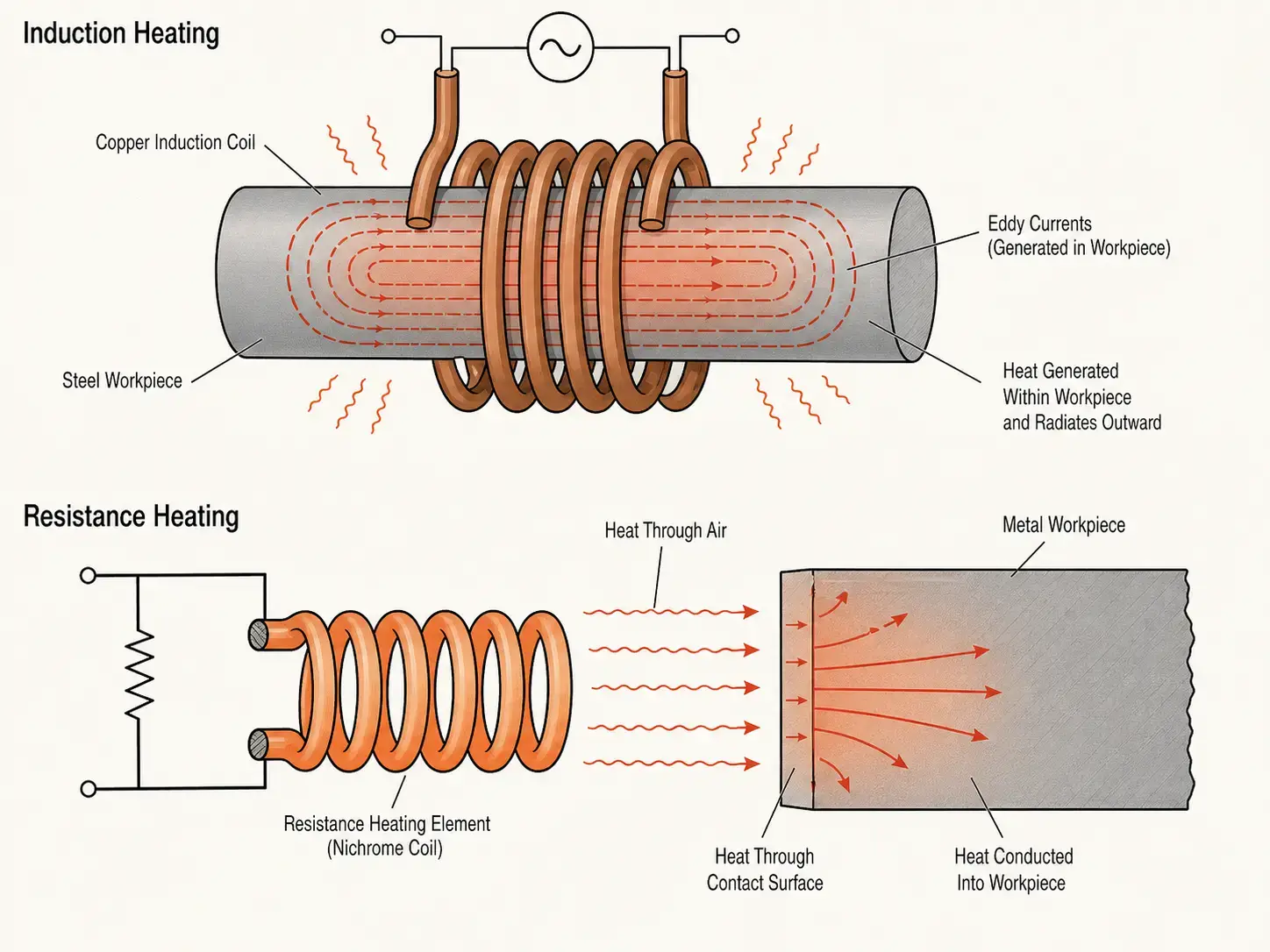
Induction heating uses an alternating electromagnetic field to generate heat directly inside an electrically conductive workpiece. An induction power supply sends alternating current through a copper coil, creating a magnetic field. When a metal part enters that field, eddy currents are induced within the part itself — and those currents generate heat from the inside out. The part is its own heat source. No contact. No warm-up delay. No intermediate medium.
Resistance heating passes current through a resistive element — a coiled wire, a rod, a cartridge, or a flat strip — and that element gets hot. Heat then transfers to the workpiece by conduction, convection, or radiation. In an oven or furnace, the element heats the chamber air and walls, which then heat the part. In direct-contact resistance heating, the hot element touches the part.
The practical difference is where heat is born. Induction generates it inside the metal. Resistance generates it in a separate element and moves it to the part. Everything else — speed, precision, efficiency, part distortion — follows from that one distinction.
2. Core Differences at a Glance
| Factor | Induction Heating | Resistance Heating |
|---|---|---|
| Heat generation | Inside the workpiece — electromagnetic induction | In a resistive element — Joule heating, then transferred |
| Heating rate | Seconds to reach target temperature | Minutes — element and chamber must heat up first |
| Localization | Precise — heat only the zone inside the coil | Broad — typically heats a chamber, platen, or contact area |
| Material compatibility | Electrically conductive materials only | Conductive and nonconductive — metals, plastics, ceramics |
| Warm-up time | None — instant-on, instant-off | Minutes to reach chamber or element setpoint |
| Automation readiness | Excellent — short cycles, easy PLC/robot integration | Moderate — better suited to batch or semi-automated processes |
3. Speed and Energy Efficiency
Heating speed is one of the strongest arguments for induction. Because heat is generated inside the part, there is no waiting for an element, furnace chamber, or platen to reach temperature. A steel shaft, gear, or billet can go from cold to forging or hardening temperature in seconds.
Resistance heating always involves a thermal handoff: element gets hot → air or contact surface gets hot → part gets hot. In batch furnaces, the entire chamber mass — refractory, fixtures, atmosphere — must soak before the workload reaches temperature. That overhead is acceptable for long-cycle batch processing. It becomes a bottleneck in high-throughput lines.
On the energy side, induction delivers a higher percentage of input power directly into the workpiece — typically 50–80% system efficiency when the coil is well-designed and the frequency is matched to the part. Resistance furnaces lose energy to chamber walls, exhaust, fixtures, and repeated thermal cycling. Efficiency alone does not always decide the choice — your cost per kWh vs. cycle time vs. scrap rate together determine ROI. For a deeper look at the numbers, see our induction heating power calculation guide.
4. Temperature Control and Process Repeatability
Induction systems provide precise, near-instantaneous power control. When combined with closed-loop pyrometer feedback and recipe-based automation, each part receives nearly identical heating conditions — critical for hardening, brazing, and any process with a tight temperature window.
Resistance heating can also hold temperature accurately, especially in furnaces with high thermal mass. But response is slower — you cannot change the temperature of a hot chamber or a large platen in seconds. If your process demands rapid ramp-up, step changes, or per-part profiling, induction responds faster.
Repeatability in production depends on more than the technology label. For induction, it hinges on consistent part positioning, coil condition, and power settings. For resistance, it depends on element health, contact quality, load distribution, and airflow uniformity. In both cases, a controlled process window matters more than the name on the equipment.
5. Material and Part Geometry
The first screening question is the simplest: is the workpiece electrically conductive? Induction requires it — steel, stainless steel, copper, brass, aluminum all work. Resistance heating can heat anything you can put in an oven or press against a hot surface: metals, plastics, ceramics, composites, adhesives.
For ferrous metals like carbon and alloy steels, induction couples efficiently with the magnetic field — especially below the Curie temperature — making it the go-to for hardening and forging preheat. Nonferrous metals like copper and aluminum can also be heated by induction, but they typically require higher power density and different frequency selection due to their lower resistivity.
Part geometry matters too. Induction performs best when the coil can wrap around or closely follow the part — shafts, gears, bearings, tubes, fasteners, and cylindrical components are ideal. Complex or irregular shapes may need custom coil engineering, flux concentrators, rotation, or scanning. Resistance heating is more forgiving of odd geometries when parts are simply placed in an oven, but direct-contact resistance heating struggles with poor or variable contact surfaces.
6. Equipment, Maintenance, and Integration
An induction system is more engineered than a basic resistance heater. It includes a power supply, induction coil, water cooling system, control interface, safety interlocks, and often part handling. That complexity is not a drawback when the payoff is speed, repeatability, and easy integration into automated cells.
Power supply sizing should be based on part mass, material, target temperature, cycle time, and production rate — not guesswork. Oversizing wastes capital. Undersizing creates slow cycles and unstable processes. Our power selection guide walks through the calculation.
Cooling is just as important. Induction coils and power electronics generate heat that must be removed reliably. Poor water quality, restricted flow, or undersized cooling shortens equipment life and causes unplanned downtime.
Resistance heating equipment is mechanically simpler but still requires maintenance: elements degrade, thermocouples drift, insulation breaks down, contact surfaces oxidize, and furnace temperature uniformity shifts over time. In direct-contact applications, surface cleanliness and pressure consistency directly affect heat transfer and part quality.
7. Common Industrial Applications
Both technologies have proven industrial use cases. The deciding factor is the process objective.
Induction heating is widely used for:
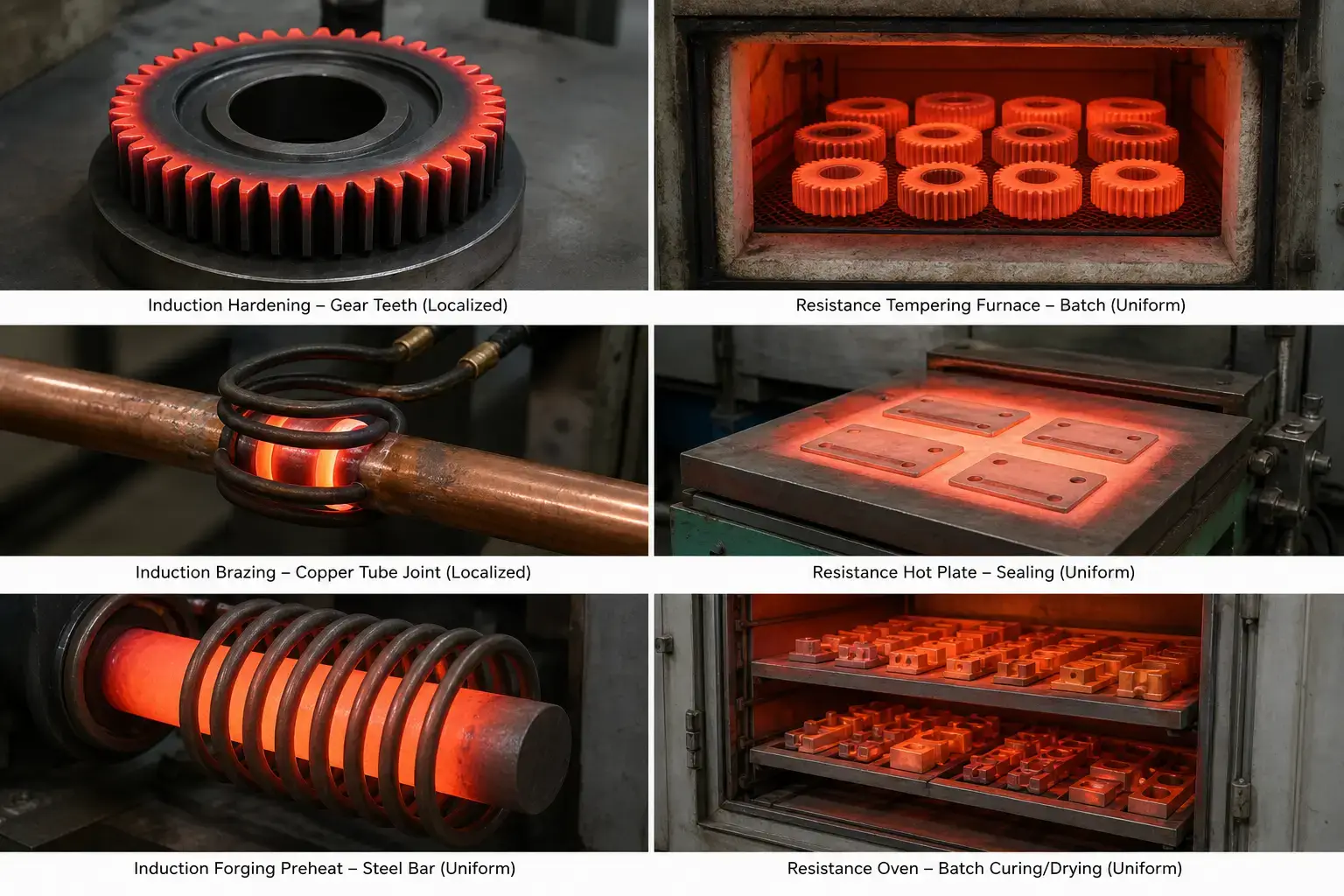
— Induction hardening — shafts, gears, pins, races, and bearing surfaces, where only the outer surface needs hardening while the core stays tough
— Brazing and soldering — carbide tool assembly, copper fittings, HVAC components, where localized joint heating prevents damage to adjacent materials
— Shrink fitting and thermal assembly — gears onto shafts, bearing rings into housings
— Forging billet preheat, annealing, and preheating before welding — fast, on-demand, minimal scale formation
Resistance heating is commonly used for:
— Batch tempering and stress relieving — large quantities of parts requiring uniform soak at moderate temperatures
— Drying, curing, and baking — coatings, adhesives, composite curing in controlled-atmosphere ovens
— Hot plate and platen heating — plastic sealing, forming, laboratory heating, low-volume processes
— Cartridge and strip heater applications — localized contact heating where simplicity matters more than speed
For more on specific processes, see our guides on common induction hardening defects and induction brazing best practices.
8. Quick Self-Score: Does Your Process Lean Induction?
Check each statement that applies to your application. The more boxes you check, the stronger the case for induction.
☐ My workpiece is electrically conductive (steel, stainless, copper, brass, aluminum).
☐ I need to heat only a specific zone — not the entire part.
☐ Cycle time under 60 seconds directly impacts my throughput.
☐ Temperature precision is critical to part quality, hardness, or joint integrity.
☐ Part geometry is cylindrical or regular enough for a coil to surround or closely follow it.
☐ I want to integrate heating into an automated cell with PLC and recipe control.
☐ Open flames, hot exhaust, or large heated chambers are undesirable in my facility.
☐ Reducing scrap, distortion, and part-to-part variation has measurable ROI for my operation.
Score 6–8: Induction is a strong fit. The technology was purpose-built for these conditions.
Score 3–5: You are in the gray zone. Run a sample test on your actual parts — the process result, not the spec sheet, should decide.
Score 0–2: Resistance heating likely fits your process better. Revisit Sections 5 through 7 above for guidance on batch, nonconductive, or long-soak applications.
Key Takeaway
Induction heating vs resistance heating is not about which technology is universally superior. It is about which one aligns with your material, geometry, cycle time, and production environment. Induction dominates when speed, localization, and repeatability matter — hardening, brazing, forging preheat, shrink fitting. Resistance heating holds its ground for batch processing, nonconductive materials, long soak cycles, and applications where simplicity outweighs speed. Start with the part, not the technology, and the answer usually becomes clear.
Q: What is the main difference between induction heating and resistance heating?
A: Induction generates heat directly inside a conductive workpiece using an electromagnetic field — the part is its own heat source. Resistance heating generates heat in a separate element (coiled wire, cartridge, strip) and transfers it to the part by conduction, convection, or radiation.
Q: Is induction heating always more energy efficient than resistance heating?
A: Not always. Induction is often more efficient for fast, localized heating of metals because less energy is wasted heating air, fixtures, or furnace mass. But actual efficiency depends on coil design, frequency match, coupling distance, and power supply selection. A poorly designed induction system can underperform a well-tuned resistance furnace.
Q: Can induction heating fully replace a resistance furnace?
A: Partially. Induction can replace resistance furnace heating when the process needs fast, localized heating of conductive parts — hardening, brazing, forging preheat. A resistance furnace is still better for batch tempering, long soak cycles, atmosphere-controlled processing, or heating nonconductive materials like plastics and ceramics.
Q: What should I prepare before contacting an induction heating equipment supplier?
A: Have your material grade, part drawings, target temperature, heating zone, cycle time target, and annual production volume ready. If possible, send sample parts for a process trial — nothing replaces a real test run on your actual workpiece.
Trying to Decide Between Induction and Resistance Heating?
Send us your workpiece details and process requirements. We will evaluate whether induction fits your application — and recommend a system matched to your parts, not a one-size-fits-all quote.