
Induction Hardening of Construction Machinery Drive Wheels: Single-Shot vs. Tooth-by-Tooth Scanning — How to Choose
Construction machinery drive wheels endure enormous alternating loads in harsh operating environments. The fatigue strength at the tooth root directly determines the service life of the entire component, making the choice of induction hardening process a decision with long-term operational consequences. This article compares the two dominant approaches — single-shot hardening and tooth-by-tooth scanning — across power requirements, frequency selection, hardened layer characteristics, and production economics, so you can make an informed decision for your manufacturing line.
📋 Table of Contents
1. Single-Shot Hardening Process
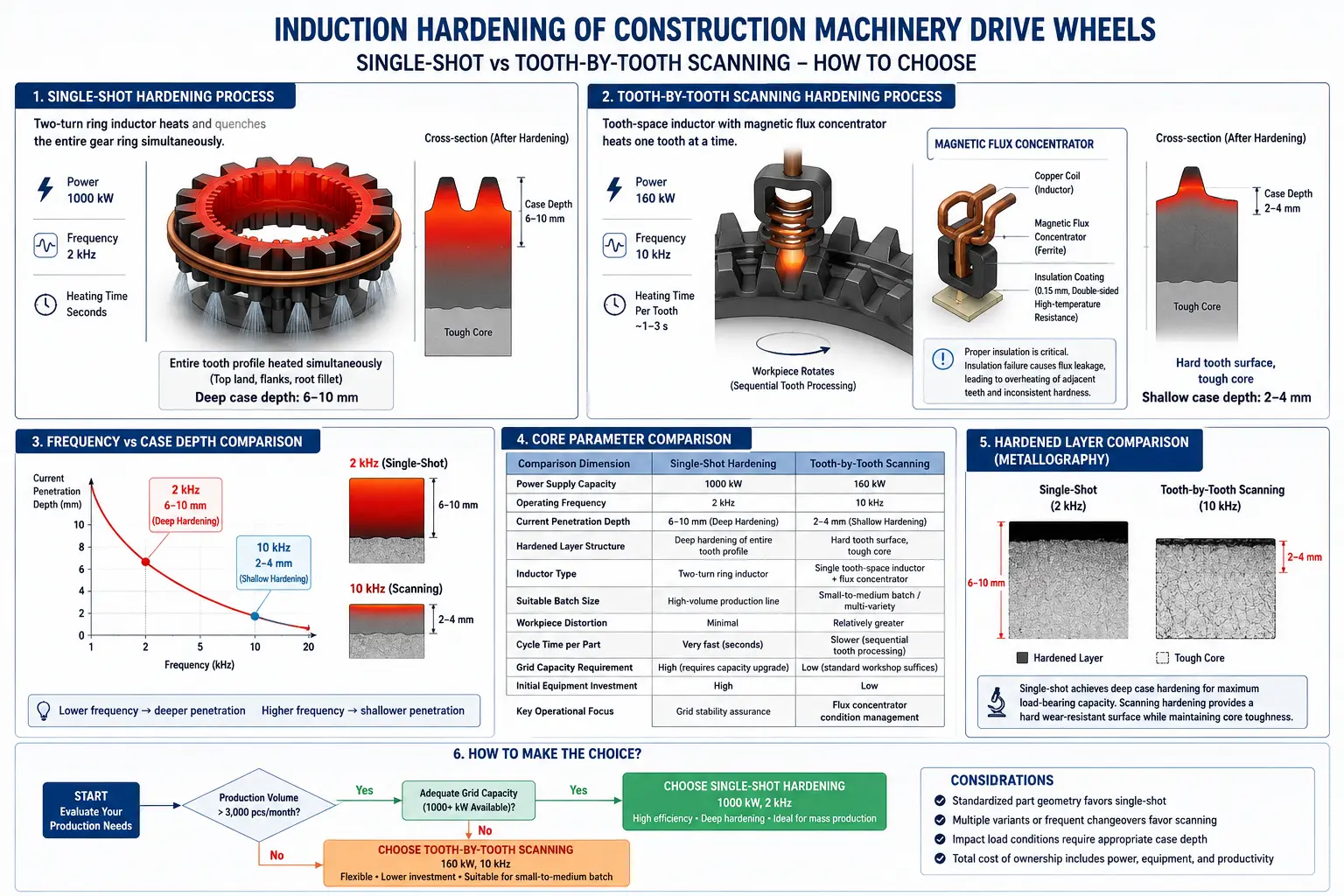
The ideal configuration is a 1000 kW medium-frequency power supply operating at approximately 2 kHz, using a two-turn inductor to simultaneously heat and quench the entire gear ring. Frequency selection directly determines the depth and distribution of the hardened layer. The 2 kHz medium-frequency current provides deep penetration (typically in the range of 6–10 mm), enabling synchronous deep hardening of the entire tooth profile — including the tooth tip, tooth flanks, and root transition zone. This is critically important for construction machinery drive wheels subjected to enormous alternating loads, as the fatigue strength at the tooth root directly determines the service life of the component.
Key Characteristics
- Extremely high power density enables heating completion within seconds
- Short heating time minimizes heat conduction toward the core, resulting in minimal workpiece distortion and very little surface oxidation
- Ideal for high-volume production lines
- Critical warning: Do not compensate for insufficient grid power by reducing power and forcibly extending heating time — this causes substantial heat transfer into the gear core, leading to burn-through and severe deformation
2. Tooth-by-Tooth Scanning Hardening Process
Power requirement is only 160 kW, with a frequency of approximately 10 kHz. The inductor must be equipped with a magnetic flux concentrator to forcibly concentrate the magnetic field within a single tooth space. This process requires the flux concentrator insulation coating to have a thickness of 0.15 mm with double-sided high-temperature resistance — if the insulation fails, magnetic flux leakage will cause abnormal temperature rise in adjacent tooth spaces, directly compromising quenching quality consistency.
Regarding frequency, the 10 kHz current provides a shallower penetration depth (typically 2–4 mm). Combined with the magnetic field concentration effect of the flux concentrator, energy is precisely confined to the surface area of a single tooth, producing a hardened layer that is relatively shallow but extremely hard (typically reaching HRC 58–62). This effectively prevents the tooth core from becoming brittle and maintains core toughness. This “hard case + tough core” microstructure holds significant engineering value for drive wheels subjected to impact loading.
Key Characteristics
- Low initial equipment investment with modest factory grid capacity requirements
- Well-suited for small-to-medium batch sizes or complex, multi-variety flexible manufacturing
- Produces a “hard case + tough core” microstructure ideal for impact-loaded drive wheels
- Drawback: Teeth are quenched sequentially, resulting in a slower overall production cycle
3. Core Parameter Comparison Between the Two Processes
The table below summarizes the key differences across all critical dimensions. Different combinations of frequency, power, heating time, and coil geometry produce markedly different hardened layer distributions on the same workpiece — this is the fundamental reason the two processes differ significantly in frequency configuration. (Reference: Gear Solutions — Induction Gear Hardening Part 2)
| Comparison Dimension | Single-Shot | Tooth-by-Tooth Scanning |
|---|---|---|
| Power Supply Capacity | 1000 kW | 160 kW |
| Operating Frequency | 2 kHz | 10 kHz |
| Current Penetration Depth | 6–10 mm (deep hardening) |
2–4 mm (shallow hardening) |
| Hardened Layer Structure | Deep hardening of entire tooth profile | Hard tooth surface, tough core |
| Inductor Type | Two-turn ring inductor | Single tooth-space inductor + flux concentrator |
| Suitable Batch Size | High-volume production line | Small-to-medium batch / multi-variety |
| Workpiece Distortion | Minimal | Relatively greater |
| Cycle Time per Part | Very fast (seconds) | Slower (sequential tooth processing) |
| Grid Capacity Requirement | High (requires capacity upgrade) | Low (standard workshop suffices) |
| Initial Equipment Investment | High | Low |
| Key Operational Focus | Grid stability assurance | Flux concentrator condition management |
4. How to Make the Choice
If the factory pursues high output and standardized operations, choose the 1000 kW single-shot process and amortize equipment costs through high efficiency. If the factory handles small-to-medium batches, multiple gear variants, or has limited grid capacity, the 160 kW tooth-by-tooth scanning process offers lower upfront investment and greater production flexibility without requiring infrastructure upgrades.
Beyond these two primary factors, also consider: (1) part geometry complexity — gears with irregular tooth profiles or limited access may favor scanning; (2) hardness specification uniformity requirements — single-shot delivers more consistent results across the entire gear ring; (3) future production growth — if volumes are projected to increase substantially, investing in single-shot upfront may reduce per-part cost over the equipment lifecycle.
FAQ: Common Questions About Drive Wheel Induction Hardening
Q1: When should I choose single-shot over tooth-by-tooth scanning?
Choose single-shot (1000 kW, 2 kHz) when you have high-volume production (thousands of units per month), a power grid that can support 1000+ kW, and standardized part geometries. Choose tooth-by-tooth scanning (160 kW, 10 kHz) for small-to-medium batches, limited grid capacity, or when processing multiple gear variants on the same production line.
Q2: Why is the frequency different between the two processes?
Frequency directly controls current penetration depth. At 2 kHz, the current penetrates 6–10 mm, achieving deep case hardening across the entire tooth profile — essential for heavy-duty drive wheels. At 10 kHz, penetration is 2–4 mm, producing a hard wear-resistant surface while keeping the tooth core tough. Deeper is not always better; the choice depends on load conditions and failure mode analysis.
Q3: How critical is the magnetic flux concentrator in scanning hardening?
It is absolutely critical. Without a properly functioning flux concentrator, the magnetic field disperses beyond the target tooth space, heating adjacent teeth and compromising hardness consistency. The 0.15 mm insulation coating with double-sided high-temperature resistance is a key quality control point — inspect it regularly as part of your preventive maintenance schedule.
Q4: What quality issues should I watch for in production?
For single-shot: monitor grid voltage stability, as fluctuations directly affect heating consistency. For scanning: regularly check flux concentrator insulation integrity, coil-to-tooth alignment, and scan speed uniformity. Both processes require periodic hardness testing and case depth measurement to validate process stability. Implement a statistical process control (SPC) program to detect drift before it produces non-conforming parts.
Contact Us for a Free Application Consultation
If you need an induction hardening solution tailored to specific components, please contact our engineering team for a technical evaluation. Our engineers can provide a free process solution assessment — simply provide the workpiece drawing, material grade, and production capacity requirements, and we will deliver a preliminary power supply configuration and inductor design proposal within 48 hours.
Take the next step: Send us your workpiece drawing and material specifications. Our application engineers will design a complete induction hardening solution — including power supply configuration, inductor design, and process parameters — at no cost and with a 48-hour turnaround.


Leave a Reply
Want to join the discussion?Feel free to contribute!