
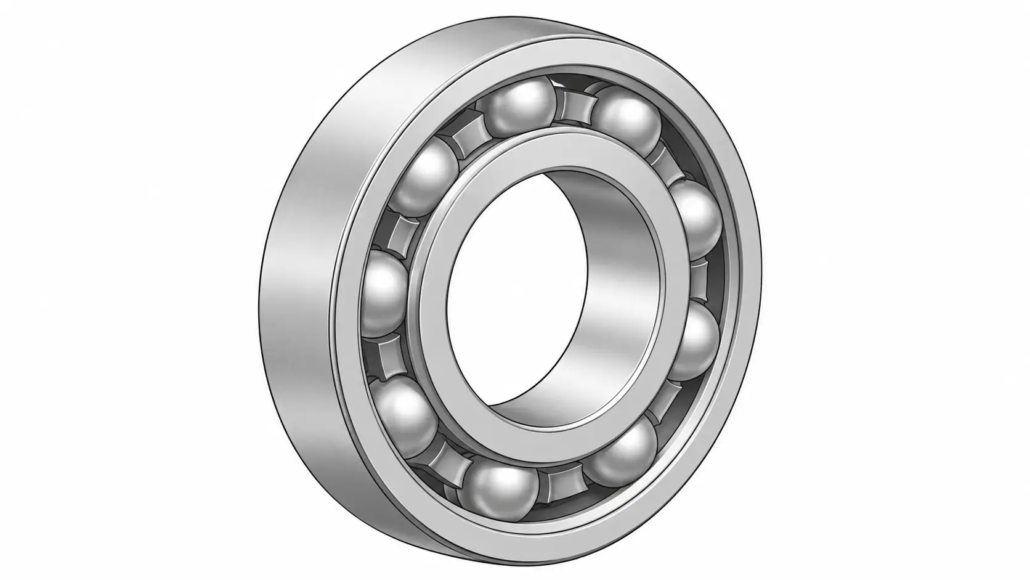
Induction Heating for Bearing Mounting: Temperature Control, Thermal Expansion and Installation Accuracy
A Practical Guide to Heating Conditions, Temperature Limits and Interference Fit Accuracy
When a bearing has an interference fit with its shaft, mounting it at room temperature can require considerable force. For medium and large bearings, this can make installation difficult and increase the risk of damaging the bearing or its mating surfaces.
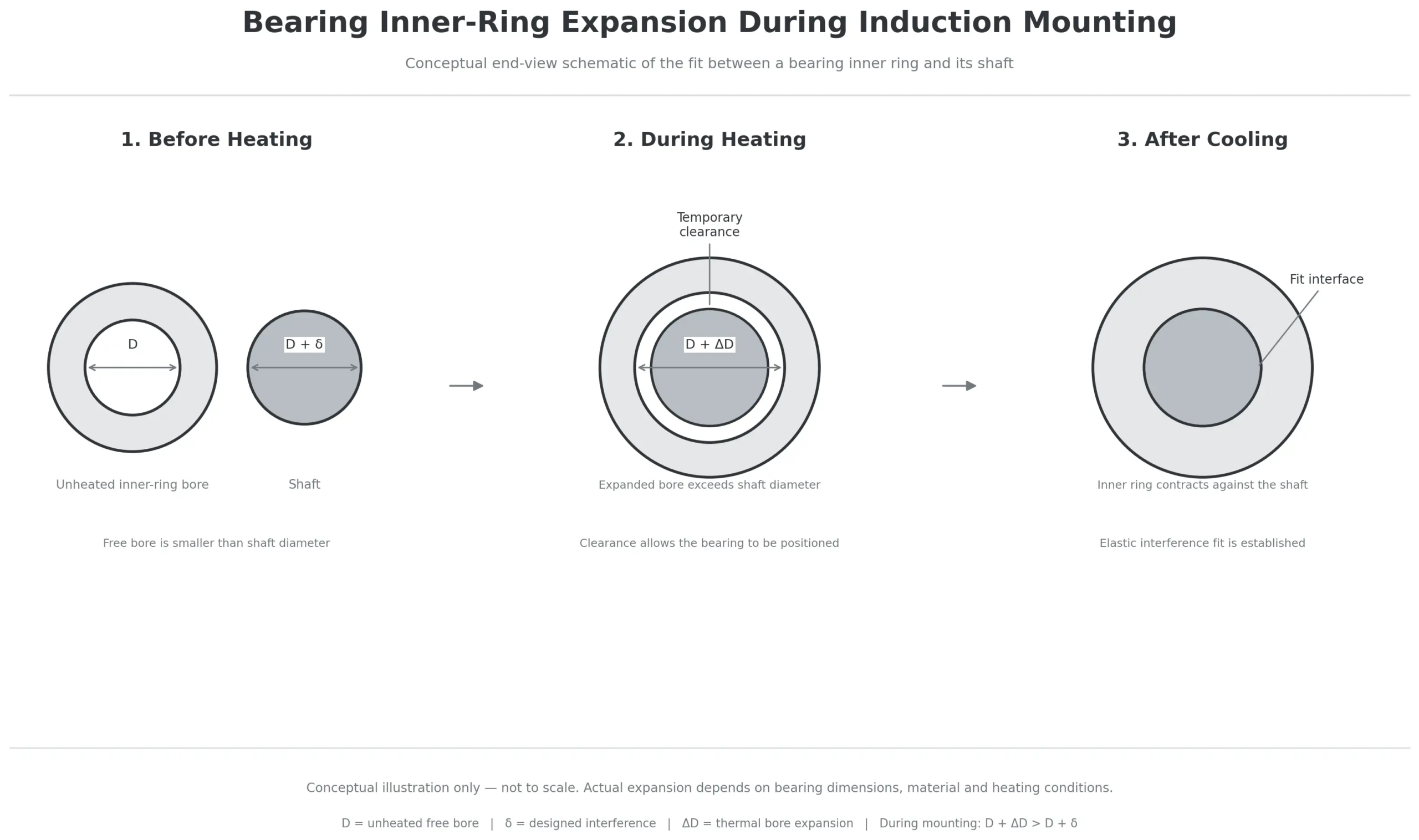
Induction heating provides a controlled way to overcome this problem. By heating the bearing, its rings expand and the bore temporarily becomes larger. The bearing can then be positioned on the shaft with less mechanical force. As it cools, the inner ring contracts and establishes the required interference fit.
However, successful bearing mounting involves more than reaching a target temperature. The required expansion, temperature distribution, transfer time and final seating position all affect the result.
This article explains how induction heating is used for bearing mounting, how to determine the required heating conditions and what needs to be checked to achieve an accurate installation.
2. Thermal Expansion and the Required Mounting Clearance
3. Bearing Temperature Control and Heating Limits
4. From Induction Heating to Final Installation
5. Bearing Fit and Installation Accuracy
6. Common Problems During Bearing Mounting
7. Selecting an Induction Heating System for Bearing Mounting
1. Why Induction Heating Is Used for Bearing Mounting
An interference fit is commonly used between a bearing inner ring and its shaft to prevent relative movement during operation.
For smaller bearings, mechanical mounting tools may be sufficient. As bearing size and interference increase, however, the required mounting force can become substantial.
If mounting force is transmitted through the rolling elements rather than applied directly to the ring with the interference fit, the raceways can develop permanent indentations known as brinelling. This may lead to increased vibration, noise and premature bearing failure.
Induction heating reduces the force required by temporarily expanding the bearing before installation.
It is particularly useful for:
•Medium and large rolling bearings
•Bearings with relatively heavy interference fits
•Repeated bearing installation in industrial production
•Applications where controlled heating is preferable to manual heating methods
Which component should be heated?
The installation arrangement determines the heating method.
When the inner ring has an interference fit with the shaft, heating the bearing is a common approach. The resulting expansion of the inner ring increases the bore diameter and facilitates mounting.
If the outer ring has an interference fit with the housing, heating the housing may be considered instead. This requires a suitable heating arrangement and consideration of surrounding components.
Where both fits are tight, the installation sequence must be evaluated as a complete assembly operation.
Induction heating is not appropriate for every bearing. Precision bearings, sealed bearings, sensor-integrated units and bearings containing temperature-sensitive materials may have specific restrictions. The manufacturer’s instructions should be checked before selecting the heating method.
2. Thermal Expansion and the Required Mounting Clearance
2.1 How Much Expansion Is Needed?
The required heating temperature is primarily related to the interference between the bearing bore and the shaft.
When the bearing inner ring expands, the difference between the two mating diameters decreases. The aim is to provide enough temporary clearance for the bearing to reach its specified position without excessive force.
A useful distinction is that eliminating the original interference is not necessarily enough. Some additional clearance is normally needed to allow the bearing to move into position.
For an initial engineering estimate, the free thermal expansion of a diameter can be expressed as:
Δd ≈ α × d × ΔT
Where:
•Δd = approximate diameter expansion
•α = linear thermal expansion coefficient
•d = original diameter
•ΔT = temperature increase
This relationship provides a preliminary estimate. Actual mounting conditions also depend on dimensional tolerances, temperature distribution, heat loss and the required assembly clearance.
The maximum interference should be determined from the actual shaft and bearing dimensions, rather than relying only on nominal diameters.
2.2 Why Transfer Time Matters
A calculated expansion value does not guarantee that the same clearance will be available when the bearing reaches the shaft.
Once heating stops, the bearing begins to cool. Its bore gradually contracts, reducing the available assembly clearance.
This becomes particularly important when:
•The bearing is large or heavy
•The shaft is long
•The installation position is difficult to access
•The bearing must be moved over a considerable distance
•The ambient temperature is relatively low
For this reason, the target temperature and installation procedure should be planned together.
The heating station should be positioned as close as practical to the installation point, and the lifting equipment and positioning tools should be ready before heating begins.
For a more detailed explanation of the expansion calculation, see our related guide: How to Calculate Shrink Fit Heating Temperature. The same expansion principle is applied in other shrink-fitting operations, such as induction heating for motor rotor installation.
3. Bearing Temperature Control and Heating Limits
3.1 Setting the Target Temperature
There is no single heating temperature suitable for all bearings.
The target depends on the required expansion, bearing construction and manufacturer’s temperature limitations.
A higher temperature produces greater expansion, but it can also affect the bearing’s metallurgical condition, lubricant and sealing materials.
Two bearings with similar dimensions may therefore require different heating conditions if they have different clearance classes, sealing arrangements or lubrication specifications.
The heating target should be established from the actual interference fit and checked against the permissible temperature for the specific bearing.
3.2 Temperature Limits Depend on Bearing Design
Published manufacturer guidance illustrates why temperature limits should not be treated as universal values.
| Reference | Published guidance |
|---|---|
| Schaeffler HEATER BA 94 | Maximum 120°C for rolling bearings and 70°C for precision bearings |
| SKF bearing mounting guidance | Sealed bearings with contact seals or shields should not be heated above 80°C in the cited guidance |
Schaeffler also notes that lubricated bearings with seals may have different permissible maximum temperatures.
These figures are examples from specific manufacturer documents, not interchangeable limits for every bearing.
Before heating, check the exact bearing model, including its seals, grease, internal clearance and precision requirements.
3.3 Measuring the Correct Temperature
Temperature measurement is only useful when the sensor is positioned correctly.
For many bearing heating arrangements, the inner ring is the critical measurement location because its bore expansion determines whether the bearing can be mounted on the shaft.
Schaeffler’s induction heater instructions describe positioning the temperature sensor on the end face of the inner ring, close to the bore.
The sensor should make proper contact with a clean measurement surface.
For large bearings or applications where temperature differences between the rings are important, monitoring both inner and outer ring temperatures can provide additional process information.
A temperature reading at one location should not automatically be interpreted as proof that the entire bearing has reached a uniform temperature.
3.4 Controlling the Temperature Difference Between Rings
The inner and outer rings do not necessarily heat at the same rate.
Depending on bearing geometry and heating conditions, the inner ring may become hotter than the outer ring. A large temperature difference can create thermal stresses and affect the mounting process.
Some industrial induction heaters provide ramp control or differential-temperature control.
These functions help manage the heating rate and the temperature difference between the rings. They are particularly relevant when processing large bearings, precision bearings or components with relatively thick cross-sections.
The appropriate control method should be established through the actual bearing geometry and heating requirements.
4. From Induction Heating to Final Installation
A reliable mounting process requires preparation before the bearing enters the heater.
4.1 Prepare the Bearing and Installation Area
Check the bearing identification, mounting instructions and permissible heating temperature.
The shaft and bearing seats should be inspected for dimensional accuracy, cleanliness and surface damage.
Prepare the lifting equipment, positioning tools and installation area before starting the heating cycle. This avoids unnecessary delays after the bearing reaches its target temperature.
4.2 Heat and Monitor the Bearing
Position the bearing according to the induction heater manufacturer’s instructions.
The support yoke, temperature sensor and heating arrangement must be suitable for the bearing dimensions and weight.
The heating cycle may use temperature control, time control or ramp control, depending on the equipment and application.
For repeated production, temperature-based control is generally useful when starting conditions or component dimensions vary. Time-based settings should be established through testing with consistent workpieces and process conditions.
The heating cycle should be monitored rather than relying exclusively on a previously established heating time.
4.3 Demagnetize Before Installation
Induction heating can leave residual magnetism in a bearing.
If the bearing is not properly demagnetized, it may attract ferrous particles during handling and installation. Contamination on the raceways or rolling elements can affect bearing performance.
Many industrial induction bearing heaters include an automatic demagnetization cycle.
Where the equipment does not provide this function, an appropriate demagnetization procedure should be followed according to the equipment manufacturer’s instructions.
Demagnetization is therefore an important part of the bearing heating process, not simply an optional finishing operation.
4.4 Transfer and Position the Heated Bearing
Once heating and demagnetization are complete, transfer the bearing to the shaft promptly.
Use suitable lifting equipment for large bearings and avoid placing unnecessary loads on the cage, seals or other sensitive components.
The bearing should be aligned with the shaft before it is moved into its final position.
If the bearing begins to cool before reaching the required position, its bore may contract and the available clearance may disappear. Do not compensate by applying uncontrolled impact force.
The installation method should allow the bearing to reach the specified axial position without transmitting excessive force through the rolling elements.
Where required by the bearing manufacturer’s procedure, maintain the bearing against the shaft shoulder while it cools.
4.5 Safety During Heating and Handling
Bearing heating involves high temperatures, electrical equipment and electromagnetic fields.
Operators should follow the equipment manufacturer’s safety instructions, including:
•Wearing suitable heat-resistant gloves, safety footwear and eye protection
•Using lifting equipment appropriate for the bearing weight
•Keeping watches and loose metallic objects away from the active heating area
•Observing electromagnetic safety requirements, particularly for personnel with pacemakers or other medical implants
•Avoiding contact with hot workpieces
•Providing suitable ventilation where smoke or vapour may be produced
Only trained personnel should operate the heating and handling equipment.
5. Bearing Fit and Installation Accuracy
Reaching the correct heating temperature does not, by itself, confirm that the bearing has been installed correctly.
The final fit must be checked against the assembly drawing and the bearing manufacturer’s requirements.
5.1 Inspecting Shaft and Housing Seats
Before mounting, check the actual dimensions of the mating components.
Important inspection points include:
•Shaft seat diameter and tolerance
•Housing bore diameter and tolerance, where applicable
•Surface condition and cleanliness
•Roundness and cylindricity where specified
•Shoulder dimensions and seating surfaces
Incorrect shaft dimensions cannot be corrected by increasing the bearing heating temperature.
The fit should be established from the specified dimensional tolerances.
5.2 Checking Alignment and Axial Position
During installation, the bearing must remain aligned with the shaft.
Misalignment can cause the bearing to stick before reaching its final position, potentially damaging the shaft seat or bearing bore.
Guide sleeves and positioning fixtures can be useful for large bearings or assemblies with limited access.
The bearing should reach the specified locating shoulder or axial position without unnecessary mechanical force.
5.3 Understanding Internal Clearance After Mounting
Bearing internal clearance changes during installation.
When the inner ring is mounted with an interference fit on the shaft, it expands elastically. This generally reduces radial internal clearance.
An interference fit between the outer ring and housing can also influence the final clearance.
Operating temperature differences between the inner and outer rings may further affect the clearance during service.
Consequently, the initial bearing clearance class must be considered together with the shaft fit, housing fit and operating conditions.
For applications where clearance reduction is part of the installation specification, it should be measured using the appropriate method rather than inferred from the heating temperature.
5.4 Additional Requirements for Tapered Bore Bearings
Tapered bore bearings require a different approach from many cylindrical bore bearings.
Their final fit is commonly established by controlled axial drive-up onto a tapered seat or adapter sleeve.
Depending on the bearing type, installation may be verified through:
•Reduction in radial internal clearance
•Axial drive-up distance
•Specified mounting position
•Other manufacturer-defined measurement procedures
Heating may be used where permitted, but the heating temperature does not establish the final fit of a tapered bore bearing.
The specified mounting procedure must still be followed.
6. Common Problems During Bearing Mounting
The following table summarizes problems that can occur during induction bearing mounting and the checks that should be made before changing the heating settings.
| Problem | Possible cause | What to check |
|---|---|---|
| Bearing cannot reach the shaft shoulder | Insufficient expansion or excessive interference | Actual shaft and bore dimensions, target temperature and transfer time |
| Bearing temperature exceeds the limit | Incorrect setpoint or sensor placement | Bearing manufacturer’s temperature limit and sensor contact |
| Large temperature difference between rings | Heating rate or workpiece arrangement unsuitable | Inner and outer ring temperatures, support and heating configuration |
| Bearing becomes stuck during transfer | Excessive cooling before installation | Transfer distance, handling sequence and installation preparation |
| Bearing is not seated correctly | Misalignment or incorrect axial positioning | Shaft shoulder, guide arrangement and final position |
| Residual magnetism remains | Incomplete or absent demagnetization | Demagnetization cycle and residual magnetism measurement where required |
| Final internal clearance is incorrect | Incorrect fit selection or dimensional conditions | Initial clearance, shaft fit, housing fit and specified verification method |
Increasing the heating temperature should not be the first response to every installation problem.
Dimensional errors, poor alignment and excessive transfer time can produce similar symptoms but require different corrective actions.
7. Selecting an Induction Heating System for Bearing Mounting
The appropriate induction heating system depends on the bearing and the installation process, not simply the bearing outside diameter.
Before selecting equipment, the following information should be established.
| Application information | Why it matters |
|---|---|
| Bearing type and model | Identifies construction and manufacturer restrictions |
| Bore, outside diameter and width | Defines the workpiece geometry |
| Bearing weight | Affects heating capacity and lifting arrangements |
| Shaft diameter and tolerance | Establishes the interference fit |
| Bearing clearance class | Influences mounting and heating requirements |
| Seals and lubrication | Determines permissible temperature |
| Required mounting temperature | Defines the target heating condition |
| Heating cycle time | Determines production capacity |
| Daily production quantity | Influences equipment configuration |
| Installation position | Determines handling and transfer arrangements |
For repeated production, additional features may include automatic temperature control, ramp control, differential-temperature monitoring, automatic demagnetization and stored heating programs.
For large bearings, the heating arrangement and lifting system should be considered together. A heater capable of reaching the required temperature is not necessarily suitable if the bearing cannot be transferred and positioned safely within the available installation time.
The final configuration should be evaluated using the actual bearing dimensions, fit requirements and production conditions.
Frequently Asked Questions
Click a question to expand the answer.
What temperature should a bearing reach before installation?
There is no universal target temperature. It depends on the interference fit, required assembly clearance, bearing design and manufacturer’s permissible temperature. The target should be calculated from the actual fit and verified against the bearing documentation.
Can all bearings be mounted using induction heating?
No. Many steel rolling bearings are suitable for induction hot mounting, but some precision, sealed, sensor-integrated and special bearing designs have additional restrictions. Always check the manufacturer’s instructions before heating.
Why does an induction-heated bearing need demagnetization?
Induction heating can leave residual magnetism in the bearing. This may attract ferrous particles to the raceways and rolling elements. Demagnetization reduces the risk of magnetic contamination during installation.
Does induction heating affect bearing internal clearance?
Heating temporarily changes the dimensions of the bearing rings. After mounting, the interference fit between the inner ring and shaft generally reduces radial internal clearance. The final clearance also depends on the outer ring fit and operating temperature conditions.
Can sealed bearings be induction heated?
Some sealed bearings can be heated if the manufacturer permits it and the temperature remains within the limits of the seals and lubricant. Others may have more restrictive mounting requirements. The specific bearing documentation should always take priority over general heating recommendations.
Conclusion
Induction heating makes it possible to mount many interference-fit bearings with less mechanical force by expanding the bearing before installation.
The quality of the installation depends on more than the temperature displayed by the heater. The actual interference, required expansion, temperature distribution, demagnetization, transfer time and final seating position must all be considered.
For industrial production, these factors should be treated as parts of one coordinated mounting process.
When the heating system is matched to the bearing and installation requirements, induction heating can provide a controlled and repeatable approach to bearing mounting. For the reverse operation of removing a fitted bearing, see our guide on induction bearing removal.
Technical References
1. SKF – Rolling Bearings and Seals in Electric Motors and Generators
2. SKF – Bearing Contamination
3. Schaeffler – Induction Heating Devices HEATER, Operating Instructions BA 94
4. Schaeffler – Induction Heating Devices HEATER, Operating Instructions BA 42
5. NTN – Bearing Mounting Instructions
Need Induction Heating for Bearing Mounting?
Tell us your bearing type and dimensions, interference fit, permissible temperature and production requirements. KECHUANG can help you evaluate a suitable induction heating arrangement for accurate, repeatable bearing installation.


