
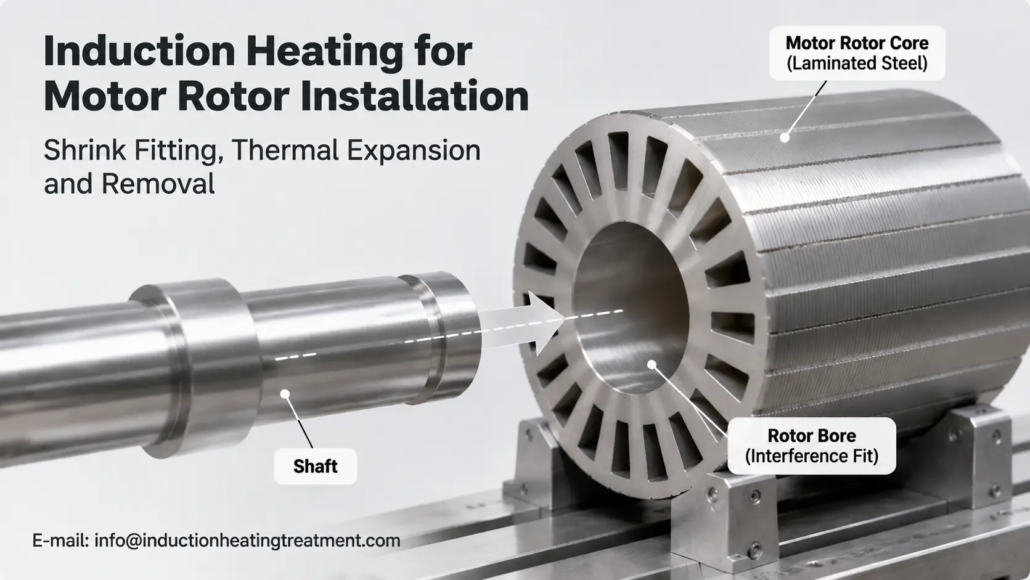
Induction Heating for Motor Rotor Installation: Shrink Fitting, Thermal Expansion and Removal
A Technical Guide to Rotor-to-Shaft Assembly, Heating Limits and Disassembly Considerations
Motor rotor installation sometimes requires a precise interference fit between the rotor core and its shaft. Induction heating can be used to expand the rotor bore temporarily, allowing the shaft to be inserted before the rotor cools and establishes the required fit.
This process is known as motor rotor shrink fitting or rotor-to-shaft shrink fitting.
However, not every motor rotor is designed for thermal assembly. Different rotor constructions, permanent magnet materials, interference requirements and temperature limits can lead to different installation methods.
This guide explains how induction heating is used for motor rotor assembly, why rotor construction matters, and what engineers should consider before selecting a heating process.
2. Why Use Induction Heating for Motor Rotor Installation?
3. How Rotor Construction Affects Heating Requirements
4. What Determines Heating Conditions and Assembly Quality?
5. Motor Rotor Removal by Induction Heating
6. When Should Induction Heating Be Considered?
1. What Is Motor Rotor-to-Shaft Shrink Fitting?
Motor rotor shrink fitting is a thermal assembly method used to join a rotor core to a shaft or sleeve through an interference fit.
The rotor bore is heated to expand its internal diameter. The shaft is then inserted while sufficient assembly clearance is available. As the rotor cools, the bore contracts and establishes the designed interference between the two components.
A typical rotor-to-shaft shrink-fitting process involves:
①Preparing and inspecting the rotor and shaft dimensions.
②Heating the rotor core to the specified assembly condition.
③Positioning the shaft and aligning it with the rotor bore.
④Inserting the shaft before the assembly clearance is lost.
⑤Allowing the assembly to cool according to the specified procedure.
⑥Inspecting the completed assembly.
Shrink Fitting vs. Press Fitting
Both methods are used to establish interference fits, but their assembly mechanisms differ.
Press fitting uses mechanical force to push the shaft into the rotor bore. Shrink fitting uses thermal expansion to create temporary clearance before insertion.
A 2018 research paper, Optimization of Rotor Shaft Shrink Fit Method for Motor Using Robust Design, investigated high-frequency induction heating as an alternative to conventional press fitting.
The research addressed rotor shaft deflection associated with unbalanced loading during press fitting. Its experimental results demonstrated the feasibility of induction shrink fitting under the specific conditions studied.
This does not mean shrink fitting is universally superior. The appropriate assembly method depends on rotor construction, mechanical requirements and manufacturing specifications.
2. Why Use Induction Heating for Motor Rotor Installation?
Induction heating generates heat in electrically conductive materials through electromagnetic induction.
An alternating current passes through the induction coil, creating a magnetic field. This field induces electrical currents in the rotor material, generating heat within the component.
For motor rotor installation, induction heating offers several potential advantages.
Localized and Controlled Heating
An induction coil can be designed around the rotor geometry and the region requiring thermal expansion.
This helps direct energy into the rotor assembly without necessarily heating the entire surrounding equipment.
Short Heating Cycles
Induction heating can deliver energy rapidly, making it suitable for production environments where rotor preparation and shaft insertion must follow a coordinated assembly sequence.
Repeatable Production Conditions
Power output, heating time, temperature monitoring and workpiece positioning can be coordinated to establish a repeatable process.
For repeated motor rotor assembly, a validated heating recipe can help maintain consistent production conditions.
Coil Configuration for Rotor Geometry
The induction coil must be designed around the rotor’s dimensions, construction and required heating distribution.
Two possible arrangements are:
— Internal Diameter (ID) Heating: The induction coil is positioned inside the rotor bore.
— Outer Diameter (OD) Heating: The coil is positioned around the outside of the rotor.
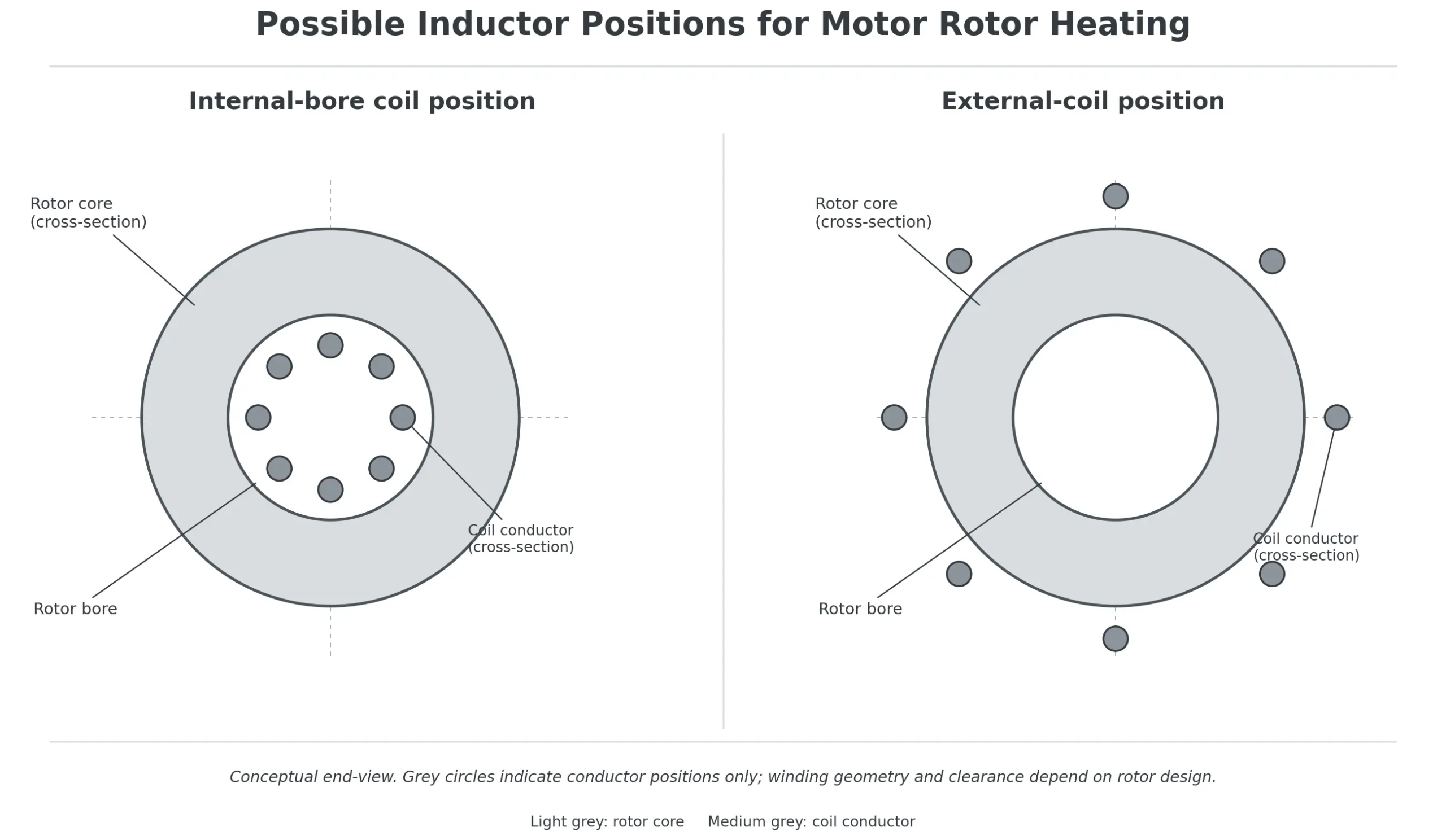
According to Ambrell’s induction heating application guide, ID heating can provide more effective energy delivery for certain laminated steel rotor assemblies.
In some rotor designs, OD heating can cause localized overheating in thin sections between magnet slots and the outer circumference.
However, OD heating can also be practical for other rotor geometries.
The appropriate coil arrangement must therefore be determined through workpiece evaluation and application testing rather than assuming one configuration is suitable for every motor rotor.
3. How Rotor Construction Affects Heating Requirements
One of the most important considerations in motor rotor shrink fitting is the rotor’s internal construction.
Two rotors with similar external dimensions may have very different thermal limitations.
Laminated Steel Rotor Cores
Many electric motor rotors use stacks of electrical steel laminations.
These structures have different electrical and thermal characteristics from a solid steel component.
During induction heating, the coil arrangement, lamination geometry and heat conduction through the stack influence the overall heating process.
Engineers need to consider:
— Rotor bore diameter and core length
— Lamination stack construction
— Magnet slots and other internal features
— End rings and supporting structures
— Required temperature distribution
The objective is to achieve the required expansion without creating excessive local heating.
Permanent Magnet Rotors
Permanent magnet motors require particular attention because excessive temperature can affect magnet performance.
The allowable temperature depends on the magnet material, rotor design and manufacturer’s specifications.
For example, a Mitsubishi Electric spindle motor manual specifies different heating requirements for different rotor types:
— Its specified IM rotor assembly uses a recommended heating temperature of 300–350°C.
— Its specified IPM rotor assembly must be heated to 130°C or less.
These are manufacturer-specific instructions, not general induction heating parameters. The manual also specifies furnace heating to obtain an even temperature distribution.
See the Mitsubishi Electric SJ-B Series Specifications and Instruction Manual.
Another Mitsubishi manual describes rotor designs using different assembly arrangements, including press fitting and bolted sleeve connections. It also specifies a 130°C maximum for the SPM rotor covered by its relevant instructions.
See the Mitsubishi Electric SJ-BG Series Manual.
These examples demonstrate why motor rotor installation cannot be assigned one universal heating temperature.
Before applying induction heating, engineers must verify the rotor manufacturer’s temperature restrictions and the suitability of the proposed assembly method.
4. What Determines Heating Conditions and Assembly Quality?
A successful motor rotor shrink-fitting process depends on more than reaching a particular temperature.
Several factors influence the expansion, assembly and final fit.
Interference and Required Assembly Clearance
The initial interference between the rotor bore and shaft determines how much dimensional expansion is required.
The assembly process must provide sufficient temporary clearance for shaft insertion while maintaining the specified final interference after cooling.
Important information includes:
— Rotor bore diameter
— Shaft diameter
— Dimensional tolerances
— Maximum interference
— Required assembly clearance
— Material thermal expansion characteristics
For general shaft-and-hub applications, see our guide:
How to Calculate Shrink Fit Heating Temperature from Interference and Clearance
Motor rotor applications require additional consideration of rotor construction and OEM temperature restrictions.
Heating Distribution
The rotor needs an appropriate temperature distribution throughout the relevant assembly region.
Uneven heating can create insufficient expansion in some areas while exposing other regions to unnecessary thermal stress.
Coil geometry, heating position, power input and heating time must therefore be considered together.
Temperature Measurement and Process Control
The measured temperature should represent the actual heating condition relevant to assembly.
Depending on the rotor design, the heating system may use suitable temperature measurement and feedback arrangements to monitor the process.
A temperature reading alone does not prove that the rotor bore has achieved the required expansion.
The measurement method should be verified against actual workpiece conditions and assembly results.
Transfer Time and Shaft Positioning
After heating, the rotor must be transferred and aligned with the shaft before the available assembly clearance is lost.
For production applications, the heating station, handling mechanism and assembly position should be designed as one coordinated process.
Post-Assembly Inspection
After installation, the completed rotor assembly should be checked against its engineering requirements.
Relevant inspections may include:
— Shaft and rotor alignment
— Rotor runout
— Axial positioning
— Dimensional conformity
— Dynamic balancing
A published motor rotor shrink-fitting study specifically investigated the relationship between assembly conditions and rotor shaft deflection.
These checks are important because a successful insertion does not automatically establish that the finished assembly meets its mechanical requirements.
5. Motor Rotor Removal by Induction Heating
Induction heating can also be considered for motor rotor removal when the rotor-to-shaft connection and surrounding construction permit thermal disassembly.
The principle is similar to shrink fitting: heating the appropriate component can temporarily change the dimensional relationship between mating parts and help release an interference fit.
However, motor rotor removal requires additional precautions.
Protecting Permanent Magnets
Permanent magnet rotors may be sensitive to excessive heating.
A temperature that might be acceptable for one rotor assembly could damage the magnets in another.
The manufacturer’s disassembly instructions and allowable temperature limits must be checked before selecting an induction heating method.
Protecting the Rotor Core and Other Components
Heating can also affect:
— Laminated steel structures
— Insulating materials
— Adhesives and bonding materials
— End rings
— Nearby motor components
The complete rotor construction must be considered, not just the interference-fit connection.
Selecting an Appropriate Removal Method
Before attempting motor rotor removal, engineers should establish:
— Whether the rotor is designed for thermal disassembly
— Which component can safely be heated
— Whether the shaft or surrounding components need protection
— Whether the rotor will be reused
— Which removal procedure is permitted by the manufacturer
Induction heating should not be treated as a universal rotor removal method.
Where the rotor has strict thermal restrictions or the design does not permit heating, the specified mechanical disassembly method should be followed instead.
6. When Should Induction Heating Be Considered for Motor Rotor Assembly?
Induction heating is worth evaluating when a motor manufacturing process requires controlled thermal expansion for rotor-to-shaft assembly.
It can be particularly relevant when:
— The rotor design specifies shrink fitting.
— The rotor material and construction permit the required heating process.
— Production requires repeatable assembly conditions.
— Heating and shaft insertion need to be coordinated.
— The manufacturer requires control over thermal exposure and assembly quality.
For a technical evaluation, the most useful information includes:
— Rotor and shaft drawings
— Material specifications
— Rotor construction and magnet type
— Interference and dimensional tolerances
— Maximum allowable heating temperature
— Required production cycle
— Assembly positioning requirements
— Inspection and balancing requirements
The induction power supply, operating frequency, coil geometry, temperature measurement and handling arrangement should be determined from these actual requirements.
For a broader discussion of equipment configuration and purchasing considerations, see:
Before You Buy an Induction Shrink Fitting Machine: 6 Decisions That Matter
Frequently Asked Questions
Click a question to expand the answer.
+ Can all motor rotors be installed using induction shrink fitting?
No. The assembly method depends on the rotor design. Some rotors use shrink fitting, while others use press fitting or bolted sleeve connections. The manufacturer’s assembly specifications must be checked first.
+ What temperature is required for motor rotor shrink fitting?
There is no universal temperature. It depends on the rotor material, construction, interference, required expansion and allowable thermal limits. Permanent magnet rotors may have particularly strict restrictions.
+ Is induction heating better than press fitting for motor rotor assembly?
Not in every application. Induction shrink fitting can reduce the mechanical insertion load and was demonstrated as a feasible alternative in a published motor rotor study. The final choice depends on engineering requirements and validation results.
+ Can induction heating be used for motor rotor removal?
In some applications, yes. However, the rotor structure, permanent magnets, surrounding components and manufacturer-approved disassembly procedure must be considered before heating.
+ Does motor rotor shrink fitting affect rotor balancing?
The assembly process can affect the dimensional condition of the rotor and shaft. Runout and dynamic balance should be checked according to the motor manufacturer’s requirements after assembly.
+ What information is needed to design an induction heating system for motor rotor installation?
The supplier should review the rotor and shaft drawings, materials, interference dimensions, temperature restrictions, required assembly cycle and production arrangement before recommending the induction heating configuration.
Conclusion
Motor rotor shrink fitting is a specialized thermal assembly application in which heating conditions must be matched to the rotor’s construction and mechanical requirements.
Induction heating provides a way to control the thermal expansion process, but successful motor rotor installation depends on more than heating speed or power output.
Coil configuration, temperature distribution, permanent magnet limitations, assembly timing and post-installation inspection all contribute to the final result.
The most reliable approach is to evaluate the actual rotor and shaft assembly before determining whether induction heating is suitable and how the process should be configured.
Planning a Motor Rotor Shrink-Fitting Application?
Send us your rotor and shaft drawings, material specifications and assembly requirements. Our engineering team can evaluate the heating method and equipment configuration for your application.


