
Induction Heating for Pipeline Field-Joint Coating: FBE and Heat-Shrink Sleeve Applications
How Induction Preheating Supports Anti-Corrosion Coating of Pipeline Weld Joints
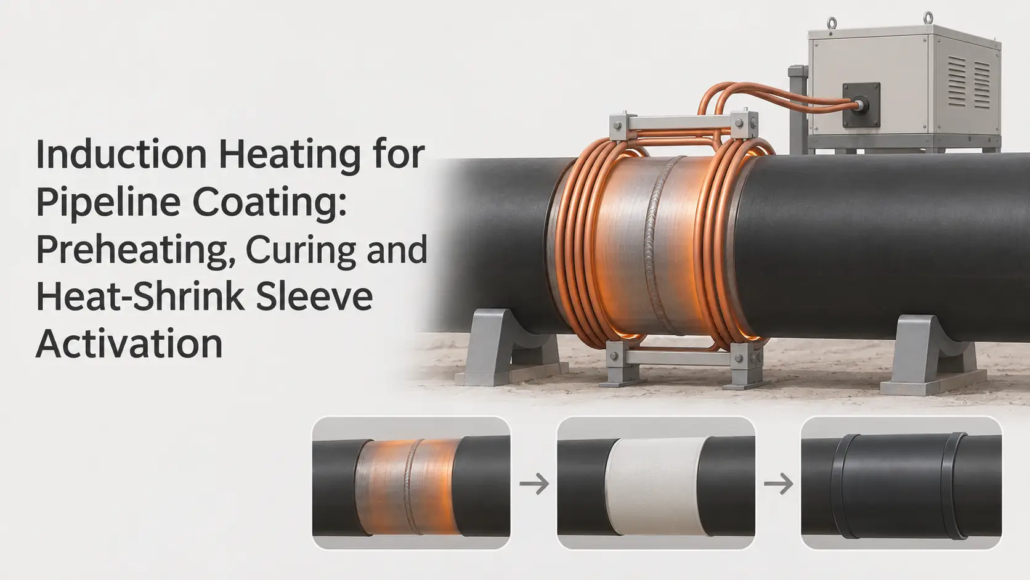
Induction heating is used in pipeline field-joint coating to preheat the exposed steel around a pipeline girth weld before applying an anti-corrosion coating.
Two important applications are FBE (fusion-bonded epoxy) field-joint coating and heat-shrink sleeve installation. In both cases, induction heating prepares the steel substrate for the coating process, but the subsequent application steps are different.
Quick Answer
For FBE field-joint coating, the heated steel allows the epoxy powder to melt, flow and cure according to the coating manufacturer’s requirements. For heat-shrink sleeve systems, induction heating can provide controlled preheating before the sleeve is wrapped around the joint. The subsequent sleeve-shrinking operation is a separate process.
Understanding these differences helps engineers select an appropriate heating arrangement and control the temperature conditions during pipeline coating operations.
2. Induction Preheating for FBE Field-Joint Coating
3. Induction Heating for Heat-Shrink Sleeve Installation
4. What Affects Induction Heating Uniformity and Coating Quality?
1. What Is Pipeline Field-Joint Coating?
Why pipeline weld joints need additional corrosion protection
Steel pipelines are often supplied with factory-applied external coatings such as fusion-bonded epoxy (FBE), three-layer polyethylene (3LPE) or three-layer polypropylene (3LPP).
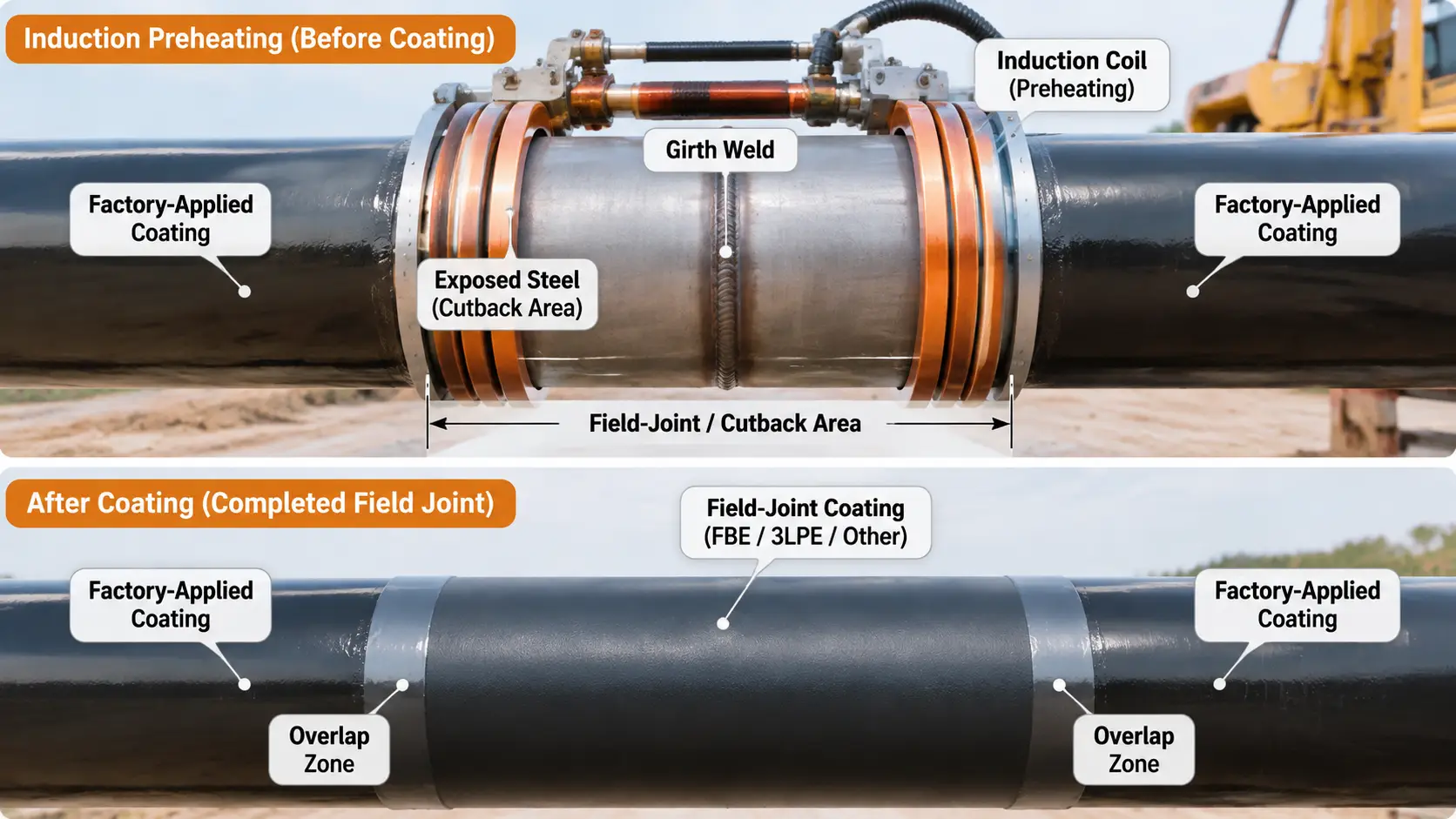
During pipeline construction, individual pipe sections are joined by circumferential welding, commonly called girth welding. The factory coating stops short of the pipe ends, leaving an exposed steel area around each weld.
After welding and surface preparation, this exposed area needs its own corrosion protection. The process is known as pipeline field-joint coating, or FJC.
The selected field-joint coating system needs to be compatible with the existing mainline coating and the pipeline’s service conditions. FBE, liquid-applied coatings and heat-shrink sleeves are among the systems used, depending on the project requirements.
Where induction heating is used
Induction heating is applied to the steel around the field joint. An induction coil is positioned around the pipe, generating heat in the conductive steel through electromagnetic induction.
The resulting heat prepares the joint for the next coating operation. The heating zone needs to cover the required field-joint area without unnecessarily exposing the adjacent factory-applied coating to excessive heat.
This application is different from induction preheating on a pipe manufacturing line, where long sections of pipe may be heated before factory coating or lining.
For a broader discussion of induction heating in pipe production, see our existing article: Induction Heating in Oil & Gas Pipe Manufacturing.
2. Induction Preheating for FBE Field-Joint Coating
How induction heating works with FBE powder coating
Fusion-bonded epoxy (FBE) is a powder coating applied to a heated steel surface. It is widely used for corrosion protection of pipelines, including field-joint applications where the mainline coating system and project specification call for FBE.
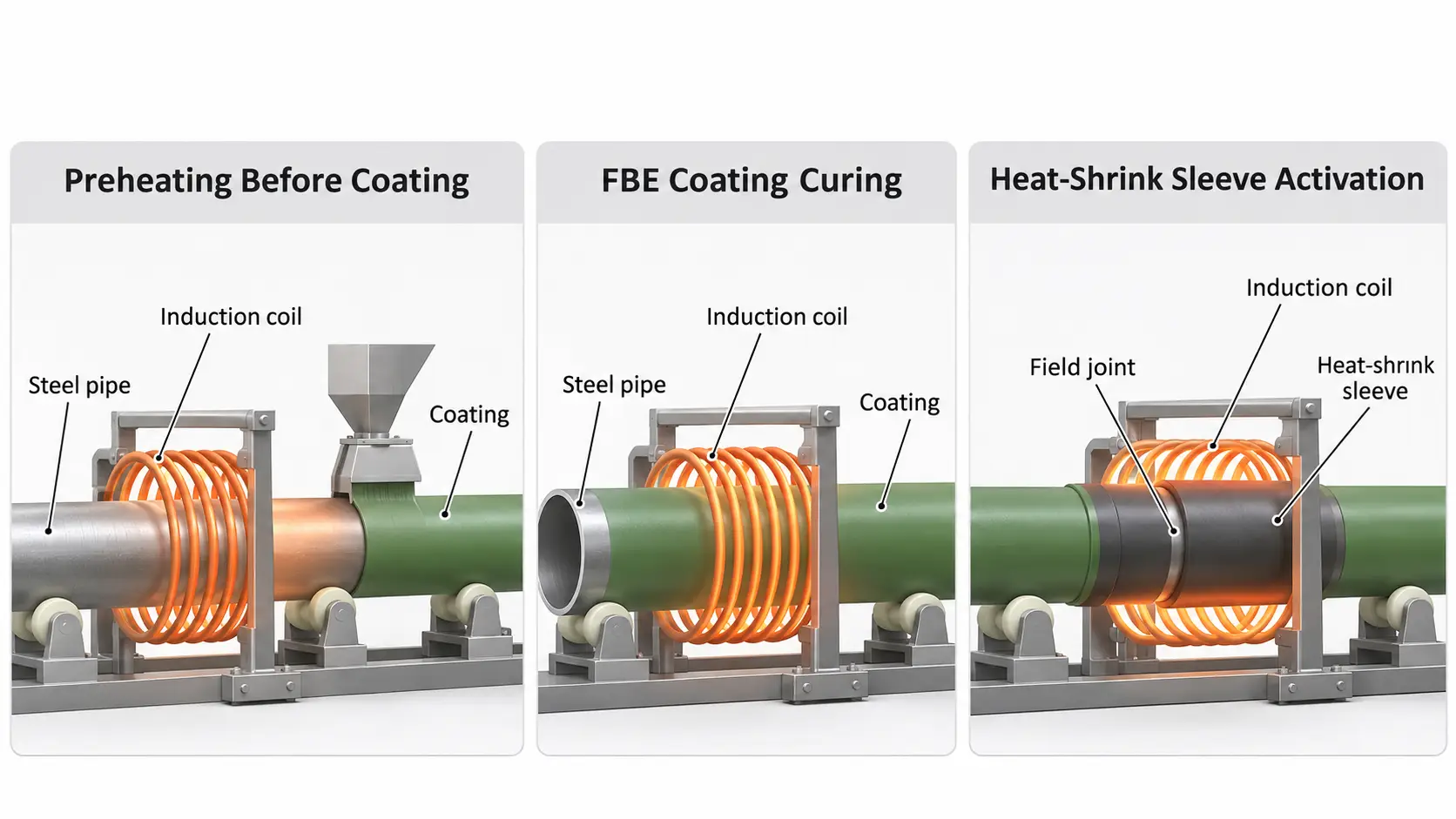
During FBE field-joint coating, induction heating brings the exposed steel to the application temperature specified for the selected powder.
A typical process includes:
①Preparing the exposed steel surface by abrasive blasting and completing the required surface checks.
②Positioning the induction coil around the field joint.
③Heating the steel substrate to the specified FBE application temperature.
④Applying FBE powder to the heated surface.
⑤Allowing the powder to melt, flow and cure according to the product’s application requirements.
⑥Inspecting the finished field-joint coating.
The induction coil does not replace the powder application equipment. Its role is to establish the required thermal condition of the steel before coating.
Why temperature uniformity matters
A suitable average temperature does not necessarily mean the entire field joint has been heated evenly.
If the coil is not concentric with the pipe, or its windings are unevenly spaced, different areas can experience different heating conditions.
A technical report by Advantica, published in Germanischer Lloyd’s nonstop magazine, describes how coil positioning and winding spacing can produce axial and radial temperature variations. In the reported FBE field-joint applications, excessively hot areas were associated with coating foaming, while colder areas could experience undercuring.
This is why coil geometry and positioning need to be considered during process development, rather than relying on power output alone.
Protecting the adjacent factory coating
The exposed weld area is surrounded by the original factory-applied coating. That coating must remain suitable for service after the field-joint coating operation.
Induction primarily heats the steel substrate. Heat can then transfer into the adjacent coating, so the heating width and thermal exposure need to be controlled.
Excessive heating may contribute to blistering, disbondment or other damage, depending on the coating material and its condition.
Radyne’s field-joint heating systems specifically address this issue by designing the coil heat profile to limit unwanted heating of the parent coating.
3. Induction Heating for Heat-Shrink Sleeve Installation
How heat-shrink sleeves protect pipeline field joints
Heat-shrink sleeves are another widely used field-joint coating solution, particularly for pipelines with 3LPE or 3LPP mainline coatings.
A typical heat-shrink sleeve consists of a heat-shrinkable polymer backing and an adhesive layer. Depending on the product, the adhesive may be a hot-melt adhesive or mastic.
When installed correctly, the sleeve covers the exposed welded joint and overlaps the adjacent factory coating to provide corrosion protection.
Different sleeve constructions are designed for different mainline coating systems. For example, three-layer sleeve systems are available for three-layer PE and PP coatings. Product compatibility must always be checked against the manufacturer’s documentation.
Induction preheating before sleeve application
Before installing a heat-shrink sleeve, the field-joint area needs to be prepared and preheated according to the sleeve manufacturer’s instructions.
Induction heating can be used for this preheating operation. It heats the steel beneath the joint area and can help establish a more uniform temperature around large-diameter pipes.
Radyne specifically identifies induction-powered clam coils for preheating pipeline field joints before heat-shrink sleeve application.
The process generally involves:
①Cleaning and preparing the exposed joint and adjacent coating.
②Positioning the induction coil around the pipe joint.
③Preheating the steel to the temperature specified for the sleeve system.
④Removing or opening the coil as required by the equipment arrangement.
⑤Positioning and wrapping the heat-shrink sleeve.
⑥Heating the sleeve according to the manufacturer’s installation procedure.
⑦Checking the finished sleeve and its overlap areas.
Preheating and sleeve shrinking are not the same operation
This distinction is particularly important when discussing induction heating for heat-shrink sleeves.
Induction heating may be used to preheat the steel before sleeve installation. The sleeve itself must then receive the heat required for shrinking and adhesive activation.
ISO 21809-3:2016 describes induction heating as a suitable method for preheating field-joint areas where practical. It separately describes heating the installed sleeve with a gas torch or another suitable heat source, following the application procedure and manufacturer’s instructions.
Therefore, induction preheating does not automatically mean that the entire heat-shrink sleeve installation is performed by induction heating.
The actual heating arrangement depends on the sleeve construction and the approved installation procedure.
4. What Affects Induction Heating Uniformity and Coating Quality?
Pipeline field-joint coating involves more than reaching a target temperature. The coil arrangement, pipe geometry, existing coating and application sequence all affect the heating result.
Coil positioning and concentricity
For circumferential pipeline heating, the induction coil needs to be correctly positioned around the pipe.
An off-center coil can create different coupling conditions around the circumference. Uneven spacing between coil windings may also produce variations along the pipe axis.
The coil design should account for the actual pipe diameter, required heating width and field-joint arrangement.
Pipe diameter and wall thickness
Pipe diameter affects the coil geometry and the distance between the coil and the steel surface.
Wall thickness and pipe dimensions also influence the heating response. A heating procedure developed for one pipe configuration should not automatically be transferred to another.
This is particularly relevant to large-diameter pipeline field-joint coating, where maintaining a suitable temperature around the full circumference can be challenging.
Heating temperature and measurement
The target temperature depends on the selected coating material and its application procedure.
For FBE field-joint coating, the steel must reach the application conditions specified by the powder manufacturer.
For heat-shrink sleeve installation, the preheating requirement depends on the sleeve and adhesive system.
Temperature should be measured using an appropriate calibrated instrument at the locations specified by the qualified procedure. A reading at one convenient point does not necessarily establish uniform heating across the entire field joint.
Heating the adjacent mainline coating
The existing factory coating needs attention during both FBE and heat-shrink sleeve applications.
Excessive thermal exposure may affect its appearance, adhesion or performance. This is especially important around the overlap between the field-joint coating and the original mainline coating.
The heating procedure should account for the thermal limitations of both coating systems.
Process qualification and repeatability
A heating cycle should be qualified using the actual pipe configuration, coating materials and equipment arrangement.
Relevant variables include:
— Pipe outside diameter and wall thickness
— Field-joint width
— Coil positioning and winding spacing
— Heating rate and temperature distribution
— Temperature measurement locations
— Time between heating and coating application
— Thermal limitations of the adjacent factory coating
For production operations, the qualified procedure should be followed and relevant process conditions recorded. An automated control system can help monitor and repeat the heating cycle, but automation alone does not establish coating quality.
Frequently Asked Questions
Click a question to expand the answer.
Conclusion
Induction heating provides a practical way to prepare pipeline field joints for anti-corrosion coating, particularly in FBE field-joint coating and heat-shrink sleeve applications.
The two processes have different requirements. FBE relies on a properly heated steel substrate for powder melting and curing, while heat-shrink sleeve installation involves preheating the joint followed by a separate sleeve application and shrinking operation.
For both applications, coil positioning, temperature uniformity and protection of the adjacent factory-applied coating deserve attention during process development.
Understanding these requirements helps engineers develop more suitable induction preheating procedures for pipeline field-joint coating.
Technical References
1. Germanischer Lloyd / Advantica, Field-Joint Coating Options for FBE Mainline Coatings. Read technical article
2. Radyne – Pipe Heating Clam Coils. Field-joint preheating and heat-shrink sleeve applications.
3. TESI – Corrosion Protection. Heat-shrink sleeve construction and installation information.
4. ISO 21809-3:2016 – Field Joint Coatings. Scope and requirements for field-joint coating qualification, application and testing.
Need Induction Heating for Pipeline Field-Joint Coating?
Tell us your pipe diameter, wall thickness, coating system and field-joint requirements. KECHUANG can help you evaluate an induction preheating arrangement for FBE field-joint coating or heat-shrink sleeve installation.


