
Induction Heating for Fastener Manufacturing: Hot Heading, Nut Forming and Warm Forming
How Induction Preheating Supports the Production of Bolts, Screws and Nuts
Induction heating is used in fastener manufacturing to preheat metal wire, rods and blanks before forming operations. It allows manufacturers to heat selected sections of a workpiece shortly before deformation, making it suitable for hot heading, hot nut forming and warm forming applications.
For production lines manufacturing bolts, screws, nuts and other industrial fasteners, the heating arrangement depends on the material, workpiece dimensions, forming method and required production cycle.
Quick Answer
Induction heating in fastener manufacturing is mainly used before hot or warm forming. Typical applications include heating the ends of steel wire for bolt and screw heading, preheating nut blanks before hot forging, and heating fastener stock before warm heading or thread rolling. The heated area and temperature must match the following forming operation rather than being selected from equipment power alone.
2. Induction Heating for Hot Heading of Bolts and Screws
3. Induction Heating for Hot Nut Forming
4. Induction Warm Forming and Warm Heading
5. Induction Heating Before Thread Rolling
6. Process Factors Affecting Fastener Billet Heating
1. Where Is Induction Heating Used in Fastener Manufacturing?
Fastener manufacturing includes several metal-forming operations. Depending on the product and manufacturing route, induction heating may be integrated before one or more of these operations.
| Manufacturing Process | Role of Induction Heating |
|---|---|
| Bolt and screw hot heading | Preheats the wire or rod end before head formation |
| Hot nut forming | Heats nut blanks or stock before forging |
| Warm heading | Preheats the material before warm deformation |
| Warm forming | Provides controlled heating before selected forming operations |
| Thread rolling | Preheats fastener stock or blanks for specific warm or hot rolling processes |
Not every fastener requires induction preheating. Cold heading and conventional cold thread rolling remain widely used manufacturing processes.
Induction heating becomes relevant when the selected forming route requires additional thermal preparation of the material.
2. Induction Heating for Hot Heading of Bolts and Screws
How Does Induction Hot Heading Work?
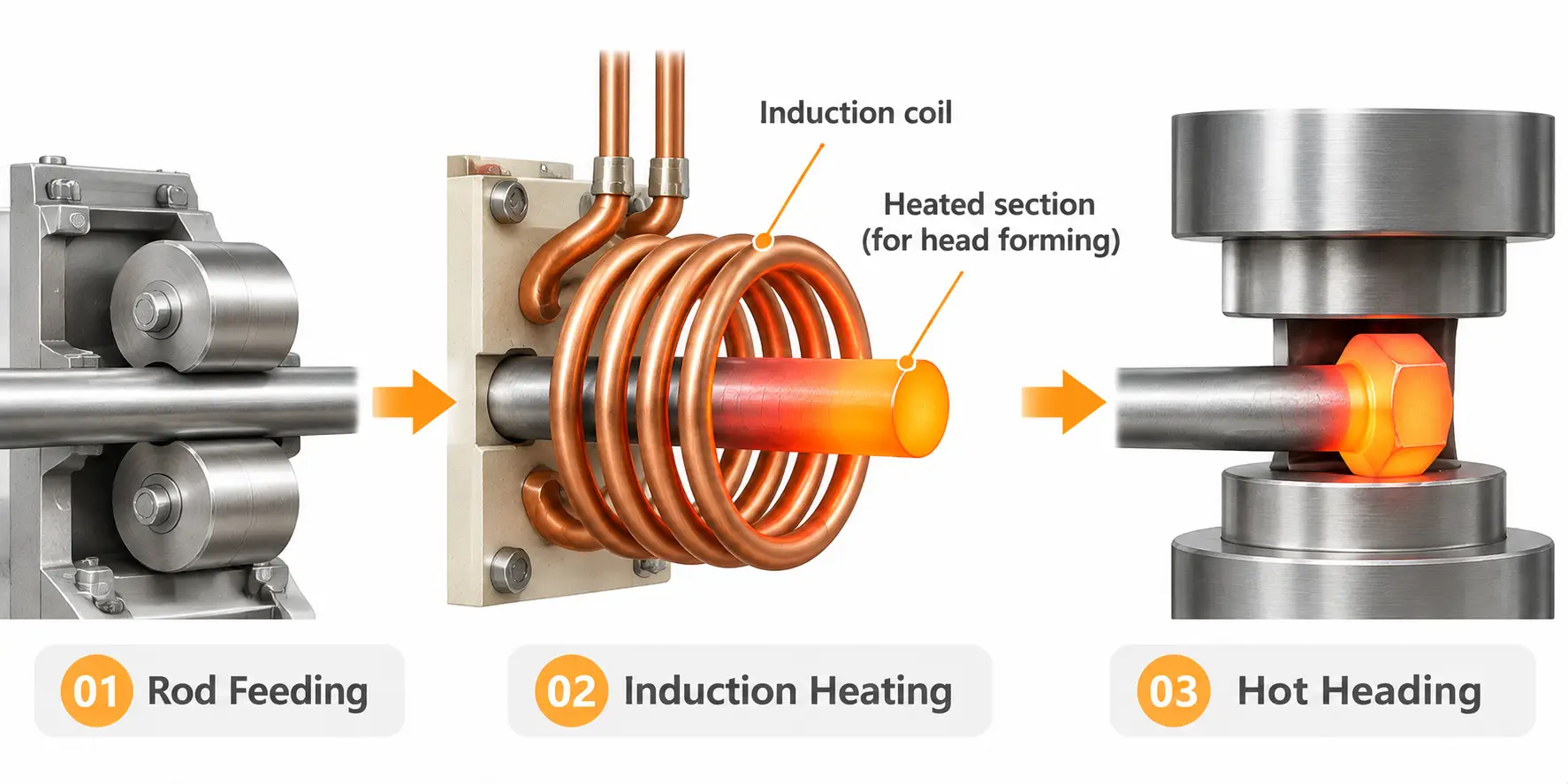
Hot heading is a forming operation used to produce the heads of bolts, screws and similar fasteners. A section of metal wire or rod is heated before being compressed by a punch or heading die.
In an induction hot-heading process, the wire or rod passes through an induction coil before entering the forming station. Depending on the workpiece and process design, heating may be concentrated near the end that will become the fastener head.
After reaching the required forming condition, the heated material moves to the heading machine, where compressive force shapes the head.
Why Is Localized Heating Important?
For many bolt and screw applications, the head-forming region requires more heating than the remaining shank. Induction heating can concentrate energy in this selected area instead of unnecessarily heating the entire workpiece.
The required heated length and temperature profile depend on the head geometry, material and deformation process. Some applications require a relatively sharp transition between the heated and unheated sections, while others need a more gradual temperature transition.
Inductotherm’s technical paper on fastener induction heating describes selective heating of rod ends and different inductor arrangements for hot and warm working applications.
3. Induction Heating for Hot Nut Forming
How Is Induction Heating Used in Nut Manufacturing?
Hot nut forming is another application of induction heating in fastener production.
Depending on the manufacturing route, metal stock or prepared nut blanks are heated before entering the forging and forming equipment. The heated material is then deformed into the required nut geometry through the appropriate forming operations.
In induction nut forming applications, the heating system is positioned before the forming station and prepares the material for the subsequent operation.
What Needs to Be Considered?
Unlike bolt heading, where heating is often concentrated at the end of a rod, nut-forming applications may require heating a larger portion of the workpiece.
The actual heating arrangement depends on:
— Nut dimensions and blank geometry
— Material composition
— The forming method
— Required forming temperature
— Production speed and material transfer
Ajax TOCCO specifically identifies hot heading and nut forming as applications in which induction is used to preheat fasteners before forging.
It is important to distinguish hot nut forming from cold nut forming. Induction heating is relevant to manufacturing routes that require thermal preparation, not to every nut production process.
4. Induction Warm Forming and Warm Heading
Warm forming is another important application of induction heating in the fastener industry.
Unlike conventional hot forging, warm forming uses a lower material temperature while still providing thermal assistance during deformation. The purpose is to improve the material’s formability under the selected manufacturing conditions.
Warm Heading
Warm heading is a heading operation performed under warm-forming conditions.
The wire, rod or fastener blank is heated before entering the heading machine. The heated material is then compressed to produce the required head or shape.
Depending on the material and workpiece geometry, warm heading may be considered when manufacturers need to change forming loads, material flow or tooling conditions compared with cold forming.
Other Warm Forming Applications
Induction warm forming is not limited to heading. It can also be applied to selected thread-rolling and single-shot forging operations.
CEIA identifies heading, thread rolling and single-shot forging as warm-forming applications in fastener manufacturing.
The terms hot heading, warm heading and warm forming should not be treated as interchangeable. Heading describes the forming operation, while hot and warm describe the thermal conditions under which deformation takes place.
The appropriate temperature depends on the alloy, material condition and forming requirements. There is no single temperature range that applies to every fastener material and application.
5. Induction Heating Before Thread Rolling
Thread rolling is an important operation in bolt and screw manufacturing. It forms external threads by pressing the workpiece between dies rather than cutting the threads away.
Conventional thread rolling is commonly performed in the cold condition. However, some manufacturing processes use induction heating before warm or hot thread rolling.
Why Is Preheating Used Before Thread Rolling?
Depending on the material and forming requirements, preheating can change the material’s resistance to deformation and its behavior during rolling.
An induction heating system can be installed before the thread-rolling machine to prepare the required section of the fastener blank.
Two types of applications should be distinguished:
•Heating stock before hot forming and thread rolling: Rods or blanks are heated before a subsequent hot-forming operation that includes thread formation.
•Localized preheating before warm thread rolling: A selected section of an already prepared fastener blank is heated before it enters the rolling machine.
The heating arrangement depends on the threading process, workpiece geometry, material and production cycle.
Ambrell documents applications involving induction heating of fastener rods and blanks for hot forming and thread rolling. CEIA also describes preheating arrangements integrated with thread-rolling machinery.
Induction heating before thread rolling is therefore a specific manufacturing application, not a requirement for all bolt and screw production lines.
6. Process Factors Affecting Fastener Billet Heating
The performance of an induction heating process depends on matching the heating arrangement to the workpiece and the forming operation.
Material and Workpiece Dimensions
Steel, stainless steel, titanium and other fastener materials have different electrical, magnetic and thermal properties.
The diameter, cross-sectional shape and length of the workpiece also affect how energy is transferred and how heat develops inside the material.
A heating arrangement designed for small-diameter wire cannot automatically be applied to a larger fastener blank without evaluating the process requirements.
Heated Length and Heating Position
The required heating area depends on the following forming operation.
For bolt heading, the end of the rod may require localized heating. Other applications may require a larger heated section or a different temperature profile along the workpiece.
Frequency, Power and Heating Time
These parameters work together to determine the heating behavior.
Frequency influences the distribution of induced current, while power and heating time influence the rate and amount of energy delivered to the workpiece.
The appropriate combination depends on material properties, workpiece dimensions, required temperature distribution and production cycle.
Transfer Time and Production Speed
The material continues to lose heat after leaving the induction coil.
The time between heating and forming can therefore influence the actual temperature when the workpiece reaches the heading press or rolling machine.
For automated fastener production, the heating cycle, material feeding and forming sequence need to be coordinated.
Temperature Measurement and Process Monitoring
Actual workpiece temperature should be evaluated under representative production conditions.
Infrared pyrometers can be used for non-contact temperature monitoring where the measurement arrangement is suitable for the material and surface condition.
For applications requiring a particular internal temperature distribution, surface measurements alone may not fully describe the thermal condition of the workpiece.
The process should be validated using representative materials and workpiece dimensions rather than relying only on nominal generator settings.
Frequently Asked Questions
Click a question to expand the answer.
References
1. Inductotherm Group, Induction Heating and Heat Treating of Fasteners.
2. Ajax TOCCO, Fastener Manufacturing Systems.
3. Ambrell, Hot Heading Steel Wire: Create Screws.
4. Ambrell, Heating Rods for Thread Rolling to Create Fasteners.
5. CEIA USA, Fastener: Induction Heating Solutions for the Fastener Industry.
Need Induction Heating for Fastener Manufacturing?
Send us your fastener material, dimensions, forming method and production volume. KECHUANG can evaluate the right induction heating arrangement for your hot heading, nut forming, warm forming or thread rolling line.


