Tube Induction Hardening and Tempering Line for Oil & Gas Tubing
Ⅰ. See the Line in Operation
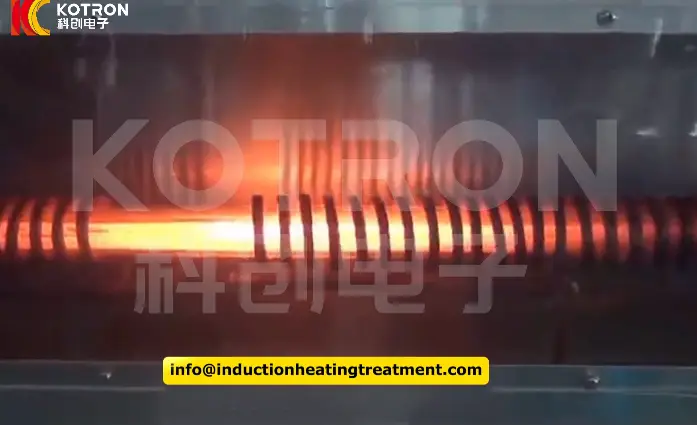
The video shows a long cylindrical workpiece travelling continuously through a helical induction heating section. As the workpiece passes through the coil, it is heated to the required high-temperature condition while gas protection is applied around the heating zone.
This continuous arrangement allows tube movement and induction heating to be coordinated with the downstream heat-treatment process. The material, dimensions and operating parameters are selected according to the actual application rather than inferred from the equipment layout alone.
Ⅱ. How the Hardening and Tempering Line Works
A typical process follows this sequence:
The tube enters the heating section at a controlled travel speed. Induction power, operating frequency, heating length and coil design are selected around the tube dimensions, material and required thermal cycle.
Where gas protection is required, the high-temperature heating area is arranged to reduce direct exposure of the heated surface to the surrounding air.
After reaching the required heating condition, the tube proceeds to quenching. Rapid cooling develops the hardened structure required by the material and heat-treatment specification. The actual quenching method is selected according to the tube grade, wall thickness and required properties.
The tube then enters the tempering stage. Tempering adjusts the condition produced by quenching and helps establish the required balance of hardness, strength, toughness and residual stress.
For a continuous line, these stages cannot be treated independently. Increasing tube speed, changing the wall thickness or processing a different alloy can affect the heating requirement, quenching response and subsequent tempering cycle.
Temperature monitoring and other process-control functions can be integrated where required so that the thermal process can be coordinated with tube movement throughout production.
Ⅲ. Protective-Atmosphere Heating and Uniform Tube Heating
Heating steel to hardening temperature in air can lead to oxidation and scale formation. Depending on the steel grade and process conditions, changes to the near-surface condition may also become a concern.
For many conventional steel tubes, this is manageable through later descaling, shot blasting, pickling or machining. In other applications, however, additional oxidation creates unnecessary finishing work or affects a surface that needs tighter control.
Protective-atmosphere induction heating can be considered in these cases.
Its purpose is to reduce the reaction between the hot tube surface and the surrounding atmosphere. Depending on how the atmosphere is controlled, the process can help reduce scale formation, maintain a cleaner heated surface and lower the risk of surface decarburization.
This does not mean that every tube hardening line requires gas protection. Its value is higher where material cost, surface condition, decarburization control or downstream cleaning makes oxidation more significant to the process.
Heating uniformity is equally important.
Before the tube enters the quenching stage, large temperature differences along its length or around its circumference can make the final result more difficult to control. Uneven heating may contribute to variations in hardness and microstructure and may increase the risk of distortion or quench cracking.
The heating system therefore has to be considered as a combination of several variables:
•Induction power and operating frequency
•Coil geometry and heating length
•Tube diameter and wall thickness
•Tube travel speed
•Material response
•Temperature monitoring, where required
The objective is not simply to bring the surface to a high temperature as quickly as possible. The tube needs to reach the quenching stage in a sufficiently consistent and repeatable thermal condition.
Ⅳ. IGBT Induction Power and Process Control
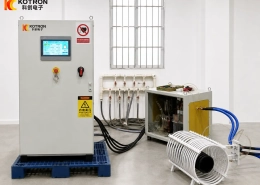
The induction power supply is a core part of the tube heat-treatment process.
KOTRON induction heating systems can use IGBT power conversion with DSP digital control, allowing the heating output to be adjusted around the process rather than operated as a fixed heat source.
Depending on the selected configuration, operating information such as voltage, current, power and frequency can be monitored during production. The power supply can also be integrated with the wider line-control system where required.
For continuous tube processing, power cannot be considered on its own.
A change in wall thickness, tube diameter, material or travel speed changes the thermal load seen by the induction system. The operating frequency and inductor geometry also influence how energy is introduced into the workpiece.
This means that several variables need to work together: Power + Frequency + Coil Design + Heating Length + Tube Speed + Temperature
When these variables are coordinated correctly, the induction heating section can maintain a more repeatable thermal condition as tubes move through the line.
Depending on the project, the control configuration can also include PLC/HMI operation, temperature feedback, process recipes, alarms and production records. These functions are selected according to the required automation level and traceability rather than treated as identical standard equipment for every line.
For recurring tube specifications, recipe-based operation can also reduce repeated manual adjustment when production returns to a previously established process.
Specific power ratings and frequency ranges are selected after the tube and required heat-treatment cycle have been evaluated.
Ⅴ. Oil & Gas Tubing and Other Suitable Applications
Oil & gas tubing is one of the application areas where controlled quenching and tempering can be required to develop specified mechanical properties in alloy and martensitic steel grades.
A tube induction hardening and tempering line can be evaluated for applications such as:
Protective atmosphere should not be treated as mandatory for every oil & gas or alloy steel tube. Many carbon and low-alloy tube products are successfully processed on conventional quenching and tempering lines.
The additional gas-protection section becomes more relevant when oxidation, surface condition, decarburization or downstream cleaning has a meaningful effect on production.
Ⅵ. Main Line Configuration and Customization
The final production line is configured around the tube rather than around a single standard machine size.
Depending on the project, the system can include tube feeding and conveying, induction heating, a protective-atmosphere heating section, quenching, tempering, cooling and discharge, together with the induction power supply and control system.
Temperature monitoring and other process-supervision functions can be added where required.
The important point is how these sections work together.
A thin-wall precision tube and a heavy-wall oil & gas tube may both require hardening and tempering, but they do not necessarily require the same power, frequency, inductor, heating length or conveying arrangement.
Several workpiece and production conditions therefore affect the final configuration:
| Project Factor | Influence on the Line |
|---|---|
| Tube outer diameter and wall thickness | Heating load, inductor design and process time |
| Material / grade | Heating, quenching and tempering requirements |
| Tube length | Conveying arrangement and line layout |
| Required properties | Target heat-treatment cycle |
| Production rate | Tube speed and required heating capacity |
| Surface condition | Need for protective-atmosphere heating |
| Factory layout | Equipment arrangement and material flow |
| Automation requirement | Handling and control configuration |
This is why the line should not be selected from induction power alone.
Power, operating frequency, coil design, tube speed, quenching conditions and tempering process have to be evaluated together. A change to one part of the process may affect the others.
For projects involving several tube specifications, the line can also be evaluated around the required product range rather than a single workpiece size.
Ⅶ. Send Us Your Tube Drawing
To start the evaluation, send us your tube drawing, material and basic heat-treatment requirement.
If detailed process data is not yet available, the remaining information can be discussed during the technical evaluation.
Frequently Asked Questions
Click a question to expand the answer.
Is protective-atmosphere heating required for every tube?
No. Gas protection adds the most value where oxidation, scale formation, surface decarburization or downstream cleaning has a meaningful effect on production. Many carbon and low-alloy tubes are processed on conventional quenching and tempering lines without it.
What tube materials can be processed on this line?
Oil & gas tubing, 13Cr and other martensitic stainless steels, alloy and high-carbon steel tubes, and precision mechanical tubes. The heating, quenching and tempering conditions are established from each material specification rather than from the tube dimensions alone.
What determines the induction power and operating frequency?
Tube outer diameter, wall thickness, material, travel speed and the required thermal cycle are evaluated together with the coil design and heating length. Power and frequency are selected after the tube and heat-treatment cycle are known.
Can one line process more than one tube specification?
Yes. For projects involving several tube specifications, the line can be evaluated around the required product range rather than a single workpiece size, so that power, frequency, coil design and conveying are sized for the intended range.
What do you need from me to prepare a technical proposal?
Send your tube drawing, material and basic heat-treatment requirement. If detailed process data is not yet available, the remaining information can be discussed during the technical evaluation.
Get a Technical Proposal for Your Tube Line
Send your tube drawing, material and basic heat-treatment requirement. We will evaluate the heating, quenching, tempering, coil design, induction power and conveying arrangement together, then return a technical proposal.