
Why Use Induction Heating Before Extrusion? Benefits, Applications, and Process Control
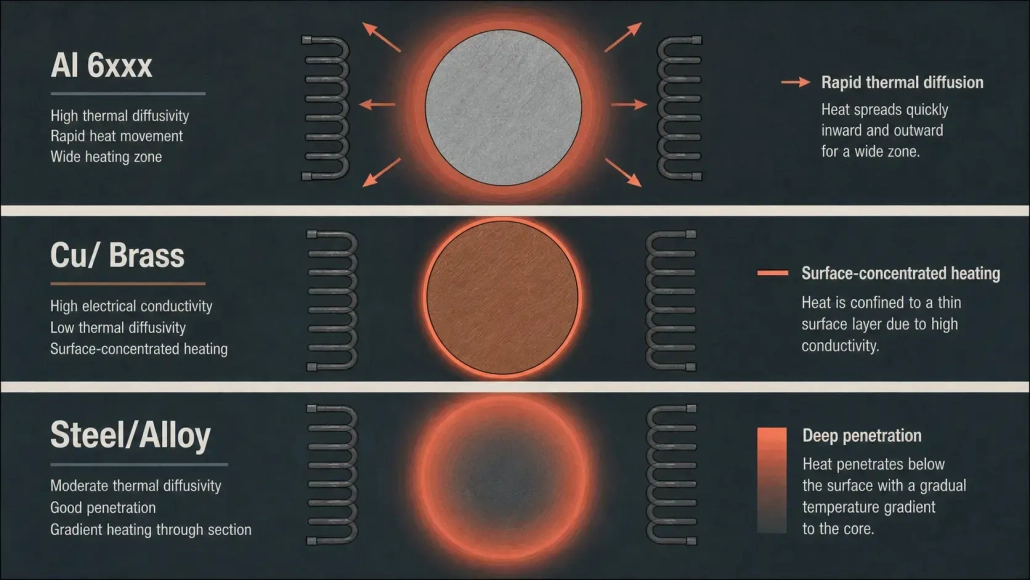
Induction Heating Before Extrusion brings billets, bars, and tubes to a controlled forming temperature before they hit the extrusion press. The preheating step determines press load, die life, surface finish, dimensional stability, and overall line output. Get it wrong and the press operator fights the material all shift.
For aluminum, copper, brass, steel, and specialty alloys, the heating method is a process control decision. Temperature variation at the press entry cascades into every downstream variable. A properly engineered induction preheating system tightens that variation, shortens cycle time, and makes the extrusion line easier to automate.
| 1. What Induction Preheating Does | 2. Why Manufacturers Choose Induction |
| 3. Applications Across Extrusion Lines | 4. Induction vs. Furnace Heating |
| 5. Process Control & Specification | Key Takeaway |
| FAQ |
1. What Induction Preheating Does for Extrusion
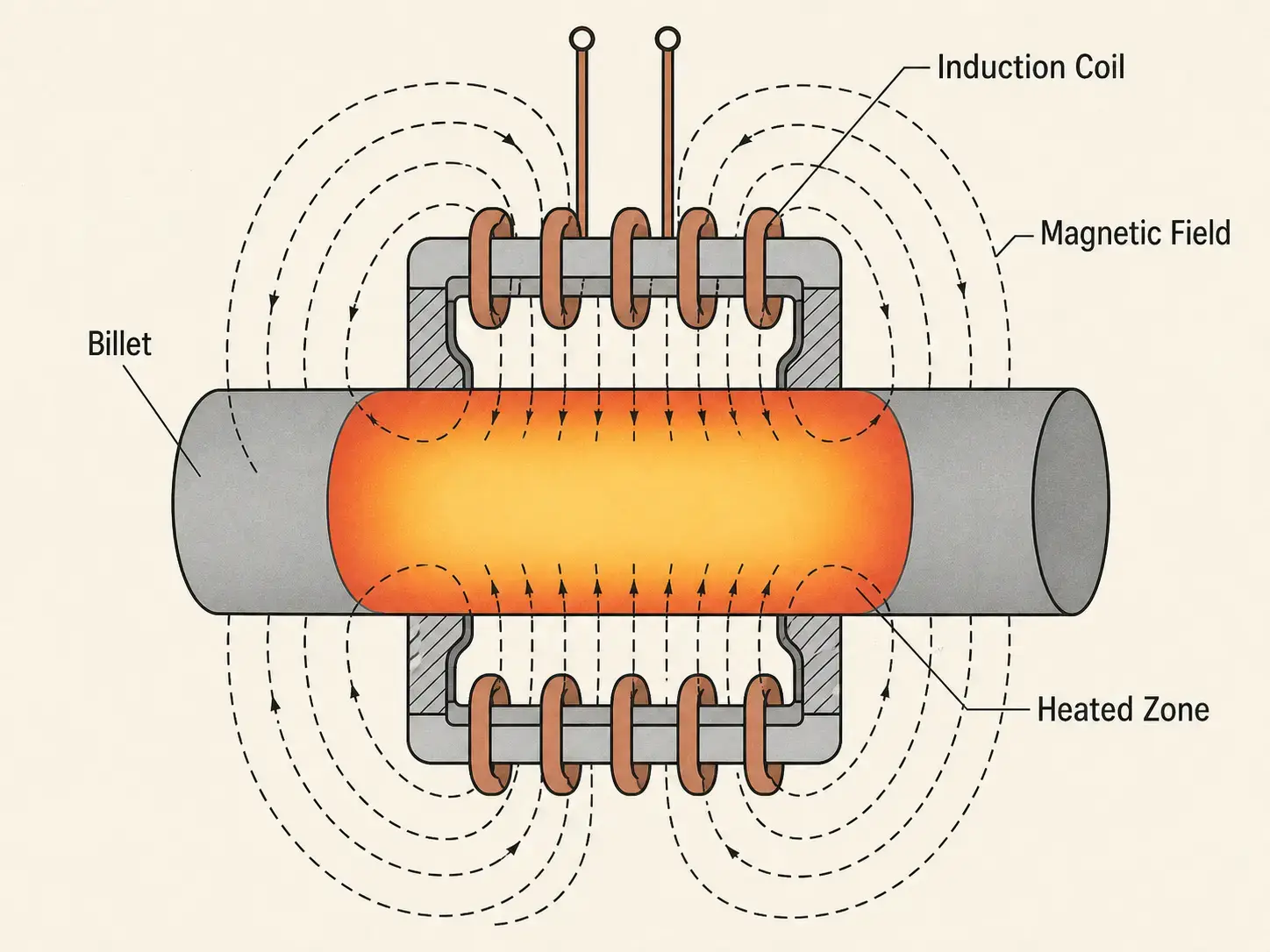
Induction heating raises metal temperature with an alternating magnetic field. The workpiece becomes the heat source. No combustion gases. No radiant elements. No hot air. Energy deposited directly inside the metal.
Before extrusion, the billet must reach a forming temperature high enough to reduce flow stress — but controlled enough to avoid overheating, oxidation, grain growth, surface defects, and die damage. Miss the window in either direction and the extrusion press pays the price.
In a typical extrusion heating system, the workpiece passes through or sits inside an induction coil. The power supply, coil geometry, frequency, and heating time determine how energy is deposited and distributed through the material. For the underlying principles, see how induction heating works.
2. Why Manufacturers Choose Induction
Heat-up speed. Induction generates energy inside the workpiece. Batch furnaces heat from the outside in, through the surface, relying on thermal conduction. The difference in preheat time — hours versus minutes in most extrusion billet sizes — changes how the entire line operates.
Faster heating means heating tracks press demand. No large batch of billets waiting upstream at temperature.
Temperature repeatability. Extrusion lives and dies on billet temperature. Too cold and press load spikes, material flow becomes unstable, die wear accelerates. Too hot and surface defects, sticking, dimensional variation, or metallurgical problems appear — which one depends on the alloy. Induction systems lock in heating profiles via pyrometer feedback, closed-loop power control, billet tracking, and recipe management. Operators run the same profile by material grade, billet size, and target temperature. Billet to billet. Shift to shift.
Less scale, less oxidation. Shorter time at temperature means less oxidation. Induction heats in minutes, furnaces soak for hours. For materials where surface quality affects machining allowance, coating adhesion, or final product appearance, this difference alone justifies the capital cost.
Energy where it counts. Induction transfers energy into the workpiece — not into a furnace chamber, refractory mass, and surrounding atmosphere. For plants running intermittent production, part-family changeovers, or just-in-time heating, the standby losses of keeping a furnace at temperature disappear. Actual efficiency depends on coil coupling, material properties, and how well the system matches production demand.
Inline integration. An induction preheating system installs inline with billet loaders, transfer mechanisms, temperature measurement stations, extrusion presses, and plant control networks. PLCs, HMIs, press controls, data collection — all connected. For automated extrusion cells where repeatability, traceability, and process alarms matter, this is not a nice-to-have.
3. Applications Across Extrusion Lines
| Material | Key Consideration | Induction Approach |
|---|---|---|
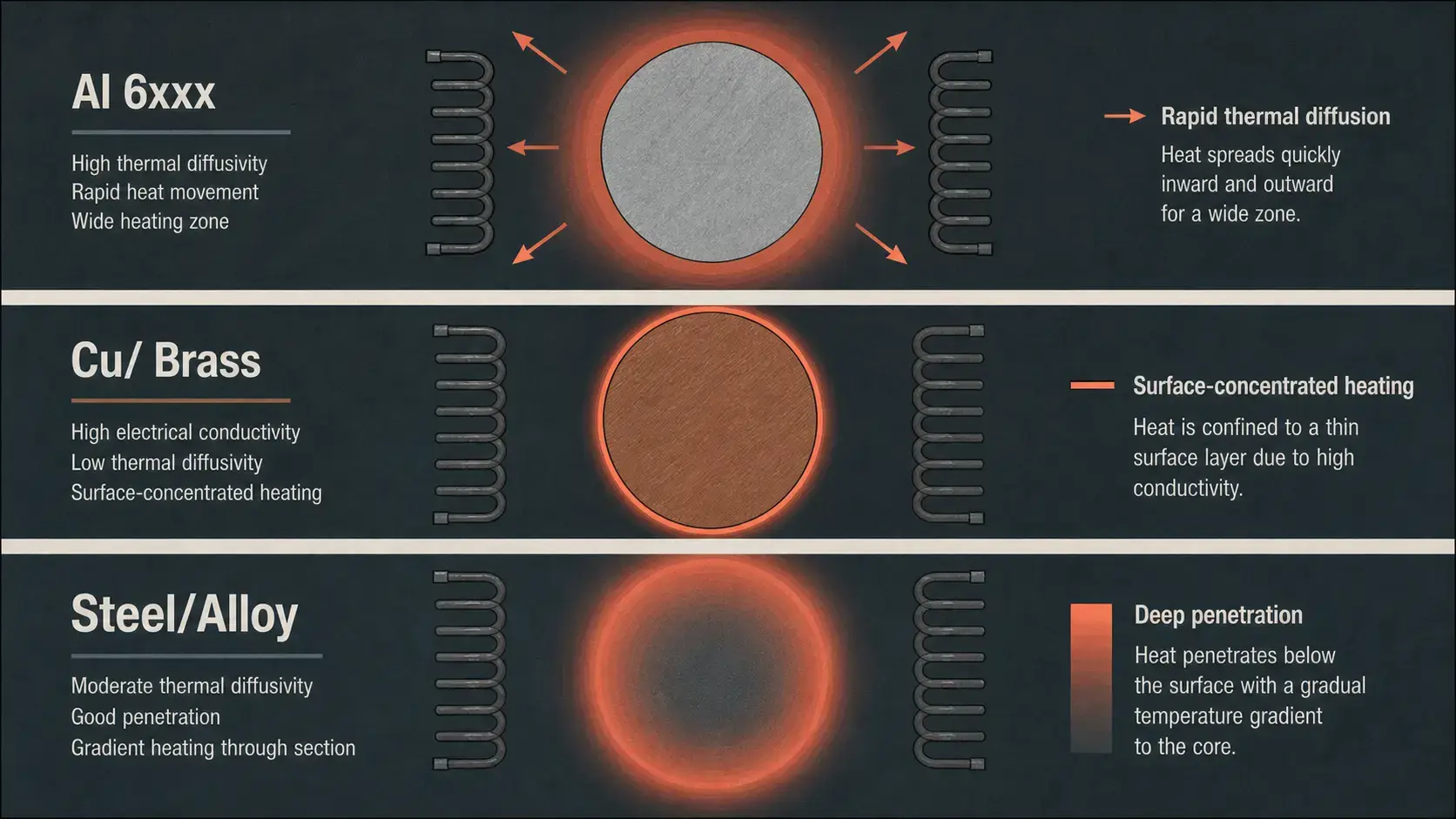
| Aluminum | High thermal conductivity spreads heat fast; nonmagnetic, low resistivity | Higher frequency, tight coil coupling, careful power density control |
| Copper & Brass | Excellent conductors; oxidation-sensitive at extrusion temperatures | Rapid heating, short dwell time, minimal high-temperature exposure |
| Steel & Alloys | Curie temperature transition shifts heating behavior; scale and decarb risk | Lower frequency for deeper penetration; possibly multi-zone for gradient control |
| Tubes & Profiles | Varied geometry, thin walls, frequent size changes | Quick-change coils, adjustable handling, recipe-based controls |
Aluminum extrusion dominates the installed base of induction preheating systems. The high throughput of aluminum presses — coupled with narrow temperature windows for 6xxx series alloys — makes induction the natural fit. Copper and brass extrusion runs hotter and faster. Steel and alloy extrusion pushes the highest temperatures, where scale control and core-to-surface gradients become the defining design parameters.
Tube, bar, and profile extrusion lines switch between diameters, wall thicknesses, and alloy families inside a single shift. Flexible coil design and multi-recipe control handle that variability without the furnace transition delays that bottleneck mixed-product operations. For similar billet heating challenges in other forming processes, see induction billet heating for forging.
4. Induction vs. Furnace Heating Before Extrusion
Gas and resistance furnaces still have their place — long soak times, large batch capacity, established infrastructure. The question is what the extrusion line needs.
| Factor | Induction Heating | Furnace Heating |
|---|---|---|
| Heat-Up Time | Minutes from cold start. Billet-by-billet heating matched to press demand. | Hours to stabilize. Batch heating with large thermal mass to manage. |
| Temperature Control | Closed-loop per billet. Pyrometer feedback, recipe-based, traceable. | Zone-based with thermal inertia. Transitions between setpoints are slow. |
| Scale & Oxidation | Short time at temperature. Lower oxidation in most applications. | Extended exposure at high temperature. Combustion atmosphere accelerates oxidation. |
| Floor Space | Compact. Installs inline with existing material handling. | Substantial footprint with furnace body, combustion system, and handling. |
| Production Flexibility | Recipes change in software. No thermal inertia between alloy or size changes. | Atmosphere and zone temperatures need stabilization between product changes. |
| Standby Losses | Near zero. System draws power only when heating billets. | Continuous fuel consumption to maintain temperature, even during downtime. |
| Automation Fit | Native PLC/HMI integration. Power adjusts on billet presence or pyrometer signal. | Combustion control and atmosphere regulation add complexity layers. |
Furnace heating remains practical when billets are very large and require extended soaking, when throughput is stable and predictable, or when existing furnace capacity is already sunk cost. For a broader comparison across heating technologies, see induction heating vs gas furnace.
Many plants run a hybrid: induction as a booster or equalizer downstream of an existing furnace, compensating for temperature loss between furnace and press. Not induction or furnace. Induction where it counts.
5. Process Control & System Specification
Specifying an induction preheating system starts with the extrusion process — not the power supply catalog. Skip this step and the system arrives either underpowered or overcomplicated.
Target temperature and tolerance. Define the billet exit temperature range, maximum surface temperature, and allowable core-to-surface variation. Narrow tolerance demands slower heating, multiple coils, equalization time, or closed-loop control. Wide tolerance allows a simpler system with higher throughput. Pin this number down first — everything downstream follows from it.
Material and geometry. Different alloys, different behavior. Electrical resistivity, magnetic properties, thermal conductivity, billet diameter, and length all shape heating performance. Carbon steel below Curie behaves one way. Aluminum behaves another. A round billet heats differently than a rectangular section or a tube. Frequency selection, coil dimensions, power requirements, and heating time all derive from these inputs. See frequency selection and power selection for application-specific guidance.
Frequency selection. Frequency sets current penetration depth and heating distribution. Lower frequencies for deeper heating in larger sections. Higher frequencies for surface-dominant or smaller-section heating. For extrusion, the goal is bulk temperature — not just surface heat. Select frequency on billet size, material, required temperature profile, production rate, and available heating time.
Coil design. The coil is a process tool. Geometry, turns, spacing, length, lining, cooling, and workpiece clearance all affect heating efficiency and temperature uniformity. Poor coil design produces uneven heating, low electrical efficiency, excessive coil heating, difficult maintenance, or short service life. High-production extrusion lines need durable coils with reasonable replacement access. See coil design fundamentals and water cooling systems.
Temperature measurement. Infrared pyrometers dominate production environments. Emissivity settings, surface condition, steam, scale, and line-of-sight access all affect accuracy. Temperature feedback must tie to actionable control logic — power adjustment, conveyor speed, billet dwell time, or coil zone output based on measured values. Measure what matters to the extrusion process.
Cooling water quality. Power supplies and coils generate heat that water must remove reliably. Flow rate, pressure, temperature, conductivity, and filtration are process specifications — not afterthoughts. Poor cooling is the most common cause of nuisance faults and premature component failure in induction systems.
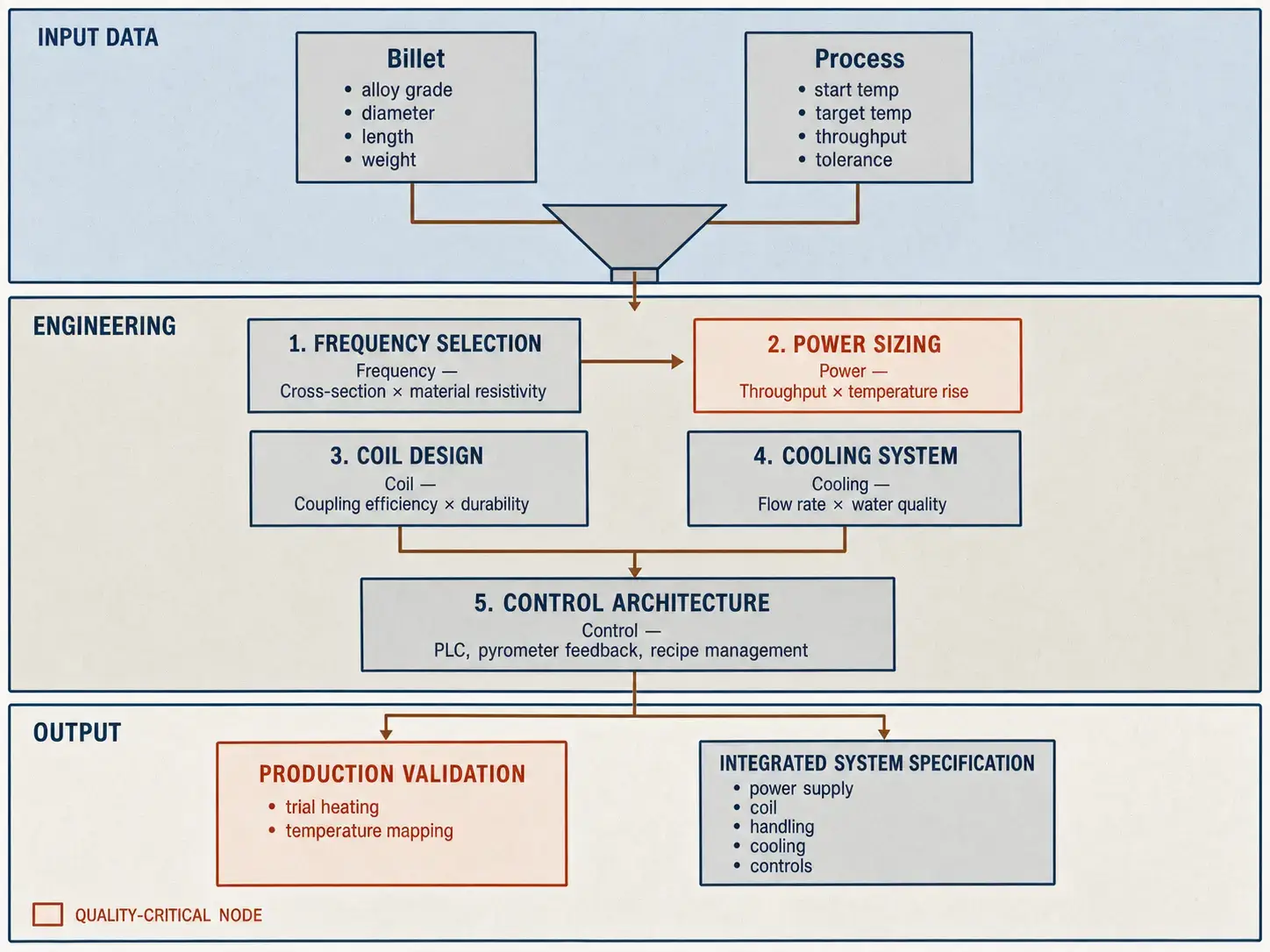
Supplier input checklist. Before requesting a quote, have these numbers ready:
— Material grade and alloy family
— Billet diameter, length, and weight
— Starting temperature and target extrusion temperature
— Required throughput (pieces/hour or lbs/hour)
— Acceptable temperature tolerance (±°C)
— Maximum allowable surface temperature
— Available cycle time before the press
— Handling method and line layout
— Power availability and plant utilities
— Cooling water conditions
— Automation, PLC, HMI, and data logging requirements
Production testing reduces risk for critical applications. Lab trials confirm power requirements, heating time, temperature uniformity, surface condition, and handling assumptions. Worth the time for large billets, high-value alloys, tight process windows, or retrofits into existing lines.
Key Takeaway
Induction Heating Before Extrusion tightens billet temperature control, shortens heating time, and supports inline automation when the system is engineered around the material, geometry, throughput, and extrusion temperature window. Two systems with the same power rating perform differently if one has better coil coupling, better frequency match, and better control logic. Specify from the extrusion process outward — not from the equipment catalog inward.
FAQ
Q: What is an induction preheating system for extrusion?
A: An induction power supply and coil assembly that heats billets, bars, or tubes before they enter an extrusion press. The system includes material handling, temperature measurement, closed-loop controls, water cooling, and automation interfaces.
Q: Is induction heating suitable for aluminum extrusion?
A: Yes — when the system is designed for aluminum’s electrical and thermal properties. Aluminum is nonmagnetic and highly conductive, so frequency selection, coil design, and power density require careful engineering. A steel billet setup does not transfer to aluminum.
Q: How do you control billet temperature before extrusion?
A: Adjust induction power, heating time, conveyor speed, coil zoning, or dwell time based on pyrometer feedback or process recipes. Tight tolerances require closed-loop control with multiple temperature measurement points.
Q: What information is needed to size an induction preheating system?
A: Material type, billet size and weight, starting and target temperatures, throughput, allowable temperature variation, available cycle time, line layout, cooling water conditions, automation requirements, and plant power availability.
Evaluate Your Extrusion Heating Process
Share your billet size, alloy, target temperature, and production rate. Our engineering team can help size induction power, frequency, coil design, and control requirements for your extrusion line.


