
Before You Buy an Induction Shrink Fitting Machine: 6 Decisions That Matter
Most induction shrink fitting machine purchases start with a power rating. They should start with a part drawing. The kilowatts matter, but they answer a question you have not asked yet: how much expansion do you need, how fast, and how repeatably? If you cannot pin down those three numbers, the nameplate figure means nothing.
A machine that pays for itself in twelve months and one that collects dust are usually separated by six decisions — all made before the purchase order is signed.
1. Do You Understand What the Process Actually Demands?
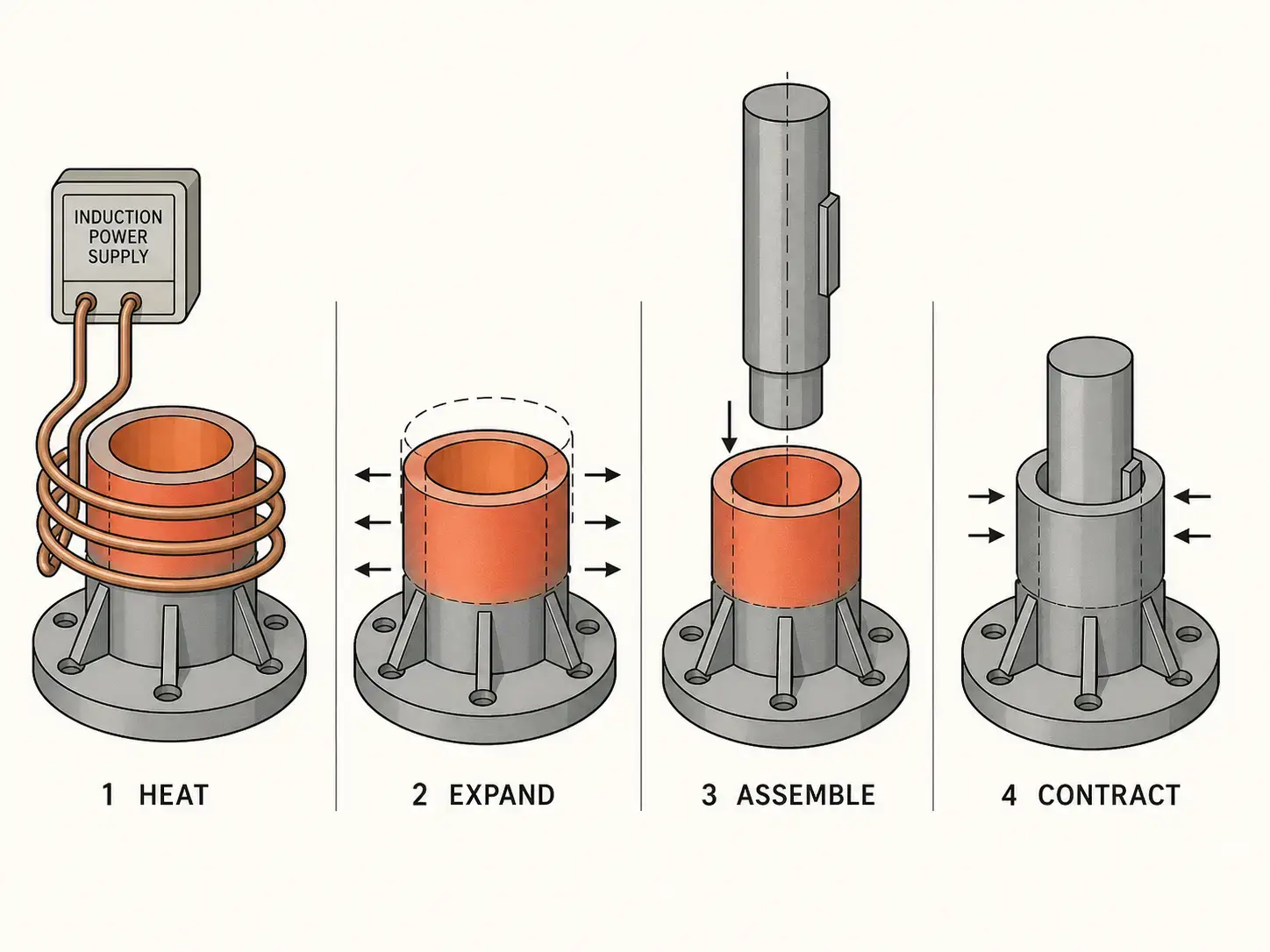
An induction shrink fitting machine uses electromagnetic induction heating to expand a metal component so it can accept another part with an interference fit. After assembly, the heated outer part cools and contracts, creating a strong mechanical joint—no adhesives, no welding, no mechanical fasteners. Typical applications include tool holders, motor rotors, gear assemblies, bearing seats, couplings, shafts, and sleeves.
Induction heats only the component you need expanded, not the entire assembly. Faster cycles than an oven, better repeatability than a torch, no oil bath to maintain. None of that matters if the process window is wrong.
Before comparing machine models, put the assembly on paper first:
— Outer component material, grade, and heat-treated condition
— Inner component material
— Outside diameter, inside diameter, and heated length
— Interference fit range and required assembly clearance
— Target expansion or target temperature
— Maximum allowable temperature
— Part coatings, platings, or surface conditions
— Required cycle time and production volume per shift
— Loading method: manual, semi-automatic, or fully automated
Material condition is critical. If the part has already been hardened and tempered, the shrink fitting heating temperature must stay at least 20–30°C below the original tempering temperature. Exceed that threshold and you risk reducing hardness, altering dimensions, or degrading the surface condition. For parts with tighter thermal limits, review the process window alongside your induction tempering parameters to confirm the temperature margin is sufficient.
2. Which Machine Configuration Matches Your Production?
Pick the configuration based on the part, not the catalog. Part geometry, weight, production volume, and how the assembly moves through your shop decide the layout.
| Configuration | Best For | Typical Volume |
|---|---|---|
| Bench-top | Tool holders, small precision assemblies, toolroom or maintenance work | Low |
| Vertical | Shafts, sleeves, rotors, bearing assemblies — gravity assists alignment | Low–medium |
| Horizontal | Long shafts, tubes, cylindrical components impractical to handle vertically | Low–high |
| Rotary indexing | Multi-station: load, heat, assemble, unload at separate positions | Medium–high |
| Robotic / conveyor cell | Inline production with tight takt time, traceability, or labor reduction goals | High |
| Custom-fixtured | Heavy, irregular, or difficult-to-handle components beyond standard tooling | Varies |
Many buyers need one machine to cover a family of parts. This is practical when the parts share similar materials, diameters, and heating lengths. But a machine stretched to cover too wide a range often becomes inefficient, expensive, or difficult to tool. A good supplier should review your full part family and identify which parts can share coils, fixtures, and recipes. In some cases, two smaller dedicated stations deliver better throughput and simpler operation than one oversized universal system.
3. Power, Frequency, and Cycle Time—Did You Test or Guess?
Power determines how quickly the machine delivers heat. Frequency determines where the heat concentrates. For shrink fitting, the goal is to heat enough of the outer component to create uniform bore expansion through the fit area—not just the surface, and not so deeply that the inner part receives unnecessary heat before assembly.
— Smaller, thinner parts typically use higher frequency (energy concentrates near the surface, faster bore expansion on thin-walled components)
— Larger or thicker parts generally require lower frequencies (deeper current penetration to expand the full wall thickness)
— Higher power can reduce heating time, but only when the coil and part design support efficient coupling
— Excessive power without proper control creates overheating, hot spots, or part distortion
Do not size the power supply by part diameter alone. Two parts with the same OD can need different power levels if wall thickness, material grade, heated length, or temperature limit changes. The only way to confirm power and frequency is application testing—document heating time, final temperature, measured expansion, part appearance, and assembly repeatability on your actual components.
One more thing: a five-second heat cycle means nothing if the operator needs twenty seconds to load and align the assembly. The bottleneck is usually handling, not heating.
4. Is the Coil Designed for Your Part?
The induction coil is where the machine meets the part. Even a high-quality power supply will perform poorly with the wrong coil geometry. For shrink fitting, the coil must place energy into the required heating zone with good circumferential uniformity—uneven heating produces uneven expansion, and uneven expansion makes assembly inconsistent.
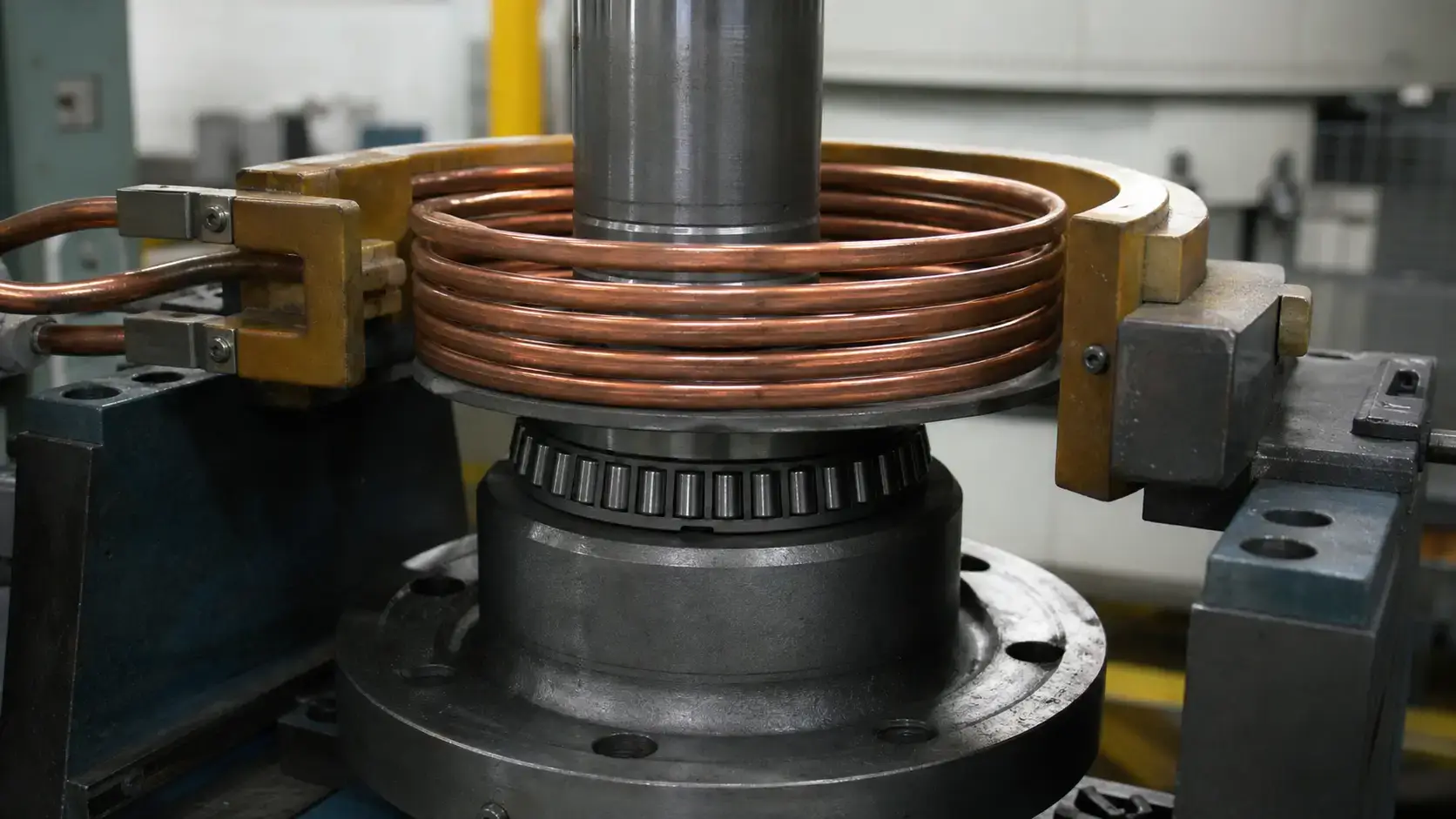
Good induction coil design for shrink fitting accounts for:
| Factor | What It Means for Shrink Fitting |
|---|---|
| Heated length & bore location | Determines the coil winding zone — energy must reach the full fit area |
| Coil-to-part clearance | Too wide loses coupling efficiency; too tight risks contact during loading |
| Temperature uniformity | Uneven heating = uneven expansion = inconsistent assembly and potential misalignment |
| Magnetic flux concentrators | Required near shoulders, flanges, or heat-sensitive features to direct energy |
| Part-to-part variation | Shifts the heating pattern; fixture should enforce consistent part positioning |
| Coil cooling duty | Must hold up under sustained production heat load without drift or failure |
| Maintenance access | Coil replacement should not require extensive machine teardown |
Coil-to-part positioning must be repeatable. If an operator can load the part at different heights or offsets, the heating pattern shifts—causing inconsistent expansion, slow assembly, or localized overheating. Production fixtures should guide the part into position without forcing the operator to make corrections by hand near a hot component.
Shrink fitting also requires timing. The part must be heated, transferred or assembled, and seated before it loses too much temperature. A slow or awkward handling sequence shrinks the available assembly window. For heavier parts, pneumatic or servo slides, vertical lift mechanisms, or robotic loading may be necessary. The fixture design is often just as important as the coil design.
5. How Much Process Control Do You Actually Need?
Heat-on, heat-off is the minimum. A production system needs repeatable energy delivery, verifiable part positioning, and a process record—especially when the part has a heat-treated condition you cannot afford to alter.
Four approaches, in order of increasing protection:
— Time-based control—simple, effective when incoming parts are consistent in geometry and starting temperature
— Power-based control—maintains a set power level, adapts to minor load variations
— Temperature feedback (infrared pyrometer or contact sensor)—provides the best protection when temperature limits are tight or when starting conditions vary part to part
— Recipe-based control—stores parameters per part number, reduces operator setup errors across changeovers
When traceability matters, specify these:
— Closed-loop power control with real-time adjustment
— Part presence detection (prevents dry firing and missed cycles)
— Coil cooling flow monitoring with alarm threshold
— Data logging with time-stamped cycle records
— Barcode or MES integration for part-level traceability
— Password-protected parameter access to prevent unauthorized adjustments
Do not automate because you can. A manual bench-top unit is the right machine for toolroom work, maintenance, and low-volume part families. A fully automated cell earns its keep when takt time drops below 30 seconds, or when traceability and labor cost tip the math. If you cannot write down the payback period for the automation, you probably do not need it yet.
6. Will It Survive Your Factory Floor?
An induction shrink fitting machine runs on a factory floor. Scale, oil, chips, coolant mist, vibration, forklift traffic, and the operator on third shift who loads parts differently than the one on first shift—all of it affects reliability. Specify for that environment.
Cooling is the first thing to get right. Insufficient cooling shortens power supply life, causes nuisance faults, and creates inconsistent heating. Most industrial systems use a closed-loop water cooling system. Verify flow rate, pressure, conductivity, and temperature range before purchase—plant water is not always suitable without filtration or heat exchange.
Safety requirements depend on part temperature, machine layout, voltage level, and operator access. At a minimum:
— Guarding and interlocks around hot parts and pinch points
— Emergency stops within operator reach
— Coil and bus voltage protection
— Clear cycle-status indication visible from the operator position
— Lockout/tagout access for maintenance
If your maintenance team needs a ladder, a mirror, and three hex keys just to inspect a coil, the machine was designed by someone who never worked a production line. Coils, hoses, fixtures, and sensors must be reachable. Frequent changeovers demand quick, repeatable coil swaps—no realignment, no guesswork. A machine sitting next to machining centers needs chip and coolant mist protection. A machine on a forging floor needs heavier guarding, more robust cooling, and controls simple enough to operate with gloves on.
The frame and tooling must support the part safely during heating and assembly. Poor ergonomics or unstable fixturing create quality problems even when the heating process is correct. Every component of the induction heating system has to work together under production conditions—not just on the quote sheet.
Key Takeaway
Six decisions. Get any one wrong and the machine underperforms. Get two wrong and you are buying a second machine within two years. The power rating gets printed on the nameplate. Everything else—process definition, machine configuration, frequency, coil geometry, control logic, factory-floor compatibility—gets decided before the quote is written. Bring part drawings, fit data, temperature limits, and a realistic cycle time to your first supplier conversation. If their proposal skips any of the six areas above, find another supplier.
Q: What information does a supplier need to size an induction shrink fitting machine?
A: Part drawings, material data, fit tolerances, required expansion or target temperature, heated length, production rate, loading method, and available plant utilities. If the part is coated, hardened, or temperature-sensitive, share that information early—it directly affects the power, frequency, and process window.
Q: Is induction shrink fitting faster than oven heating?
A: Yes, typically much faster. Induction heats only the outer component locally, bringing it to expansion temperature in seconds rather than minutes. It also reduces energy consumption, floor space, and unnecessary heat exposure to the full part. Ovens may still be suitable for low-volume work or very large components where cycle time is not the primary constraint.
Q: Can one induction shrink fitting machine handle multiple part sizes?
A: Yes, if the part family is reviewed during design. The system will need multiple coils, fixtures, and stored recipes. If the range is too wide, two dedicated stations often outperform one oversized machine.
Get an Application Review for Your Shrink Fitting Process
Send us your part drawings and fit requirements. We will tell you what power, frequency, and coil configuration makes sense—before you spend anything on equipment.


